THE PRINCIPLES OF QUR’ANIC RESEARCH METHODOLOGY
Deriving the Process of Knowledge from Revelation
By Kazi Abdul Mannan Khandaker Mursheda Farhana
A groundbreaking reconstruction of research methods rooted entirely in Qur’anic epistemology. This book unifies revelation, reason, ethics, and scientific inquiry, offering scholars a coherent Qur’an-based framework for qualitative, quantitative, and mixed-methods research across modern disciplines.
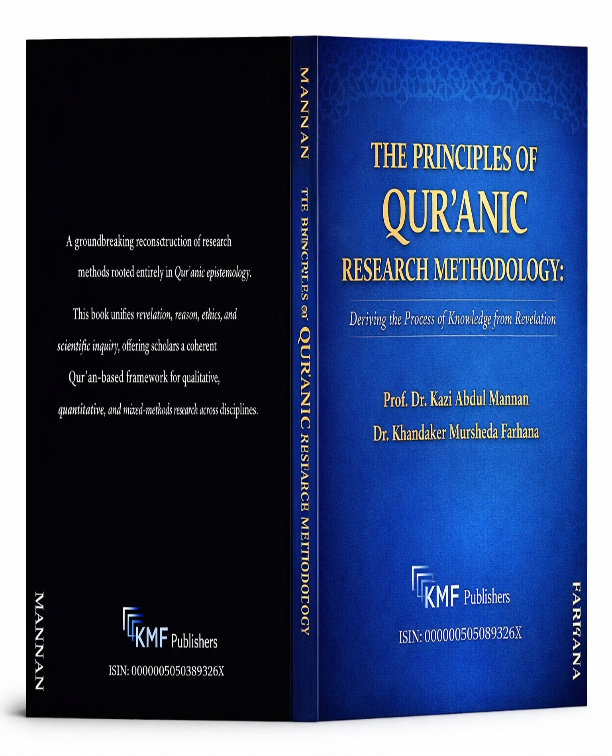 | THE PRINCIPLES OF QUR’ANIC RESEARCH METHODOLOGY: Deriving the Process of Knowledge from Revelation 89 Downloads | Download (PDF 14MB) (Free) |
| Edition | 1st Edition | |
| First Published | 2026 | |
| eBook Published | 12 February 2026 | |
| Pub. Location | Bangladesh | |
| Publisher | KMF Publishers (ISIN: 000000050389326X) | |
| ISBN | 978-984-35-8927-9 | |
| Pages | 456 | |
| QR Code |  | |
| BAR Code |  |
| Subject: Qur’anic Epistemology, Islamic Research Methodology, Philosophy of Knowledge in Islam, Revelation and Scientific Inquiry, Qualitative and Quantitative Methods, Islamic Philosophy of Science, Ethics of Knowledge Production, Tawḥīd-Based Methodology |
Book Summary
The Principles of Qur’anic Research Methodology presents a groundbreaking reconstruction of knowledge grounded entirely in the epistemic framework of the Qur’an. Moving beyond inherited medieval traditions and modern secular paradigms, this book offers a unified model in which tawḥid, ethical responsibility, rational inquiry, and empirical attentiveness form an integrated research philosophy. Through rigorous analysis of key Qur’anic concepts-ʿilm, ʿaql, yaqin, tadabbur, tafakkur, and the cosmic signs (ayat)-the work develops Qur’an-based qualitative, quantitative, and mixed-method approaches, extending even into cosmology and the natural sciences. It provides scholars, researchers, and students with a comprehensive, methodologically robust framework for conducting inquiry anchored in revelation, yet fully engaged with contemporary scientific and academic debates. This book invites a new generation to rethink knowledge through the coherence and universality of the Qur’anic worldview.
Citation: Mannan, K.A., & Farhana, K.M. (2026). The Principles of Qur’anic Research Methodology: Deriving the Process of Knowledge from Revelation. KMF Publishers. Open Access (CC BY 4.0). DOI: https://doi.org/10.64907/xkmf.book.pqrm.26.02.12
TABLE OF CONTENTS
| CONTENTS | Download (PDF) (Free) Pages (i-xlvi) |
| PART I: FOUNDATIONS OF QUR’ANIC EPISTEMOLOGY | |
| Chapter 1: Understanding Knowledge (ʿIlm) in the Qur’an | Pages 1-10 |
| Chapter 2: Cognitive Instruments of Knowing: ʿAql, Tafakkur, Tadabbur, and Tadhakkur | Pages 11-15 |
| Chapter 3: Revelation and Rationality: Integration, Not Opposition | Pages 16-25 |
| PART II: THE QUR’ANIC RESEARCH PROCESS | |
| Chapter 4: Observation (Naẓar, Sair): The Empirical Foundation of Qur’anic Inquiry | Pages 26-39 |
| Chapter 5: Reflection and Contemplation (Tafakkur, Tadabbur, Tadhakkur): Deep Thinking and Theorisation | Pages 41-49 |
| Chapter 6: Validation (Burhan, Bayyina): The Logic of Proof and Evidence | Pages 50-59 |
| Chapter 7. Synthesis (Ḥikmah): Integrating Truth and Understanding | Pages 61-74 |
| Chapter 8: Application (ʿAmal, Iman): Knowledge into Action | Pages 75-78 |
| Chapter 9: Transmission (Daʿwah, Tabligh): The Communication of Knowledge | Pages 79-90 |
| Chapter 10: Preservation (Dhikr, Kitab): The Continuity of Knowledge | Pages 91-97 |
| PART III: ETHICAL DIMENSIONS OF KNOWLEDGE | |
| Chapter 11: Ethics of Knowing: Qur’anic Principles of Honesty, Justice, and Responsibility | Pages 98-107 |
| Chapter 12: Moral Methodology in Research – From Intention (Niyyah) to Impact (ʿAmal) | Pages 108-123 |
| PART IV: STRUCTURE OF QUR’ANIC LOGIC AND DISCOVERY | |
| Chapter 13: The Cycle of Faith-Knowledge-Action | Pages 124-131 |
| Chapter 14: The Three Stages of Certainty (ʿIlm al-Yaqin, ʿAyn al-Yaqin, Ḥaqq al-Yaqin) | Pages 132-151 |
| Chapter 15: The Qur’anic Theory of Knowledge as a Unified Epistemology | Pages 152-168 |
| PART V: RECONSTRUCTION OF ISLAMIC EPISTEMOLOGY IN CONTEMPORARY CONTEXT | |
| Chapter 16: Classical Thinkers and Qur’anic Methodology | Pages 169-189 |
| Chapter 17: Qur’anic vs. Modern Scientific Method | Pages 190-231 |
| Chapter 18: Qur’anic Research Methodology in Modern Disciplines | Pages 232-253 |
| Chapter 19: The Unity of Truth (Tawḥid) as the Epistemic Paradigm | Pages 254-275 |
| Chapter 20: Qur’anic Cosmology and the Epistemology of Space Sciences | Pages 276-327 |
| PART VI: SYNTHESIS AND FUTURE DIRECTIONS | |
| Chapter 21: Toward a Unified Qur’anic Philosophy of Research | Pages 328-333 |
| Chapter 22: Future Prospects for Qur’anic Methodology Studies | Pages 334-340 |
| PART VII: QUR’ANIC EPISTEMOLOGY & MODERN RESEARCH METHODS | |
| Chapter 23: Introduction – Qur’anic Epistemology and Modern Method Debates | Pages 341-350 |
| Chapter 24 Ontology of Knowledge: Qur’an vs Modern Paradigms | Pages 351-356 |
| Chapter 25: Modern Ontologies of Knowledge | Pages 357-362 |
| Chapter 26: Qur’anic Epistemology and Qualitative Research | Pages 363-386 |
| Chapter 27: Qur’anic Epistemology and Quantitative Research | Pages 387-392 |
| Chapter 28: Mixed-Methods & the Qur’anic Triangulation Model | Pages 393-398 |
| Chapter 29: Qur’anic Methodology as a Meta-Methodology | Pages 399-403 |
| Chapter 30: Toward an Islamically Integrated Research Paradigm | Pages 404-409 |
| References | Pages 410-417 |
| Appendix I-III | Pages 418-427 |
| Definition of Qur’anic terminology | Pages 428-437 |
Special Notice for Print Editions (Qur’anic Ethics–Framed)
In the spirit of the Qur’anic principle that knowledge is a trust (amānah) bestowed for the benefit of humanity, this work is made freely available for scholarly and educational dissemination.
Institutions or organisations wishing to reprint this book for distribution within their country or community are respectfully requested to contact the authors at drkaziabdulmannan@gmail.com or drfarhanamannan@gmail.com.
No royalties are sought or accepted for this work. Permission to reprint is granted solely for non-commercial purposes, guided by the ethical commitment to the circulation of knowledge, intellectual responsibility, and public good.
Citation Style
Islamic Studies–Friendly Hybrid Citation
Mannan, K. A., & Farhana, K. M. (2026). The Principles of Qur’anic Research Methodology: Deriving the Process of Knowledge from Revelation. KMF Publishers. Open Access (CC BY 4.0). DOI: https://doi.org/10.64907/xkmf.book.pqrm.26.02.12.
APA 7th Edition
Mannan, K. A., & Farhana, K. M. (2026). The principles of Qur’anic research methodology: Deriving the process of knowledge from revelation. KMF Publishers. DOI: https://doi.org/10.64907/xkmf.book.pqrm.26.02.12.
Chicago Style (Notes & Bibliography)
Bibliography:
Mannan, Kazi Abdul, and Khandaker Mursheda Farhana. The Principles of Qur’anic Research Methodology: Deriving the Process of Knowledge from Revelation. Dhaka: KMF Publishers, 2026. https://doi.org/10.64907/xkmf.book.pqrm.26.02.12.
Footnote:
Kazi Abdul Mannan and Khandaker Mursheda Farhana, The Principles of Qur’anic Research Methodology (Dhaka: KMF Publishers, 2026), https://doi.org/10.64907/xkmf.book.pqrm.26.02.12.
Harvard Style
Mannan, K.A. & Farhana, K.M., 2026. The principles of Qur’anic research methodology: Deriving the process of knowledge from revelation. Dhaka: KMF Publishers. Available at: https://doi.org/10.64907/xkmf.book.pqrm.26.02.12.
MLA 9th Edition
Mannan, Kazi Abdul, and Khandaker Mursheda Farhana. The Principles of Qur’anic Research Methodology: Deriving the Process of Knowledge from Revelation. KMF Publishers, 2026. https://doi.org/10.64907/xkmf.book.pqrm.26.02.12.
Scholarly Endorsement
| Book Review | The Principles of Qur’anic Research Methodology: Deriving the Process of Knowledge from Revelation Dr Craig J Selby, Australia The Principles of Qur’anic Research Methodology: Deriving the Process of Knowledge from Revelation by Professor Kazi Abdul Mannan and Dr Khandaker Mursheda Farhana is an ambitious and timely contribution to contemporary discussions on research philosophy and methodology. At a time when global scholarship is increasingly questioning the dominance of singular epistemological traditions, this volume offers a systematic articulation of research methodology grounded in Qur’anic epistemology. For much of contemporary academic discourse, research methodology has been shaped predominantly by Western philosophical traditions. While these frameworks have generated significant scholarly insight, they have also tended to position other epistemological traditions — including Indigenous, cultural, and religious knowledge systems — as peripheral to mainstream methodological thinking. This volume challenges that implicit hierarchy by presenting the Qur’an not only as a source of theological guidance, but as a coherent and sophisticated framework for understanding the nature, ethics, and processes of knowledge production. The authors advance a clear positioning that the Qur’anic worldview offers a comprehensive epistemic architecture that integrates ontology, epistemology, ethics, and method. Across seven carefully structured parts, the book reconstructs how revelation (waḥy), reason (ʿaql), reflection (tafakkur), and empirical observation can function together within a unified process of inquiry. In doing so, the authors demonstrate that Qur’anic thought does not stand in opposition to rational or empirical investigation; rather, it situates these within a broader ethical and metaphysical framework of knowledge. One of the most valuable aspects of the book is its clear engagement with contemporary research practice. Rather than presenting Qur’anic epistemology as an abstract philosophical system, the authors connect it directly to modern methodological debates, including qualitative, quantitative, and mixed-methods research. The discussion illustrates how Qur’anic concepts of reflection, verification, balance, and ethical responsibility can inform research design, interpretation, and scholarly conduct across disciplines. For scholars working in qualitative inquiry, the book’s emphasis on reflexivity, ethical responsibility, and the integration of worldview within the research process will resonate strongly. Contemporary qualitative research already recognises that knowledge production is shaped by the positionality and philosophical orientation of the researcher. In this respect, the articulation of a Qur’anic methodological worldview represents not a departure from established qualitative traditions, but a meaningful expansion of them. Ultimately, The Principles of Qur’anic Research Methodology represents an important step toward a more pluralistic understanding of research philosophy. By systematically presenting Qur’anic epistemology as a methodological framework, the authors contribute to a growing body of scholarship seeking to broaden the intellectual foundations of research. The result is a work that will be of interest not only to scholars of Islamic studies, but also to researchers concerned with the philosophical and ethical dimensions of knowledge production in an increasingly interconnected academic landscape. Dr Craig J Selby Academic Director The Third Degree Southeast Asia Co-Chair, Global Qualifications Committee PRCA |
| Professor Dr Hamida LAHJOUJI, Morocco I would like to express my sincere appreciation for your remarkable work, THE PRINCIPLES OF QUR’ANIC RESEARCH METHODOLOGY: Deriving the Process of Knowledge from Revelation. The methodological framework you present is both profound and urgently needed in contemporary Islamic scholarship. By grounding the research process in Qur’anic principles, you provide a level of objectivity, coherence and epistemic certainty that human‑made methodologies simply cannot guarantee. This foundation is what gives your work its unique depth and reliability. From a methodological standpoint, your book offers a structured, rigorous and spiritually informed framework that has the potential to significantly elevate research training within higher education. I deeply appreciate how you successfully translate Qur’anic values into practical research guidelines, thereby bridging the gap between sacred epistemology and modern academic standards. This contribution is particularly relevant for institutions seeking to cultivate a research culture rooted not only in technical rigor but also in ethical and spiritual integrity. As a scholar of research methodology myself, I find your framework exceptionally valuable. Its clarity, coherence and ethical richness make it a model that I fully intend to incorporate into my own teaching and supervision practices. I firmly believe that by adopting such a framework, universities can help students and researchers internalize research as a form of responsibility (amānah) rather than mere productivity, and publishing as an act of bearing witness (shahādah) rather than simply fulfilling metrics. In a time when academia is increasingly driven by speed, competition and quantifiable output, your work offers a restorative paradigm anchored in integrity, sincerity and purpose. For these reasons, I highly recommend your book to scholars, educators and institutions aiming to foster a research ethos that is both intellectually rigorous and ethically transformative. Thank you once again for this important and inspiring contribution. With warm regards, Professor Dr. Hamida LAHJOUJI PhD. Research Professor in Economics and Management Head of EFM/LPRI Research Team EMSI Casablanca – Morocco  |