Journal Home
OPEN ACCESS
Green Fashion Management: A Systematic Qualitative Review of Sustainable Practices, Challenges, and Future Research Directions
| Md. Jabed Omor ORCID: https://orcid.org/0009-0002-1614-9988 Department of Fashion Design & Technology Faculty of Design & Technology Shanto-Mariam University of Creative Technology Dhaka, Bangladesh |
| Prof. Dr Kazi Abdul Mannan Department of Business Administration Faculty of Business Shanto-Mariam University of Creative Technology Dhaka, Bangladesh Email: drkaziabdulmannan@gmail.com ORCID: https://orcid.org/0000-0002-7123-132X Corresponding author: Md. Jabed Omor: jabedomor72@gmail.com |
Sustain. env. bus. 2026. 6(3); https://doi.org/10.64907/xkmf.v6i3.seb.11
Submission received: 2 May 2026 / Revised: 20 June 2026 / Accepted: 25 June 2026 / Published: 03 July 2026
Download (PDF)
Abstract
The global fashion industry faces increasing pressure to reduce its environmental footprint while maintaining economic competitiveness and responding to evolving stakeholder expectations. This study provides a systematic qualitative review of contemporary research on green fashion management, synthesizing evidence on sustainable production, circular economy practices, green supply chain management, digital innovation, implementation challenges, and future research opportunities. Following the PRISMA 2020 guidelines, peer-reviewed journal articles published between 2015 and 2025 were systematically identified, screened, and thematically analyzed. The findings reveal that green fashion management has evolved from compliance-oriented environmental initiatives into a strategic organizational capability integrating sustainability across the entire fashion value chain. Sustainable production, circular economy strategies, collaborative supply chain governance, and digital technologies such as artificial intelligence, blockchain, the Internet of Things, and Digital Product Passports collectively enhance environmental performance, organizational resilience, and long-term competitiveness. However, persistent challenges-including fragmented supply chains, technological disparities, financial constraints, inconsistent regulatory frameworks, and behavioural barriers-continue to impede widespread implementation. The study contributes to the literature by integrating fragmented sustainability research into a unified management perspective supported by Stakeholder Theory, the Triple Bottom Line, and the Natural Resource-Based View. The review concludes by identifying managerial implications and future research priorities that may accelerate the transition toward a more sustainable, transparent, and resilient global fashion industry.
Keywords: Green fashion management; Sustainable fashion; Circular economy; Green supply chain management; Digital innovation; Environmental sustainability; Systematic qualitative review
1. Introduction
The global fashion industry has become one of the most influential economic sectors, contributing significantly to employment, international trade, and consumer culture. The industry generates approximately 2.5 trillion USD annually and supports millions of jobs worldwide, particularly in developing countries where textile and apparel manufacturing forms a substantial component of national economies (Niinimäki et al., 2020). However, alongside its economic importance, the fashion industry has emerged as one of the world’s most environmentally intensive industries. Extensive resource consumption, greenhouse gas emissions, excessive water use, hazardous chemical pollution, and large volumes of textile waste have intensified concerns regarding the industry’s long-term sustainability (UNEP, 2023). These environmental challenges have attracted increasing attention from governments, researchers, industry practitioners, and consumers, leading to a growing emphasis on sustainable and environmentally responsible fashion management.
The traditional fast fashion business model has played a central role in accelerating environmental degradation. Fast fashion encourages rapid production cycles, low-cost manufacturing, and frequent consumption of inexpensive garments, resulting in unprecedented levels of resource depletion and waste generation (Niinimäki et al., 2020). The production of textiles requires enormous quantities of freshwater, energy, and raw materials, while synthetic fibers contribute substantially to microplastic pollution in marine ecosystems (UNEP, 2023). Moreover, global textile production accounts for considerable carbon emissions throughout the product life cycle, from raw material extraction and manufacturing to transportation, retail, consumer use, and disposal (European Environment Agency [EEA], 2022). Consequently, sustainability has become a strategic imperative rather than merely an ethical consideration for fashion businesses seeking long-term competitiveness and resilience.
In response to these environmental challenges, the concept of green fashion management has gained increasing prominence within both academic research and industrial practice. Green fashion management refers to the strategic integration of environmental sustainability into every stage of the fashion value chain, including product design, material sourcing, manufacturing, logistics, retailing, consumption, and end-of-life management (Shen, 2014). Rather than focusing exclusively on environmentally friendly products, green fashion management emphasizes organizational strategies that reduce ecological impacts while maintaining economic performance and social responsibility. This management perspective aligns closely with broader sustainability principles, including the efficient use of resources, pollution prevention, circular production systems, and responsible stakeholder engagement (Elkington, 1997).
The emergence of the circular economy has further transformed sustainability discussions within the fashion industry. Unlike the traditional linear “take–make–dispose” production model, circular fashion promotes resource efficiency through recycling, remanufacturing, product longevity, repair, and material recovery (Geissdoerfer et al., 2017). Fashion companies increasingly adopt circular business models to reduce waste generation while improving resource productivity and corporate sustainability. These initiatives include the use of recycled fibers, garment rental platforms, resale markets, textile recycling technologies, and closed-loop supply chains. Simultaneously, technological innovations such as artificial intelligence, blockchain, digital product passports, and Internet of Things applications are enabling greater transparency, traceability, and sustainability across fashion supply chains (Jin & Shin, 2021). These developments demonstrate that sustainability has evolved from a compliance-oriented activity into a strategic management function capable of generating long-term competitive advantage.
The increasing importance of sustainability is also reinforced by international policy frameworks and stakeholder expectations. The United Nations Sustainable Development Goals (SDGs), particularly Goals 12 (Responsible Consumption and Production), 13 (Climate Action), and 17 (Partnerships for the Goals), encourage industries to adopt sustainable production systems and minimize environmental impacts (United Nations, 2015). Similarly, the Paris Agreement has intensified pressure on industries to reduce greenhouse gas emissions and transition toward low-carbon production systems (United Nations Framework Convention on Climate Change [UNFCCC], 2015). Investors, consumers, regulators, and civil society organizations increasingly expect fashion companies to demonstrate environmental accountability through Environmental, Social, and Governance (ESG) initiatives, sustainability reporting, and transparent supply chain management (UNEP, 2023). Consequently, green fashion management has become an essential strategic priority for organizations seeking legitimacy and sustainable business growth.
Despite the rapid growth of sustainability research, the existing literature on green fashion management remains fragmented across multiple disciplines, including environmental management, supply chain management, marketing, consumer behavior, circular economy, and sustainable development. Many previous studies examine isolated aspects of sustainability, such as sustainable textiles, consumer purchasing behavior, eco-design, circular business models, or green supply chain management, without integrating these perspectives into a comprehensive management framework (Niinimäki et al., 2020). Furthermore, empirical findings often differ across geographical regions, industrial contexts, and methodological approaches, making it difficult to establish a coherent understanding of the key drivers, challenges, and strategic implications of green fashion management. As a result, researchers and practitioners still lack an integrated synthesis that consolidates current knowledge and identifies emerging research priorities.
Another important limitation within the existing literature concerns the limited attention given to the managerial dimension of sustainability implementation. While numerous studies emphasize environmental technologies and sustainable materials, comparatively fewer investigations examine how organizations develop governance structures, leadership capabilities, strategic decision-making processes, and stakeholder collaboration mechanisms necessary for implementing green fashion initiatives successfully. In addition, rapid technological developments, evolving regulatory frameworks, and changing consumer expectations continue to reshape sustainability practices, creating an urgent need for updated evidence synthesis that reflects recent developments in the global fashion industry.
Accordingly, this study aims to provide a systematic qualitative review of the contemporary literature on green fashion management. Specifically, the study seeks to synthesize existing evidence regarding sustainable management practices, identify major implementation challenges, and highlight emerging opportunities for future research. By systematically reviewing recent scholarly publications, this article contributes to the literature in three important ways. First, it integrates fragmented knowledge from multiple research domains into a unified management perspective. Second, it identifies recurring themes, critical challenges, and managerial implications that can support evidence-based decision-making within the fashion industry. Third, it proposes future research directions that may facilitate the continued development of sustainable fashion management theory and practice. Through these contributions, the study provides valuable insights for researchers, policymakers, industry practitioners, and sustainability professionals seeking to accelerate the transition toward a more environmentally responsible and resilient global fashion system.
2. Literature Review
The literature on green fashion management has expanded considerably over the past decade in response to growing concerns about climate change, resource depletion, textile waste, and the environmental impacts of fast fashion. Existing studies examine diverse dimensions of sustainability, including sustainable production, circular economy practices, green supply chain management, sustainable consumer behaviour, digital innovation, and environmental governance. Although these studies provide valuable insights, much of the literature remains fragmented, with individual sustainability practices often investigated independently rather than as components of an integrated management system. Consequently, there is a need for a comprehensive synthesis that consolidates current knowledge, identifies recurring themes, evaluates theoretical developments, and highlights unresolved research gaps. This literature review critically examines contemporary scholarship to establish the conceptual foundation for understanding green fashion management as a multidimensional strategic approach to achieving long-term environmental, economic, and social sustainability.
2.1 Green Fashion Management
Green fashion management refers to the strategic integration of environmental sustainability into all stages of the fashion value chain, from product design and raw material sourcing to manufacturing, distribution, retailing, consumption, and end-of-life management. Unlike conventional environmental management, which primarily emphasizes regulatory compliance and pollution control, green fashion management adopts a proactive and holistic approach that seeks to balance environmental protection, economic performance, and social responsibility (Shen, 2014). As sustainability has become a strategic priority for businesses worldwide, fashion organizations increasingly recognize that environmental stewardship can enhance competitiveness, improve operational efficiency, strengthen corporate reputation, and generate long-term value for stakeholders (Hart, 1995).
The rapid expansion of the global fashion industry has intensified environmental concerns associated with resource depletion, greenhouse gas emissions, excessive water consumption, hazardous chemical use, and textile waste. According to Niinimäki et al. (2020), the fashion industry is among the world’s most resource-intensive sectors, contributing significantly to climate change and environmental degradation throughout its product life cycle. These environmental challenges have shifted managerial attention from maximizing short-term production efficiency toward developing sustainable business models that reduce ecological footprints while maintaining economic viability. Consequently, green fashion management has evolved into a strategic framework that emphasizes cleaner production, sustainable resource utilization, waste minimization, environmental innovation, and responsible stakeholder engagement.
The theoretical foundation of green fashion management is closely associated with the Triple Bottom Line (TBL), Stakeholder Theory, and the Natural Resource-Based View (NRBV). The Triple Bottom Line framework argues that organizations should simultaneously pursue environmental integrity, social equity, and economic prosperity rather than focusing exclusively on financial performance (Elkington, 1997). Similarly, Stakeholder Theory suggests that long-term organizational success depends on effectively responding to the expectations of diverse stakeholders, including consumers, employees, investors, governments, suppliers, and local communities (Freeman, 1984). The NRBV further proposes that environmental capabilities, such as pollution prevention, product stewardship, and sustainable resource management, constitute strategic assets that contribute to sustained competitive advantage (Hart, 1995). Collectively, these theoretical perspectives provide a comprehensive foundation for understanding how sustainability can be embedded within organizational strategies and operational processes.
Recent developments in green fashion management emphasize organizational transformation rather than isolated environmental initiatives. Fashion companies increasingly adopt sustainability governance structures, environmental performance measurement systems, supplier sustainability assessments, eco-design principles, and life-cycle thinking to improve environmental outcomes across global supply networks (Koberg & Longoni, 2019). Furthermore, sustainability reporting and Environmental, Social, and Governance (ESG) disclosure have become important managerial practices that enhance organizational transparency and accountability while strengthening relationships with investors and consumers (United Nations Environment Programme [UNEP], 2023).
Despite substantial progress, the implementation of green fashion management remains uneven across the industry. Many organizations continue to face challenges associated with high implementation costs, fragmented supply chains, limited technological capabilities, inconsistent environmental regulations, and consumer demand for low-cost products. Consequently, scholars increasingly advocate integrated management approaches that combine strategic leadership, technological innovation, stakeholder collaboration, and circular business models to accelerate the industry’s transition toward sustainability.
2.2 Sustainable Fashion and Circular Economy
Sustainable fashion represents a comprehensive approach to designing, producing, distributing, consuming, and disposing of fashion products in ways that minimize environmental impacts while promoting social responsibility and economic resilience. Unlike conventional fashion systems that prioritize rapid production and consumption, sustainable fashion seeks to optimize resource efficiency, reduce pollution, extend product life cycles, and encourage responsible consumer behavior (Niinimäki et al., 2020). This approach recognizes that sustainability must be integrated throughout the entire product life cycle rather than confined to individual production stages.
The emergence of the circular economy has significantly reshaped sustainability strategies within the fashion industry. Circular economy principles challenge the traditional linear production model by promoting closed-loop systems in which materials, products, and resources remain in productive use for as long as possible (Geissdoerfer et al., 2017). In the fashion sector, circular strategies include product durability, repair services, garment rental, resale platforms, remanufacturing, textile recycling, and the incorporation of recycled fibers into new products. These practices reduce dependence on virgin raw materials while minimizing waste generation and environmental pollution.
Several international fashion brands have incorporated circular business models into their sustainability strategies by investing in recycling technologies, take-back programs, and product life-extension initiatives. Such practices contribute to improved resource productivity while supporting corporate sustainability objectives and regulatory compliance (Ellen MacArthur Foundation, 2017). Moreover, circular fashion creates new business opportunities by encouraging innovative service-based business models that emphasize access, reuse, refurbishment, and collaborative consumption rather than continuous product ownership.
Although sustainable fashion and circular economy concepts share common environmental objectives, they differ in scope. Sustainable fashion encompasses broader environmental, social, and economic dimensions, including ethical labor practices, responsible sourcing, and stakeholder well-being, whereas the circular economy primarily focuses on resource circulation, waste reduction, and material efficiency (Kirchherr et al., 2017). Integrating these perspectives enables organizations to develop more comprehensive sustainability strategies that simultaneously improve environmental performance, strengthen supply chain resilience, and create long-term value for businesses and society. Consequently, the combination of sustainable fashion principles and circular economy practices has become a cornerstone of contemporary green fashion management.
2.3 Green Supply Chain Management
Green Supply Chain Management (GSCM) has become a fundamental component of green fashion management because the majority of the fashion industry’s environmental impacts occur across geographically dispersed supply chain activities. From raw material extraction and textile processing to garment manufacturing, transportation, retailing, consumer use, and end-of-life disposal, every stage of the fashion supply chain influences environmental sustainability (Koberg & Longoni, 2019). Consequently, sustainability can no longer be achieved through isolated organizational initiatives but requires coordinated environmental management across the entire supply network.
GSCM integrates environmental considerations into traditional supply chain management by promoting sustainable procurement, cleaner production technologies, environmentally responsible logistics, waste reduction, reverse logistics, and collaborative partnerships with suppliers (Sarkis et al., 2011). Within the fashion industry, sustainable sourcing has become particularly important because raw materials such as conventional cotton, synthetic fibers, and chemically intensive textiles contribute substantially to water pollution, greenhouse gas emissions, and biodiversity loss (Niinimäki et al., 2020). Increasingly, fashion companies are replacing conventional materials with organic cotton, recycled polyester, regenerated cellulose fibers, and other environmentally preferable alternatives to reduce the ecological footprint of textile production.
Supplier collaboration represents another critical dimension of GSCM. Fashion brands increasingly require suppliers to comply with environmental standards through sustainability audits, certification programs, supplier codes of conduct, and life-cycle assessments (Koberg & Longoni, 2019). Such collaborative approaches improve environmental transparency, strengthen supply chain resilience, and reduce sustainability risks associated with global outsourcing. Moreover, reverse logistics systems, including garment collection, repair, resale, remanufacturing, and textile recycling, support circular supply chain practices by extending product life cycles and minimizing waste generation (Geissdoerfer et al., 2017).
Despite these advances, implementing GSCM remains challenging because global fashion supply chains are highly fragmented, involve multiple tiers of suppliers, and operate across diverse regulatory environments. Limited supplier capabilities, inconsistent environmental standards, insufficient information sharing, and cost pressures frequently hinder effective sustainability implementation. Consequently, scholars emphasize that successful GSCM requires strategic leadership, long-term supplier partnerships, technological integration, and continuous environmental performance evaluation throughout the supply network.
2.4 Sustainable Production and Consumption
Sustainable production and consumption constitute two interconnected pillars of green fashion management that collectively determine the environmental performance of the fashion industry. Sustainable production focuses on minimizing environmental impacts through cleaner manufacturing processes, efficient resource utilization, renewable energy adoption, pollution prevention, and waste reduction, whereas sustainable consumption encourages consumers to purchase, use, maintain, and dispose of products in environmentally responsible ways (United Nations, 2015). Integrating these two dimensions is essential for achieving long-term sustainability because environmental improvements during production can be undermined by unsustainable consumer behavior.
Cleaner production practices increasingly emphasize eco-design, low-impact manufacturing technologies, water-efficient dyeing processes, renewable materials, and reduced chemical consumption (UNEP, 2023). These practices not only decrease environmental pollution but also improve resource efficiency and operational performance. Simultaneously, sustainable consumption promotes purchasing durable products, extending garment life through repair and reuse, participating in resale and rental markets, and recycling textiles at the end of their useful life (Niinimäki et al., 2020). Such behavioral changes reduce demand for virgin resources while supporting circular material flows throughout the fashion system.
However, significant barriers continue to impede the transition toward sustainable production and consumption. Producers often face financial constraints associated with technological investments and sustainable material sourcing, while consumers frequently prioritize affordability, convenience, and rapidly changing fashion trends over environmental considerations. Addressing these challenges requires coordinated actions involving governments, manufacturers, retailers, and consumers to create supportive regulatory frameworks, improve environmental awareness, and encourage more sustainable production and consumption patterns across the global fashion industry.
2.5 Digital Innovation in Green Fashion
Digital innovation has emerged as a key enabler of green fashion management by improving supply chain transparency, resource efficiency, and sustainability performance. The integration of Industry 4.0 technologies, including artificial intelligence (AI), blockchain, the Internet of Things (IoT), big data analytics, and digital product passports (DPPs), is transforming how fashion companies design, manufacture, distribute, and manage products throughout their life cycles (Jin & Shin, 2021). These technologies facilitate data-driven decision-making, optimize operational efficiency, and strengthen environmental accountability across increasingly complex global supply chains.
Artificial intelligence contributes to sustainability by enhancing demand forecasting, inventory optimization, quality control, and production planning. Accurate demand prediction reduces overproduction, one of the primary causes of textile waste in the fashion industry, while intelligent manufacturing systems improve resource utilization and energy efficiency (Jin & Shin, 2021). Similarly, big data analytics enables organizations to monitor environmental performance, identify inefficiencies, and evaluate sustainability indicators across production and distribution processes.
Blockchain technology has gained considerable attention for its ability to improve supply chain traceability and transparency. By recording transactions in decentralized and immutable digital ledgers, blockchain enables stakeholders to verify the origin of raw materials, monitor supplier compliance, and authenticate sustainability claims (Saberi et al., 2019). This enhanced transparency strengthens consumer confidence, supports regulatory compliance, and reduces the risk of greenwashing. In parallel, IoT technologies facilitate real-time monitoring of production facilities, logistics operations, and resource consumption, enabling firms to improve environmental performance through continuous data collection and operational optimization.
Another emerging innovation is the Digital Product Passport, which provides standardized information regarding material composition, manufacturing processes, repairability, recyclability, and environmental impacts throughout a product’s life cycle. Digital product passports support circular economy objectives by improving product traceability, facilitating recycling, and encouraging responsible consumer decision-making (European Commission, 2022). Collectively, these digital technologies are reshaping green fashion management by enabling more transparent, efficient, and circular business models. Nevertheless, challenges such as high implementation costs, technological complexity, cybersecurity concerns, and varying digital capabilities among supply chain partners continue to limit widespread adoption, particularly in developing economies.
2.6 Research Gap
Although scholarly interest in green fashion management has increased substantially over the past decade, the existing literature remains fragmented and lacks an integrated management perspective. Most previous studies investigate sustainability from individual disciplinary viewpoints, such as sustainable textiles, consumer behavior, circular economy, green marketing, or environmental management, with limited efforts to synthesize these perspectives into a comprehensive strategic management framework (Niinimäki et al., 2020). Consequently, the relationships among organizational strategy, technological innovation, supply chain sustainability, stakeholder engagement, and environmental performance remain insufficiently integrated.
Methodological limitations also characterize the current body of literature. Existing research is dominated by empirical case studies, consumer surveys, and quantitative investigations conducted within specific countries or organizations. Comparatively few studies have undertaken systematic qualitative evidence synthesis to consolidate contemporary knowledge, identify recurring management themes, and evaluate emerging sustainability strategies across diverse geographical and industrial contexts (Koberg & Longoni, 2019). This limitation reduces opportunities to establish broader theoretical generalizations and evidence-based managerial recommendations.
Another important gap concerns geographical representation. Most published studies originate from Europe, North America, and selected East Asian countries, while research focusing on developing economies, where a substantial proportion of global apparel manufacturing occurs, remains comparatively limited. This imbalance restricts understanding of how institutional environments, regulatory systems, technological capabilities, and socioeconomic conditions influence the implementation of green fashion management in different regions.
Furthermore, the rapid emergence of digital technologies, Environmental, Social, and Governance (ESG) reporting, climate-related regulations, and circular business models has significantly reshaped sustainability practices in recent years. However, these developments have not yet been comprehensively synthesized within the existing review literature. Addressing these knowledge gaps requires an updated systematic qualitative review that integrates sustainable management practices, circular economy principles, green supply chain strategies, and digital innovations into a unified conceptual perspective. Accordingly, the present study seeks to provide a comprehensive synthesis of contemporary research, identify major implementation challenges, and propose future research directions that can advance both theory and practice in green fashion management.
3. Theoretical and Conceptual Framework
The growing complexity of sustainability challenges within the global fashion industry necessitates a robust theoretical foundation capable of explaining how organizations integrate environmental responsibility into strategic decision-making. Green fashion management is a multidimensional concept that encompasses environmental stewardship, organizational governance, stakeholder engagement, technological innovation, and sustainable value creation. Consequently, no single theoretical perspective is sufficient to explain the diverse organizational, environmental, and social factors influencing sustainable fashion practices. This study therefore adopts an integrated theoretical framework by combining Stakeholder Theory, the Triple Bottom Line (TBL) framework, and the Natural Resource-Based View (NRBV). These complementary perspectives provide a comprehensive foundation for understanding the drivers, implementation mechanisms, and outcomes of green fashion management.
Stakeholder Theory provides the primary lens for explaining why fashion organizations increasingly adopt sustainable management practices. Proposed by Freeman (1984), the theory argues that organizational success depends not only on maximizing shareholder value but also on responding effectively to the expectations of multiple stakeholder groups, including customers, employees, suppliers, governments, investors, non-governmental organizations, and local communities. Within the fashion industry, stakeholder expectations regarding environmental protection, ethical sourcing, labor rights, product transparency, and climate responsibility have intensified considerably over the past decade. Consumers increasingly demand environmentally responsible products, investors evaluate Environmental, Social, and Governance (ESG) performance before making investment decisions, while governments continue to strengthen environmental regulations and reporting requirements (United Nations Environment Programme [UNEP], 2023). Consequently, fashion companies increasingly integrate sustainability into corporate governance, strategic planning, and supply chain management to maintain legitimacy, enhance corporate reputation, and strengthen stakeholder relationships.
Although Stakeholder Theory explains the external drivers of sustainability adoption, it does not fully explain how organizations should evaluate sustainability performance. The Triple Bottom Line (TBL) framework addresses this limitation by proposing that organizational success should be measured through three interdependent dimensions: environmental sustainability, social responsibility, and economic performance (Elkington, 1997). Rather than viewing environmental initiatives as financial burdens, the TBL framework considers sustainability a strategic mechanism for creating long-term organizational value. In the context of green fashion management, environmental sustainability involves reducing carbon emissions, minimizing textile waste, improving energy efficiency, conserving water resources, and adopting circular production systems. The social dimension emphasizes ethical labor practices, employee well-being, supplier responsibility, and consumer protection, whereas the economic dimension focuses on profitability, innovation, operational efficiency, and long-term business resilience. Integrating these three dimensions enables fashion organizations to pursue sustainable growth while balancing the expectations of diverse stakeholder groups.
While the TBL framework establishes the desired sustainability outcomes, the Natural Resource-Based View (NRBV) explains how organizations develop internal capabilities to achieve these outcomes. Extending the traditional Resource-Based View, Hart (1995) argues that environmental capabilities constitute strategic resources capable of generating sustained competitive advantage. According to the NRBV, organizations that invest in pollution prevention, product stewardship, eco-innovation, cleaner technologies, and sustainable resource management are better positioned to improve operational performance while simultaneously reducing environmental impacts. These capabilities are particularly relevant within the fashion industry, where increasing environmental regulations, resource scarcity, and consumer demand for sustainable products require continuous organizational innovation. Investments in eco-design, renewable materials, digital technologies, resource-efficient manufacturing, and circular business models therefore represent strategic assets rather than merely environmental compliance measures.
The integration of these three theoretical perspectives provides a comprehensive explanation of green fashion management. Stakeholder Theory explains why organizations adopt sustainability by emphasizing external stakeholder pressures and organizational legitimacy. The Triple Bottom Line explains what organizations seek to achieve by balancing environmental, social, and economic performance. The Natural Resource-Based View explains how organizations create sustainable competitive advantages through environmental capabilities and strategic resource management. Together, these theories provide a coherent framework for understanding the adoption, implementation, and performance outcomes of green fashion management within the contemporary fashion industry.
This integrated theoretical perspective also supports the systematic synthesis of evidence presented in this review. It enables the analysis of sustainable production, circular economy practices, green supply chain management, digital innovation, and stakeholder collaboration within a unified conceptual structure rather than treating these themes as isolated sustainability initiatives. Accordingly, the theoretical framework forms the foundation for the conceptual framework proposed in the following section, which illustrates the relationships among stakeholder pressures, organizational sustainability practices, environmental performance, and long-term business sustainability.
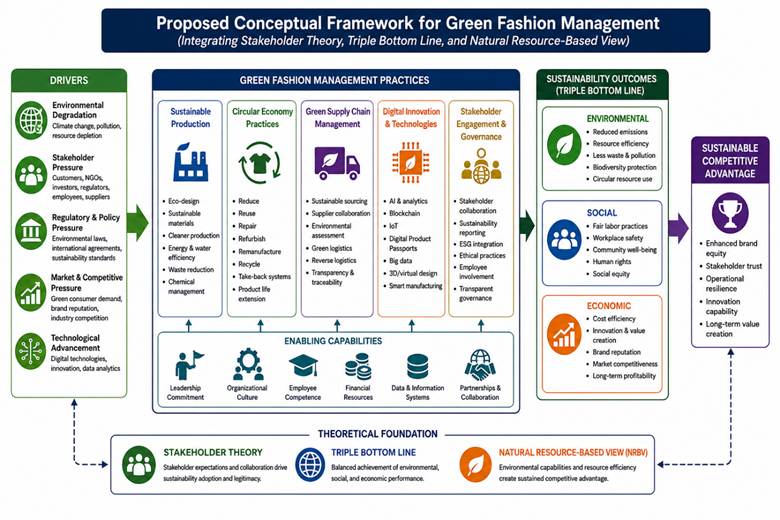
Building upon the integrated theoretical foundation of Stakeholder Theory, the Triple Bottom Line (TBL), and the Natural Resource-Based View (NRBV), this study proposes a conceptual framework that explains the strategic mechanisms through which green fashion management contributes to environmental and organizational sustainability. The framework synthesizes the principal themes identified in the literature, including stakeholder influence, sustainable production, green supply chain management, circular economy practices, and digital innovation. Rather than treating these elements as independent sustainability initiatives, the framework conceptualizes them as interrelated managerial capabilities that collectively improve environmental performance and support long-term business sustainability.
Stakeholder Theory suggests that increasing pressure from consumers, investors, governments, non-governmental organizations, and regulatory agencies motivates fashion companies to adopt environmentally responsible business strategies (Freeman, 1984). These external expectations encourage organizations to implement green fashion management practices that extend across the entire product life cycle. Such practices include sustainable production methods, environmentally responsible supply chain management, circular economy initiatives, and the adoption of digital technologies that improve transparency and resource efficiency.
From the perspective of the NRBV, these sustainability practices represent valuable organizational capabilities rather than compliance-oriented activities (Hart, 1995). Investments in cleaner production technologies, eco-design, resource-efficient operations, supplier collaboration, and digital traceability strengthen organizational competitiveness by reducing operational risks, improving resource productivity, and fostering innovation. These capabilities enable firms to respond more effectively to changing market conditions while simultaneously improving environmental outcomes.
The TBL framework provides the performance perspective of the proposed model by emphasizing that successful green fashion management should generate value across environmental, economic, and social dimensions (Elkington, 1997). Environmentally, organizations reduce greenhouse gas emissions, textile waste, energy consumption, and water pollution. Economically, sustainability practices improve operational efficiency, stimulate innovation, reduce long-term costs, and strengthen competitive advantage. Socially, sustainable management enhances ethical sourcing, labor standards, stakeholder trust, and corporate reputation. These multidimensional outcomes collectively contribute to long-term business sustainability and organizational resilience.
The framework further recognizes environmental performance as a mediating outcome between sustainability practices and overall business sustainability. Previous studies indicate that organizations rarely achieve sustainable competitive advantage solely through environmental initiatives; instead, environmental improvements create organizational capabilities that subsequently enhance economic performance, corporate legitimacy, stakeholder confidence, and long-term resilience (Hart, 1995; Koberg & Longoni, 2019). Consequently, environmental performance functions as the principal mechanism through which green fashion management generates sustainable organizational value.
Finally, the proposed framework acknowledges that digital innovation serves as an enabling capability that strengthens the effectiveness of all sustainability practices. Technologies such as artificial intelligence, blockchain, Internet of Things (IoT), big data analytics, and digital product passports improve supply chain transparency, support evidence-based decision-making, optimize resource utilization, and facilitate circular business models (Jin & Shin, 2021). Accordingly, digital transformation is positioned as a cross-cutting organizational capability that enhances the implementation of green fashion management rather than as an isolated sustainability initiative.
Based on this integrated theoretical perspective, the framework proposes that increasing stakeholder pressures stimulate the adoption of comprehensive green fashion management practices. These practices enhance environmental performance through sustainable production, green supply chain management, circular economy strategies, and digital innovation. Improved environmental performance subsequently contributes to business sustainability by generating environmental, economic, and social value simultaneously. The framework therefore provides a coherent theoretical foundation for synthesizing existing literature and identifying future research priorities within green fashion management.
Proposed Conceptual Framework
Research Propositions
P1. Stakeholder pressure positively influences the adoption of green fashion management practices.
P2. Green fashion management practices positively influence environmental performance.
P3. Sustainable production, green supply chain management, circular economy practices, and digital innovation collectively enhance environmental performance.
P4. Improved environmental performance positively contributes to business sustainability through environmental, economic, and social value creation.
P5. Digital innovation strengthens the implementation and effectiveness of green fashion management practices.
4. Methodology
This study employed a systematic qualitative literature review (SQLR) to synthesize existing knowledge on green fashion management and identify contemporary sustainable management practices, implementation challenges, and future research opportunities. Unlike traditional narrative reviews, systematic qualitative literature reviews follow transparent, replicable, and evidence-based procedures for identifying, evaluating, and synthesizing relevant scholarly publications (Snyder, 2019). This methodological approach minimizes selection bias while providing a comprehensive understanding of research trends, theoretical developments, and managerial implications across diverse academic disciplines.
A qualitative evidence synthesis was considered appropriate because the objective of this study was not to statistically aggregate empirical findings but rather to interpret, compare, and integrate conceptual and empirical evidence reported in previous studies. Green fashion management encompasses multiple interconnected research domains-including sustainability management, circular economy, green supply chain management, digital innovation, and sustainable consumer behavior-that cannot be adequately synthesized using purely quantitative approaches. Consequently, a systematic qualitative review provides greater flexibility for identifying recurring themes, theoretical relationships, and emerging research patterns across heterogeneous studies (Xiao & Watson, 2019).
To ensure methodological rigor, the review followed the Preferred Reporting Items for Systematic Reviews and Meta-Analyses (PRISMA 2020) guidelines developed by Page et al. (2021). The PRISMA framework provides internationally recognized reporting standards for systematic reviews by promoting transparency in article identification, screening, eligibility assessment, and study inclusion. Adopting the PRISMA protocol enhances the credibility, reproducibility, and reliability of literature synthesis while reducing the risk of subjective study selection.
Furthermore, this review adopted an interpretivist approach to qualitative evidence synthesis, recognizing that sustainability management practices are shaped by organizational contexts, institutional environments, technological developments, and stakeholder expectations. Rather than seeking universal causal relationships, the study aimed to identify common management practices, recurring implementation challenges, and theoretical patterns across the existing literature. This interpretive perspective supports the development of a comprehensive understanding of green fashion management while facilitating the identification of future research directions.
4.1 Review Protocol
The systematic review process was conducted according to the PRISMA 2020 Statement, which provides updated guidance for reporting systematic reviews across multiple disciplines (Page et al., 2021). The review protocol consisted of four sequential stages: identification, screening, eligibility assessment, and final inclusion. These stages ensured that only relevant, high-quality, peer-reviewed studies were included in the qualitative synthesis.
During the identification stage, comprehensive searches were conducted across multiple international academic databases using predefined search terms related to green fashion management and sustainable fashion. Retrieved records were exported to reference management software, where duplicate publications were identified and removed. The remaining records were subsequently screened based on their titles and abstracts to determine their relevance to the research objectives.
The eligibility assessment involved a full-text review of potentially relevant articles. Studies were evaluated according to predetermined inclusion and exclusion criteria, ensuring methodological consistency throughout the review process. Articles failing to satisfy the eligibility requirements were excluded, while eligible studies were retained for qualitative synthesis.
Following study selection, the included articles underwent systematic data extraction and thematic analysis to identify major sustainability practices, implementation challenges, theoretical perspectives, and research gaps. Throughout the review process, decisions regarding article inclusion and exclusion were documented to maintain transparency and facilitate future replication. Following the PRISMA protocol strengthened the methodological rigor of the review and improved the reliability of the synthesized findings.
4.2 Search Strategy and Data Sources
A comprehensive literature search was conducted using six internationally recognized academic databases that index high-quality peer-reviewed research in sustainability, environmental management, business, and fashion studies. These databases included Scopus, Web of Science Core Collection, ScienceDirect, SpringerLink, Wiley Online Library, and Emerald Insight. The use of multiple databases minimized publication bias and increased the likelihood of capturing relevant multidisciplinary literature.
The search strategy employed combinations of keywords connected through Boolean operators. Primary search terms included “green fashion management,” “sustainable fashion,” “circular fashion,” “green supply chain,” “fashion sustainability,” “textile sustainability,” “circular economy,” “eco-fashion,” “sustainable apparel,” and “digital innovation in fashion.” Boolean operators (“AND” and “OR”) were used to broaden or refine search results, while quotation marks ensured precise phrase matching.
To maintain the contemporary relevance of the review, the search focused primarily on studies published between 2015 and 2025, a period characterized by rapid developments in circular economy strategies, Environmental, Social, and Governance (ESG) practices, Industry 4.0 technologies, and sustainable fashion management. Only peer-reviewed journal articles published in English were considered eligible for inclusion. Conference papers, editorials, book reviews, dissertations, magazine articles, and non-peer-reviewed publications were excluded to ensure the scientific quality of the evidence base.
The initial search identified a substantial number of publications across the selected databases. After removing duplicate records and applying the screening and eligibility criteria, the final corpus consisted of studies directly addressing sustainable management practices within the global fashion industry. These studies formed the basis for the subsequent qualitative synthesis and thematic analysis presented in this review.
4.3 Eligibility Criteria
To ensure the relevance, consistency, and scientific quality of the review, explicit inclusion and exclusion criteria were established prior to the study selection process. Defining eligibility criteria in advance reduces selection bias and improves the transparency and reproducibility of systematic literature reviews (Page et al., 2021).
The inclusion criteria were designed to capture recent, peer-reviewed studies that directly addressed sustainable management practices within the fashion industry. Eligible studies were required to: (a) be published in English; (b) appear in peer-reviewed academic journals; (c) be published between 2015 and 2025; (d) focus on green fashion management, sustainable fashion, circular economy, green supply chain management, sustainable production, sustainable consumption, or digital innovation in the fashion industry; and (e) provide empirical, conceptual, or review-based evidence relevant to the research objectives.
Conversely, studies were excluded if they: (a) were conference proceedings, editorials, book reviews, dissertations, reports, or magazine articles; (b) were not written in English; (c) focused exclusively on technical textile engineering without managerial implications; (d) lacked sufficient methodological information; or (e) were duplicate publications identified across multiple databases.
The predefined eligibility criteria ensured that the final evidence base consisted of high-quality scholarly publications directly relevant to green fashion management. Applying consistent inclusion and exclusion standards also enhanced the reliability of the subsequent thematic synthesis and strengthened the validity of the review findings.
Table 1. Inclusion and Exclusion Criteria
| Inclusion Criteria | Exclusion Criteria |
| Peer-reviewed journal articles | Conference papers |
| English-language publications | Non-English publications |
| Published between 2015 and 2025 | Editorials and book reviews |
| Green fashion and sustainability-related studies | Dissertations and reports |
| Empirical, conceptual, or review studies | Duplicate records |
| Direct relevance to research objectives | Studies lacking managerial relevance |
4.4 Data Extraction and Thematic Analysis
Following the final selection of eligible studies, relevant information was extracted using a standardized data extraction framework to ensure consistency throughout the review process. Standardized extraction procedures improve the transparency and reproducibility of systematic reviews while reducing researcher bias during evidence synthesis (Snyder, 2019).
The extracted information included publication characteristics (author, publication year, journal, and country), research objectives, theoretical foundations, methodological approaches, principal sustainability themes, key findings, managerial implications, and identified research gaps. Recording these variables facilitated systematic comparison across studies and enabled the identification of recurring patterns within the literature.
Table 2. Data Extraction Framework
| Variable | Description |
| Author(s) | Publication authors |
| Year | Publication year |
| Country | Study context |
| Research Objective | Primary research focus |
| Theoretical Framework | Theory or conceptual foundation |
| Methodology | Qualitative, quantitative, mixed methods, or review |
| Key Findings | Principal research outcomes |
| Sustainability Theme | Major thematic category |
| Research Gap | Limitations and future research suggestions |
The extracted data were subsequently analyzed using thematic analysis, following the six-phase framework proposed by Braun and Clarke (2006). This analytical approach is widely employed in qualitative evidence synthesis because it enables researchers to identify, organize, interpret, and report meaningful patterns across heterogeneous studies.
The six analytical phases included: familiarization with the selected literature; generation of preliminary codes; identification of potential themes; review and refinement of thematic categories; definition and naming of final themes; and preparation of the analytical narrative. Through this iterative process, the review identified five overarching themes: green manufacturing and sustainable production, circular economy practices, green supply chain management, consumer behavior and sustainable marketing, and implementation challenges. These themes formed the analytical foundation for the Results and Discussion section.
4.5 Quality Assessment and Trustworthiness
To enhance methodological rigor, the quality of the included studies was evaluated using established principles of systematic review methodology. Rather than assigning numerical quality scores, studies were critically assessed according to methodological transparency, research design, theoretical consistency, clarity of data collection procedures, analytical rigor, and the credibility of reported findings (Xiao & Watson, 2019). Studies lacking sufficient methodological detail or demonstrating limited relevance to the research objectives were excluded during the eligibility assessment.
Trustworthiness was further strengthened through several methodological strategies. First, multiple academic databases were searched to minimize publication bias and improve literature coverage. Second, predefined search strategies and eligibility criteria enhanced consistency throughout the review process. Third, transparent documentation of article selection and data extraction procedures improved the reproducibility of the review. Finally, thematic analysis was conducted systematically using an established analytical framework, reducing subjective interpretation and increasing analytical credibility (Braun & Clarke, 2006).
Collectively, these methodological procedures ensured that the review was transparent, systematic, and replicable. The combination of PRISMA-guided study selection, standardized data extraction, thematic analysis, and quality appraisal provides a robust methodological foundation for synthesizing current knowledge on green fashion management and identifying future research priorities.
5. Findings and Analysis
This section presents the findings derived from the systematic qualitative review and interprets the evidence through thematic analysis. Following the PRISMA-guided study selection and the six-stage thematic analysis framework proposed by Braun and Clarke (2006), the reviewed literature was synthesized into five interrelated themes: green manufacturing and sustainable production, circular economy and resource efficiency, green supply chain management, digital innovation and supply chain transparency, and consumer behaviour, ESG, and implementation challenges. Rather than summarizing individual studies, this analysis identifies recurring patterns, conceptual relationships, and emerging trends across the literature. The discussion further examines how these themes collectively contribute to the evolution of green fashion management as an integrated strategic management approach capable of enhancing organizational sustainability, stakeholder value, and long-term competitive advantage.
5.1 Green Manufacturing and Sustainable Production
The systematic qualitative review demonstrates that green manufacturing has evolved beyond an operational environmental initiative to become a strategic management capability that underpins long-term organizational sustainability within the fashion industry. Across the reviewed literature, sustainable production consistently emerges as the primary mechanism through which fashion firms reduce environmental impacts while simultaneously improving operational efficiency and organizational resilience (Niinimäki et al., 2020; UNEP, 2023). Rather than concentrating solely on pollution control or regulatory compliance, contemporary green manufacturing integrates environmental considerations into every stage of the production process, including eco-design, sustainable material sourcing, resource-efficient manufacturing, cleaner technologies, renewable energy adoption, water conservation, and responsible chemical management.
One of the most consistent findings across the literature is that sustainability outcomes are significantly influenced by decisions made during the product design phase. Eco-design has shifted from being a technical design practice to becoming a strategic management tool that determines a product’s environmental footprint throughout its entire life cycle. The reviewed studies indicate that incorporating design principles such as material efficiency, product durability, modular construction, repairability, and recyclability substantially reduces waste generation while facilitating circular production systems (Niinimäki et al., 2020). These findings reinforce the Natural Resource-Based View (NRBV), which argues that environmental capabilities developed through proactive innovation become valuable organizational resources capable of generating sustained competitive advantage (Hart, 1995). Consequently, organizations embedding sustainability within product development are better positioned to anticipate regulatory changes, respond to stakeholder expectations, and differentiate themselves within increasingly sustainability-conscious markets.
The review further reveals that sustainable material selection constitutes another decisive determinant of environmental performance. The transition from conventional cotton and petroleum-based synthetic fibres toward recycled polyester, organic cotton, regenerated cellulose fibres, and bio-based alternatives contributes significantly to reducing greenhouse gas emissions, freshwater consumption, hazardous chemical use, and textile waste (Niinimäki et al., 2020). However, a deeper interpretation of the reviewed evidence suggests that material substitution alone cannot guarantee environmental sustainability. Several studies emphasize that genuine sustainability depends upon integrating environmentally preferable materials with cleaner production technologies, life-cycle assessment, responsible chemical management, and comprehensive environmental monitoring systems. This finding illustrates that isolated sustainability initiatives produce only incremental improvements, whereas integrated management approaches generate more substantial environmental and organizational benefits.
Another important theme emerging from the review concerns the increasing adoption of resource-efficient manufacturing systems. Numerous studies report widespread implementation of energy-efficient machinery, closed-loop water recycling systems, low-impact dyeing technologies, renewable energy utilization, and waste minimization practices across leading fashion manufacturers (UNEP, 2023). These technological innovations not only reduce environmental impacts but also improve production efficiency, lower operating costs, and enhance supply chain resilience. Such findings provide empirical support for the Triple Bottom Line (TBL) framework, which proposes that environmental responsibility and economic performance should be viewed as mutually reinforcing rather than competing organizational objectives (Elkington, 1997). The evidence therefore challenges the traditional perception that environmental sustainability necessarily increases production costs. Instead, the literature increasingly portrays sustainable production as an investment that generates long-term operational savings, strengthens organizational reputation, and enhances business resilience.
Despite these encouraging developments, the review identifies persistent implementation barriers that continue to constrain widespread adoption of green manufacturing practices. High capital investment requirements, technological complexity, fragmented supplier networks, limited environmental expertise, and insufficient financial resources remain significant obstacles, particularly for small and medium-sized enterprises operating within developing economies (Koberg & Longoni, 2019). Furthermore, many sustainability initiatives remain fragmented, concentrating on individual production stages rather than addressing the environmental performance of the complete product life cycle. This fragmented implementation limits the cumulative impact of sustainability initiatives and reduces opportunities for achieving systemic environmental improvements.
From a broader managerial perspective, the reviewed evidence indicates that successful green manufacturing requires organizational transformation rather than isolated technological adoption. Sustainable production becomes most effective when supported by strategic leadership, sustainability-oriented organizational culture, cross-functional collaboration, environmental performance measurement, and continuous innovation. Accordingly, green manufacturing should be interpreted not merely as a production function but as a dynamic organizational capability that simultaneously strengthens environmental performance, operational efficiency, stakeholder confidence, and long-term competitive advantage.
5.2 Circular Economy and Resource Efficiency
The systematic review identifies the circular economy as one of the most transformative developments shaping contemporary green fashion management. Unlike the conventional linear production model characterised by resource extraction, manufacturing, consumption, and disposal, circular economy principles promote continuous resource circulation through product longevity, reuse, repair, remanufacturing, recycling, and regenerative production systems (Geissdoerfer et al., 2017). Across the reviewed studies, circularity consistently emerges as a strategic management philosophy rather than merely a waste reduction initiative, fundamentally reshaping how fashion organizations create, deliver, and retain value.
A central finding of the review is that successful circular implementation requires a comprehensive transformation of organizational business models rather than isolated recycling programmes. Fashion companies increasingly redesign products for durability, modularity, repairability, and recyclability while simultaneously developing reverse logistics systems capable of recovering products and materials after consumer use. Such initiatives extend product life cycles, reduce dependence on virgin raw materials, and minimise environmental degradation (Ellen MacArthur Foundation, 2017). Importantly, the reviewed literature suggests that organizations integrating circular principles throughout product design, sourcing, manufacturing, distribution, retailing, and post-consumption activities consistently achieve superior environmental performance compared with firms implementing isolated recycling interventions.
The evidence further demonstrates that resource efficiency extends beyond conserving raw materials to encompass comprehensive optimization of water, energy, transportation, inventory management, production scheduling, and logistics. Life-cycle assessment (LCA) and environmental performance measurement increasingly support managerial decision-making by identifying environmental hotspots across the entire product life cycle (Geissdoerfer et al., 2017). This systems-oriented perspective illustrates that improving sustainability requires coordinated optimization across interconnected organizational processes rather than isolated operational improvements. Such findings strongly support the NRBV by demonstrating that superior resource management constitutes a strategic organizational capability capable of enhancing long-term competitiveness while simultaneously reducing environmental impacts (Hart, 1995).
Another significant finding concerns the rapid emergence of innovative circular business models. Clothing rental services, resale platforms, repair programmes, product take-back schemes, remanufacturing initiatives, and advanced textile recycling technologies have become increasingly prominent within the reviewed literature. These business models simultaneously reduce textile waste, create alternative revenue streams, diversify customer relationships, and improve resource productivity (Ellen MacArthur Foundation, 2017). Viewed through the Triple Bottom Line perspective, circular business models generate multidimensional value by reducing environmental impacts, stimulating economic innovation, and promoting more responsible consumption behaviours (Elkington, 1997). Consequently, circularity increasingly represents a strategic business opportunity rather than solely an environmental obligation.
Nevertheless, the review also reveals several persistent barriers limiting the large-scale adoption of circular economy practices. Mixed-fibre textile recycling remains technologically challenging, while inadequate collection infrastructure, inconsistent regulatory frameworks, fragmented reverse logistics systems, and varying levels of consumer participation constrain effective implementation (Kirchherr et al., 2017). Furthermore, consumer acceptance of repaired, recycled, rented, or second-hand garments differs substantially across geographical and cultural contexts, indicating that technological innovation alone cannot achieve systemic transformation. Effective circular implementation therefore depends upon supportive public policies, industry collaboration, consumer education, standardized sustainability reporting, and stronger stakeholder engagement.
Overall, the reviewed evidence suggests that the circular economy represents a strategic paradigm shift in green fashion management rather than simply an environmental waste-management strategy. By integrating regenerative resource management with organizational innovation, collaborative stakeholder relationships, and sustainable business model transformation, circular economy practices enhance environmental performance while strengthening organizational resilience and long-term business sustainability. These findings further support the integrated theoretical framework adopted in this study by illustrating how stakeholder expectations, strategic environmental capabilities, and Triple Bottom Line performance objectives collectively drive the transition towards more sustainable fashion systems.
5.3 Green Supply Chain Management and Sustainable Sourcing
The systematic review identifies Green Supply Chain Management (GSCM) as one of the most influential strategic mechanisms for implementing green fashion management across increasingly complex global value chains. Unlike conventional supply chain management, which primarily emphasizes cost reduction, quality improvement, and delivery efficiency, GSCM incorporates environmental considerations into procurement, production, logistics, distribution, retailing, reverse logistics, and end-of-life product management (Sarkis et al., 2011). The reviewed studies consistently demonstrate that environmental sustainability within the fashion industry cannot be achieved through isolated organizational initiatives because a substantial proportion of environmental impacts originates from geographically dispersed suppliers operating across multiple countries (Koberg & Longoni, 2019).
A recurring finding throughout the reviewed literature is that sustainable sourcing represents the foundation of environmentally responsible supply chain management. Fashion firms increasingly replace environmentally intensive raw materials with organic cotton, recycled polyester, regenerated cellulose fibres, and other low-impact alternatives to reduce carbon emissions, water consumption, and chemical pollution (Niinimäki et al., 2020). However, the evidence indicates that sustainable sourcing should not be interpreted merely as material substitution. Instead, effective sourcing requires rigorous supplier evaluation, environmental certification, traceability systems, and long-term collaborative partnerships that promote continuous environmental improvement throughout the supply network. This interpretation aligns closely with Stakeholder Theory, which emphasizes that sustainable organizational performance depends upon effective collaboration with multiple stakeholders rather than unilateral organizational actions (Freeman, 1984).
The review further demonstrates that supplier collaboration has evolved into a strategic capability rather than a contractual obligation. Fashion brands increasingly employ supplier audits, sustainability scorecards, environmental management systems, and supplier development programmes to improve environmental compliance while simultaneously enhancing supply chain resilience (Koberg & Longoni, 2019). Rather than functioning as monitoring mechanisms alone, these collaborative initiatives facilitate knowledge sharing, technological transfer, innovation diffusion, and collective problem-solving across supply chain partners. Such findings suggest that environmental sustainability is increasingly co-created through inter-organizational collaboration instead of being independently managed by individual firms.
Another important finding concerns the growing significance of reverse logistics within sustainable fashion supply chains. Product collection systems, garment repair services, resale platforms, remanufacturing, textile recycling, and closed-loop logistics enable organizations to recover material value while supporting circular economy objectives (Geissdoerfer et al., 2017). These practices not only reduce waste generation but also strengthen supply chain adaptability by extending product life cycles and reducing dependence on virgin resources. From the perspective of the Natural Resource-Based View, reverse logistics represents an environmental capability that enhances both operational efficiency and competitive advantage through superior resource utilization (Hart, 1995).
Despite these positive developments, the review identifies several structural barriers limiting effective GSCM implementation. Fashion supply chains remain highly fragmented, involving multiple tiers of suppliers operating under diverse institutional, technological, and regulatory environments. Limited transparency, inconsistent environmental standards, insufficient information sharing, and cost pressures frequently hinder sustainability integration across supplier networks (Sarkis et al., 2011). Small suppliers, particularly within developing economies, often lack the technological capability and financial resources required to comply with increasingly demanding sustainability standards. Consequently, the reviewed evidence suggests that future progress depends upon stronger international cooperation, harmonized sustainability standards, digital traceability systems, and long-term supplier capacity-building initiatives. Overall, GSCM should be understood as a strategic governance framework that integrates environmental responsibility across the entire fashion value chain while simultaneously improving resilience, transparency, and long-term organizational sustainability.
5.4 Digital Innovation and Supply Chain Transparency
The review identifies digital innovation as one of the most significant enablers of contemporary green fashion management. Across the reviewed studies, Industry 4.0 technologies-including artificial intelligence (AI), blockchain, the Internet of Things (IoT), big data analytics, and Digital Product Passports (DPPs)-consistently emerge as strategic tools for improving environmental transparency, operational efficiency, and evidence-based decision-making (Jin & Shin, 2021). Rather than functioning as independent technological innovations, these digital solutions increasingly operate as integrated organizational capabilities that strengthen sustainability implementation across the entire fashion value chain.
Artificial intelligence is repeatedly identified as improving demand forecasting, inventory optimization, production scheduling, and quality management. More accurate forecasting reduces overproduction, which remains one of the principal contributors to textile waste within the fashion industry (Jin & Shin, 2021). Simultaneously, big data analytics enables organizations to monitor environmental performance, evaluate sustainability indicators, identify operational inefficiencies, and optimize resource allocation. These findings suggest that digital technologies contribute not only to operational efficiency but also to proactive environmental management through continuous organizational learning and adaptive decision-making.
The reviewed literature also highlights blockchain technology as a transformative mechanism for improving supply chain transparency and traceability. Blockchain enables immutable documentation of raw material origins, manufacturing activities, supplier compliance, and environmental certifications, thereby reducing information asymmetry and strengthening stakeholder confidence (Saberi et al., 2019). From the perspective of Stakeholder Theory, enhanced transparency strengthens relationships among consumers, investors, suppliers, regulators, and civil society organizations by increasing organizational accountability and reducing opportunities for greenwashing. Consequently, transparency increasingly becomes a strategic organizational asset that supports corporate legitimacy and sustainable competitive positioning.
Digital Product Passports and IoT technologies further strengthen circular economy implementation by providing standardized information concerning product composition, repairability, recyclability, environmental impacts, and life-cycle history (European Commission, 2022). Such innovations facilitate product recovery, material recycling, regulatory compliance, and informed consumer decision-making. Nevertheless, the review indicates that digital transformation remains uneven across the global fashion industry due to high implementation costs, technological complexity, cybersecurity concerns, and disparities in digital infrastructure, particularly within developing economies. Therefore, successful digital transformation requires complementary investments in organizational capabilities, workforce development, governance systems, and stakeholder collaboration rather than technology adoption alone.
5.5 Consumer Behaviour, ESG, and Implementation Challenges
Another major theme emerging from the review concerns the growing influence of consumer behaviour, Environmental, Social, and Governance (ESG) initiatives, and broader implementation challenges in shaping green fashion management. The reviewed studies consistently indicate that sustainability is increasingly driven by changing stakeholder expectations rather than regulatory compliance alone. Consumers demonstrate growing interest in environmentally responsible products, supply chain transparency, ethical sourcing, and corporate sustainability reporting, thereby encouraging fashion organizations to integrate sustainability into strategic decision-making (UNEP, 2023).
However, the evidence simultaneously reveals a persistent attitude–behaviour gap. Although consumers frequently express positive attitudes toward sustainable fashion, actual purchasing behaviour continues to be strongly influenced by price, convenience, product availability, brand image, and rapidly changing fashion trends (Niinimäki et al., 2020). This discrepancy suggests that consumer awareness alone is insufficient to transform market behaviour. Effective sustainability strategies therefore require coordinated interventions involving environmental education, transparent product information, supportive public policies, financial incentives, and innovative business models capable of making sustainable consumption both accessible and economically attractive.
The review also demonstrates the growing strategic importance of ESG reporting within the fashion industry. Sustainability reporting enhances corporate transparency, strengthens investor confidence, improves stakeholder trust, and facilitates regulatory compliance. Rather than functioning solely as disclosure mechanisms, ESG initiatives increasingly influence organizational governance, investment decisions, and long-term strategic planning (UNEP, 2023). Nevertheless, the reviewed studies caution that inconsistent reporting frameworks and limited verification mechanisms continue to create opportunities for selective disclosure and greenwashing, thereby highlighting the need for internationally harmonized sustainability standards.
Across the literature, implementation challenges remain remarkably consistent. Financial constraints, fragmented global supply chains, technological limitations, regulatory inconsistencies, insufficient managerial expertise, and unequal institutional capacities continue to impede sustainability implementation, particularly among small and medium-sized enterprises. These findings suggest that successful green fashion management requires integrated governance frameworks that simultaneously address technological, organizational, institutional, and behavioural dimensions of sustainability rather than focusing exclusively on environmental technologies.
5.6 Integrated Thematic Analysis and Managerial Implications
Synthesizing the evidence across all reviewed themes reveals that green fashion management should be conceptualized as an integrated strategic management system rather than a collection of isolated environmental initiatives. Sustainable production, circular economy practices, green supply chain management, digital innovation, and stakeholder engagement operate as mutually reinforcing organizational capabilities that collectively improve environmental performance and long-term business sustainability. This integrated interpretation strongly supports the theoretical framework adopted in this study by illustrating how Stakeholder Theory, the Triple Bottom Line, and the Natural Resource-Based View collectively explain the adoption, implementation, and outcomes of green fashion management.
The review further indicates that sustainability generates the greatest organizational value when environmental considerations are embedded throughout strategic planning, organizational governance, operational decision-making, and stakeholder relationships. Firms treating sustainability as a core organizational capability consistently demonstrate stronger innovation capacity, improved resource efficiency, enhanced stakeholder legitimacy, and greater resilience under rapidly changing market and regulatory conditions (Hart, 1995; Koberg & Longoni, 2019). Conversely, organizations implementing fragmented or compliance-oriented sustainability initiatives frequently experience limited environmental improvements and reduced strategic benefits.
From a managerial perspective, the findings emphasize that future competitiveness within the fashion industry will increasingly depend upon organizations’ ability to integrate sustainability into every stage of the product life cycle while leveraging digital technologies, collaborative supply chain governance, and circular business models. Accordingly, green fashion management should no longer be viewed as an environmental responsibility alone but as a strategic organizational capability that simultaneously creates environmental, economic, and social value. This integrated perspective provides a coherent foundation for the discussion of theoretical implications, policy recommendations, and future research directions presented in the subsequent sections of this study.
6. Discussion
The discussion interprets the findings within the broader context of sustainability management and examines their theoretical, managerial, and policy significance. Rather than reiterating the results, this section critically evaluates how the identified themes contribute to the evolving understanding of green fashion management and compares the synthesized evidence with existing scholarly literature. The discussion also explores the applicability of Stakeholder Theory, the Triple Bottom Line, and the Natural Resource-Based View in explaining the adoption and effectiveness of sustainable fashion practices. Furthermore, it considers the implications of the findings for organizational strategy, public policy, and future research. Through this critical interpretation, the discussion demonstrates how integrated sustainability practices can support environmental stewardship, organizational resilience, and sustainable competitive advantage within the rapidly transforming global fashion industry.
6.1 Interpretation of the Major Findings
The findings of this systematic qualitative review demonstrate that green fashion management has evolved from a collection of environmentally oriented operational practices into a comprehensive strategic management paradigm that integrates sustainability across organizational governance, production systems, supply chain management, digital innovation, and stakeholder engagement. Rather than treating environmental responsibility as a peripheral corporate activity, the reviewed literature consistently portrays sustainability as a core organizational capability that enhances long-term competitiveness, resilience, and stakeholder legitimacy (Hart, 1995; Niinimäki et al., 2020). This interpretation extends beyond the descriptive findings presented in the previous section by illustrating how the identified sustainability practices collectively transform organizational decision-making within the global fashion industry.
One of the most significant findings emerging from the review is that sustainability has shifted from reactive environmental compliance toward proactive strategic management. Earlier approaches to environmental management primarily emphasized pollution control and regulatory adherence. In contrast, contemporary green fashion management integrates environmental considerations into product design, material selection, manufacturing, logistics, retailing, consumption, and end-of-life product recovery. This transformation reflects an important conceptual shift from minimizing environmental harm to creating long-term organizational value through sustainable innovation. The evidence indicates that organizations increasingly perceive environmental sustainability not as a cost burden but as a strategic investment capable of improving operational efficiency, strengthening corporate reputation, and enhancing competitive positioning (Elkington, 1997; UNEP, 2023).
The findings also suggest that sustainability should be interpreted as a systems-based organizational capability rather than a series of isolated environmental initiatives. The reviewed studies repeatedly demonstrate that organizations implementing fragmented sustainability measures-for example, adopting recycled materials without improving supply chain governance or introducing recycling programmes without redesigning production systems-achieve comparatively limited environmental improvements. In contrast, firms integrating sustainable production, circular economy practices, green supply chain management, digital technologies, and stakeholder collaboration consistently report stronger environmental and organizational outcomes (Geissdoerfer et al., 2017; Koberg & Longoni, 2019). This systems perspective emphasizes that sustainability performance emerges through interactions among multiple organizational functions rather than through improvements within individual operational activities.
Another important interpretation concerns the strategic significance of circular economy practices. The findings indicate that circularity should not be understood merely as an advanced waste management technique but rather as a fundamental transformation of business models and value creation processes. The reviewed literature demonstrates that organizations adopting product life-extension strategies, repair services, remanufacturing, resale platforms, and closed-loop resource systems generate environmental benefits while simultaneously diversifying revenue sources and improving supply chain resilience (Ellen MacArthur Foundation, 2017). Consequently, circular economy principles redefine organizational success by shifting managerial priorities from maximizing production volume toward maximizing resource productivity and long-term value creation. This transition reflects an important departure from the traditional linear production paradigm that has historically characterized the global fashion industry.
The review further reveals that digital transformation has become an indispensable enabling capability for sustainability implementation. Technologies such as artificial intelligence, blockchain, the Internet of Things (IoT), big data analytics, and Digital Product Passports increasingly facilitate environmental monitoring, supply chain transparency, resource optimization, and evidence-based managerial decision-making (Jin & Shin, 2021; Saberi et al., 2019). Rather than functioning as purely technological innovations, these digital systems improve organizational learning by enabling firms to collect, analyse, and utilize environmental data throughout increasingly complex global supply chains. Consequently, digital innovation strengthens not only operational efficiency but also organizational accountability, stakeholder trust, and regulatory compliance.
However, the findings simultaneously indicate that technological advancement alone cannot guarantee successful sustainability implementation. Across the reviewed studies, persistent barriers-including fragmented international supply chains, unequal technological capabilities, financial constraints, inconsistent regulatory frameworks, and varying levels of environmental awareness-continue to limit widespread adoption of green fashion management practices. These challenges are particularly evident among manufacturers operating in developing economies, where resource limitations frequently restrict investments in advanced technologies and sustainability infrastructure (Koberg & Longoni, 2019; UNEP, 2023). This observation suggests that technological innovation must be complemented by institutional support, organizational leadership, stakeholder collaboration, and supportive public policy to achieve meaningful environmental transformation.
Another noteworthy finding concerns the evolving role of consumers within sustainable fashion systems. While consumers increasingly express concern regarding environmental sustainability, ethical sourcing, and corporate transparency, the review identifies a persistent discrepancy between stated environmental attitudes and actual purchasing behaviour. Economic considerations, product availability, convenience, and rapidly changing fashion trends continue to exert stronger influence on purchasing decisions than environmental preferences alone (Niinimäki et al., 2020). This finding indicates that sustainable consumption cannot rely solely on consumer awareness campaigns. Instead, meaningful behavioural change requires coordinated interventions involving governments, educational institutions, industry organizations, and retailers that collectively reduce barriers to sustainable purchasing while improving consumer access to environmentally responsible alternatives.
Collectively, these findings suggest that green fashion management represents a multidimensional organizational transformation rather than a collection of environmental practices. Sustainable competitive advantage increasingly depends upon organizations’ capacity to integrate environmental responsibility into strategic planning, operational management, technological innovation, stakeholder relationships, and organizational culture. Consequently, sustainability should be viewed as an ongoing process of organizational adaptation that continuously responds to evolving environmental challenges, stakeholder expectations, and technological developments rather than as a fixed set of environmental performance indicators.
6.2 Theoretical Implications
The findings of this review provide substantial theoretical contributions to the emerging literature on green fashion management by demonstrating that sustainability within the fashion industry is best understood through an integrated theoretical perspective rather than a single conceptual framework. The combined application of Stakeholder Theory (Freeman, 1984), the Triple Bottom Line (TBL) framework (Elkington, 1997), and the Natural Resource-Based View (NRBV) (Hart, 1995) offers a more comprehensive explanation of the drivers, implementation mechanisms, and organizational outcomes associated with green fashion management than any individual theory considered independently. The present findings therefore reinforce the value of theoretical integration for explaining the complexity of sustainability within contemporary global industries.
First, the findings strongly support Stakeholder Theory by demonstrating that sustainability adoption is increasingly driven by external stakeholder expectations rather than internal organizational preferences alone. Governments, investors, consumers, non-governmental organizations, international regulatory agencies, suppliers, and civil society collectively influence corporate sustainability strategies through increasing demands for transparency, ethical sourcing, environmental accountability, and ESG performance (Freeman, 1984; UNEP, 2023). However, this review extends traditional stakeholder theory by suggesting that stakeholder relationships are no longer primarily mechanisms of organizational legitimacy but have become strategic resources that facilitate innovation, knowledge exchange, collaborative governance, and long-term organizational resilience. Sustainable value creation therefore increasingly depends upon collaborative stakeholder networks rather than unilateral organizational decision-making.
Second, the findings reinforce the continued relevance of the Triple Bottom Line framework while simultaneously expanding its practical interpretation within green fashion management. Consistent with Elkington’s (1997) proposition, organizations achieving superior sustainability performance demonstrate balanced improvements across environmental, economic, and social dimensions. Nevertheless, the review indicates that these three dimensions should not be interpreted as independent organizational objectives. Instead, they operate as mutually reinforcing outcomes generated through integrated sustainability strategies. Environmental improvements contribute to operational efficiency and innovation; improved economic performance enables continued investment in sustainability initiatives; while enhanced social responsibility strengthens stakeholder trust, organizational legitimacy, and long-term resilience. Accordingly, the present review supports a dynamic interpretation of the Triple Bottom Line in which the environmental, economic, and social dimensions function as an interconnected system rather than separate measures of organizational performance.
Third, the findings provide particularly strong support for the Natural Resource-Based View. Across virtually all thematic areas-including sustainable production, circular economy implementation, green supply chain management, digital innovation, and environmental governance-the reviewed studies consistently identify organizational environmental capabilities as critical determinants of long-term competitiveness (Hart, 1995). Investments in cleaner production technologies, eco-design, renewable materials, resource-efficient manufacturing, digital traceability, and circular business models repeatedly emerge as strategic organizational assets rather than compliance-related expenditures. These findings therefore reinforce the NRBV’s central proposition that environmental capabilities represent valuable, rare, difficult-to-imitate, and organizationally embedded resources capable of generating sustained competitive advantage.
Importantly, the review also identifies important theoretical interactions among these three frameworks. Stakeholder Theory explains why organizations adopt sustainability by emphasizing external pressures and legitimacy concerns. The Triple Bottom Line explains what organizations seek to achieve through balanced environmental, social, and economic performance. The Natural Resource-Based View explains how organizations generate sustainable competitive advantage by developing unique environmental capabilities. The systematic synthesis therefore demonstrates that these theories are complementary rather than competing perspectives. Together, they provide a coherent explanatory framework for understanding the evolution of green fashion management from environmental compliance toward strategic organizational transformation.
Beyond validating existing theories, the review also suggests opportunities for future theoretical development. The growing importance of digital technologies, circular business models, ESG governance, and international sustainability regulations indicates that traditional management theories should increasingly incorporate concepts from digital transformation, institutional theory, dynamic capabilities, and circular economy research. Future theoretical models may therefore benefit from integrating these emerging perspectives with established sustainability theories to explain the rapidly evolving relationship between technological innovation, organizational adaptation, environmental governance, and sustainable competitive advantage. Such theoretical integration would further strengthen the conceptual foundation of green fashion management while supporting more comprehensive empirical investigations across diverse institutional and geographical contexts.
6.3 Managerial and Policy Implications
The findings of this systematic qualitative review provide important managerial and policy implications for accelerating sustainability transitions within the global fashion industry. The reviewed literature consistently indicates that environmental sustainability can no longer be regarded as a peripheral corporate responsibility or a compliance-oriented activity. Instead, green fashion management should be institutionalized as a strategic management philosophy that informs organizational governance, product development, supply chain management, technological innovation, and stakeholder engagement (Hart, 1995; Koberg & Longoni, 2019). Managers who integrate sustainability into long-term corporate strategy are more likely to improve organizational resilience, strengthen stakeholder trust, and generate sustainable competitive advantage than those relying on isolated environmental initiatives.
A major managerial implication concerns the importance of embedding sustainability into organizational governance structures. The reviewed studies demonstrate that successful sustainability implementation depends on executive leadership commitment, clearly defined sustainability objectives, cross-functional coordination, and continuous environmental performance evaluation (UNEP, 2023). Sustainability should therefore become an integral component of strategic planning, risk management, investment decision-making, and organizational performance measurement rather than being delegated exclusively to environmental departments. Organizations that adopt sustainability-oriented governance structures are better positioned to anticipate regulatory changes, respond to stakeholder expectations, and integrate environmental considerations into operational decision-making.
The findings also highlight the necessity of adopting life-cycle thinking throughout fashion value chains. Managers should move beyond isolated production improvements by incorporating sustainability into product design, procurement, manufacturing, logistics, retailing, consumer engagement, and end-of-life product recovery. Eco-design principles, sustainable material selection, cleaner production technologies, and reverse logistics should be coordinated within integrated management systems that optimize environmental performance throughout the entire product life cycle (Geissdoerfer et al., 2017; Niinimäki et al., 2020). Such integrated approaches enable organizations to reduce waste, improve resource productivity, and strengthen long-term operational efficiency.
Another important implication concerns supplier relationship management. Because fashion production depends heavily on geographically dispersed global supply networks, sustainability performance increasingly depends upon collaborative partnerships rather than transactional supplier relationships. Fashion firms should invest in supplier training, environmental audits, knowledge sharing, sustainability certification, and long-term supplier development programmes to improve environmental performance across all supply chain tiers (Koberg & Longoni, 2019). These collaborative approaches reduce sustainability risks while strengthening organizational resilience against increasing regulatory and market pressures.
The review further emphasizes the strategic importance of digital transformation for sustainability implementation. Artificial intelligence, blockchain, IoT technologies, big data analytics, and Digital Product Passports should be integrated into sustainability management systems to improve traceability, environmental monitoring, demand forecasting, inventory optimization, and evidence-based decision-making (Jin & Shin, 2021; Saberi et al., 2019). Nevertheless, managers should recognize that technology alone cannot deliver sustainability. Digital investments must be accompanied by organizational learning, employee capability development, effective governance mechanisms, and continuous stakeholder collaboration to maximize their environmental and business value.
From a policy perspective, the findings indicate that governments play a central role in facilitating sustainable transformation across the fashion industry. The reviewed literature consistently demonstrates that fragmented regulatory systems and inconsistent environmental standards remain major obstacles to sustainability implementation, particularly within international supply chains (UNEP, 2023). Policymakers should therefore promote harmonized environmental regulations, standardized sustainability reporting frameworks, extended producer responsibility policies, and incentives supporting cleaner production technologies and circular business models. Public investment in textile recycling infrastructure, renewable energy systems, green innovation, and sustainability research can further accelerate industry-wide environmental improvements.
Furthermore, educational institutions and professional organizations should strengthen sustainability education and capacity-building initiatives. Developing managerial competencies in sustainable production, circular economy management, environmental accounting, digital sustainability technologies, and ESG governance will be essential for preparing future leaders capable of managing increasingly complex sustainability challenges. Collectively, these managerial and policy implications suggest that successful green fashion management requires coordinated action among businesses, governments, academic institutions, industry associations, investors, and consumers rather than isolated organizational initiatives.
6.4 Comparison with Previous Literature
The findings of this review are broadly consistent with previous research emphasizing the growing strategic importance of sustainability within the fashion industry, while simultaneously extending existing knowledge by integrating fragmented evidence into a comprehensive management perspective. Earlier studies primarily focused on individual sustainability dimensions such as eco-design, sustainable textiles, consumer behaviour, green marketing, circular economy practices, or environmental management (Shen, 2014; Niinimäki et al., 2020). Although these investigations significantly advanced understanding of specific sustainability issues, they often examined environmental practices independently rather than considering their interrelationships within broader organizational management systems.
Consistent with previous systematic reviews, this study confirms that sustainable production and circular economy practices constitute fundamental pillars of environmental improvement within the fashion industry (Geissdoerfer et al., 2017; Niinimäki et al., 2020). However, the present review extends previous literature by demonstrating that these sustainability initiatives are most effective when implemented within integrated governance frameworks incorporating stakeholder engagement, green supply chain management, and digital innovation. Rather than viewing sustainability practices as discrete interventions, the synthesized evidence suggests that organizational performance depends upon the interaction among multiple complementary capabilities.
The review also corroborates earlier findings regarding the growing importance of green supply chain management. Previous studies have emphasized sustainable procurement, supplier collaboration, environmental certification, and reverse logistics as critical components of sustainable supply chains (Koberg & Longoni, 2019; Sarkis et al., 2011). The present synthesis reinforces these conclusions while providing deeper interpretation by illustrating how supply chain collaboration contributes not only to environmental compliance but also to organizational learning, innovation, and strategic resilience. This broader interpretation positions supply chain sustainability as a dynamic governance capability rather than solely an operational management practice.
The findings similarly support recent research highlighting the transformative potential of digital technologies for improving sustainability performance. Previous investigations have documented the contributions of artificial intelligence, blockchain, IoT, and Digital Product Passports to supply chain transparency, traceability, and operational efficiency (Jin & Shin, 2021; Saberi et al., 2019). The present review confirms these observations but further argues that digital technologies function most effectively when integrated into broader organizational sustainability strategies. Consequently, digital transformation should be viewed as an enabling organizational capability rather than an independent sustainability solution.
Despite these areas of agreement, the present review also identifies several gaps within previous literature. Existing studies remain heavily concentrated in developed economies, particularly Europe, North America, and selected East Asian countries, whereas comparatively limited attention has been devoted to developing economies where a substantial proportion of global apparel manufacturing occurs. Institutional environments, technological capabilities, regulatory systems, and socioeconomic conditions vary considerably across these regions, suggesting that sustainability implementation may differ substantially according to local contexts. Future research should therefore expand geographical representation to improve understanding of sustainability practices across diverse institutional environments.
Another limitation identified within previous literature concerns methodological fragmentation. Much existing research relies on case studies, consumer surveys, or firm-level quantitative analyses conducted within specific organizational settings. Comparatively few investigations have synthesized evidence across multiple sustainability domains using systematic qualitative methodologies. By integrating findings from diverse research streams, the present review contributes a more comprehensive conceptual understanding of green fashion management while identifying relationships among sustainable production, circular economy practices, digital innovation, stakeholder engagement, and organizational governance. Accordingly, the review advances the literature by providing an integrated management perspective capable of supporting both theoretical development and evidence-based managerial practice.
6.5 Overall Discussion and Transition to the Conclusion
Taken together, the findings of this systematic qualitative review demonstrate that green fashion management has entered a new stage of development characterized by strategic integration, organizational transformation, and increasing stakeholder accountability. Sustainability within the fashion industry is no longer confined to environmental compliance or isolated operational improvements; instead, it has become a multidimensional organizational capability that influences governance structures, production systems, supply chain relationships, technological innovation, corporate transparency, and long-term value creation.
The synthesis further illustrates that the transition toward sustainable fashion depends upon the interaction of multiple organizational capabilities rather than any single environmental initiative. Sustainable production, circular economy implementation, green supply chain management, digital innovation, and collaborative stakeholder governance reinforce one another to create integrated systems capable of improving environmental, economic, and social performance simultaneously. This interconnected perspective supports the integrated theoretical framework proposed in this study and reinforces the argument that sustainability should be conceptualized as a dynamic organizational system rather than a collection of independent environmental practices.
At the same time, the review acknowledges that substantial challenges remain. Financial constraints, fragmented international supply chains, inconsistent policy frameworks, technological disparities, and behavioural barriers continue to slow sustainability implementation across many regions of the global fashion industry. Addressing these challenges will require stronger collaboration among governments, industry, researchers, investors, and consumers, together with continued technological innovation and institutional reform.
Overall, the evidence synthesized in this review suggests that green fashion management offers a viable strategic pathway for simultaneously achieving environmental protection, organizational competitiveness, and long-term business resilience. Nevertheless, realizing this potential requires organizations to move beyond incremental environmental improvements toward comprehensive sustainability transformation supported by strategic leadership, collaborative governance, digital innovation, and continuous organizational learning. Building upon these insights, the following conclusion synthesizes the principal contributions of the study, highlights its limitations, and proposes directions for future research that may further advance both the theory and practice of green fashion management.
7. Conclusion
This systematic qualitative review provides a comprehensive synthesis of contemporary knowledge on green fashion management by integrating evidence from sustainable production, circular economy practices, green supply chain management, digital innovation, and stakeholder-oriented sustainability strategies. The review demonstrates that environmental sustainability has become a strategic organizational priority rather than merely an operational or regulatory concern. Across the reviewed literature, sustainability is consistently portrayed as an integrated management capability that enhances environmental performance, organizational resilience, stakeholder trust, and long-term competitive advantage.
The findings reveal that effective green fashion management requires organizations to adopt a systems perspective in which environmental considerations are embedded throughout the entire product life cycle, from product design and sustainable sourcing to manufacturing, logistics, retailing, consumer engagement, and end-of-life resource recovery. Sustainable production practices, circular business models, collaborative supply chain governance, and digital technologies collectively contribute to reducing resource consumption, minimizing environmental pollution, improving transparency, and strengthening organizational adaptability. These interconnected capabilities generate simultaneous environmental, economic, and social benefits, reinforcing the principles of the Triple Bottom Line while supporting long-term organizational sustainability.
The review also highlights the increasingly important role of stakeholder collaboration in achieving sustainability objectives. Governments, investors, suppliers, consumers, non-governmental organizations, and regulatory agencies collectively influence organizational sustainability strategies through increasing demands for environmental accountability, ethical sourcing, supply chain transparency, and Environmental, Social, and Governance (ESG) performance. At the same time, the review demonstrates that digital technologies-including artificial intelligence, blockchain, the Internet of Things, and Digital Product Passports-are transforming sustainability management by improving traceability, evidence-based decision-making, resource efficiency, and environmental monitoring throughout complex global supply networks.
Despite significant progress, substantial implementation challenges remain. Financial constraints, fragmented international supply chains, technological disparities, inconsistent environmental regulations, and persistent gaps between consumer attitudes and purchasing behaviour continue to limit large-scale sustainability adoption. These findings suggest that technological innovation alone cannot achieve sustainable transformation without complementary institutional reforms, supportive public policies, organizational leadership, workforce development, and collaborative stakeholder engagement.
From a theoretical perspective, this study demonstrates that Stakeholder Theory, the Triple Bottom Line, and the Natural Resource-Based View collectively provide a robust conceptual foundation for explaining the adoption, implementation, and outcomes of green fashion management. Integrating these complementary perspectives contributes to a more comprehensive understanding of sustainability as a multidimensional strategic capability rather than a collection of isolated environmental initiatives.
Although this review synthesizes a substantial body of contemporary literature, several limitations should be acknowledged. The review focused exclusively on English-language, peer-reviewed journal articles published between 2015 and 2025 and therefore may not capture relevant evidence contained in books, conference proceedings, industry reports, or publications in other languages. Future research should expand geographical representation, particularly within developing economies, investigate the long-term effectiveness of emerging digital sustainability technologies, examine evolving ESG governance practices, and develop integrated empirical models capable of evaluating the relationships among environmental performance, organizational innovation, stakeholder collaboration, and business resilience. Advancing these research priorities will further strengthen both the theoretical development and practical implementation of green fashion management while supporting the transition toward a more sustainable and circular global fashion industry.
References
Braun, V., & Clarke, V. (2006). Using thematic analysis in psychology. Qualitative Research in Psychology, 3(2), 77–101. https://doi.org/10.1191/1478088706qp063oa
Elkington, J. (1997). Cannibals with forks: The triple bottom line of 21st century business. Capstone Publishing.
Ellen MacArthur Foundation. (2017). A new textiles economy: Redesigning fashion’s future. Ellen MacArthur Foundation. https://ellenmacarthurfoundation.org/a-new-textiles-economy
European Commission. (2022). Sustainable and circular textiles strategy. Publications Office of the European Union. https://environment.ec.europa.eu
European Environment Agency. (2022). Textiles and the environment: The role of design in Europe’s circular economy. European Environment Agency. https://www.eea.europa.eu
Freeman, R. E. (1984). Strategic management: A stakeholder approach. Pitman.
Geissdoerfer, M., Savaget, P., Bocken, N. M. P., & Hultink, E. J. (2017). The circular economy-A new sustainability paradigm? Journal of Cleaner Production, 143, 757–768. https://doi.org/10.1016/j.jclepro.2016.12.048
Hart, S. L. (1995). A natural-resource-based view of the firm. Academy of Management Review, 20(4), 986–1014. https://doi.org/10.5465/amr.1995.9512280033
Jin, B. E., & Shin, D. C. (2021). The power of 4IR technologies in the fashion industry: Opportunities for sustainable fashion. Fashion and Textiles, 8(1), 1–28. https://doi.org/10.1186/s40691-021-00265-4
Kirchherr, J., Reike, D., & Hekkert, M. (2017). Conceptualizing the circular economy: An analysis of 114 definitions. Resources, Conservation and Recycling, 127, 221–232. https://doi.org/10.1016/j.resconrec.2017.09.005
Koberg, E., & Longoni, A. (2019). A systematic review of sustainable supply chain management in global supply chains. Journal of Cleaner Production, 207, 1084–1098. https://doi.org/10.1016/j.jclepro.2018.10.033
Niinimäki, K., Peters, G., Dahlbo, H., Perry, P., Rissanen, T., & Gwilt, A. (2020). The environmental price of fast fashion. Nature Reviews Earth & Environment, 1(4), 189–200. https://doi.org/10.1038/s43017-020-0039-9
Page, M. J., McKenzie, J. E., Bossuyt, P. M., Boutron, I., Hoffmann, T. C., Mulrow, C. D., Shamseer, L., Tetzlaff, J. M., Akl, E. A., Brennan, S. E., Chou, R., Glanville, J., Grimshaw, J. M., Hróbjartsson, A., Lalu, M. M., Li, T., Loder, E. W., Mayo-Wilson, E., McDonald, S., … Moher, D. (2021). The PRISMA 2020 statement: An updated guideline for reporting systematic reviews. BMJ, 372, n71. https://doi.org/10.1136/bmj.n71
Saberi, S., Kouhizadeh, M., Sarkis, J., & Shen, L. (2019). Blockchain technology and its relationships to sustainable supply chain management. International Journal of Production Research, 57(7), 2117–2135. https://doi.org/10.1080/00207543.2018.1533261
Sarkis, J., Zhu, Q., & Lai, K. H. (2011). An organizational theoretic review of green supply chain management literature. International Journal of Production Economics, 130(1), 1–15. https://doi.org/10.1016/j.ijpe.2010.11.010
Shen, B. (2014). Sustainable fashion supply chain management: From sourcing to retailing. Springer. https://doi.org/10.1007/978-3-319-12703-3
Snyder, H. (2019). Literature review as a research methodology: An overview and guidelines. Journal of Business Research, 104, 333–339. https://doi.org/10.1016/j.jbusres.2019.07.039
United Nations. (2015). Transforming our world: The 2030 Agenda for Sustainable Development. United Nations. https://sdgs.un.org/2030agenda
United Nations Environment Programme. (2023). Sustainability and circularity in the textile value chain: Global roadmap. United Nations Environment Programme. https://www.unep.org
United Nations Framework Convention on Climate Change. (2015). Paris Agreement. United Nations. https://unfccc.int/process-and-meetings/the-paris-agreement/the-paris-agreement
Xiao, Y., & Watson, M. (2019). Guidance on conducting a systematic literature review. Journal of Planning Education and Research, 39(1), 93–112. https://doi.org/10.1177/0739456X17723971