Journal Home
OPEN ACCESS
Conditional Support for AI Assisted Environmental Business Compliance in Bangladesh
| Torikul Islam ORCID: https://orcid.org/0009-0003-2452-9929 Sorubi Akter ORCID: https://orcid.org/0009-0004-2697-3086 Md. Emon Mridha ORCID: https://orcid.org/0009-0000-1117-7838 Department of Law Shanto-Mariam University of Creative Technology Dhaka, Bangladesh |
| Prof. Dr Kazi Abdul Mannan Department of Business Administration Faculty of Business Shanto-Mariam University of Creative Technology Dhaka, Bangladesh Email: drkaziabdulmannan@gmail.com ORCID: https://orcid.org/0000-0002-7123-132X Corresponding author: Torikul Islam: torikulislamtofi621@gmail.com |
Sustain. env. bus. 2026. 6(4); https://doi.org/10.64907/xkmf.v6i4.seb.2
Submission received: 20 September 2026 / Revised: 25 October 2026 / Accepted: 28 October 2026 / Published: 30 October 2026
Download (PDF)
Abstract
Artificial intelligence (AI) may help businesses identify environmental obligations, yet support for its use can depend on how a proposed service is governed. This cross-sectional study distinguishes perceived usefulness for identifying obligations from support conditional on transparency and accountability. It uses 385 adult responses to a common questionnaire on AI, environment and climate justice in Bangladesh. We report individual item distributions, joint endorsement and paired comparisons, followed by exploratory adjusted models of conditional support and expected consistency of compliance practices. Conditional support was endorsed by 315 respondents (81.8%), whereas 230 (59.7%) endorsed usefulness for identifying obligations. The paired difference was 22.1 percentage points (95% CI 15.8 to 28.1; Holm-adjusted p < 0.001). Both were endorsed by 189 respondents (49.1%). Of the 315 conditional supporters, 116 also endorsed both updating tools when relevant rules change and retaining human legal review for complex decisions. No focal adjusted coefficient met the multiplicity-adjusted threshold. The findings distinguish support for a stated governance condition from endorsement of a specific task and show why a single acceptance score would obscure the response patterns. They motivate separate evaluation of rule currency, human review and practical usefulness when assessing compliance tools. The study measures stated judgements in a mixed adult sample; it does not estimate the effect of safeguards on uptake, verify compliance or observe enforcement outcomes.
Keywords: artificial intelligence; environmental compliance; perceived usefulness; accountability; human legal review; Bangladesh.
1. Introduction
A business may need to determine which environmental requirements apply before undertaking a project, changing a process or renewing a permission. That determination can involve legislation, implementing rules and site-specific conditions. A digital tool can make these materials easier to find or organise, especially when the relevant information is spread across documents. A system that generates an answer may also hide uncertainty about which document governs or whether a provision remains current. The value of such a tool depends on the task it assists and on whether the business can check the result before acting.
Identifying a potentially relevant obligation differs from determining that it applies and from demonstrating compliance. A tool could correctly retrieve a general rule while overlooking a permit condition or a factual distinction that changes the analysis. Conversely, an organisation can have an accurate list of requirements and still lack procedures or resources to implement them. A study about whether respondents find an obligation-identification tool promising should therefore avoid treating their answers as evidence that AI improves business performance or enforcement.
The distinction is especially important when a tool presents advice in ordinary language. A user may find a clear answer more useful than a long list of sources. Clarity does not establish accuracy. The practical question is whether the answer helps a user reach the relevant source and determine what remains uncertain. Where a conclusion depends on an exception or a factual classification, an effective design can make that dependency visible instead of offering a definitive answer without a check. Governance then becomes part of the task: the system must expose enough information to permit review.[1]
The questionnaire distinguishes a specific belief that AI can identify environmental obligations from a broader willingness to support AI-assisted compliance where transparency and accountability are maintained. These are separate propositions. A person may be open to governed use without being convinced that a tool can identify obligations reliably. Another may see practical value in identification while remaining uncertain about a commitment to use the tool. The empirical question is how often those positions occur together and how far they diverge in the same respondents.
The problem also extends to safeguards. Support for a transparent and accountable tool does not specify what transparency means, which actors are responsible or whether human legal review should be required. The instrument includes separate statements about updating tools when rules change and retaining human legal review in complex decisions. Reporting them individually allows a distinction between a broad principle and specific operating expectations. In turn, comparing joint endorsement reveals whether the same individuals affirm the principle and both operating expectations.
Bangladesh’s Environment Conservation Act 1995 supplies the domestic setting for the analysis. Its provisions address the powers and functions of the Director General, inspection and sampling, clearance and appeal. Section 12 concerns environmental clearance. A business tool may help locate applicable materials, but the source and scope of an obligation depend on the relevant law, implementing instruments and facts of the case. Nothing in this survey determines whether a tool can replace a clearance, inspection or statutory decision. It addresses the user-facing task of understanding obligations and the conditions under which respondents support assistance.[2]
The companion Group 13 research on environmental monitoring asks about AI as an aid to inspection and the validation of alerts. The present article instead considers the business-facing workflow of identifying and applying obligations. Inspection and business compliance can use some of the same information, but their decision makers and consequences differ. An alert that directs a regulator’s attention is not equivalent to a tool that tells a business what it must do. The shared records are disclosed because the two papers should not be treated as independent samples.
The study asks how frequently respondents endorse each business compliance statement; how conditional support compares with task usefulness within the same respondents; and how task usefulness and safeguard expectations covary with conditional support and expected consistency after adjustment. It also reports how often conditional supporters endorse both rule currency and legal review. This analysis makes it possible to distinguish wide agreement with a general commitment from agreement with the particular practices that might give it operational meaning.
The contribution is a measurement distinction with a practical use. It identifies which statements drew broad support without translating that support into actual adoption or statutory compliance. It also examines the limits of perceived usefulness as an explanation of support. The literature review develops the conceptual distinctions, the methodology specifies the observed measures, and the results report the item patterns and exploratory models. The discussion turns those results into questions that could be tested in a deployment or a more specific survey.
2. Literature Review and Theoretical Foundation
Perceived usefulness concerns what a tool helps a person do. Institutional accountability concerns who must explain its operation and correct failures. Environmental responsibility concerns the purpose for which the tool is used. These perspectives help distinguish a favourable judgement about a task from conditional support for deployment. The observed statements capture aspects of these perspectives rather than a complete technology acceptance or institutional model.
2.1 Task usefulness and the work of compliance
Davis defines perceived usefulness in relation to the expected contribution of a system to performance. That distinction directs attention to a defined task. In this survey, the task is identifying environmental compliance obligations. The item does not ask whether a tool is easy to use, whether it improves the speed of the task or whether its answer is accurate. Nor does it measure a respondent’s perception of a named system. We use it as an observed judgement of potential usefulness for a specific function and do not infer that a technology acceptance model has been tested.[3]
What counts as a useful identification aid depends on the problem. For a familiar recurring obligation, a tool might help find a deadline or direct a user to a relevant condition. For a new project, a user may need to determine whether a classification applies, whether a rule has changed and who can resolve the issue. The first task may be amenable to a verified lookup. The second requires reasoning about facts and legal authority. A broad answer about usefulness can therefore conceal substantial variation across tasks. Evaluation should specify what output is sought and what a correct result would look like.
Consistency is also distinct from usefulness. A tool may provide the same checklist to two businesses, making a process easier to compare. If those businesses face different conditions, identical guidance may be wrong for one of them. Consistency should mean like cases are treated alike and material differences are recognised. An expectation of more consistent practices is therefore not an observation that compliance is more uniform or more accurate. It is a separate proposition about a possible benefit of responsible use.
2.2 Environmental purpose and institutional legitimacy
Value-belief-norm theory links support for environmental action with values, beliefs about consequences and responsibility, and personal norms. In this context it offers a reason why some respondents might endorse tools that make environmental obligations easier to understand. They may value the environmental objective even if they have no role in procurement. But the questionnaire does not measure the values, causal beliefs or personal norms needed to estimate the theoretical sequence. The framework is used to interpret the purpose of support, not to establish that environmental values caused it.[4]
Institutional legitimacy concerns whether practices are seen as appropriate within a wider system of expectations. A business may regard a tool as suitable for finding sources but inappropriate for determining a contested obligation. An authority may welcome a service that clarifies procedures while requiring statutory decisions to remain with authorised officials. A tool’s legitimacy is thus connected to where it is used and how decisions are reviewed. The survey’s conditional wording captures endorsement of a general arrangement, but does not measure trust in a named institution or verify that its processes are legitimate.[5]
Accountability gives the institutional question a more concrete form. If a tool offers incorrect guidance, who must explain how the answer was produced, who can assess that explanation and who can correct the information? The answer might involve a software provider, a business compliance team or another actor. Their responsibilities may be different. An internal reviewer who can revise a checklist cannot amend a statutory requirement. An audit can identify a problem in the tool without deciding what a regulated operator was legally required to do. The design should make these limits understandable to a user.[6]
2.3 Rule currency and human review
Rule currency is an operational property. A tool needs a defined source collection, a record of when it was updated and a way to flag uncertainty when sources conflict or change. An update is not simply a technical refresh. It requires deciding whether a new instrument has come into force, whether a transitional provision matters, and which results must be reviewed again. Where these questions cannot be resolved automatically, the tool can identify the uncertainty and refer the user to a qualified reviewer. A system with a current model can still rely on an outdated legal source, so the date of the underlying authority matters.
Human legal review serves a related but different function. A reviewer can evaluate the relationship between an authority and facts, identify missing information and explain why an exception does or does not apply. Review is meaningful only if the person has sufficient information, time and authority to change a conclusion. A superficial confirmation can preserve an error while giving the appearance of control. The questionnaire asks about review for complex decisions and does not identify how complexity is defined or when review should occur. Those questions need to be resolved for a concrete workflow.[7]
Risk appraisal provides a reason to distinguish review requirements by consequence. An incorrect search suggestion may be easy to reverse. An incorrect conclusion about a deadline or whether a clearance is needed can have greater practical consequences. A firm can therefore prefer a tool that handles low-consequence steps while requiring review where the facts or legal position are uncertain. The two safeguards in the questionnaire describe such concerns at a general level. Their descriptive distributions are kept separate; their mean in regression is an observed summary rather than a verified account of controls.
2.4 Conditional support and its boundaries
The conditional support item asks whether respondents would support AI-assisted compliance where transparency and accountability are maintained. It does not ask the same question without those conditions. Consequently, it cannot identify how much the condition adds to support. It also does not specify a provider, cost, task or alternative. The item is useful as a statement of openness under a stated condition, but an evaluation of adoption would need a concrete decision about whether and how to use the service.
The meaning of transparency can vary. A user may want links to the provisions relied on, a date showing when they were checked or an explanation of why the tool refers the case for review. A technical team may need documentation of data and version changes. A governance team may need records showing who reviewed the output and what action followed. These are different audiences and purposes. A general endorsement cannot determine which format best serves them. A deployment study can test whether each audience can use the information needed for its decision.[8]
2.5 Conceptual framework and exploratory expectations
Figure 1 identifies perceived task usefulness and safeguard expectations as distinct explanatory measures. The outcomes are conditional support and expected consistency. The first asks about support under transparency and accountability; the second asks about the ability of responsible use to support consistent practices. The arrows represent exploratory associations in cross-sectional data. They do not represent mediation, effects of a safeguard or a causal sequence.
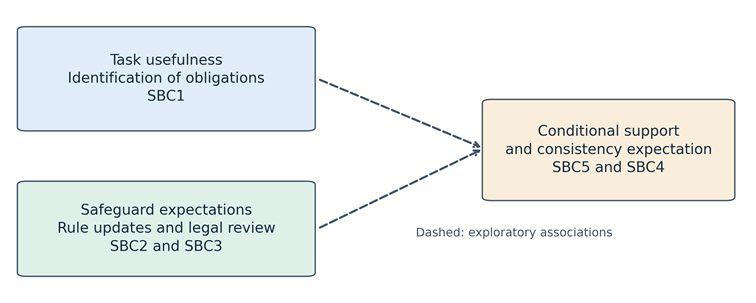
Figure 1. Analytical framework for usefulness safeguards and conditional compliance support
Task usefulness could track support if respondents who see a benefit in finding obligations are more willing to endorse deployment. It need not do so when support is contingent on governance and the perceived usefulness item describes only one function. Safeguard expectations could track conditional support because respondents who value review also value accountability, or show little relationship if the statements evoke different aspects of responsible use. Expected consistency may be more closely associated with rule currency and review because those practices can keep guidance aligned with relevant requirements. These expectations are interpretive; the already collected questionnaire does not permit a confirmatory test of institutional theory or a causal comparison of safeguards.
3. Methodology
The study uses a cross-sectional questionnaire and analyses the observed statements at their original level. We describe the sample, the coding of the focal variables and the uncertainty of the estimates separately. The reporting follows cross-sectional guidance on the source of observations, denominators and study limitations.[9]
3.1 Data source and sample
The Group 13 workbook includes a Data sheet, README and codebook for the shared Q13 questionnaire. The unit is an adult respondent. All 385 records contain affirmative consent, age eligibility and relevant AI awareness. All were retained. The status field records law students, graduates, advocates or legal professionals and other relevant respondents. It does not verify that a person is a business owner, compliance officer or regulator.
The supplied materials do not establish a probability sampling frame, invitation denominator, exact fieldwork dates, verified distribution mode or pilot results. No response rate or design weight is available. The number 385 is the achieved analytical sample, not proof of the precision of an estimate for Bangladesh’s business population. No assumption about the recruitment mode is carried over from another project.
3.2 Screening and provenance
We checked the uniqueness of the record sequence, screening responses, missingness in numerical and profile fields and permissible values. All 20 agreement items were within the 1-5 range. No duplicate response and profile patterns were found after excluding sequence and contextual text. The tool category “None” was retained as a valid response. No record was removed. The authors confirmed the numerical responses as empirical and identified the synthetic descriptions attached to the sequence and contextual fields as metadata labelling errors. The contextual field was not analysed or quoted.
3.3 Item definitions
Table 1 maps the observed variables to their analytical roles. SBC1 asks about identifying obligations. SBC2 and SBC3 address rule updates and human legal review; their equal-weight mean is the safeguard expectations summary used only in regression. SBC4 and SBC5 are distinct outcomes. All items retain their original 1-5 direction and the outcomes are excluded from the explanatory measures.
Table 1. Analytical roles of business compliance and adjustment items
| Role | Code | Interpretation |
| Task usefulness | SBC1 | AI can help businesses identify obligations |
| Safeguard expectations | SBC2 and SBC3 | Equal-weight mean of rule currency and human legal review |
| Consistency expectation | SBC4 | Responsible AI can support more consistent practices |
| Conditional support | SBC5 | Support where transparency and accountability are maintained |
| Adjustment | AIL1-3 and profile | General AI orientation; categorical status, location and training |
Outcomes do not enter either predictor. Safeguards are expectations, not observed controls.
The mean of AIL1-3 summarises general orientation towards AI inaccuracy, verification and bias. It is not a performance assessment. The remaining AIL items and the environmental monitoring and climate-risk blocks are not used in the focal models. Appendix A gives exact item wording. We report alpha and item rank correlations as descriptive diagnostics. Neither a low alpha nor an unweighted mean establishes dimensionality or validates a formative scale; the substantive differences among the items justify separate reporting.[10]
3.4 Endorsement and paired comparisons
We report each of the five rating categories and define endorsement as agree or strongly agree. Wilson intervals describe the uncertainty of the marginal proportions under an independent respondent working model. We cross-tabulate SBC1 and SBC5 and report percentages using all 385 records. Neutrality is part of non-endorsement and is not treated as opposition. We also report the count endorsing SBC2, SBC3 and SBC5 together and the count endorsing all five statements. These are descriptive combinations, not criteria for responsible use.[11]
Paired contrasts compare SBC2-5 with SBC1. The difference equals the number endorsing only the comparator minus the number endorsing only SBC1, divided by 385. Exact McNemar tests use discordant pairs. Pointwise intervals use 10,000 respondent-level percentile resamples with replacement and seed 20261103. This preserves within-person dependence. The four tests are Holm adjusted as a family. The intervals do not represent survey-design precision for a national population.[12]
3.5 Exploratory regression
Separate linear models use the original ratings for conditional support and expected consistency. Both include task usefulness, the safeguard expectations mean, general AI orientation and categorical indicators for status, location and formal AI training. We use HC3 standard errors and report unstandardised coefficients with pointwise intervals. Holm adjustment covers the four focal coefficients across the two main models. The adjusted associations describe patterns in the measured variables; the covariates are not a sufficient set for causal inference.[13]
Two sensitivity analyses focus on conditional support: a linear probability model of endorsement with HC3 intervals, and the original rating model restricted to law students. The binary model describes differences on the probability scale and does not require modelling the boundary between agreement and strong agreement. The student subset shares records with the main sample, and status contributes no contrast there. Each sensitivity model uses a separate two-coefficient Holm family. Neither analysis is an interaction test or an external validation.
3.6 Ethics and data protection
The analysis concerns a non-interventional adult questionnaire. All 385 records contain affirmative consent and adult eligibility responses. Contextual text was excluded and the article reports aggregate results.
4. Results
The results first describe the respondent profile and distribution of each rating. The joint and paired analyses then distinguish broad support from endorsement of particular tasks or safeguards. The adjusted models examine whether the focal ratings track each other after accounting for recorded background differences.
4.1 Respondent profile
Table 2 presents age, status, location and training. The largest age category was 21-23 (153 respondents, 39.7%). The status field recorded 118 law students, 64 law graduates and 49 advocates or legal professionals; 154 were classified as other relevant respondents. Dhaka accounted for 147 responses, district towns for 88 and upazila or rural areas for 73. No formal training was reported by 208 respondents, short orientation by 125, and course or certified training by 52.
Table 2. Sample profile
| Characteristic | Category | n (%) |
| Age | 21-23 | 153 (39.7%) |
| Age | 24-26 | 85 (22.1%) |
| Age | 18-20 | 61 (15.8%) |
| Age | 31+ | 47 (12.2%) |
| Age | 27-30 | 39 (10.1%) |
| Status | Other relevant respondent | 154 (40.0%) |
| Status | Law student | 118 (30.6%) |
| Status | Law graduate | 64 (16.6%) |
| Status | Advocate or legal professional | 49 (12.7%) |
| Location | Dhaka | 147 (38.2%) |
| Location | District town | 88 (22.9%) |
| Location | Upazila-rural area | 73 (19.0%) |
| Location | Other city corporation | 69 (17.9%) |
| Location | Other | 8 (2.1%) |
| AI training | No | 208 (54.0%) |
| AI training | Yes, short orientation | 125 (32.5%) |
| AI training | Yes, course or certified training | 52 (13.5%) |
Denominator = 385 for all percentages.
The sample contains a substantial legal-sector component: the three law-related categories together account for 60.0%. The other category does not identify respondents as business operators or employees responsible for compliance. Although 269 respondents (69.9%) reported weekly or daily or almost daily generative AI use, the item does not identify which tasks they performed. The sample is best understood as AI-aware adults with mixed recorded statuses.
4.2 Item distributions and measurement diagnostics
Table 3 shows all five response categories. Usefulness for identifying obligations was endorsed by 230 respondents (59.7%); rule updates by 236 (61.3%); and human legal review by 234 (60.8%). Between 126 and 136 respondents selected neutrality on these three statements. Disagreement was least frequent for updating tools (18 responses) and most frequent for human legal review (25).
Table 3. Distributions of environmental business compliance ratings
| Item | 1 | 2 | 3 | 4 | 5 | Agree n (%) | 95% CI (%) |
| SBC1 | 1 | 18 | 136 | 174 | 56 | 230 (59.7%) | 54.8 to 64.5 |
| SBC2 | 1 | 17 | 131 | 177 | 59 | 236 (61.3%) | 56.3 to 66.0 |
| SBC3 | 1 | 24 | 126 | 167 | 67 | 234 (60.8%) | 55.8 to 65.5 |
| SBC4 | 0 | 6 | 83 | 164 | 132 | 296 (76.9%) | 72.4 to 80.8 |
| SBC5 | 0 | 0 | 70 | 185 | 130 | 315 (81.8%) | 77.7 to 85.4 |
Agree combines 4 and 5. Intervals are Wilson intervals.
Expected consistency was endorsed by 296 respondents (76.9%), and conditional support by 315 (81.8%). No respondent chose either disagreement category for conditional support; the remaining 70 chose neutrality. The two statements with the highest endorsement also had the most responses at the highest rating: 132 for expected consistency and 130 for conditional support. The restricted lower tail matters for model interpretation because this outcome distinguishes mostly between neutral, agree and strongly agree.
Coefficient alpha across SBC1-5 was 0.157. Pairwise rank correlations ranged from −0.033 to 0.095. The largest was between expected consistency and conditional support; the rank correlation between task usefulness and conditional support was 0.010. These diagnostics do not establish the number of latent factors. They are consistent with the decision to report the original statements separately and to avoid a single reflective compliance scale.
4.3 Joint endorsement
Table 4 shows that 189 respondents endorsed both identification usefulness and conditional support (49.1%). Another 126 (32.7%) endorsed conditional support without endorsing identification usefulness; 41 (10.6%) showed the reverse pattern and 29 (7.5%) endorsed neither. Conditional support was endorsed by 82.2% of usefulness endorsers and 81.3% of other respondents. Thus the joint pattern reflects a broad support margin in both groups.
Table 4. Joint endorsement of obligation identification and conditional support
| Obligation identification | Support not endorsed | Support endorsed | Total |
| Not endorsed | 29 (7.5%) | 126 (32.7%) | 155 (40.3%) |
| Endorsed | 41 (10.6%) | 189 (49.1%) | 230 (59.7%) |
| Total | 70 (18.2%) | 315 (81.8%) | 385 (100.0%) |
Cell percentages use the full sample. Non-endorsement includes neutral responses.
Of the 315 conditional supporters, 116 (36.8%) also endorsed both specific safeguards, namely updating tools when rules change and retaining human legal review for complex decisions. That group accounts for 30.1% of the full sample. Sixty respondents (15.6%) endorsed all five statements. These counts describe combinations of answers. They do not classify the remaining respondents as opponents of safeguards or establish which practices they would require in a particular deployment.
4.4 Paired contrasts
Table 5 compares the four statements with usefulness for identifying obligations. Conditional support exceeded usefulness by 22.1 percentage points (95% CI 15.8 to 28.1), based on 126 versus 41 discordant responses. Expected consistency exceeded usefulness by 17.1 points (95% CI 10.9 to 23.4), based on 115 versus 49 discordant responses. Both adjusted p values were below 0.001.
Table 5. Paired contrasts with obligation identification
| Contrast | Other only | Utility only | Gap (pp) | 95% CI (pp) | Holm p |
| SBC2 − SBC1 | 92 | 86 | 1.6 | -5.2 to 8.3 | 1.000 |
| SBC3 − SBC1 | 98 | 94 | 1.0 | -6.0 to 8.1 | 1.000 |
| SBC4 − SBC1 | 115 | 49 | 17.1 | 10.9 to 23.4 | <0.001 |
| SBC5 − SBC1 | 126 | 41 | 22.1 | 15.8 to 28.1 | <0.001 |
Exact McNemar tests. Pointwise percentile intervals use 10,000 respondent resamples.
Rule currency and human review exceeded usefulness by 1.6 and 1.0 points, respectively. The corresponding intervals crossed zero and the adjusted p values were 1.000. This does not demonstrate equivalent endorsement. The differences for the two broad statements are clearer in this sample, but they compare the statements as worded rather than choices among alternative compliance tools.
4.5 Adjusted estimates
Table 6 shows the focal estimates. In the conditional-support model, a one-point increase in task usefulness corresponded to an estimated −0.005 points (95% CI −0.098 to 0.088) on the original 1-5 rating. The safeguard coefficient was −0.018 (95% CI −0.139 to 0.103). The corresponding coefficients for expected consistency were 0.056 (95% CI −0.046 to 0.158) and 0.137 (95% CI approximately 0.000 to 0.274). The latter’s unrounded lower limit was slightly above zero, but its Holm-adjusted p value was 0.200. None of the four focal terms met the adjusted threshold.
Table 6. Adjusted associations with conditional support and consistency expectation
| Model (n) | Term | Estimate | 95% CI | Holm p | R² |
| Conditional support (385) | Utility | -0.005 | -0.098 to 0.088 | 1.000 | 0.041 |
| Conditional support (385) | Safeguards | -0.018 | -0.139 to 0.103 | 1.000 | 0.041 |
| Consistency expectation (385) | Utility | 0.056 | -0.046 to 0.158 | 0.839 | 0.057 |
| Consistency expectation (385) | Safeguards | 0.137 | 0.000 to 0.274 | 0.200 | 0.057 |
| Support endorsement (385) | Utility | -0.006 | -0.056 to 0.044 | 0.882 | 0.041 |
| Support endorsement (385) | Safeguards | -0.027 | -0.095 to 0.041 | 0.882 | 0.041 |
| Law students support (118) | Utility | -0.104 | -0.277 to 0.068 | 0.472 | 0.039 |
| Law students support (118) | Safeguards | -0.096 | -0.315 to 0.122 | 0.472 | 0.039 |
All rows report unstandardised coefficients, HC3 intervals and ordinary R². Support endorsement is coded 0 or 1, so its coefficient is on the probability scale. Holm families: four main coefficients together, two coefficients separately for each sensitivity model.
The main models explained 4.1% and 5.7% of observed variance in conditional support and expected consistency, respectively. The binary sensitivity estimates were −0.006 for utility and −0.027 for safeguards on the probability scale, with both intervals spanning zero. In the 118 law students, the corresponding original-rating coefficients were −0.104 and −0.096, with intervals spanning zero. These analyses provide no clear evidence that the focal terms robustly distinguish conditional support. The results do not establish equivalence or imply that useful, well-governed tools would make no difference in practice.
5. Discussion
The strongest result is the difference between endorsement of governed AI use and endorsement of a specific compliance function. Most respondents supported AI-assisted compliance under transparency and accountability, but fewer agreed that AI can help identify business obligations. This divergence is visible within the same individuals. It motivates separating broad support from task evaluation in both surveys and deployment decisions.
5.1 Conditional support and specific usefulness
The paired difference is informative because it compares the answers of people who received both statements. The 126 who endorsed conditional support without endorsing usefulness demonstrate that approval under a broad condition need not imply confidence in a specific capability. The 41 with the opposite response show that a favourable view of the task does not invariably entail support for deployment. Neither group should be treated as internally uniform, because neutrality and disagreement both count as non-endorsement.
The difference also reflects what respondents were asked. The support item describes a favourable governance condition, whereas the usefulness item asks about a particular ability without naming a safeguard or provider. The survey did not vary the condition while keeping the task constant. It cannot identify whether the gap arises from transparency, accountability, general optimism, the specificity of the task or differences in wording. A more decisive comparison would present the same tool and task with randomly varied governance conditions and measure support using the same question.
From a technology acceptance perspective, a useful question is what performance a user expects the tool to improve. In a compliance setting, finding a document, interpreting an obligation and documenting fulfilment involve different skills and sources. An organisation might support a tool for the first task while requiring qualified review for the second and independent evidence for the third. The item-level results support this differentiated evaluation. They do not show that perceived usefulness is irrelevant to adoption in a setting where a user actually chooses between tools.[14]
5.2 The difference between a general assurance and specific controls
The joint safeguard pattern provides another reason to avoid a single acceptance score. Only 116 of 315 conditional supporters endorsed both specific safeguards as well. One interpretation is that respondents differ in what they consider accountability to require. Another is that they agree with the principle but are uncertain about the exact demands of rule updates or legal review. The data cannot decide between those explanations. They do show that endorsement of the broad statement is not a reliable substitute for asking about these practices separately.
Rule currency concerns whether the underlying authority is valid for the date and circumstances of the query. Legal review concerns what happens when an answer requires judgement or when a conflict cannot be resolved by retrieval. A deployment can do well on one and poorly on the other. A well-maintained source set does not eliminate difficult interpretation, and an expert reviewer cannot reliably correct an answer if the original sources and assumptions are unavailable. Good institutional design connects the two through a record that identifies the authority and the reason for escalation.[15]
5.3 Interpreting the exploratory associations
The adjusted coefficients for conditional support were close to zero. The consistency model yielded a modest positive safeguard estimate, but it did not retain support after adjusting across the four focal terms. Common wording about responsible use may contribute to this estimate. The observed mean also joins two practices that need not be valued equally. A future instrument should ask about each practice in a concrete scenario before treating their association with expected consistency as a mechanism.
The absence of clear adjusted associations is compatible with broad endorsement and limited variation. No respondent selected disagreement for conditional support, leaving relatively little information about what distinguishes opponents from supporters. The full model cannot recover that contrast from neutrality alone. The cross-sectional design further limits interpretation because background, experience and attitudes were recorded together. A well-designed service may change perceptions, and perceptions may change whether a person uses it. The survey does not resolve either direction.
5.4 Regulatory and business consequences
Bangladesh’s statutory framework provides the setting for distinguishing assistance from official determination. A tool may help a business identify where a clearance question arises, but it cannot establish which procedure applies without current sources and facts. An institution evaluating such a service can ask whether it correctly identifies those dependencies and whether a reviewer can reconstruct a recommendation. Those are practical questions that a survey item cannot answer.[16]
A compliance aid also differs from a regulatory monitoring tool. A regulator may use evidence to investigate a potential violation, while a business may seek information to prevent one. If the same system supports both purposes, the interface and documentation should make clear which function is being performed and who is responsible for the result. Information used to support an internal checklist should not silently become an official finding. These distinctions are consistent with the article’s broader point: the outcome and standard of evidence should follow the task.
6. Theoretical and Practical Implications
The findings favour evaluating task usefulness and governance conditions separately. For researchers this means defining the outcome before choosing a scale. For organisations it means specifying what a tool can do, what evidence it supplies and where responsibility for decisions remains.
6.1 Theoretical implications
A study of technology acceptance in compliance could distinguish expected performance in identifying obligations from willingness to use a tool for a consequential decision. A test of institutional legitimacy could vary review authority or access to correction while holding the tool’s function constant. A value-belief-norm analysis would need independent measures of environmental values, responsibility and personal norms. The present item comparisons show why these questions matter; the questionnaire does not test the complete theoretical models.[17]
6.2 Business and developer implications
A pilot could require each recommendation to identify its source, date and factual assumptions. A change in a source should trigger review of affected guidance and leave a record of what changed. Where the tool cannot identify the applicable authority, it can report uncertainty and refer the case for review. An evaluation can use examples in which the general rule is clear, in which an exception applies and in which a site-specific condition changes the answer. These examples test whether the system gives the user enough information to check its advice.[18]
The organisation can also define what a reviewer is expected to do. Reviewers need access to the supporting authorities and authority to correct or stop use of an output. If a problem is found, the organisation should know whether other cases received similar guidance. The process can be tested by introducing a documented rule change or a deliberately ambiguous case and tracking whether the tool and review team respond appropriately. These steps give transparency and accountability observable content.
A practical test can ask a reviewer to reconstruct the advice as it stood on the date it was given. The record would need to preserve the question, the version of the cited source and the facts entered by the user. If the system later changes, a corrected answer should not erase the record of the earlier recommendation. This matters when a firm discovers that it acted on guidance that no longer applies. An organisation can then determine which decisions need reconsideration and what information should be communicated to people who relied on the earlier answer. A usable correction process is a stronger demonstration of accountability than a general promise that a person remains responsible.[19]
6.3 Policy and evaluation
Public guidance could distinguish a tool that explains a requirement from an official determination of compliance. An evaluation should record how often the tool identifies the correct source, how often it misses a relevant requirement and how often reviewers detect and correct errors. Small businesses and people with limited access to legal support should be included in usability assessment rather than assumed to benefit from a generic interface. These recommendations follow from the need to test specific capabilities and safeguards; the survey does not quantify their costs or benefits.
An evaluation should also distinguish retrieval errors from review failures. If a system omits a relevant rule, the corrective action may involve improving the source collection or changing when the tool abstains. If the system flags uncertainty and staff disregard it, the problem lies in the workflow as well as the output. Recording both types of failure helps organisations decide where to intervene. Measures of staff time and turnaround can be useful alongside accuracy, but an improvement in speed should be interpreted in light of the consequences of errors that remain undetected.
The same distinction applies when reporting findings to a regulator or industry body. An organisation might provide aggregate results showing how often cited authorities were current and how frequently qualified reviewers reversed a recommendation. These metrics describe whether the proposed controls work in the tested setting. They do not establish that the service is suitable for all businesses or that use of the service fulfils a legal duty. A pilot should identify the types of cases, users and jurisdictions it covers so that readers can judge where its results might apply.
7. Conclusion Limitations and Future Research
Conditional support for AI-assisted environmental compliance was more common than endorsement of usefulness for identifying obligations in the 385-record sample. The difference was 22.1 percentage points, while about half endorsed both statements. Only 116 conditional supporters also endorsed both rule currency and human legal review. The exploratory regressions did not identify a focal coefficient that survived adjustment. The results support asking separately about business tasks, safeguard expectations and conditional support.
The sample was not a verified probability sample of firms or regulators, and exact recruitment details were not documented. The questionnaire does not verify use of a compliance tool, actual legal review or compliance outcomes. Each focal outcome is a single statement, and the absence of disagreement on conditional support limits differentiation at the low end. The association estimates are cross-sectional and subject to omitted factors and shared response format. The shared Group 13 records do not provide independent replication across its companion papers.
A follow-up could recruit business operators, compliance staff and legal reviewers separately, then ask them to use the same prototype on defined tasks. An experiment could vary source visibility, update information and the availability of review. It could assess whether participants locate the correct obligation, understand uncertainty and choose to use the tool for different decisions. A field study could track how tools respond to real rule changes and whether reviewers catch errors before action. These designs would connect the survey’s stated expectations to performance and organisational practice.
Declarations
Ethical approval and oversight
No study-specific formal ethics approval or exemption was documented in the available materials. Section 3.6 describes adult consent indicators, exclusion of contextual text and aggregate reporting.
Informed consent
All 385 analysed records contain affirmative consent and adult eligibility responses.
Data availability
Requests for de-identified numerical data and analysis specifications may be directed to the corresponding author, subject to participant confidentiality and applicable institutional requirements.
Funding and competing interests
No external funding or competing interest was disclosed in the available study materials.
Author contributions
Torikul Islam Tofi led the student research, developed the research question, organised the study materials and prepared the initial manuscript. Prof. Kazi Abdul Mannan supervised the research, provided conceptual and methodological guidance, contributed to interpretation and critically revised the manuscript. Kazi Abdul Mannan is the corresponding author.
Generative AI disclosure
Generative AI assisted literature retrieval, drafting, editing and preparation of analytical code. Numerical estimates were computed programmatically from the supplied workbook. The authors are responsible for verifying and approving the analysis, interpretation and reporting.
Bibliography
Bovens M, ‘Analysing and Assessing Accountability: A Conceptual Framework’ (2007) 13 European Law Journal 447
Davis FD, ‘Perceived Usefulness, Perceived Ease of Use, and User Acceptance of Information Technology’ (1989) 13 MIS Quarterly 319
Efron B and Tibshirani RJ, An Introduction to the Bootstrap (Chapman & Hall 1993)
Holm S, ‘A Simple Sequentially Rejective Multiple Test Procedure’ (1979) 6 Scandinavian Journal of Statistics 65
Lee JD and See KA, ‘Trust in Automation: Designing for Appropriate Reliance’ (2004) 46 Human Factors 50
McNemar Q, ‘Note on the Sampling Error of the Difference between Correlated Proportions or Percentages’ (1947) 12 Psychometrika 153
National Institute of Standards and Technology, Artificial Intelligence Risk Management Framework (AI RMF 1.0) (NIST AI 100-1, 2023) doi:10.6028/NIST.AI.100-1
Sijtsma K, ‘On the Use, the Misuse, and the Very Limited Usefulness of Cronbach’s Alpha’ (2009) 74 Psychometrika 107
Stern PC and others, ‘A Value-Belief-Norm Theory of Support for Social Movements: The Case of Environmentalism’ (1999) 6 Human Ecology Review 81
Suchman MC, ‘Managing Legitimacy: Strategic and Institutional Approaches’ (1995) 20 Academy of Management Review 571
von Elm E and others, ‘The Strengthening the Reporting of Observational Studies in Epidemiology (STROBE) Statement: Guidelines for Reporting Observational Studies’ (2007) 4 PLOS Medicine e296
White H, ‘A Heteroskedasticity-Consistent Covariance Matrix Estimator and a Direct Test for Heteroskedasticity’ (1980) 48 Econometrica 817
Wilson EB, ‘Probable Inference, the Law of Succession, and Statistical Inference’ (1927) 22 Journal of the American Statistical Association 209
Appendix A Questionnaire wording
Table A1 gives the five business compliance statements and three items used for the general AI orientation adjustment.
Table A1. Exact wording of the analysed questionnaire statements
| Code | Questionnaire statement |
| AIL1 | I understand that generative AI can produce plausible but inaccurate information. |
| AIL2 | I verify important AI-generated information before relying on it. |
| AIL3 | I understand that AI outputs may reflect bias or incomplete data. |
| SBC1 | AI can help businesses identify environmental compliance obligations. |
| SBC2 | AI-enabled compliance tools should be updated when relevant rules change. |
| SBC3 | Human legal review remains necessary for complex environmental compliance decisions. |
| SBC4 | Responsible AI use can support more consistent environmental compliance practices. |
| SBC5 | I would support AI-assisted compliance where transparency and accountability are maintained. |
Source: Group 13 Codebook. Response anchors run from 1 strongly disagree to 5 strongly agree.
SBC4 and SBC5 are separate outcomes. The safeguards mean contains SBC2 and SBC3 only.
Table of Legislation
Bangladesh Environment Conservation Act 1995, Act No 1 of 1995, ss 4, 10-12 and 14
[1] National Institute of Standards and Technology, Artificial Intelligence Risk Management Framework (AI RMF 1.0) (NIST AI 100-1, 2023) doi:10.6028/NIST.AI.100-1.
[2] Bangladesh Environment Conservation Act 1995, Act No 1 of 1995, ss 4, 10–12 and 14.
[3] Fred D Davis, ‘Perceived Usefulness, Perceived Ease of Use, and User Acceptance of Information Technology’ (1989) 13 MIS Quarterly 319.
[4] Paul C Stern and others, ‘A Value-Belief-Norm Theory of Support for Social Movements: The Case of Environmentalism’ (1999) 6 Human Ecology Review 81.
[5] Mark C Suchman, ‘Managing Legitimacy: Strategic and Institutional Approaches’ (1995) 20 Academy of Management Review 571.
[6] Mark Bovens, ‘Analysing and Assessing Accountability: A Conceptual Framework’ (2007) 13 European Law Journal 447.
[7] NIST, AI RMF (n 1); John D Lee and Katrina A See, ‘Trust in Automation: Designing for Appropriate Reliance’ (2004) 46 Human Factors 50.
[8] NIST, AI RMF (n 1); Bovens (n 6).
[9] Erik von Elm and others, ‘The Strengthening the Reporting of Observational Studies in Epidemiology (STROBE) Statement: Guidelines for Reporting Observational Studies’ (2007) 4 PLOS Medicine e296.
[10] Klaas Sijtsma, ‘On the Use, the Misuse, and the Very Limited Usefulness of Cronbach’s Alpha’ (2009) 74 Psychometrika 107.
[11] Edwin B Wilson, ‘Probable Inference, the Law of Succession, and Statistical Inference’ (1927) 22 Journal of the American Statistical Association 209.
[12] Quinn McNemar, ‘Note on the Sampling Error of the Difference between Correlated Proportions or Percentages’ (1947) 12 Psychometrika 153; Bradley Efron and Robert J Tibshirani, An Introduction to the Bootstrap (Chapman & Hall 1993); Sture Holm, ‘A Simple Sequentially Rejective Multiple Test Procedure’ (1979) 6 Scandinavian Journal of Statistics 65.
[13] Halbert White, ‘A Heteroskedasticity-Consistent Covariance Matrix Estimator and a Direct Test for Heteroskedasticity’ (1980) 48 Econometrica 817; Holm (n 12).
[14] Davis (n 3).
[15] Bovens (n 6); NIST, AI RMF (n 1).
[16] Bangladesh Environment Conservation Act 1995; NIST, AI RMF (n 1).
[17] Davis (n 3); Suchman (n 5); Stern and others (n 4).
[18] NIST, AI RMF (n 1).
[19] Bovens (n 6); NIST, AI RMF (n 1).