Journal Home
OPEN ACCESS
Support for AI Assisted Environmental Inspection and Alert Validation in Bangladesh
| Sorubi Akter ORCID: https://orcid.org/0009-0004-2697-3086 Md. Emon Mridha ORCID: https://orcid.org/0009-0000-1117-7838 Torikul Islam ORCID: https://orcid.org/0009-0003-2452-9929 Department of Law Shanto-Mariam University of Creative Technology Dhaka, Bangladesh |
| Prof. Dr Kazi Abdul Mannan Department of Business Administration Faculty of Business Shanto-Mariam University of Creative Technology Dhaka, Bangladesh Email: drkaziabdulmannan@gmail.com ORCID: https://orcid.org/0000-0002-7123-132X Corresponding author: Sorubi Akter: suruviakter37@gmail.com |
Sustain. env. bus. 2026. 6(4); https://doi.org/10.64907/xkmf.v6i4.seb.1
Submission received: 20 September 2026 / Revised: 25 October 2026 / Accepted: 28 October 2026 / Published: 30 October 2026
Download (PDF)
Abstract
Artificial intelligence (AI) can help environmental regulators identify cases that merit investigation, but support for using AI in inspection does not establish support for acting on its alerts without verification. This cross-sectional study separates support for AI as a complement to human inspection from endorsement of regulatory validation before serious enforcement action. It analyses 385 adult responses to a common questionnaire on AI, environment and climate justice in Bangladesh. We report full item distributions, joint endorsement and within-person comparisons, then examine whether perceived pattern utility and self-reported awareness of AI limitations are associated with the two focal ratings. Inspection support was endorsed by 301 respondents (78.2%) and alert validation by 237 (61.6%). Both were endorsed by 182 (47.3%). Support for complementary inspection exceeded endorsement of validation by 16.6 percentage points (paired 95% CI 9.9 to 23.1; Holm-adjusted p < 0.001). Expectations that transparent monitoring could improve confidence were also widely endorsed (304, 79.0%). None of the four focal adjusted regression coefficients met the multiplicity-adjusted threshold. The results distinguish support for investigative assistance from views about the procedure that should precede consequential action. They support assessing the two judgements separately in public engagement and evaluating alert validation as a distinct stage of deployment. The study measures stated judgements, not regulatory practice, system performance or the causal effects of awareness. Its mixed respondent sample does not support national prevalence estimates.
Keywords: environmental compliance; artificial intelligence; inspection; alert validation; procedural legitimacy; Bangladesh.
1. Introduction
Environmental regulators face a practical problem of attention. Potential harms may be dispersed across many sites, data arrive at different times, and inspections require people and resources. A tool that helps identify unusual patterns could direct attention towards a site that otherwise would receive little scrutiny. This potential is especially attractive when observations can be made remotely or when a repeated pattern is difficult to see from isolated reports. A monitoring output still needs interpretation: an alert may reflect an environmental event, a change in observation conditions or an error in how records were assembled. Acting on the output requires knowing what it can support and what additional evidence is needed.[1]
The important distinction is between flagging a case and determining what occurred. For instance, a model may associate an unusual signal with an industrial area. An inspector may then examine the time and location, identify possible sources, consult permits or other records and determine whether further observation is justified. Some of those steps can be supported by software, but they answer different questions. A signal about a location cannot by itself identify the responsible operator, establish the applicable standard or show that a statutory threshold was crossed. A monitoring system can be useful at the first stage without being sufficient at the last.
Support for AI in environmental regulation is often described as if it were a single preference. A person may instead support the use of software to complement human inspection while expecting different checks depending on what the regulator plans to do next. The verification needed to send an inspector to a site need not be the same as the verification needed to take a serious enforcement action. Public endorsement of a useful tool does not tell an institution where respondents would draw that boundary. A survey that distinguishes the stages can identify a more practical question: how often do respondents endorse both assistance and validation, and how common is endorsement of one without the other?
The question also bears on the interpretation of AI awareness. Recognising that a generative system can produce inaccurate or biased content may inform a person’s view of monitoring. It is not a direct measure of knowledge of remote sensing, environmental evidence or regulatory powers. Awareness could make a person more willing to support assistance with safeguards or more cautious about reliance. If awareness and support are measured with broad statements at the same time, their association cannot show that training caused either view. The purpose of this study is to establish what the questionnaire can show about these positions before proposing interventions.
The Bangladesh Environment Conservation Act 1995 provides a domestic frame for distinguishing environmental observation from official action. Its provisions address powers and functions of the Director General, entry and inspection, sampling, environmental clearance and appeal. These statutory functions concern particular actors and procedures. The article does not infer from the Act that every AI-generated alert is admissible evidence or that a particular algorithm can substitute for a prescribed process. Those questions depend on the action, applicable instruments and facts.[2]
The possibility of monitoring assistance is not unique to Bangladesh. UNEP’s Methane Alert and Response System uses satellite observations to identify major methane emissions and notify relevant actors. It illustrates the organisation of a detection and notification process. It is not evidence that the same approach is deployed in Bangladesh for the activities discussed here, or that a methane observation establishes a violation. The example is useful because it makes the handoff from detection to response visible. Local implementation would need its own validation and legal assessment.[3]
The study asks three questions. First, how frequently do respondents endorse pattern identification, reliable and verifiable data, alert validation, transparency and complementary human inspection? Second, how often do they endorse both complementary inspection and validation before serious action, and how do the item endorsements compare within respondents? Third, are recognition of general AI limitations and perceived usefulness for identifying patterns associated with the two focal ratings after adjustment for recorded respondent characteristics?
The analysis uses the 385 records in the Group 13 questionnaire. It concentrates on environmental compliance monitoring, while the shared instrument also supports separate inquiries about climate risk and sustainable business compliance. These inquiries have different outcomes but are not independent samples. The distinctive contribution of the present article is to compare adoption of an investigative aid with endorsement of a procedural checkpoint, and to report which positions coexist in the same respondents. This approach avoids treating the sum of differently worded statements as a general acceptance score.
The theoretical discussion situates environmental support, AI awareness and institutional legitimacy in relation to the stages of a regulatory process. The methods then explain the limits of the observed items and the choice to analyse them separately. The results move from distributions to paired patterns and exploratory regression. The final sections discuss what the patterns imply for evaluating a monitoring workflow and what would require direct evidence of the technology, enforcement process or affected communities.
2. Literature Review and Theoretical Foundation
The literature is organised around a practical distinction: a monitoring tool can help an institution decide where to look, whereas an enforcement decision requires the institution to justify what it does. Environmental support explains why a person may value better monitoring. Awareness of AI limitations helps explain why the same person might seek verification. Institutional legitimacy brings the procedure for acting on an alert into focus. The questionnaire measures judgements related to these ideas without operationalising every component of their theories.
2.1 Environmental monitoring and the significance of an alert
Environmental observations can arise from direct inspections, monitoring stations, reports, remote sensing or records supplied by regulated organisations. AI can assist by classifying an observation or highlighting differences from an expected pattern. The output is necessarily tied to the observations used to produce it. Coverage, measurement quality and changes in the population of observed sites can affect how often the tool flags a case. A tool built for one pollutant or type of site may not generalise to another. Consequently, the claim that AI can identify relevant patterns is narrower than the claim that any specific system will perform adequately.[4]
An alert can be useful even when some alerts are false positives, provided that its use and consequences match the evidence. If the alert only determines which records to review, the immediate cost of an error may be limited to staff time or attention diverted from another case. If the alert is treated as a determination of non-compliance, the consequences can be much greater. False negatives also matter because a tool can redirect attention away from a site where harm is occurring. An evaluation should therefore consider how alert thresholds affect investigation and which cases are missed, as well as whether the model classifies observations accurately in a test set.
2.2 Environmental support and the limits of the value belief norm framework
Value-belief-norm theory links environmental values, beliefs about consequences and responsibility, personal norms and forms of support for environmental action. It offers a reason why people may support institutional monitoring even when they do not personally operate the technology. Monitoring can be understood as an instrument for an environmental objective, and the objective can give meaning to support beyond interest in the technology. But the questionnaire does not ask respondents about values, perceived environmental consequences, ascription of responsibility or personal obligations in a way that tests the sequence. The theory guides interpretation without supplying a causal model for the observed items.[5]
The distinction is important because support for an environmental end does not entail approval of every means. A respondent may welcome better detection while questioning whether a deployment will overlook poorly monitored communities or impose unjustified costs on particular operators. Conversely, a person may accept strong oversight while being uncertain about the benefit of AI for detecting environmental patterns. Different positions can therefore be consistent with concern for environmental protection. The analysis reports support for specific propositions, rather than classifying respondents as more or less environmentally responsible.
2.3 AI literacy and risk appraisal
AI literacy research distinguishes competencies for recognising, evaluating and using AI from simple familiarity with the term. In a regulatory setting, evaluation would include identifying what a model has been asked to detect, when its information may be incomplete and what independent evidence can resolve a question. Self-reported recognition of inaccuracy and bias may be relevant to these competencies but does not show that a respondent can apply them. The two awareness items also refer to general AI or generative AI, whereas an environmental monitoring tool could use remote-sensing classification, anomaly detection or another technique. Domain transfer should therefore be tested rather than assumed.[6]
Risk appraisal also depends on the intended action. A person may tolerate uncertainty when AI directs an investigator to a promising lead but demand a stronger basis when a decision could affect legal interests or livelihoods. The questionnaire’s validation item specifically refers to serious enforcement action, and its inspection item expressly retains human inspection. These qualifications matter: neither item asks about unconstrained automation. Recognising both as qualified propositions avoids a misleading interpretation in which one group favours human involvement and another group favours machines.
2.4 Institutional legitimacy and accountable decisions
Institutional legitimacy concerns the perceived appropriateness of an organisation and its practices within a wider set of expectations. A tool can be seen as useful yet poorly governed, or as carefully governed yet unhelpful in a particular setting. For an environmental authority, legitimacy may depend on how it explains the role of a model, handles contradictory evidence and gives reasons for taking action. Accountability adds the question of who must provide an explanation to whom, and what a reviewing forum can do with that explanation.[7]
A reviewer cannot assess a decision if the record preserves only the label “AI alert.” The relevant record may include the original observation, its time and location, the model version and relevant limitations, any changes made by an analyst, the independent checks undertaken and the decision maker’s reasons. The value of transparency thus depends on the person who needs information and the action they want to understand. Technical documentation can help an analyst reproduce a signal; an explanation directed to an affected person may instead need to identify the observation and legal basis for a particular decision. Both functions can matter without being interchangeable.
The survey’s transparency item asks whether transparent AI monitoring can improve confidence. It records agreement with a proposition about confidence, not current confidence in a named authority. The study reports it as a distinct judgement. A high endorsement rate would show that many respondents accept the proposition as worded, but not that disclosure has been effective, that a particular review mechanism is available or that an institution is trusted. This distinction also informs the policy implications: transparency should be evaluated through specific practices rather than treated as a general reputational benefit.
2.5 Construct boundaries and exploratory expectations
The questionnaire separates five substantive statements. Pattern utility concerns whether AI can identify relevant patterns. Data quality concerns reliable and verifiable inputs. Alert validation concerns a check before serious action. Transparency concerns anticipated confidence. Complementary inspection concerns support for responsible use alongside human inspection. The statements span technology capability, procedural requirements and conditional support. Combining them would conceal whether the same respondent endorses assistance but remains neutral about a particular procedure.
Figure 1 shows the two exploratory outcomes and the explanatory variables. Perceived pattern utility may track support for an investigative aid because respondents who see a practical purpose may be more willing to support deployment. It need not track endorsement of validation, which could be motivated by concerns about consequences independently of perceived benefits. Awareness of AI limitations could be associated with greater demand for validation or with support for a limited role for AI. Competing interpretations are plausible, particularly because the awareness items do not refer to a concrete inspection scenario. The arrows describe statistical associations rather than time order or causal paths.
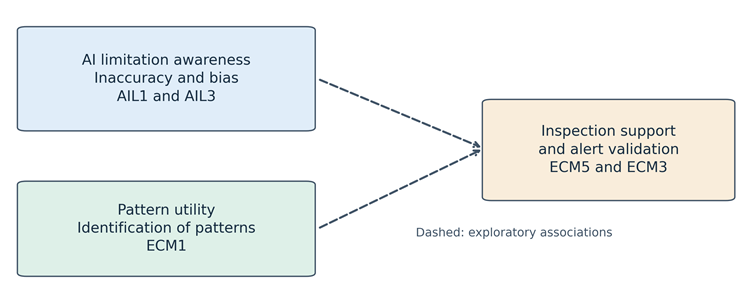
Figure 1. Analytical framework for AI awareness and environmental monitoring judgements
The study does not use the general human-oversight statement, AIL5, in the predictor. Its wording overlaps with validation and complementary inspection and could make an apparent relationship partly a product of asking similar questions. The focal awareness summary instead combines inaccuracy and bias recognition, while verification and sensitive-data precautions are used as a separate adjustment summary. The main empirical question remains the joint endorsement of inspection and validation; the regressions are secondary.
3. Methodology
The study uses item-level analysis of a cross-sectional questionnaire. We first checked which questions the available data could answer, then chose comparisons that preserve the relation between responses from the same person. The reporting states the observed sample, the analytical coding and the limits of inference rather than treating the data as a probability survey.[8]
3.1 Design and sample
The Group 13 workbook contains the Data sheet, the README identifying the shared Q13 instrument and a codebook of response options. The unit of analysis is a respondent. All 385 records carry affirmative participation consent, adult eligibility and general AI awareness. All were retained. The instrument records legal-sector and other respondents, rather than a list of licensed environmental inspectors, firms or residents of affected sites. The general AI eligibility criterion means this survey cannot compare adults who are aware of AI with adults who are unaware of it. Variation in the awareness ratings is variation within the eligible sample.
The materials do not provide a verified sampling frame, invitation denominator, exact collection dates, distribution mode or pilot records. The achieved number is therefore reported as an analytical count, not as confirmation of random selection or a specified sampling precision. No response rate or population weight is calculated. The study does not assume that a general sample-size formula identifies a representative sample.
3.2 Screening and data boundaries
We checked record sequence uniqueness, consent and eligibility fields, blanks and permissible values. All 20 agreement fields were within the 1-5 range. There were no duplicate response and profile patterns after removing the sequence and contextual-text fields. “None” is a valid tool category rather than a missing value. No case was deleted based on the observed pattern of agreement. The study team confirmed the numerical responses as empirical and identified the synthetic descriptors on the sequence and contextual fields as labelling errors. Contextual text was excluded and does not contribute to the results.
3.3 Measurement and analytical coding
Table 1 maps item content to its role in the analysis. ECM3 and ECM5 are the focal outcomes. ECM1 is a separate explanatory item. The limitation-awareness summary is the unweighted mean of AIL1 and AIL3, which refer to plausible inaccuracy and bias or incomplete data. The precaution summary is the mean of AIL2 and AIL4, which refer to verification and sensitive-data handling. Both are observed summaries of self-report. They are not psychometric measures of demonstrated skill. AIL5 is not used, and the climate justice and business compliance items are outside the focal analysis.
Table 1. Analytical roles of environmental monitoring and adjustment items
| Role | Code | Interpretation |
| AI limitation awareness | AIL1 and AIL3 | Mean of self-reported recognition of inaccuracy and bias |
| Precaution orientation | AIL2 and AIL4 | Mean of self-reported verification and sensitive-data precautions |
| Pattern utility | ECM1 | Perceived potential to identify relevant patterns |
| Data and transparency | ECM2 and ECM4 | Separate descriptive items; not entered in regressions |
| Validation | ECM3 | Endorsement of validation before serious action |
| Inspection support | ECM5 | Support for AI as a complement to human inspection |
Ratings retain their original direction. Status, location and training are categorical adjustment variables.
The exact wording is reproduced in Appendix A. The ECM items are not averaged into an outcome. We report the five-item alpha and pairwise rank correlations as descriptive diagnostics, alongside the substantive distinction among items. Alpha is not evidence of a single factor or of a valid formative model. The analysis does not estimate structural paths, mediation or latent scale reliability for statements that ask about different policy judgements.[9]
3.4 Paired analysis
For each ECM item, the analysis reports counts for all five response categories and defines endorsement as agreement or strong agreement. The descriptive intervals for the marginal proportions use Wilson’s method. We cross-tabulate ECM3 and ECM5 to identify joint endorsement. Neutrality remains in the non-endorsed category, alongside disagreement, and is not interpreted as opposition. All reported cell percentages use the full sample.[10]
Each of ECM1, ECM2, ECM4 and ECM5 is compared with ECM3, chosen as the procedural benchmark. The paired percentage-point difference is the net discordance divided by 385. Exact McNemar tests condition on the number of discordant pairs. Pointwise percentile intervals use 10,000 resamples of respondents with replacement (seed 20261103). Resampling whole records preserves the dependence between item responses. Holm adjustment covers the four paired comparisons. The intervals reflect uncertainty under a respondent-level working model and are not national margins of error.[11]
3.5 Exploratory regression and sensitivity
Separate linear regressions model the original inspection support and alert validation ratings. Each includes the pattern-utility rating, limitation-awareness and precaution means, and categorical indicators for current status, location and formal AI training. The two focal terms are pattern utility and limitation awareness. Coefficients report fitted average differences in the 1-5 rating per unit of the predictor. HC3 standard errors address heteroskedasticity; intervals are pointwise. Holm adjustment applies across the four focal coefficients from the two primary regressions. No causal effect is inferred from adjustment.[12]
Sensitivity analyses focus on inspection support. The first fits a logistic regression for endorsement, with sandwich intervals, using the same predictor specification. The second repeats the linear model among law students, for whom status is constant. The two focal probabilities are Holm adjusted separately within each sensitivity model. These analyses ask whether the result depends on retaining all five response levels or on including all recorded status groups. They do not test an interaction or provide an independent validation sample.[13]
3.6 Ethics and data protection
Ethical approval for this study was obtained from the Center for Academic & Professional Career Development and Research (CAPCDR), an external institutional body, under approval reference CAPCDR: SMUCT/LLB/SS-0020260912-08. External ethical review was sought because Shanto-Mariam University of Creative Technology does not have an institutional ethics committee responsible for reviewing this type of research.
4. Results
The results distinguish the frequency of endorsement from the overlap between judgements. Item distributions are followed by the joint inspection and validation results, paired comparisons and adjusted estimates. Each main analysis uses all 385 records.
4.1 Respondent profile
Table 2 shows the recorded age, current status, location and training categories. The largest age group was 21-23 (153 respondents, 39.7%), and 238 (61.8%) were aged 21-26. Of the 385 respondents, 118 were law students, 64 law graduates and 49 advocates or legal professionals. The remaining 154 were classified as other relevant respondents. Dhaka accounted for 147 records, district towns for 88 and upazila or rural areas for 73. The workbook recorded no formal AI training for 208 respondents; 125 reported a short orientation and 52 reported course or certified training.
Table 2. Sample profile
| Characteristic | Category | n (%) |
| Age | 21-23 | 153 (39.7%) |
| Age | 24-26 | 85 (22.1%) |
| Age | 18-20 | 61 (15.8%) |
| Age | 31+ | 47 (12.2%) |
| Age | 27-30 | 39 (10.1%) |
| Status | Other relevant respondent | 154 (40.0%) |
| Status | Law student | 118 (30.6%) |
| Status | Law graduate | 64 (16.6%) |
| Status | Advocate or legal professional | 49 (12.7%) |
| Location | Dhaka | 147 (38.2%) |
| Location | District town | 88 (22.9%) |
| Location | Upazila-rural area | 73 (19.0%) |
| Location | Other city corporation | 69 (17.9%) |
| Location | Other | 8 (2.1%) |
| AI training | No | 208 (54.0%) |
| AI training | Yes, short orientation | 125 (32.5%) |
| AI training | Yes, course or certified training | 52 (13.5%) |
Denominator = 385 for all percentages.
The three law-related categories account for 60.0% of the sample. Neither the status field nor the location field identifies a person as a regulator, employee of a regulated firm or member of a community affected by a particular environmental issue. Weekly or daily or almost daily generative AI use was reported by 269 respondents (69.9%). This indicates frequency of general tool use, rather than experience with environmental monitoring. The data therefore describe opinions in a mixed, AI-aware adult sample.
4.2 Distributions of environmental monitoring judgements
Table 3 reports all response categories. Pattern identification was endorsed by 220 respondents (57.1%), and reliable and verifiable data by 231 (60.0%). Validation before serious enforcement action was endorsed by 237 (61.6%). For the three statements, 135 to 137 respondents chose the midpoint. The number disagreeing or strongly disagreeing ranged from 13 for validation to 28 for pattern utility. Neutrality therefore accounts for more of the non-endorsing group than explicit disagreement.
Table 3. Distributions of environmental monitoring ratings
| Item | 1 | 2 | 3 | 4 | 5 | Agree n (%) | 95% CI (%) |
| ECM1 | 1 | 27 | 137 | 171 | 49 | 220 (57.1%) | 52.2 to 62.0 |
| ECM2 | 0 | 19 | 135 | 171 | 60 | 231 (60.0%) | 55.0 to 64.8 |
| ECM3 | 0 | 13 | 135 | 173 | 64 | 237 (61.6%) | 56.6 to 66.3 |
| ECM4 | 0 | 4 | 77 | 181 | 123 | 304 (79.0%) | 74.6 to 82.7 |
| ECM5 | 0 | 9 | 75 | 182 | 119 | 301 (78.2%) | 73.8 to 82.0 |
Agree combines 4 and 5. Intervals are Wilson intervals.
The proposition that transparent AI monitoring could improve confidence was endorsed by 304 respondents (79.0%), including 123 who strongly agreed. Responsible complementary inspection was endorsed by 301 (78.2%), including 119 who strongly agreed. The gap between the marginal endorsement of these two statements is small, but their content differs. One concerns an anticipated effect on confidence; the other states support for a defined role for AI. Neither measures actual trust in an agency or actual deployment decisions.
Coefficient alpha for ECM1-5 was 0.181. The largest absolute pairwise Spearman correlation was 0.103, between pattern utility and complementary inspection. The rank correlation between validation and complementary inspection was −0.045. The diagnostic results do not identify a common scale, and the content of the items independently supports treating them as distinct judgements. The full distributions and joint counts remain the basis for interpretation.
4.3 Joint endorsement of inspection and validation
Table 4 shows the overlap between ECM5 and ECM3. The 182 respondents endorsing both constituted 47.3% of all respondents and 60.5% of the 301 who endorsed complementary inspection. Another 119 supported complementary inspection without endorsing validation (30.9% of all respondents). Conversely, 55 endorsed validation without endorsing complementary inspection (14.3%). Twenty-nine endorsed neither.
Table 4. Joint endorsement of alert validation and inspection support
| Alert validation | Inspection support not endorsed | Inspection support endorsed | Total |
| Not endorsed | 29 (7.5%) | 119 (30.9%) | 148 (38.4%) |
| Endorsed | 55 (14.3%) | 182 (47.3%) | 237 (61.6%) |
| Total | 84 (21.8%) | 301 (78.2%) | 385 (100.0%) |
Cell percentages use the full sample. Non-endorsement includes neutral responses.
The joint distribution shows that the two positions can coexist and that neither is a reliable substitute for the other. Of the 237 who endorsed validation, 182 also endorsed complementary inspection (76.8%). Among the 148 who did not endorse validation, 119 endorsed complementary inspection (80.4%). The relatively similar percentages illustrate why frequent joint endorsement need not imply a positive association. The results also distinguish the 119 inspection-only respondents from people who explicitly rejected validation. Non-endorsement includes neutral responses; the survey does not establish that this group supports unverified enforcement.
4.4 Paired contrasts with validation
Table 5 uses validation as the common comparison. The net difference for complementary inspection was 64 respondents: 119 endorsed inspection support without endorsing validation and 55 did the reverse. This corresponds to 16.6 percentage points (pointwise 95% CI 9.9 to 23.1). The transparency proposition exceeded validation by 17.4 points (95% CI 10.9 to 23.6), based on 117 versus 50 discordant pairs. Both comparisons retained Holm-adjusted p values below 0.001.
Table 5. Paired contrasts with alert validation
| Contrast | Other only | Validation only | Gap (pp) | 95% CI (pp) | Holm p |
| ECM1 − ECM3 | 83 | 100 | -4.4 | -11.2 to 2.3 | 0.474 |
| ECM2 − ECM3 | 82 | 88 | -1.6 | -8.1 to 5.2 | 0.701 |
| ECM4 − ECM3 | 117 | 50 | 17.4 | 10.9 to 23.6 | <0.001 |
| ECM5 − ECM3 | 119 | 55 | 16.6 | 9.9 to 23.1 | <0.001 |
Exact McNemar tests. Pointwise percentile intervals use 10,000 respondent resamples.
Pattern utility was 4.4 percentage points below validation, and reliable data was 1.6 points below. Both intervals spanned zero and neither comparison met the adjusted threshold. The magnitudes are therefore better characterised as observed estimates with uncertainty than as evidence that the three positions have the same endorsement rate. The comparisons address how often the statements as written received a rating of 4 or 5. They do not estimate relative preferences among identical scenarios with one feature varied.
4.5 Adjusted associations and sensitivity
Table 6 reports the two focal coefficients in each model. The adjusted coefficient for pattern utility in the complementary inspection model was 0.083 (95% CI −0.016 to 0.182; adjusted p = 0.406). The corresponding coefficient for limitation awareness was 0.035 (95% CI −0.094 to 0.164; adjusted p = 0.990). For the validation outcome the pattern-utility coefficient was −0.034 (95% CI −0.133 to 0.064) and the awareness coefficient was 0.071 (95% CI −0.058 to 0.200). Neither met the adjusted threshold. The main specifications explained 8.1% and 3.1% of observed variance in the inspection and validation ratings, respectively.
Table 6. Adjusted associations with inspection support and alert validation
| Model (n) | Term | Estimate | 95% CI | Holm p | R² |
| Inspection support (385) | Pattern utility | 0.083 | -0.016 to 0.182 | 0.406 | 0.081 |
| Inspection support (385) | AI limits | 0.035 | -0.094 to 0.164 | 0.990 | 0.081 |
| Validation support (385) | Pattern utility | -0.034 | -0.133 to 0.064 | 0.990 | 0.031 |
| Validation support (385) | AI limits | 0.071 | -0.058 to 0.200 | 0.848 | 0.031 |
| Support endorsement (385) | Pattern utility | 1.369 | 0.983 to 1.907 | 0.126 | 0.087 |
| Support endorsement (385) | AI limits | 0.968 | 0.628 to 1.493 | 0.884 | 0.087 |
| Law students (118) | Pattern utility | 0.075 | -0.114 to 0.264 | 0.872 | 0.080 |
| Law students (118) | AI limits | 0.035 | -0.226 to 0.295 | 0.872 | 0.080 |
Linear rows report unstandardised coefficients, HC3 intervals and ordinary R². Binary support rows report odds ratios, sandwich intervals and McFadden pseudo-R². Holm families: four main coefficients together, two coefficients separately for each sensitivity model.
For binary endorsement of complementary inspection the adjusted odds ratio was 1.369 for pattern utility (95% CI 0.983 to 1.907) and 0.968 for awareness (95% CI 0.628 to 1.493). The intervals include one. In the 118 law students, the corresponding linear estimates were 0.075 and 0.035, with intervals spanning zero. The results provide little evidence of robust focal associations across these specifications. They do not establish equivalence or show that knowledge and perceptions of utility are unimportant. In particular, the reported awareness summary does not assess whether a respondent can interpret an environmental alert.
5. Discussion
Complementary inspection was widely endorsed, but endorsement of alert validation was less frequent. The paired data show that a substantial group endorsed both and that many others endorsed only one of the statements. This finding matters because a consultation that asks only whether people support AI in inspection leaves the validation question unresolved. The regression results add a qualification: the measured general awareness and pattern-utility ratings did not reliably distinguish the focal judgements after adjustment.
5.1 Assistance and consequential action
The finding of a 16.6-point gap should be interpreted in light of what each question asks. Complementary inspection is described as responsible and supportive of an existing human function. Validation refers to a regulator’s conduct before a serious action. A person could respond favourably to the first without having a definite opinion about the second, especially if “validation” does not specify a method or responsible official. This wording difference offers an alternative explanation for the gap. The results therefore support asking separately about the stages of the process, not concluding that respondents have knowingly rejected a safeguard.
The presence of 182 joint endorsements is consistent with a view in which AI can improve attention to environmental signals while officials retain responsibility for checking them. The 55 validation-only responses also matter: a respondent need not favour a tool’s deployment to believe that any alert used in serious action should be checked. A procurement or consultation exercise could capture these views by presenting a concrete tool and asking separately about its use for triage, its use as supporting evidence and its use in decisions with legal consequences. This would make the implied stage of reliance explicit.
There are also differences between validation of a tool and validation of a particular alert. Tool validation examines performance under specified conditions, including whether the tool transfers to new locations. Alert validation concerns whether an observation supports the inference made in one case. A system may perform adequately on average while producing a misleading output in a particular case. A case reviewer needs access to the underlying observations and an account of the limits of the method. Neither the survey item nor a general declaration that a system is trustworthy can establish that these processes are in place.[14]
5.2 What awareness does and does not explain
Neither the awareness summary nor pattern utility had a robust adjusted association with the two focal ratings. The finding narrows what can be said about the original question. It does not imply that AI education has no value or that the environmental usefulness of a system is irrelevant. Respondents report recognition of inaccuracy and bias in general AI, while the policy decisions concern environmental monitoring. A person may recognise that a chatbot can fabricate information and still have little basis for evaluating the reliability of satellite data or a site-specific classification. A domain-specific performance task would be needed to test this transfer.[15]
The relation between awareness and support may also depend on details the instrument omits. Knowledge of a model’s limitations can increase support if a workflow uses the model only where it is useful and preserves independent checks. The same knowledge can reduce support if a model is used for decisions it cannot justify. Since all respondents received the same brief statements, the study cannot distinguish these processes. This is one reason to avoid interpreting a near-zero coefficient as a verdict on the role of literacy.
The environmental support lens makes a related point. The perceived legitimacy of AI can depend on whether a proposed monitoring practice serves an environmental objective and whether the means are acceptable. General agreement with environmental protection may lead to different choices when site access, uncertainty or unequal coverage is specified. The present questionnaire cannot test a value-belief-norm chain, and the estimated coefficients should not be used to confirm or reject it. The theory instead guides future measurement of the reasons people support monitoring.[16]
5.3 Transparency and the local legal setting
The high endorsement of the transparency proposition is a reason to test what transparent monitoring means in practice. An analyst may need information about model inputs and thresholds. A regulated operator may need to understand the observation and the rule applied to it. An affected resident may want to know whether a report was investigated. Disclosing one type of information does not necessarily satisfy these other needs. An accountable institution can identify who is responsible for answering each question and how an incomplete explanation can be reviewed.[17]
The Bangladesh Environment Conservation Act provides a context for these institutional questions through provisions on powers, inspection, sampling, clearance and appeals. The applicable process cannot be determined by the survey or by a general preference for validation. A legal assessment would need to identify the particular action, check the relevant legislation and rules, and establish what evidence and procedures are required. The distinction is consequential for design: an alert can help organise an investigation without changing the standard or authority for an official decision.[18]
Likewise, the UNEP example of methane detection and notification illustrates a workflow, rather than a legal precedent for Bangladesh. A regulator considering a similar stage of alerting would need to determine local performance, potential sources of systematic error and who can obtain confirming information. An evaluation could compare cases flagged by the system with cases identified through other channels, including places with limited data coverage. The question is whether the tool improves investigation without making the absence of an alert a reason to disregard credible reports.[19]
5.4 Integrated interpretation
The clearest evidence is about how respondents answer distinct questions. Inspection support and validation coexist in many records, yet their margins differ and neither predicts the other strongly at the item level. The regression results do not justify treating self-reported awareness as a mechanism that generates support. Together, these findings favour designing consultation around concrete stages rather than compressing varied judgements into a general endorsement score. They also favour evaluating what a tool does in the field, what an official can verify and how a decision can be explained as distinct tasks.
6. Theoretical and Practical Implications
The distinction between investigative assistance and validation gives researchers and institutions different outcomes to measure. One is whether a proposed tool is acceptable for directing attention. The other is whether the process for checking and acting on a signal is acceptable and effective. A single measure of AI acceptance cannot answer both.
6.1 Implications for theory and measurement
A stronger design would distinguish familiarity with general AI, ability to interpret evidence, and confidence in the authority responsible for review. An item about model limitations could be accompanied by a task in which respondents explain what additional information they would need after seeing an alert. Environmental support could be assessed independently of approval of the tool, using measures appropriate to the value-belief-norm framework. Procedural legitimacy could be assessed by varying the nature of the review and asking whether people consider the procedure fair even when they disagree with the outcome. These steps would let a study compare explanations that are compatible with the present data but not separately identified.[20]
6.2 Implications for regulators and developers
A pilot workflow could begin by defining the permitted role of an alert. For investigative triage, the system could flag a site for review while the investigator records why additional action is warranted. For more consequential use, the organisation could specify what independent observations or records a decision maker needs and who is authorised to make the decision. Developers could provide documentation of coverage, known failure modes and version changes. The evidence record could include the source, timestamp, location, model version and reasons for escalating or closing a case. These are operational proposals, not determinations of legal admissibility.[21]
An evaluation should include missed events, not just the proportion of alerts found to be valid. Reviewing only flagged sites makes it difficult to identify harms the tool does not detect. Comparison with independent monitoring, inspections or credible reports can help identify such failures. Evaluators could also test whether access to data or the ability to investigate is uneven across locations. If poor coverage is systematically associated with fewer alerts, an organisation may need additional reporting or inspection channels. The model should not become the only route by which a concern receives attention.
6.3 Implications for public engagement
A consultation can present the same scenario with different levels of reliance: alert for review, corroborated evidence, and a proposed serious action supported by documented checks. Respondents can then comment on each stage and on the information they would need to question a decision. The language should explain what an alert represents and who can investigate it. Testing comprehension can show whether a person can identify the distinction between a provisional signal and a regulatory finding. This is a more concrete measure of transparency than agreement that transparency is desirable.[22]
7. Conclusion Limitations and Future Research
Among 385 adult respondents to the Group 13 questionnaire, support for AI as a complement to human environmental inspection was more common than endorsement of regulatory validation before serious action. Almost half endorsed both. Neither self-reported awareness of general AI limitations nor perceived utility for pattern identification was a robust adjusted correlate of the two focal ratings. The most defensible implication is that consultation and evaluation should separate interest in investigative assistance from the acceptability and operation of the checks that precede consequential action.
The sample is not a verified probability sample, and it includes substantial representation from legal study and practice. Recruitment dates, mode and the invitation denominator were unavailable. The questionnaire does not verify experience with monitoring systems, enforcement decisions or environmental harms. Its items differ in abstraction and conditional wording, and each focal outcome is measured with one statement. The regression adjusts for recorded differences but cannot establish temporal order or control all sources of confounding. The shared Group 13 questionnaire means companion studies use the same observations and do not constitute independent replications.
A follow-up could recruit regulators, regulated organisations and residents of affected areas through documented sampling routes. A vignette experiment could hold the environmental issue constant and vary the degree of reliance on an alert, the quality of independent evidence and the availability of review. It could measure support, perceived fairness and ability to interpret the evidence separately. A field evaluation could then compare alerts with independent observations, document changes in inspection decisions and examine who can challenge the resulting action. Combining those designs would connect the opinions recorded here to both system performance and the operation of environmental procedures.
Declarations
Ethical approval and oversight
Ethical approval for this study was obtained from the Center for Academic & Professional Career Development and Research (CAPCDR), an external institutional body, under approval reference CAPCDR: SMUCT/LLB/SS-0020260912-08. External ethical review was sought because Shanto-Mariam University of Creative Technology does not have an institutional ethics committee responsible for reviewing this type of research.
Informed consent
All 385 analysed records contain affirmative consent and adult eligibility responses. The questionnaire described voluntary participation and the option to discontinue.
Data availability
Requests for de-identified numerical data and analysis specifications may be directed to the corresponding author, subject to participant confidentiality and applicable institutional requirements.
Funding and competing interests
No external funding or competing interest was disclosed in the available study materials.
Author contributions
Sorubi Akter led the student research, developed the research question, organised the study materials and prepared the initial manuscript. Prof. Dr Kazi Abdul Mannan supervised the research, provided conceptual and methodological guidance, contributed to interpretation and critically revised the manuscript. Kazi Abdul Mannan is the corresponding author.
Generative AI disclosure
Generative AI assisted literature retrieval, drafting, language editing and preparation of analytical code. Numerical results were computed programmatically from the supplied workbook. The authors are responsible for verifying and approving the analysis, interpretation and reporting.
Bibliography
Bovens M, ‘Analysing and Assessing Accountability: A Conceptual Framework’ (2007) 13 European Law Journal 447
Efron B and Tibshirani RJ, An Introduction to the Bootstrap (Chapman & Hall 1993)
Holm S, ‘A Simple Sequentially Rejective Multiple Test Procedure’ (1979) 6 Scandinavian Journal of Statistics 65
Hosmer DW Jr, Lemeshow S and Sturdivant RX, Applied Logistic Regression (3rd edn, John Wiley & Sons 2013)
Long D and Magerko B, ‘What Is AI Literacy? Competencies and Design Considerations’ (Proceedings of the 2020 CHI Conference on Human Factors in Computing Systems, ACM 2020) doi:10.1145/3313831.3376727
McNemar Q, ‘Note on the Sampling Error of the Difference between Correlated Proportions or Percentages’ (1947) 12 Psychometrika 153
National Institute of Standards and Technology, Artificial Intelligence Risk Management Framework (AI RMF 1.0) (NIST AI 100-1, 2023) doi:10.6028/NIST.AI.100-1
Sijtsma K, ‘On the Use, the Misuse, and the Very Limited Usefulness of Cronbach’s Alpha’ (2009) 74 Psychometrika 107
Stern PC and others, ‘A Value-Belief-Norm Theory of Support for Social Movements: The Case of Environmentalism’ (1999) 6 Human Ecology Review 81
Suchman MC, ‘Managing Legitimacy: Strategic and Institutional Approaches’ (1995) 20 Academy of Management Review 571
United Nations Environment Programme, Methane Alert and Response System <https://www.unep.org/en/what-we-do/energy/methane/methane-alert-and-response-system-mars> accessed 3 November 2026
von Elm E and others, ‘The Strengthening the Reporting of Observational Studies in Epidemiology (STROBE) Statement: Guidelines for Reporting Observational Studies’ (2007) 4 PLOS Medicine e296
Wasserstein RL and Lazar NA, ‘The ASA Statement on p-Values: Context, Process, and Purpose’ (2016) 70 American Statistician 129
White H, ‘A Heteroskedasticity-Consistent Covariance Matrix Estimator and a Direct Test for Heteroskedasticity’ (1980) 48 Econometrica 817
Wilson EB, ‘Probable Inference, the Law of Succession, and Statistical Inference’ (1927) 22 Journal of the American Statistical Association 209
Appendix A Questionnaire wording
Table A1 reproduces the five environmental monitoring statements and four items used to summarise general AI awareness and precaution orientation.
Table A1. Exact wording of the analysed questionnaire statements
| Code | Questionnaire statement |
| AIL1 | I understand that generative AI can produce plausible but inaccurate information. |
| AIL2 | I verify important AI-generated information before relying on it. |
| AIL3 | I understand that AI outputs may reflect bias or incomplete data. |
| AIL4 | I avoid sharing confidential or sensitive information with AI tools unless appropriate safeguards are in place. |
| ECM1 | AI can help identify patterns relevant to environmental compliance monitoring. |
| ECM2 | AI-based monitoring should use reliable and verifiable environmental data. |
| ECM3 | Regulators should validate AI alerts before taking serious enforcement action. |
| ECM4 | Transparent AI monitoring can improve confidence in environmental enforcement. |
| ECM5 | I support responsible use of AI to complement human environmental inspection. |
Source: Group 13 Codebook. Response anchors run from 1 strongly disagree to 5 strongly agree.
ECM3 and ECM5 are analysed separately. AIL5 is excluded because its general oversight wording overlaps with the focal environmental judgements.
Table of Legislation
Bangladesh Environment Conservation Act 1995, Act No 1 of 1995, ss 4, 10-12 and 14
[1] United Nations Environment Programme, Methane Alert and Response System <https://www.unep.org/en/what-we-do/energy/methane/methane-alert-and-response-system-mars> accessed 3 November 2026; National Institute of Standards and Technology, Artificial Intelligence Risk Management Framework (AI RMF 1.0) (NIST AI 100-1, 2023) doi:10.6028/NIST.AI.100-1.
[2] Bangladesh Environment Conservation Act 1995, Act No 1 of 1995, ss 4, 10–12 and 14.
[3] UNEP, Methane Alert and Response System (n 1).
[4] NIST, AI RMF (n 1); UNEP, Methane Alert and Response System (n 1).
[5] Paul C Stern and others, ‘A Value-Belief-Norm Theory of Support for Social Movements: The Case of Environmentalism’ (1999) 6 Human Ecology Review 81.
[6] Duri Long and Brian Magerko, ‘What Is AI Literacy? Competencies and Design Considerations’ (Proceedings of the 2020 CHI Conference on Human Factors in Computing Systems, ACM 2020) doi:10.1145/3313831.3376727.
[7] Mark C Suchman, ‘Managing Legitimacy: Strategic and Institutional Approaches’ (1995) 20 Academy of Management Review 571; Mark Bovens, ‘Analysing and Assessing Accountability: A Conceptual Framework’ (2007) 13 European Law Journal 447.
[8] Erik von Elm and others, ‘The Strengthening the Reporting of Observational Studies in Epidemiology (STROBE) Statement: Guidelines for Reporting Observational Studies’ (2007) 4 PLOS Medicine e296.
[9] Klaas Sijtsma, ‘On the Use, the Misuse, and the Very Limited Usefulness of Cronbach’s Alpha’ (2009) 74 Psychometrika 107.
[10] Edwin B Wilson, ‘Probable Inference, the Law of Succession, and Statistical Inference’ (1927) 22 Journal of the American Statistical Association 209.
[11] Quinn McNemar, ‘Note on the Sampling Error of the Difference between Correlated Proportions or Percentages’ (1947) 12 Psychometrika 153; Bradley Efron and Robert J Tibshirani, An Introduction to the Bootstrap (Chapman & Hall 1993); Sture Holm, ‘A Simple Sequentially Rejective Multiple Test Procedure’ (1979) 6 Scandinavian Journal of Statistics 65.
[12] Halbert White, ‘A Heteroskedasticity-Consistent Covariance Matrix Estimator and a Direct Test for Heteroskedasticity’ (1980) 48 Econometrica 817; Holm (n 11).
[13] David W Hosmer Jr, Stanley Lemeshow and Rodney X Sturdivant, Applied Logistic Regression (3rd edn, John Wiley & Sons 2013); Ronald L Wasserstein and Nicole A Lazar, ‘The ASA Statement on p-Values: Context, Process, and Purpose’ (2016) 70 American Statistician 129.
[14] NIST, AI RMF (n 1).
[15] Long and Magerko (n 6).
[16] Stern and others (n 5); Suchman (n 7).
[17] Bovens (n 7).
[18] Bangladesh Environment Conservation Act 1995.
[19] UNEP, Methane Alert and Response System (n 1); NIST, AI RMF (n 1).
[20] Long and Magerko (n 6); Stern and others (n 5); Suchman (n 7).
[21] NIST, AI RMF (n 1); Bangladesh Environment Conservation Act 1995.
[22] Bovens (n 7); NIST, AI RMF (n 1).