Journal Home
OPEN ACCESS
From Idealism to Materialism: Tracing the Emergence of Marxism through a Qualitative Comparison of Hegelian Dialectics and Marxist Historical Materialism
| Dr Khandaker Mursheda Farhana Associate Professor Department of Sociology & Anthropology Shanto-Mariam University of Creative Technology Uttara, Dhaka-1230, Bangladesh ORCID: https://orcid.org/0009-0009-1526-6147 |
| Prof. Dr Moshfeka Khatun Professor Department of Sociology Dhaka International University (DIU) Satatrkul, Badda Dhaka-1212, Bangladesh Email: moshfeka1963@diu.ac Corresponding author: Dr Khandaker Mursheda Farhana, Email: drfarhanamannan@gmail.com |
Tour. herit. cult. stud. 2026, 6(2); https://doi.org/10.64907/xkmf.v6i2.thcs.13
Submission received: 21 March 2026 / Revised: 02 May 2026 / Accepted: 15 May 2026 / Published: 21 May 2026
Download PDF (989 KB)
Abstract
This study explores the philosophical transition from Hegelian idealism to Marxist historical materialism through a qualitative comparative analysis. Hegelian dialectics emphasises the development of consciousness, logical contradictions within ideas, and the teleological unfolding of freedom in social institutions. Marx, while adopting the dialectical method, relocates the foundation of social reality to material production and economic relations, highlighting structural contradictions, class struggle, and collective praxis as drivers of historical change. Employing a qualitative textual analysis of canonical works by Hegel and Marx, alongside secondary literature, the study identifies three key dimensions of transformation: ontological foundation, mechanism of historical change, and human agency. The analysis reveals both continuity-retention of dialectical reasoning and relational analysis, and rupture-the shift from idealist metaphysics to materialist critique. This comparative approach demonstrates how Marxism operationalises dialectical reasoning for empirical and sociological analysis, providing a framework to understand structural inequality, labour relations, and institutional power. The study also discusses the implications for critical theory, labour studies, and contemporary social research, highlighting the enduring relevance of dialectical methods for analysing historical processes and social transformation. By bridging philosophical reflection with empirical social inquiry, this research contributes to a deeper understanding of the theoretical and methodological foundations of historical materialism.
Keywords: Hegelian dialectics, Marxist historical materialism, dialectical method, materialism, social change, class struggle, labour theory
1. Introduction
The philosophical foundations of Marxism are deeply rooted in the intellectual tradition of German Idealism, particularly in the dialectical philosophy of Georg Wilhelm Friedrich Hegel. While Marxism is widely recognised for its materialist conception of history and its focus on economic structures and class relations, its methodological origins lie in Hegel’s dialectical logic, which conceptualises historical development as a dynamic process driven by contradiction and transformation (Hegel, 1977). Understanding Marxism, therefore, requires not only engagement with political economy but also careful philosophical examination of how Marx appropriated, revised, and ultimately transformed Hegelian dialectics into a materialist theory of social change.
Hegel’s philosophy represents one of the most sophisticated attempts to construct a comprehensive system explaining the development of human consciousness, social institutions, and history itself. For Hegel, history is not a random sequence of events but the rational unfolding of Spirit (Geist) toward freedom and self-realisation (Hegel, 1991). Social institutions such as law, civil society, and the state are interpreted as manifestations of ethical life (Sittlichkeit), through which freedom becomes concrete. Conflict and contradiction are not merely social disruptions but necessary moments in the self-development of rationality. This teleological conception of history situates ideas, consciousness, and reason as the primary driving forces of social evolution.
Marx’s intellectual project emerges from a critical engagement with this philosophical tradition. As a young scholar associated with the Young Hegelians, Marx initially adopted Hegelian categories to critique religion and politics, but gradually shifted toward a materialist interpretation of social life (McLellan, 2006). Dissatisfied with what he saw as the abstract nature of speculative philosophy, Marx redirected attention from consciousness to material conditions, from ideas to production, and from metaphysical spirit to concrete social relations. This transformation resulted in the formulation of historical materialism, which explains historical change through contradictions within modes of production and class structures (Marx & Engels, 1978).
Despite this radical shift, Marx did not abandon dialectical reasoning. Instead, he reinterpreted dialectics as a method for analysing social relations embedded in economic structures. Contradiction remains central, but it is now located in material conditions rather than in conceptual categories. The conflict between capital and labour, between productive forces and relations of production, becomes the engine of historical transformation (Marx, 1976). Thus, Marxism represents both continuity and rupture: continuity in methodological form, rupture in ontological foundation.
The relationship between Hegelian dialectics and Marxist historical materialism has long been debated within philosophy, political theory, and sociology. Some scholars argue that Marx fundamentally rejected Hegelian idealism and developed an entirely new scientific framework (Althusser, 2005), while others maintain that Marx remained deeply indebted to Hegel’s dialectical logic throughout his career (Avineri, 1968; Lukács, 1971). This debate is not merely philosophical but has significant implications for how Marxism is interpreted as social theory, whether as economic determinism, structural analysis, or critical praxis.
Moreover, understanding this philosophical transition has practical relevance for contemporary social research. Marxist-inspired frameworks continue to shape analyses of inequality, labour exploitation, globalisation, and industrial relations, particularly in developing economies where class dynamics remain visible in manufacturing and export-oriented sectors. By tracing the philosophical origins of Marxist methodology, scholars can better understand the analytical tools used to study social conflict and structural transformation.
This article aims to contribute to this debate by offering a qualitative comparative analysis of Hegelian dialectics and Marxist historical materialism. Rather than treating Marxism as a complete rejection of idealism, the study emphasises the dialectical continuity between the two systems while identifying decisive theoretical transformations. The central argument is that Marx’s historical materialism represents a materialist reconstruction of dialectical logic rather than its abandonment. Marx retains Hegel’s dynamic conception of history but relocates its driving force from consciousness to material production.
The article addresses three interrelated research questions. First, how does Hegel conceptualise historical development through dialectical movement and rational self-realisation? Second, how does Marx critique and transform this framework through materialist analysis of production and class relations? Third, what are the theoretical implications of this transformation for social science and political sociology? These questions are explored through close reading of primary philosophical texts and engagement with secondary theoretical interpretations.
Methodologically, the study adopts qualitative textual analysis grounded in interpretive social theory. This approach prioritises conceptual coherence, historical context, and philosophical meaning rather than empirical generalisation (Creswell & Poth, 2018). By comparing foundational categories-such as contradiction, agency, and historical movement-the article demonstrates how Marxist theory emerges through critical engagement with idealist philosophy.
By clarifying the philosophical transformation from Hegel to Marx, this study seeks to enhance theoretical understanding of Marxism as both a philosophical and sociological tradition. In doing so, it contributes to broader discussions on the relationship between ideas and material structures, agency and constraint, and theory and praxis in social science.
2. Theoretical Framework
The theoretical framework of this study is grounded in dialectical philosophy and historical materialism as complementary yet distinct approaches to understanding social change. Dialectics, as developed by Hegel, provides a logic of contradiction and transformation, while historical materialism, as formulated by Marx, applies this logic to material production and class relations. The framework integrates philosophical dialectics with sociological analysis to examine how historical processes are shaped by structural contradictions.
2.1 Dialectics as a Theory of Development
Dialectics refers to a mode of reasoning that understands reality as dynamic, relational, and internally contradictory. In Hegel’s philosophy, dialectics is not merely a method of argument but the very structure of reality itself. Concepts, institutions, and historical stages develop through internal tensions that lead to qualitative transformation (Hegel, 1977). This process is governed by negation and sublation (Aufhebung), whereby contradictions are not eliminated but preserved and transformed into higher unities.
Hegelian dialectics operates within an idealist ontology. Reality is ultimately rational, and historical development reflects the progressive realisation of freedom through consciousness and ethical institutions. Human history is interpreted as the self-actualisation of Spirit, moving toward absolute knowledge and rational social order (Hegel, 1991). Within this framework, social conflicts are moments in the unfolding of universal reason rather than struggles rooted in material scarcity or exploitation.
2.2 Materialism and Social Ontology
Marx rejects the primacy of consciousness in shaping social reality. Instead, he argues that material conditions-specifically the organisation of production- constitute the foundation of social life (Marx & Engels, 1978). This position is known as historical materialism, which explains historical development through changes in economic structures and class relations.
According to Marx, every society is organised around a mode of production that combines productive forces (technology, labour, resources) and relations of production (property, class relations). When productive forces outgrow existing relations, structural contradictions emerge, leading to social transformation (Marx, 1970). History is therefore not the unfolding of ideas but the outcome of material struggles over economic control.
This materialist ontology redefines social institutions. Law, politics, and ideology are shaped by economic interests and function to stabilise dominant class relations. Consciousness itself is socially produced, reflecting material circumstances rather than transcending them.
2.3 Dialectics within Historical Materialism
Although Marx rejects idealism, he retains dialectics as a method of analysis. Contradiction remains central, but it is now embedded in economic structures. Capitalism, for example, contains inherent contradictions between capital accumulation and labour exploitation, between socialised production and private appropriation (Marx, 1976). These contradictions generate crises and class conflict, which drive historical change.
This dialectical materialism integrates structure and agency. While economic structures shape opportunities, human actors transform history through collective struggle. Class consciousness arises from shared material conditions, enabling organised resistance. Thus, dialectics becomes a tool for analysing social movements, political struggle, and institutional change.
2.4 Praxis and Revolutionary Transformation
A crucial element of Marxist theory is praxis-the unity of theory and action. Unlike Hegel’s reconciliation through philosophical comprehension, Marx insists that social contradictions can only be resolved through material transformation of economic relations (Marx, 1845/1978). Philosophy must therefore become a critical social science linked to political practice.
This emphasis on praxis distinguishes Marxism from purely interpretive social theories. Knowledge is not neutral but historically situated and politically consequential. Social theory must contribute to emancipation by exposing mechanisms of exploitation and domination.
2.5 Comparative Theoretical Positioning
Within political sociology, Marxist historical materialism provides a structural explanation of inequality, state power, and social movements. It complements conflict theory, world-systems analysis, and critical political economy. By contrast, idealist approaches emphasise culture, norms, and institutional legitimacy as drivers of social order.
This study positions Marxism as a dialectical synthesis of philosophy and social science. It draws on Hegelian logic to conceptualise change but grounds explanation in economic relations. The framework, therefore, allows analysis of both structural constraints and transformative agency.
2.6 Analytical Categories
Three analytical categories guide the comparison:
- Ontology – whether ideas or material relations are primary
- Historical Movement – whether change occurs through rational self-development or class struggle
- Agency – whether freedom is achieved through consciousness or collective material action
These categories provide a systematic basis for comparing the philosophical assumptions and social implications of both theories.
3. Literature Review
The relationship between Hegelian dialectics and Marxist historical materialism has long been a central theme in philosophical, sociological, and political theory scholarship. Debates have focused on whether Marx represents a radical rupture from German Idealism or a continuation of its dialectical logic within a materialist framework. This literature review surveys classical interpretations, structuralist critiques, humanist readings, and contemporary reassessments to situate the present study within ongoing theoretical debates.
3.1 Classical Interpretations: Marx as a Dialectical Heir to Hegel
Early twentieth-century Marxist philosophers emphasised the continuity between Hegel and Marx, particularly in terms of dialectical methodology. Lukács (1971) argued that Marx preserved the revolutionary core of Hegelian dialectics by applying it to material social relations. For Lukács, reification under capitalism distorts human consciousness, and dialectics provides the methodological means to recover historical totality. He contended that Marx’s materialism should not be understood as mechanical determinism but as a dialectical theory of social relations embedded in praxis.
Similarly, Gramsci (1971) viewed Marxism as a “philosophy of praxis” that synthesises theory and political action. While rejecting metaphysical idealism, Gramsci maintained that Marxist theory retains Hegel’s emphasis on historical movement and human agency. He emphasised the role of ideology, culture, and hegemony in shaping social transformation, suggesting that material structures alone cannot explain political stability or change.
These classical interpretations resist reductive economic determinism and instead highlight the philosophical depth of Marxist theory. They emphasise that Marx did not abandon dialectics but rather transformed its subject matter from metaphysical spirit to concrete social relations.
3.2 Structuralist and Anti-Hegelian Readings
In contrast, structuralist interpretations argue that Marx’s mature works represent a decisive epistemological break from Hegelian philosophy. Althusser (2005) famously introduced the concept of an “epistemological rupture” between Marx’s early humanist writings and his later scientific analysis of capitalism. According to Althusser, Marx abandoned philosophical speculation in favour of structural analysis based on modes of production and ideological state apparatuses.
From this perspective, dialectics becomes a scientific tool rather than a philosophical logic of contradiction. Social structures, rather than human consciousness or ethical ideals, determine social outcomes. Individuals function primarily as bearers of structural relations rather than autonomous historical agents.
While influential, structuralist interpretations have been criticised for downplaying agency and political struggle. Critics argue that Althusser’s framework risks transforming Marxism into deterministic structuralism that contradicts Marx’s emphasis on class struggle and revolutionary praxis (Callinicos, 1989).
3.3 Humanist and Praxis-Oriented Interpretations
Humanist interpretations emphasise Marx’s early writings on alienation, labour, and human emancipation. Scholars such as Fromm (1961) and Ollman (2003) argue that Marx’s critique of capitalism is fundamentally ethical, rooted in concerns about human flourishing and self-realisation. From this perspective, Marx’s materialism does not eliminate normative considerations but grounds them in social relations.
Ollman (2003) further emphasises Marx’s use of dialectics as a method for grasping complex social relations rather than static variables. Dialectical analysis focuses on processes, contradictions, and interconnectedness, allowing researchers to capture the dynamic nature of social systems.
These humanist approaches argue that Marxism remains deeply connected to Hegelian concerns with freedom, development, and self-consciousness, though expressed in material terms.
3.4 Political Economy and Historical Sociology
Within political economy and historical sociology, scholars have examined historical materialism as a framework for analysing long-term social change. Brenner (1976) and Wallerstein (2004) employ Marxist-inspired approaches to study class relations and global capitalism. Their work emphasises structural contradictions in economic systems while acknowledging political and institutional factors.
Historical sociologists such as Skocpol (1979) draw on materialist explanations of state formation and revolution, highlighting how class relations intersect with geopolitical pressures. Although not strictly Marxist, these approaches reflect historical materialist logic in prioritising structural conditions over cultural explanations.
This body of literature demonstrates the empirical utility of Marxist frameworks beyond philosophy, reinforcing the importance of understanding their theoretical foundations.
3.5 Debates on Determinism and Agency
A major concern in Marxist theory is whether historical materialism implies economic determinism. Critics argue that Marx reduces social life to economic forces, neglecting cultural and political autonomy (Weber, 1978). Weber’s comparative sociology emphasises ideas, religious ethics, and political authority as independent variables influencing social development.
In response, Marxist scholars argue that historical materialism does not deny cultural influence but situates it within structural constraints (Eagleton, 2011). Ideology, law, and religion possess relative autonomy but ultimately reflect material interests. This debate highlights the continuing relevance of the idealism-materialism tension.
3.6 Contemporary Reassessments of Dialectics
Recent scholarship has revisited dialectics in light of globalisation, neoliberalism, and post-industrial economies. Harvey (2014) employs Marxist dialectics to analyse capitalist crises, urbanisation, and spatial inequality. He argues that contradictions in capital accumulation continue to generate social instability and political resistance.
Similarly, Bhaskar (2008) integrates dialectical materialism with critical realism, proposing that social structures possess causal powers that operate independently of human awareness but are nevertheless transformable through collective action. This approach bridges philosophical realism with Marxist social theory.
Postcolonial scholars have also reinterpreted Marxist theory to account for global inequality, colonial legacies, and development disparities (Amin, 1976; Frank, 1967). These studies extend historical materialism beyond European industrial capitalism, emphasising global structural hierarchies.
3.7 Relevance for Contemporary Labour and Industrial Studies
Marxist frameworks remain influential in studies of labour precarity, global supply chains, and industrial exploitation. Research on garment manufacturing, informal labour, and subcontracting reflects historical materialist concerns with exploitation and class relations (Standing, 2011). These studies demonstrate that contradictions between capital accumulation and labour welfare persist in contemporary economies.
Understanding the philosophical roots of Marxism is therefore not merely theoretical but directly relevant to applied social research, particularly in developing economies where industrial labour remains central to economic growth and social conflict.
3.8 Research Gap and Contribution
Despite extensive scholarship, existing literature often treats Hegelian dialectics and Marxist materialism as either continuous or discontinuous traditions without sufficiently integrating both perspectives. Structuralist accounts tend to downplay philosophical continuity, while humanist interpretations may underestimate Marx’s structural analysis of capitalism.
This study seeks to bridge this divide by offering a qualitative comparative framework that recognises methodological continuity alongside ontological rupture. By systematically comparing core categories-contradiction, agency, and historical movement-the study contributes to a more integrated understanding of Marxist theory as both dialectical and materialist.
Furthermore, by situating philosophical analysis within sociological relevance, the study strengthens connections between classical theory and contemporary social research, particularly in labour and industrial studies.
4. Conceptual Framework
The conceptual framework of this study is designed to explain the philosophical transformation from Hegelian idealist dialectics to Marxist historical materialism by mapping how dialectical logic is retained while the ontological foundation shifts from consciousness to material production. The framework integrates three core analytical dimensions-ontology, mechanism of historical change, and human agency-to compare how Hegel and Marx conceptualise social transformation.
Rather than treating idealism and materialism as mutually exclusive traditions, this framework conceptualises Marxism as a dialectical reorientation of historical explanation. The framework highlights both continuity (methodological dialectics) and rupture (materialist ontology), allowing systematic comparison between the two theories.
4.1 Core Constructs of the Framework
4.1.1 Ontological Foundation
Ontology refers to what is considered the primary reality shaping social life.
In Hegelian philosophy, consciousness and rational spirit (Geist) constitute the foundation of reality. Material institutions are manifestations of evolving ideas and ethical self-awareness (Hegel, 1977, 1991). Social structures reflect stages in the self-development of freedom.
In contrast, Marxist theory locates ontology in material production and economic relations. Human consciousness, ideology, and institutions arise from the organisation of labour and property relations (Marx & Engels, 1978). Social being determines consciousness, not the reverse.
Thus, the first dimension of the framework contrasts ideal ontology vs. material ontology.
4.1.2 Mechanism of Historical Change
Hegel explains historical movement through the dialectical development of concepts. Contradictions arise within forms of consciousness and institutions, leading to sublation into higher rational forms (Hegel, 1977). History is ultimately teleological, progressing toward freedom and rational statehood.
Marx reconceptualises contradiction as structural rather than conceptual. Conflict emerges between productive forces and relations of production, producing class struggle and economic crises (Marx, 1976). Historical change occurs not through philosophical reconciliation but through material transformation of social relations.
Therefore, the second dimension contrasts conceptual contradiction vs. structural-economic contradiction as the driver of history.
4.1.3 Human Agency and Praxis
In Hegelian thought, agency is exercised through ethical participation in institutions. Individuals achieve freedom by recognising rational social norms and aligning personal will with universal reason (Hegel, 1991).
Marxist theory emphasises collective praxis. Workers become historical agents by organising politically to transform exploitative relations. Social change requires material struggle, not merely ethical recognition (Marx, 1978).
Thus, the third dimension contrasts ethical self-consciousness vs. collective class action as the basis of agency.
4.2 Integrative Logic of the Framework
The framework conceptualises Marxism as a transformation, not abandonment, of dialectical reasoning. Dialectics remains the method of understanding social processes as contradictory, dynamic, and relational. However, Marx relocates dialectics from the realm of philosophical abstraction to the sphere of political economy.
This shift allows social theory to explain:
- why inequality persists structurally,
- how economic relations shape political institutions, and
- why social change requires collective struggle rather than ideological reform alone.
The framework, therefore, integrates philosophy and sociology by linking epistemology (how knowledge is formed) with social ontology (what structures shape reality).
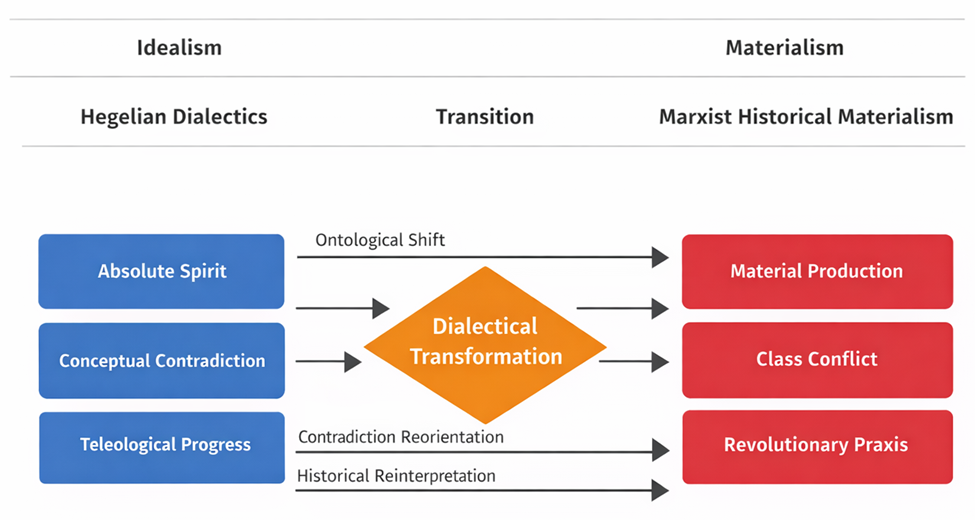
Figure 1. Conceptual Framework: From Hegelian Dialectics to Marxist Historical Materialism
Figure 1 presents the conceptual framework illustrating the transformation from Hegelian dialectics to Marxist historical materialism, highlighting both continuity and rupture in philosophical reasoning. The left-hand column represents Hegelian dialectics, grounded in idealism, where social reality is understood primarily through the development of consciousness and rational spirit (Hegel, 1977). Hegel emphasises the dialectical process, in which contradictions within concepts and social institutions are resolved through sublation (Aufhebung), producing increasingly rational forms of social organisation. Teleological progress characterises this system, as historical development culminates in the realisation of ethical freedom within the state and civil society (Hegel, 1991). In Hegelian terms, contradiction is primarily conceptual, serving as a mechanism for intellectual and moral reconciliation rather than material transformation.
The right-hand column represents Marxist historical materialism, which reinterprets the dialectical method through a materialist lens. Marx relocates the ontological foundation from consciousness to material production and labour relations, asserting that social structures, institutions, and consciousness are conditioned by economic realities (Marx & Engels, 1978). Contradictions are now structural, manifesting as tensions between productive forces and relations of production, as well as between classes, ultimately generating crises that drive historical transformation (Marx, 1976). Human agency is similarly reconceptualised: rather than achieving ethical freedom through recognition within institutions, individuals, particularly the working class, exercise collective praxis to transform material conditions and restructure social relations.
The central diamond labelled “Dialectical Transformation” visually signifies the methodological and conceptual reorientation from Hegel’s idealist dialectics to Marx’s materialist critique. Arrows illustrate the ontological shift, the reorientation of contradiction from the conceptual to the structural, and the reinterpretation of historical progress from teleological development to contingent, class-driven transformation. This framework emphasises that while Marx inherits the analytical rigour and attention to relational dynamics of Hegelian dialectics, he fundamentally reconceives the sources, mechanisms, and implications of historical change.
By situating both philosophical systems in a single framework, the figure provides a clear visual representation of how dialectical reasoning evolved into a practical methodology for social analysis. It underscores the continuity in dialectical logic, relational thinking, and historical perspective, while simultaneously highlighting the rupture that enables Marxism to serve as a critical tool for examining material conditions, class struggle, and structural inequality in contemporary social research (Ollman, 2003; Harvey, 2014). Consequently, this conceptual framework not only clarifies the theoretical lineage from idealism to materialism but also provides a methodological foundation for subsequent empirical and sociological studies.
4.3 Analytical Application of the Framework
This conceptual framework guides the comparative analysis in three ways.
First, it structures textual comparison by identifying where Hegel and Marx diverge on ontology, causality, and agency. This prevents oversimplification of Marx as merely anti-idealist and instead reveals a systematic philosophical reconstruction.
Second, it supports sociological interpretation by linking philosophical categories to social structures. Concepts such as class, state, and ideology are interpreted as products of economic relations rather than ethical abstractions.
Third, the framework enables interdisciplinary relevance. By integrating philosophy and social science, it allows political sociologists to trace how epistemological assumptions shape explanations of inequality, labour relations, and institutional power.
4.4 Relevance for Contemporary Social Research
Historical materialism derived from this framework remains central to labour studies, development sociology, and political economy. Analyses of global supply chains, informal labour, and industrial disasters often rely on structural explanations of capitalist production and regulatory failure.
Understanding the dialectical roots of this framework strengthens theoretical rigour in applied research by connecting empirical findings to foundational assumptions about social causality and power.
5. Methodology
This study adopts a qualitative comparative research design to examine the philosophical transformation from Hegelian dialectics to Marxist historical materialism. Qualitative comparison is particularly appropriate for analysing abstract theoretical systems because it allows in-depth interpretation of meanings, concepts, and logical structures rather than numerical measurement (Creswell & Poth, 2018). The aim is not to test hypotheses statistically but to explore how two foundational philosophical frameworks conceptualise history, contradiction, and agency.
Comparative qualitative design is widely used in political theory and historical sociology to analyse ideological traditions, intellectual movements, and theoretical paradigms (Mahoney & Thelen, 2015). By systematically comparing conceptual categories across texts, this study identifies patterns of continuity and rupture between idealist and materialist traditions.
5.1 Data Sources and Text Selection
The primary data consist of canonical philosophical texts by G. W. F. Hegel and Karl Marx that explicitly address history, social relations, and dialectical logic. The selected texts represent mature and influential formulations of each thinker’s theoretical position.
Primary Sources
For Hegel, the analysis focuses on:
- Phenomenology of Spirit (1807/1977), which outlines the dialectical development of consciousness and historical rationality.
- Elements of the Philosophy of Right (1821/1991), which presents the ethical and political culmination of dialectical development in the modern state.
For Marx, the analysis draws on:
- Economic and Philosophic Manuscripts of 1844, which articulate alienation and labour as foundations of human life.
- The German Ideology (1846/1978), which formulates historical materialism and critiques idealist philosophy.
- Capital, Volume I (1867/1976), which provides a structural analysis of capitalist production and class relations.
These texts are selected because they represent theoretical continuity across Marx’s intellectual development while demonstrating clear philosophical engagement with Hegelian categories.
Secondary Sources
Secondary literature includes peer-reviewed monographs and theoretical syntheses that interpret dialectics, materialism, and political economy (e.g., Avineri, 1968; Lukács, 1971; Ollman, 2003; Eagleton, 2011). These sources contextualise debates and support analytical triangulation.
5.2 Analytical Approach: Qualitative Textual Analysis
The study employs qualitative textual analysis, which involves systematic interpretation of meaning, conceptual relationships, and argument structure within philosophical texts (Saldaña, 2016). Unlike discourse analysis focused on linguistic practices, this study emphasises conceptual content and theoretical logic. The analysis proceeds in three stages:
Stage 1: Concept Identification
Key concepts related to dialectics, history, and agency were identified through close reading. For Hegel, these included Spirit, negation, sublation, ethical life, and rational freedom. For Marx, key concepts included labour, material production, class relations, ideology, and praxis. These concepts were treated as analytical codes representing theoretical positions.
Stage 2: Thematic Categorisation
Concepts were organised under three comparative categories derived from the conceptual framework:
- Ontological foundation (ideal vs. material)
- Mechanism of historical change (conceptual vs. structural contradiction)
- Human agency (ethical consciousness vs. collective praxis)
This thematic categorisation enabled systematic comparison across philosophical traditions.
Stage 3: Comparative Interpretation
The final stage involved interpretive comparison, examining how similar concepts function differently within each theoretical system. For example, contradiction in Hegel functions as a logical development of consciousness, whereas in Marx it operates as economic and social conflict. This step emphasised relational analysis rather than isolated concept comparison.
5.3 Comparative Logic and Case-Oriented Strategy
This study follows a case-oriented comparative logic, where each philosophical system is treated as a theoretical “case” with internally coherent assumptions (Ragin, 2014). Rather than isolating variables, the analysis examines how interrelated concepts form integrated explanatory frameworks.
Case-oriented comparison is particularly suitable for theoretical traditions because it preserves historical context and philosophical coherence. This approach avoids reductionism by recognising that categories such as labour, state, and ideology operate differently within distinct ontological systems.
5.4 Validity and Analytical Rigour
Ensuring rigour in qualitative theoretical research requires transparency, coherence, and triangulation (Creswell & Poth, 2018). Conceptual definitions are derived directly from primary texts rather than secondary summaries, reducing misinterpretation. Interpretations are supported by multiple textual references rather than isolated quotations.
Secondary literature is used to cross-check interpretations and situate findings within broader scholarly debates. Divergent interpretations are acknowledged, particularly in discussions of Marx’s relation to Hegel.
The study recognises that theoretical interpretation is influenced by disciplinary traditions. To mitigate bias, the analysis explicitly compares multiple scholarly perspectives, including structuralist and humanist interpretations.
5.5 Ethical Considerations
As a theoretical study using publicly available texts, this research does not involve human participants and therefore does not require institutional ethical clearance. However, academic integrity is maintained through accurate citation, faithful representation of original arguments, and avoidance of selective quotation.
5.6 Limitations of the Methodology
Several limitations should be acknowledged.
First, philosophical interpretation is inherently interpretive and may vary across scholars. While this study aims for analytical consistency, alternative readings of Hegel or Marx may emphasise different dimensions of their work.
Second, the study focuses on classical texts and does not empirically test the applicability of historical materialism in contemporary contexts. Therefore, findings relate primarily to theoretical coherence rather than predictive explanatory power.
Third, the comparative framework prioritises ontology and methodology over political strategy or ethical theory, which may limit discussion of normative dimensions of Marxist thought.
Despite these limitations, qualitative comparative design remains appropriate for addressing the philosophical research questions guiding this study.
5.7 Contribution of Methodological Approach
By integrating qualitative textual analysis with comparative historical logic, this methodology allows systematic examination of philosophical transformation across intellectual traditions. It bridges philosophy and social science by treating theoretical systems as historically situated explanatory frameworks rather than isolated doctrines.
This approach strengthens the analytical foundation of the study and supports its broader aim of linking dialectical philosophy to sociological explanation of social change.
6. Comparative Analysis: Hegelian Dialectics and Marxist Historical Materialism
This section presents a systematic comparison between Hegelian dialectics and Marxist historical materialism across key theoretical dimensions: ontology, contradiction, historical movement, social institutions, labour, alienation, and revolutionary transformation. While Marx adopts dialectical reasoning from Hegel, he fundamentally transforms its philosophical grounding by embedding contradiction in material production rather than in conceptual development. This comparative analysis demonstrates how Marxism both inherits and reconstructs dialectical logic.
6.1 Ontological Foundations: Spirit versus Material Production
Hegel’s philosophical system is grounded in absolute idealism, which posits that reality is ultimately constituted by rational spirit (Geist). For Hegel, material conditions and social institutions are externalisations of developing consciousness. Historical reality is therefore intelligible as the self-realisation of reason through successive stages of awareness and ethical organisation (Hegel, 1977).
In this view, social institutions such as family, civil society, and the state are not arbitrary human constructs but necessary expressions of ethical life. Freedom becomes actual only when individuals recognise themselves within rational institutions, especially the modern constitutional state (Hegel, 1991). Ontologically, ideas precede material arrangements.
Marx decisively reverses this relationship. He argues that social reality is constituted by material relations of production, which shape consciousness, ideology, and political institutions (Marx & Engels, 1978). Rather than viewing institutions as embodiments of rational spirit, Marx interprets them as mechanisms that stabilise class relations and protect dominant economic interests.
This ontological shift transforms the focus of social theory from philosophical speculation to political economy. Human consciousness is not autonomous but socially conditioned, reflecting lived material circumstances. As Marx states, “It is not the consciousness of men that determines their existence, but their social existence that determines their consciousness” (Marx, 1970, p. 21).
Thus, while Hegel views social reality as the expression of rational ideas, Marx understands it as the outcome of historically specific economic arrangements.
6.2 Contradiction: Logical Negation versus Structural Conflict
Contradiction occupies a central position in both Hegelian and Marxist dialectics, but its meaning and function differ significantly. In Hegel’s system, contradiction arises within concepts and forms of consciousness. Each stage of development contains internal tensions that lead to negation and eventual sublation (Aufhebung), preserving elements of earlier stages while overcoming their limitations (Hegel, 1977).
This process is fundamentally logical and epistemological. Contradictions reflect limitations in understanding rather than material conflicts between social groups. Even wars and political upheavals ultimately serve the rational development of freedom.
Marx relocates contradiction to the sphere of material production. Contradictions emerge between productive forces and relations of production, and between classes with opposing economic interests (Marx, 1976). Capitalism, in particular, contains inherent contradictions between socialised production and private appropriation, generating economic crises and political instability.
For Marx, contradiction is not a conceptual problem to be philosophically resolved but a structural condition requiring material transformation. Class conflict becomes the practical expression of dialectical contradiction. This shift transforms dialectics from speculative logic into a critical method for analysing social inequality and economic exploitation.
6.3 Historical Movement: Teleology versus Open-Ended Struggle
Hegel conceives history as a rational, teleological process culminating in the realisation of freedom. Each historical stage represents a necessary moment in the unfolding of Spirit. Although historical actors may not recognise rational necessity, their actions contribute to universal progress (Hegel, 1991).
This philosophy of history provides metaphysical justification for existing institutions. The modern state becomes the culmination of historical development, embodying ethical rationality.
Marx rejects teleological reconciliation. While historical materialism recognises patterns of development across modes of production, it does not posit inevitable moral progress. Social transformation depends on material conditions and political struggle, not philosophical destiny (Marx & Engels, 1978).
History remains contingent upon class agency. Although capitalism generates conditions favourable to socialism, revolutionary outcomes are not guaranteed. Political organisation and consciousness play decisive roles. Thus, Marx replaces philosophical necessity with socio-political contingency, transforming history into a terrain of struggle rather than predetermined realisation.
6.4 The State and Social Institutions
Hegel views the state as the highest expression of ethical life, reconciling individual freedom with universal rationality (Hegel, 1991). Political institutions represent the culmination of dialectical development, integrating civil society and moral life.
Marx fundamentally rejects this interpretation. For Marx, the state functions as an instrument of class domination, enforcing property relations and protecting capitalist interests (Marx, 1976). Political equality conceals economic inequality.
Law and citizenship provide ideological legitimacy for exploitation by presenting social relations as neutral and universal. Institutions, therefore, reproduce structural inequality rather than resolve it.
This divergence reflects deeper philosophical differences: reconciliation through rational institutions versus emancipation through economic restructuring.
6.5 Labour and Human Self-Realisation
Labour occupies different roles in Hegelian and Marxist theory. Hegel acknowledges labour as formative of self-consciousness, particularly in the master–slave dialectic, where productive activity enables self-recognition (Hegel, 1977).
However, labour remains subordinate to consciousness and ethical life. It is a means of self-development rather than the foundation of social reality.
Marx elevates labour to the core of human existence. Through labour, humans transform nature and create social relations. Alienation occurs when workers lose control over their productive activity and its products (Marx, 2007).
Labour thus becomes both the source of exploitation and the basis of revolutionary potential. Workers’ collective position in production enables class consciousness and political mobilisation. This materialist conception of labour anchors Marxist theory in everyday social experience rather than philosophical abstraction.
6.6 Alienation: Philosophical Estrangement versus Economic Exploitation
Alienation appears in both Hegel and Marx, but with different meanings. In Hegel, alienation refers to stages in the development of consciousness where individuals experience estrangement from social norms before achieving reconciliation (Hegel, 1977).
Alienation is, therefore, temporary and ultimately resolved through ethical integration. For Marx, alienation is structural and persistent under capitalism. Workers are alienated from:
- the product of labour,
- the labour process,
- their own human potential, and
- Other workers (Marx, 2007).
Alienation is not psychological but economic, rooted in wage labour and private property. It cannot be resolved through ideological reform but requires the transformation of ownership relations. This marks a decisive break from idealist reconciliation toward materialist critique.
6.7 Revolution and Social Transformation
Hegelian dialectics resolves contradictions through conceptual integration and institutional development. Social conflicts ultimately strengthen rational order.
Marxist dialectics resolves contradictions through revolutionary restructuring of material relations. Political change without economic transformation reproduces exploitation (Marx & Engels, 1978).
Revolution is not moral rebellion but structural necessity arising from class antagonism. The proletariat becomes revolutionary not through ethical insight but through material dispossession. This redefinition of social change transforms dialectics into a theory of political struggle.
6.8 Methodological Implications for Social Science
Hegelian dialectics provides a holistic framework emphasising coherence and rational development, but offers limited tools for empirical analysis of inequality.
Marxist historical materialism, by contrast, offers concrete categories-class, production, exploitation, ideology-usable in sociological research. It allows systematic analysis of power relations, labour markets, and institutional regulation. This methodological transformation enables Marxism to function as a social science rather than speculative philosophy.
6.9 Synthesis: Continuity and Rupture
The comparison reveals that Marx neither simply rejects nor passively adopts Hegelian dialectics. Instead, he reconstructs dialectical logic within a materialist ontology. Continuity exists in:
- emphasis on contradiction,
- process-oriented analysis, and
- historical development.
Rupture exists in:
- rejection of idealist metaphysics,
- relocation of causality to economic structures, and
- transformation of dialectics into political praxis.
This synthesis explains why Marxism remains both philosophically rich and empirically applicable.
6.10 Implications for Critical Theory
Later Marxist thinkers such as Lukács and Gramsci reintroduced dialectical philosophy to counter mechanical materialism, emphasising culture, ideology, and political leadership (Gramsci, 1971; Lukács, 1971). Their work demonstrates the lasting relevance of Hegelian categories within Marxist social theory.
Contemporary critical theory continues to integrate dialectical reasoning with material analysis in studies of globalisation, neoliberalism, and labour precarity (Harvey, 2014). Thus, the philosophical dialogue between Hegel and Marx continues to shape modern social theory.
7. Discussion and Implications
The comparative analysis of Hegelian dialectics and Marxist historical materialism provides a nuanced understanding of how philosophical idealism evolved into materialist social theory. This discussion synthesises the findings of Section 6, evaluates their broader theoretical significance, and identifies implications for contemporary social research and critical theory.
7.1 Philosophical Continuity and Transformation
The analysis demonstrates that Marx retains the methodological rigour of Hegelian dialectics while fundamentally transforming its ontological and epistemological premises. Hegel’s dialectic, rooted in absolute idealism, emphasises the development of consciousness and rational spirit through stages of negation and sublation (Hegel, 1977). Contradiction is internal to conceptual categories, and historical movement is teleological, culminating in ethical reconciliation within institutions such as the modern state (Hegel, 1991).
Marx preserves dialectical reasoning-attention to contradictions, dynamic development, and relational analysis-but relocates the foundation from spirit to material production (Marx, 1976; Marx & Engels, 1978). Contradictions are structural rather than conceptual, arising from tensions between productive forces and relations of production. Historical change is contingent on material conditions and collective human praxis rather than inevitable philosophical progression.
This transformation reflects both continuity and rupture: continuity in the retention of dialectical logic, relational analysis, and historical perspective, and rupture in the reorientation toward materialist ontology and class-based social critique. As Ollman (2003) notes, this reconfiguration allows Marxism to serve as both a philosophical and sociological framework.
7.2 Implications for Understanding History and Social Change
The study reinforces that understanding historical change requires examining the interaction between structural conditions and human agency. While Hegelian dialectics privileges philosophical reconciliation, Marxist historical materialism foregrounds the practical and political dimensions of social transformation (Harvey, 2014).
In contemporary social research, this distinction has practical implications. For instance, studies of labour exploitation, global supply chains, and industrial inequality require attention to structural forces-ownership, production processes, class relations-rather than merely ideological or ethical factors (Standing, 2011). Historical materialism provides a framework for analysing how structural contradictions generate crises and social movements, offering explanatory power beyond philosophical speculation.
Moreover, the discussion highlights the importance of contingency in historical outcomes. Unlike Hegel’s deterministic model, Marxian materialism emphasises that revolutionary transformation is not guaranteed; it depends on class consciousness, political organisation, and strategic praxis (Marx, 1970). This insight aligns with Gramsci’s (1971) concept of cultural hegemony, where structural change requires simultaneous attention to ideology, culture, and political leadership.
7.3 Relevance for Critical Theory and Social Research
The study contributes to critical theory by clarifying how dialectical reasoning informs social analysis. Dialectics, whether idealist or materialist, provides a methodology for understanding complex, contradictory, and relational phenomena (Bhaskar, 2008). In the Marxist adaptation, dialectics becomes a tool to reveal hidden structures of power, exploitation, and social reproduction.
For contemporary social research, these insights underscore the value of integrative frameworks that combine theoretical rigour with empirical relevance. Historical materialism offers conceptual categories-class, labour, exploitation, ideology-that facilitate systematic analysis of social inequalities, labour relations, and political dynamics (Brenner, 1976; Wallerstein, 2004). Researchers can apply these categories to diverse contexts, including developing economies, informal labour markets, and global industrial supply chains.
The comparative perspective also suggests that philosophical foundations shape methodological choices. Research grounded in Hegelian idealism might prioritise interpretive coherence, ethical evaluation, or institutional analysis, while research grounded in Marxian materialism emphasises structural analysis, conflict, and empirical observation of social relations. By understanding this philosophical lineage, scholars can critically reflect on the assumptions guiding their research design.
7.4 Implications for Labour, Industrial Studies, and Policy
Historical materialism’s focus on economic structures, labour processes, and class relations has direct relevance for industrial and labour studies. For example, analyses of ready-made garment workers, informal labour sectors, and precarious employment conditions can benefit from a materialist framework to identify the systemic causes of exploitation and inequality (Standing, 2011).
Policy implications emerge as well. Recognising that labour precarity and social inequity are structurally generated suggests that policy solutions must go beyond piecemeal reforms or ideological interventions. Structural interventions-such as labour protections, collective bargaining, and redistribution of ownership-are necessary to address the root causes of exploitation. By applying Marxist analysis, policymakers can evaluate the long-term social and economic consequences of industrial practices.
7.5 Bridging Philosophy and Social Science
The study illustrates that philosophical inquiry and social science are mutually reinforcing. Hegelian dialectics contributes methodological clarity and conceptual sophistication, while Marxist historical materialism operationalises these concepts for empirical and sociological analysis. This synergy demonstrates that theory and practice are inseparable: philosophical analysis informs social research design, and empirical research tests and refines theoretical claims (Creswell & Poth, 2018; Ragin, 2014).
Furthermore, the study supports the view that historical materialism provides a framework for understanding global dynamics, including inequality, capitalism, and structural crises. Contemporary scholars, including Harvey (2014) and Bhaskar (2008), continue to apply dialectical materialism to investigate neoliberalism, spatial inequality, and labour exploitation, confirming the enduring analytical utility of Marxist theory.
7.6 Limitations and Future Research
While the study offers conceptual clarity, certain limitations exist. First, it is primarily theoretical and textual, focusing on canonical writings rather than empirical case studies. Future research could extend the framework by examining historical and contemporary industrial contexts to test the explanatory power of historical materialism empirically.
Second, while the study highlights structural and philosophical continuity, it does not deeply explore the ethical dimensions of Marxism, such as normative debates on freedom, justice, and human flourishing. Integrating ethical critique with structural analysis could enrich understanding of Marx’s relevance to contemporary social policy and global inequality.
8. Conclusion
This study traced the evolution of dialectical reasoning from Hegelian idealism to Marxist historical materialism, emphasising both continuity and rupture. Hegel’s dialectics, grounded in consciousness and rational spirit, provides a methodological foundation for understanding historical development through conceptual contradiction and ethical reconciliation. Marx reorients this framework toward material conditions, class relations, and collective praxis, transforming dialectics into a tool for structural critique and social analysis.
The comparative analysis underscores three central points:
- Marx preserves dialectical logic but relocates ontology from ideas to material production.
- Contradiction and historical change shift from philosophical reconciliation to structural conflict and revolutionary potential.
- Historical materialism provides a practical framework for analysing labour, inequality, and social transformation, bridging philosophy and social science.
By situating Marx within the dialectical tradition, this study clarifies the theoretical and methodological significance of historical materialism for contemporary research. It highlights the enduring relevance of dialectics in critical theory, labour studies, and political economy, offering conceptual tools for analysing the structural and historical roots of social phenomena.
In sum, the transformation from Hegelian idealism to Marxist materialism illustrates how philosophical reflection can inform empirical inquiry, social critique, and practical strategies for addressing structural inequality. The study contributes to both theoretical scholarship and applied social research by providing a framework for understanding the dialectical foundations of social change.
References
Althusser, L. (2005). For Marx (B. Brewster, Trans.). Verso.
Amin, S. (1976). Unequal development: An essay on the social formations of peripheral capitalism. Monthly Review Press.
Avineri, S. (1968). The social and political thought of Karl Marx. Cambridge University Press.
Bhaskar, R. (2008). Dialectic: The pulse of freedom. Routledge.
Bottomore, T. (1991). A dictionary of Marxist thought. Blackwell.
Brenner, R. (1976). Agrarian class structure and economic development in pre-industrial Europe. Past & Present, 70, 30–75. https://doi.org/10.1093/past/70.1.30
Callinicos, A. (1989). Against postmodernism: A Marxist critique. Polity Press.
Creswell, J. W., & Poth, C. N. (2018). Qualitative inquiry and research design: Choosing among five approaches (4th ed.). Sage.
Eagleton, T. (2011). Why Marx was right. Yale University Press.
Frank, A. G. (1967). Capitalism and underdevelopment in Latin America. Monthly Review Press.
Fromm, E. (1961). Marx’s concept of man. Continuum.
Gramsci, A. (1971). Selections from the prison notebooks (Q. Hoare & G. Nowell Smith, Eds. & Trans.). International Publishers.
Harvey, D. (2014). Seventeen contradictions and the end of capitalism. Oxford University Press.
Hegel, G. W. F. (1977). Phenomenology of Spirit (A. V. Miller, Trans.). Oxford University Press. (Original work published 1807)
Hegel, G. W. F. (1991). Elements of the philosophy of right (H. B. Nisbet, Trans.). Cambridge University Press. (Original work published in 1821)
Lukács, G. (1971). History and class consciousness (R. Livingstone, Trans.). MIT Press.
Mahoney, J., & Thelen, K. (2015). Advances in comparative-historical analysis. Cambridge University Press.
Marx, K. (1970). A contribution to the critique of political economy (S. W. Ryazanskaya, Trans.). International Publishers. (Original work published 1859)
Marx, K. (1976). Capital: A critique of political economy, Volume I (B. Fowkes, Trans.). Penguin Books. (Original work published in 1867)
Marx, K. (2007). Economic and Philosophic Manuscripts of 1844. Dover Publications.
Marx, K., & Engels, F. (1978). The German ideology. In R. C. Tucker (Ed.), The Marx-Engels reader (2nd ed., pp. 146–200). Norton. (Original work written in 1846)
McLellan, D. (2006). Karl Marx: A biography (3rd ed.). Palgrave Macmillan.
Ollman, B. (2003). Dance of the dialectic: Steps in Marx’s method. University of Illinois Press.
Ragin, C. C. (2014). The comparative method: Moving beyond qualitative and quantitative strategies. University of California Press.
Saldaña, J. (2016). The coding manual for qualitative researchers (3rd ed.). Sage.
Skocpol, T. (1979). States and social revolutions: A comparative analysis of France, Russia, and China. Cambridge University Press.
Standing, G. (2011). The precariat: The new dangerous class. Bloomsbury Academic.
Wallerstein, I. (2004). World-systems analysis: An introduction. Duke University Press.
Weber, M. (1978). Economy and society (G. Roth & C. Wittich, Eds.). University of California Press.