Journal Home
OPEN ACCESS
Exploring Manager-Designer Relationships and Their Impact on Product Innovation: A Qualitative Inquiry
| Mst Nafisa Anjum Arin ORCID: https://orcid.org/0009-0003-1897-6618 Department of Fashion Design & Technology Faculty of Design & Technology Shanto-Mariam University of Creative Technology Dhaka, Bangladesh |
| Prof. Dr Kazi Abdul Mannan Department of Business Administration Faculty of Business Shanto-Mariam University of Creative Technology Dhaka, Bangladesh Email: drkaziabdulmannan@gmail.com ORCID: https://orcid.org/0000-0002-7123-132X Corresponding author: Mst Nafisa Anjum Arin: nafisaanjumarin220@gmail.com |
SME rev. anal. 2026, 6(3); https://doi.org/10.64907/xkmf.v6i3.sme-ra.4
Submission received: 20 May 2026 / Revised: 25 June 2026 / Accepted: 30 June 2026 / Published: 3 July 2026
Download PDF (854 KB)
Abstract
This study examines how manager-designer relationships influence product innovation within design-intensive organisations. Drawing on a qualitative synthesis of secondary data, including empirical studies, industry case analyses, and organisational documents, the research integrates Social Exchange Theory, Leader-Member Exchange theory, and the Knowledge-Based View of the firm to explain how relational dynamics shape innovation outcomes. The findings indicate that trust, psychological safety, negotiated autonomy, and shared strategic vision function as relational mechanisms that enable effective knowledge integration and creative risk-taking. Conversely, hierarchical rigidity and short-term performance metrics constrain collaborative innovation processes. The study proposes a relational-structural framework in which relational quality mediates the translation of organisational resources into innovative outputs, while structural systems moderate the effectiveness of relational exchanges. By positioning manager-designer relationships as a form of relational infrastructure, the research advances design management and innovation scholarship. The findings offer theoretical contributions and practical guidance for organisations seeking to strengthen innovation capability through relational leadership and collaborative design governance.
Keywords: design management; product innovation; manager-designer relationships; psychological safety; knowledge integration; relational leadership
1. Introduction
Innovation has become central to organisational competitiveness in increasingly volatile markets (Teece, 2018). While technological advancement and market strategies have received significant scholarly attention, relational dynamics within organisations, particularly between managers and designers, remain comparatively underexamined. Designers are often positioned as creative agents responsible for ideation and aesthetic development, whereas managers oversee strategic alignment, resource allocation, and performance evaluation (Borja de Mozota, 2003). The intersection of these roles forms a critical site where innovation is either facilitated or constrained.
Product innovation is not merely the outcome of individual creativity but the result of coordinated collaboration across organisational roles (Verganti, 2009). Manager-designer relationships represent a nexus of power, creativity, accountability, and interpretation. In many design-led industries, such as fashion, consumer electronics, and digital platforms, these relationships shape the trajectory of product conceptualisation, iteration, and commercialisation.
Despite increasing recognition of design as a strategic asset (Brown, 2008), tensions often emerge between managerial rationality and design intuition. Managers may prioritise timelines, budgets, and measurable outcomes, whereas designers emphasise experimentation, ambiguity tolerance, and aesthetic coherence (Martin, 2009). Understanding how these relational dynamics influence product innovation outcomes constitutes the central objective of this study.
This research seeks to answer the following questions:
- How do relational dynamics between managers and designers influence product innovation processes?
- What relational factors facilitate or hinder innovative outcomes?
- How do organisational structures mediate the impact of manager-designer relationships on innovation?
By addressing these questions, the study contributes to design management literature and organisational theory by foregrounding relational processes as core determinants of innovation success.
2. Literature Review
2.1 Product Innovation and Organisational Collaboration
Product innovation refers to the development and commercialisation of new or significantly improved goods or services (OECD, 2018). Innovation literature emphasises cross-functional collaboration as a critical enabler of success (Wheelwright & Clark, 1992). However, much of this literature focuses on interdepartmental coordination rather than micro-level relational dynamics.
Research suggests that collaborative innovation requires shared understanding, trust, and knowledge integration (Nonaka & Takeuchi, 1995). Yet, designers and managers often operate within different epistemological paradigms. Designers rely on tacit knowledge and iterative experimentation, whereas managers often emphasise explicit metrics and risk minimisation (Dunne & Martin, 2006).
2.2 Design Management
Design management integrates design thinking into organisational strategy (Borja de Mozota, 2003). Scholars argue that effective design management enhances innovation performance by aligning creative processes with strategic goals (Best, 2015). However, limited research examines how interpersonal relationships mediate this alignment.
Verganti (2009) highlights the importance of “design-driven innovation,” where meaning creation is central. Such innovation requires close collaboration between managerial decision-makers and creative designers. The quality of their relationship influences the capacity to explore radical innovations.
2.3 Power, Autonomy, and Creative Work
Creative industries research indicates that autonomy and psychological safety significantly influence creative output (Amabile, 1996; Edmondson, 2018). Hierarchical dominance can suppress experimentation, whereas supportive leadership enhances risk-taking.
Leader-Member Exchange (LMX) theory posits that high-quality relationships between leaders and subordinates foster trust, respect, and mutual obligation (Graen & Uhl-Bien, 1995). In design contexts, such relationships may facilitate innovation by enabling open dialogue and shared risk-taking.
2.4 Knowledge Integration and Innovation
The Knowledge-Based View (Grant, 1996) conceptualises firms as repositories of specialised knowledge. Innovation requires effective integration of diverse expertise. Designers hold aesthetic and user-centred knowledge, while managers possess market and strategic knowledge. The relational interface determines how effectively these knowledge domains combine.
3. Theoretical Framework
This study integrates three complementary theories:
3.1 Social Exchange Theory (SET)
Social Exchange Theory suggests that social behaviour results from reciprocal exchanges that generate trust and commitment (Blau, 1964). In manager-designer relationships, reciprocity manifests through support, feedback, and recognition. When designers perceive fairness and appreciation, they are more likely to engage in discretionary creative efforts.
3.2 Leader-Member Exchange (LMX) Theory
LMX theory focuses on dyadic leader-subordinate relationships (Graen & Uhl-Bien, 1995). High-LMX relationships involve mutual trust and open communication, which may enhance collaborative innovation. Low-LMX relationships, characterised by formality and limited communication, may constrain creativity.
3.3 Knowledge-Based View (KBV)
KBV posits that competitive advantage arises from knowledge integration (Grant, 1996). The manager-designer dyad becomes a mechanism for integrating tacit design knowledge and strategic market knowledge. Effective relational processes facilitate knowledge recombination, leading to innovative outcomes.
Conceptual Model
The proposed framework suggests:
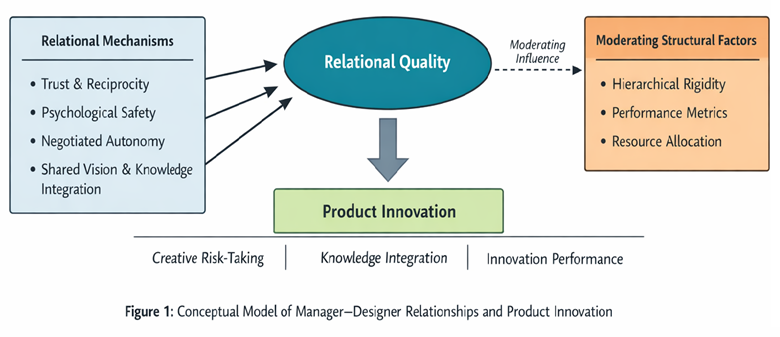
The conceptual model illustrates how manager–designer relationships influence product innovation through relational mechanisms, moderated by structural factors. At the core of the model is Relational Quality, which functions as the central mediating construct linking interpersonal dynamics to innovation outcomes. The model proposes that innovation does not emerge solely from organisational resources or structural configurations, but rather from the quality of relational exchanges between managers and designers.
On the left side of the model, Relational Mechanisms, including trust and reciprocity, psychological safety, negotiated autonomy, and shared vision with knowledge integration, serve as antecedents to relational quality. Drawing on Social Exchange Theory (Blau, 1964), trust and reciprocity are foundational elements of collaborative engagement. When managers demonstrate fairness and recognition, designers reciprocate through increased commitment and creative effort. Such reciprocal exchanges strengthen relational bonds and foster discretionary behaviours essential for innovation.
Psychological safety further enhances relational quality by creating an environment where individuals feel secure in expressing novel or unconventional ideas without fear of negative consequences (Edmondson, 2018). In creative domains, where experimentation and failure are inherent to the design process, psychological safety becomes critical for enabling risk-taking and iterative learning (Amabile, 1996). The model suggests that high psychological safety enhances relational openness, thereby promoting exploratory innovation.
Negotiated autonomy represents the balance between managerial oversight and creative freedom. Rather than conceptualising autonomy as absolute independence, the model frames it as a relationally negotiated process that aligns creative exploration with strategic intent. This perspective aligns with the Knowledge-Based View (KBV), which emphasises coordinated integration of specialised expertise (Grant, 1996). Designers contribute tacit, aesthetic knowledge, while managers provide strategic and market-oriented insights. Relational quality determines how effectively these knowledge domains are integrated.
The central construct, Relational Quality, therefore mediates the transition from relational mechanisms to innovation outcomes. High-quality relationships, consistent with Leader–Member Exchange (LMX) theory, are characterised by mutual trust, open communication, and shared responsibility (Graen & Uhl-Bien, 1995). These relational conditions facilitate effective knowledge recombination and collaborative experimentation.
Below relational quality, the model identifies Product Innovation outcomes, conceptualised as creative risk-taking, knowledge integration, and innovation performance. Creative risk-taking reflects the willingness to pursue novel design trajectories, while knowledge integration refers to the synthesis of diverse expertise. Innovation performance encompasses both market success and product novelty.
On the right side, Moderating Structural Factors, hierarchical rigidity, performance metrics, and resource allocation, shape the strength of the relationship between relational quality and innovation outcomes. Even in high-trust environments, rigid hierarchies or short-term financial metrics may constrain experimentation (March, 1991). Conversely, flexible structures and supportive incentive systems amplify the positive effects of relational quality.
Overall, the model presents a multilevel framework in which relational dynamics mediate innovation processes, while structural conditions moderate their effectiveness. It underscores that sustainable product innovation depends not only on organisational design but also on the quality of interpersonal relationships that enable collaborative creativity.
4. Methodology
4.1 Research Design
This study adopts a qualitative research design grounded in the interpretivist paradigm, utilising secondary data sources to explore manager-designer relationships and their impact on product innovation. A qualitative approach is appropriate for examining relational dynamics, power structures, and meaning-making processes embedded within organisational contexts (Creswell & Poth, 2018; Denzin & Lincoln, 2018). Rather than seeking causal generalisations, the study aims to generate analytical insights into how relational processes shape innovation outcomes.
Secondary qualitative research involves the systematic reanalysis of existing textual and documentary materials to address new research questions (Heaton, 2004). This approach is particularly valuable when investigating organisational phenomena that are difficult to access directly due to confidentiality, resource limitations, or temporal constraints. By synthesising existing empirical studies, corporate reports, case documentation, and archival materials, the research constructs an interpretive account of how manager-designer interactions influence innovation trajectories.
4.2 Data Sources and Selection Criteria
The study draws on three primary categories of secondary qualitative data:
- Peer-reviewed empirical studies examining design management, leadership dynamics, and product innovation.
- Published case studies and industry reports from design-intensive sectors such as fashion, consumer electronics, and digital platforms.
- Organisational documents and public interviews (e.g., executive interviews, design process narratives, innovation reports).
Sources were identified through systematic searches in academic databases including Scopus, Web of Science, and Google Scholar using keywords such as “design management,” “manager-designer collaboration,” “creative leadership,” and “product innovation.” Inclusion criteria were:
- Publication between 1995 and 2024 to capture contemporary innovation discourse.
- Explicit focus on relational, leadership, or collaborative dynamics in product development.
- Empirical or case-based qualitative orientation.
Foundational theoretical works were also included to support conceptual framing (Blau, 1964; Grant, 1996; Graen & Uhl-Bien, 1995). Approximately 85 scholarly articles and 20 industry case documents were reviewed, from which 52 sources were selected for in-depth qualitative analysis based on relevance and analytical richness.
4.3 Analytical Strategy
The study employs qualitative content analysis and thematic synthesis to interpret the secondary data (Braun & Clarke, 2006; Schreier, 2012). The analytical process followed three stages:
4.3.1 Familiarisation and Data Immersion
All selected documents were read multiple times to ensure deep familiarity with content, context, and theoretical positioning. During this phase, initial memos were written to capture emerging relational patterns and innovation-related themes.
4.3.2 Coding and Thematic Development
An inductive-deductive coding approach was used. Deductive codes were derived from the theoretical framework (e.g., trust, reciprocity, psychological safety, knowledge integration, autonomy), informed by Social Exchange Theory, Leader-Member Exchange Theory, and the Knowledge-Based View (Blau, 1964; Grant, 1996; Graen & Uhl-Bien, 1995). Inductive coding allowed additional themes to emerge organically from the data, such as “boundary negotiation,” “creative friction,” and “metric misalignment.”
Codes were grouped into higher-order categories through constant comparison (Charmaz, 2014). For example, instances of open communication, mutual respect, and shared goal-setting were synthesised under the broader theme of relational alignment. Contradictory cases were examined to refine conceptual boundaries.
4.3.3 Cross-Case Thematic Synthesis
Thematic patterns were compared across industries to identify convergences and divergences. This cross-case synthesis enhanced analytical generalizability by identifying recurring relational mechanisms influencing innovation (Yin, 2018). The synthesis focused on how relational quality mediated structural factors such as hierarchy, performance evaluation systems, and strategic decision-making.
4.4 Trustworthiness and Rigour
To ensure methodological rigour, the study adhered to qualitative research quality criteria: credibility, transferability, dependability, and confirmability (Lincoln & Guba, 1985).
- Credibility was strengthened through triangulation of multiple data types (academic studies, case reports, organisational narratives).
- Transferability was supported by providing thick descriptions of contextual conditions under which relational dynamics influenced innovation.
- Dependability was maintained through a transparent audit trail documenting search strategies, coding decisions, and theme development.
- Confirmability was enhanced by reflexive memo-writing, which acknowledged the researcher’s interpretive position and minimised bias.
Additionally, the use of established theoretical frameworks provided conceptual coherence and analytical depth, reinforcing interpretive validity (Maxwell, 2013).
4.5 Ethical Considerations
As this research relies exclusively on publicly available secondary data, no direct human subjects were involved. Nevertheless, ethical research standards were upheld by accurately representing original authors’ findings, avoiding selective misinterpretation, and ensuring proper citation in accordance with APA (7th ed.) guidelines. Care was taken to contextualise case materials without distorting organisational narratives (Mannan & Farhana, 2026).
4.6 Limitations of Secondary Qualitative Research
While secondary qualitative analysis offers conceptual breadth and cross-contextual comparison, it also presents limitations. The researcher is constrained by the scope and depth of original data collection (Heaton, 2004). Contextual nuances not documented in primary studies may remain inaccessible. Additionally, differences in methodological rigour across original studies may affect interpretive consistency.
However, by systematically synthesising diverse empirical insights, the study achieves theoretical integration that may be less feasible in single-site primary research. The approach thus aligns with the study’s objective of developing a relational framework applicable across design-intensive industries.
5. Findings
The qualitative synthesis of secondary data revealed five interrelated thematic domains that explain how manager-designer relationships shape product innovation outcomes: relational trust and reciprocal commitment, psychological safety and creative risk-taking, autonomy-control negotiation, shared vision and knowledge integration, and structural mediation and performance metrics. These themes collectively demonstrate that relational quality acts as a mediating mechanism between organisational structures and innovation performance.
5.1 Relational Trust and Reciprocal Commitment
Across the analysed studies and industry cases, trust emerged as the foundational condition enabling productive manager-designer collaboration. Trust was consistently associated with reduced defensive communication, enhanced idea sharing, and increased willingness to engage in exploratory experimentation. In design-intensive organisations, managers who demonstrated confidence in designers’ expertise fostered relational reciprocity, leading designers to reciprocate through heightened commitment and discretionary creative effort.
Drawing on Social Exchange Theory, trust functioned as a relational currency (Blau, 1964). When designers perceived managerial fairness, recognition, and support, they were more inclined to invest cognitive and emotional energy beyond formal role requirements. Several case narratives indicated that innovation flourished when designers felt their aesthetic judgments were respected rather than scrutinised solely through financial metrics. Conversely, low-trust environments were characterised by guarded communication and incremental rather than radical innovation.
The synthesis further revealed that trust operates bidirectionally. Managers reported greater confidence in allocating strategic decision rights to designers when previous collaborative experiences demonstrated reliability and alignment with market objectives. This reciprocal dynamic aligns with Leader-Member Exchange (LMX) theory, which posits that high-quality dyadic relationships are associated with improved performance outcomes (Graen & Uhl-Bien, 1995). High-LMX relationships in design settings were correlated with accelerated decision cycles and more ambitious innovation initiatives.
Importantly, trust was not a static attribute but developed through repeated collaborative interactions. Transparent communication regarding constraints, such as budget limitations or production feasibility, strengthened relational bonds and minimised misinterpretation. The findings suggest that trust serves as a catalyst enabling designers to propose unconventional ideas without anticipating punitive responses.
5.2 Psychological Safety and Creative Risk-Taking
Psychological safety emerged as a distinct yet closely related construct to trust. While trust pertains to relational expectations, psychological safety refers to a shared belief that interpersonal risk-taking will not result in humiliation or punishment (Edmondson, 2018). The synthesis revealed that innovation-oriented firms intentionally cultivated environments where critique focused on ideas rather than individuals.
Secondary case evidence indicated that product breakthroughs were often preceded by phases of iterative failure. In organisations where managers framed failure as a learning mechanism, designers demonstrated greater willingness to experiment with novel materials, forms, or user experiences. This finding aligns with creativity research emphasising the importance of intrinsic motivation and autonomy-supportive leadership (Amabile, 1996).
Conversely, cultures characterised by blame and rigid evaluation discouraged experimentation. Designers in such contexts gravitated toward safe design modifications aligned with established market norms. Psychological safety thus functioned as a mediating condition linking relational climate to innovation radicalness.
Notably, the data revealed that psychological safety is co-constructed. Managers who openly acknowledged uncertainty or invited dissenting perspectives modelled vulnerability, which designers reciprocated through candid feedback. This dynamic contributed to more robust design iterations and reduced downstream implementation risks. Therefore, psychological safety not only enhanced ideational diversity but also improved innovation quality through constructive critique.
5.3 Autonomy-Control Negotiation
The third major theme concerned the ongoing negotiation between creative autonomy and managerial control. Designers consistently valued autonomy as essential to maintaining creative integrity. However, complete autonomy without strategic alignment occasionally resulted in products being misaligned with market positioning or brand strategy.
The findings suggest that innovation performance is optimised when autonomy is balanced with structured guidance. Managers who articulated clear strategic parameters, such as target market, sustainability goals, or technological constraints, while allowing freedom within those boundaries, enabled designers to explore creatively without losing coherence. This phenomenon resembles what organisational theorists describe as “bounded autonomy,” wherein freedom operates within strategic intent (Grant, 1996).
Secondary data from design-driven firms demonstrated that micromanagement undermined creative confidence and slowed iteration cycles. Designers reported that excessive oversight reduced willingness to experiment and shifted focus toward meeting managerial expectations rather than exploring user-centred solutions. In contrast, participatory decision-making processes fostered ownership and accountability.
Importantly, autonomy negotiation often involves implicit power dynamics. Hierarchical cultures tended to privilege managerial authority, limiting designers’ influence over final product decisions. In flatter organisational structures, decision rights were more distributed, enabling collaborative innovation. The analysis suggests that autonomy should not be conceptualised as the absence of control but rather as negotiated alignment between creative exploration and strategic direction.
5.4 Shared Vision and Knowledge Integration
A recurring pattern across the data concerned the importance of shared vision in facilitating knowledge integration. Innovation requires the synthesis of diverse expertise, including aesthetic, technological, and market knowledge (Nonaka & Takeuchi, 1995). Manager-designer relationships functioned as integrative mechanisms through which tacit and explicit knowledge domains converged.
Where managers and designers engaged in frequent dialogue, such as co-creation workshops or joint problem-solving sessions, there was greater alignment regarding product meaning and market positioning. Shared vision reduced ambiguity and minimised conflict during later stages of product development. Designers reported that understanding strategic objectives enhanced their ability to embed brand narratives into product form.
Conversely, misaligned interpretations of product goals generated friction. In some cases, managers prioritised short-term profitability while designers emphasised long-term brand differentiation. Without a shared conceptual framework, innovation processes became fragmented. The Knowledge-Based View of the firm suggests that competitive advantage arises from effective knowledge recombination (Grant, 1996). The findings reinforce this perspective by demonstrating that relational quality determines the extent to which knowledge integration occurs.
Additionally, the synthesis highlighted the role of interpretive translation. Managers often acted as intermediaries between designers and external stakeholders (e.g., marketing teams, investors). Effective translation of design rationale into strategic language facilitated organisational support for innovative concepts. Thus, shared vision functioned not merely as cognitive alignment but as a communicative bridge linking creative and strategic domains.
5.5 Structural Mediation and Performance Metrics
While relational factors were central, the findings indicate that organisational structures significantly mediate their impact. Performance evaluation systems, hierarchical configurations, and resource allocation mechanisms either reinforced or constrained relational collaboration.
Innovation-friendly organisations often employed flexible performance metrics that valued experimentation and long-term learning. In such contexts, managers were incentivised to support exploratory design initiatives. Conversely, rigid KPI systems emphasising short-term financial returns have limited tolerance for iterative experimentation. Designers in these environments reported heightened pressure to deliver predictable outcomes, reducing the likelihood of radical innovation.
Hierarchical rigidity also influenced relational dynamics. In highly centralised organisations, decision authority resided predominantly with senior management, diminishing designers’ strategic influence. In contrast, decentralised structures facilitated cross-functional dialogue and empowered designers to participate in strategic discussions.
Importantly, structural constraints did not automatically preclude innovation. High-quality relational dynamics sometimes mitigated structural rigidity. For example, managers who advocated internally for design initiatives could buffer designers from bureaucratic obstacles. This buffering role underscores the mediating function of manager-designer relationships between institutional constraints and creative processes.
Overall, the findings suggest a multilevel dynamic: relational quality influences knowledge integration and risk-taking, while structural systems moderate the extent to which relational advantages translate into tangible innovation outcomes.
6. Integrative Interpretation of Findings
Collectively, the five themes reveal that manager-designer relationships function as relational infrastructures underpinning product innovation. Trust and psychological safety create conditions for creative exploration; autonomy negotiation balances creativity with strategy; shared vision enables knowledge integration; and structural systems shape the translation of relational processes into innovation performance.
The synthesis demonstrates that innovation is not solely a function of individual creativity or formal organisational design. Rather, it emerges from dynamic relational exchanges that integrate diverse knowledge domains within enabling structural contexts. This integrative perspective advances design management scholarship by foregrounding relational quality as a central determinant of innovation capability.
6. Discussion
The purpose of this study was to explore how manager-designer relationships influence product innovation within design-intensive organisations. Drawing on a qualitative synthesis of secondary data and anchored in Social Exchange Theory (SET), Leader-Member Exchange (LMX) theory, and the Knowledge-Based View (KBV) of the firm, the findings illuminate the relational mechanisms through which innovation capabilities are enabled or constrained. This discussion integrates the thematic findings with existing theory and extends the conceptual understanding of relational infrastructures in innovation processes.
6.1 Relational Quality as an Innovation Infrastructure
One of the central contributions of this study is the conceptualisation of manager-designer relationships as a form of relational infrastructure underpinning innovation. Traditional innovation literature emphasises structural determinants such as R&D investment, technological capability, and market orientation (Teece, 2018). However, the findings demonstrate that relational quality, particularly trust and psychological safety, functions as an enabling substrate through which structural resources are mobilised.
Consistent with Social Exchange Theory (Blau, 1964), the data suggest that reciprocal exchanges between managers and designers cultivate commitment and discretionary effort. Designers who perceive recognition and fairness are more willing to engage in creative risk-taking. This extends SET by illustrating how relational reciprocity influences not only job performance but also the novelty orientation of innovation outputs. In other words, the relational climate shapes the degree to which creative actors transcend routine solutions and pursue transformative ideas.
Furthermore, LMX theory provides explanatory depth for understanding dyadic relational variance (Graen & Uhl-Bien, 1995). High-LMX relationships in design contexts were associated with open dialogue, collaborative problem-solving, and shared accountability for outcomes. Low-LMX relationships, conversely, were characterised by formal communication and limited information exchange, resulting in incremental innovation patterns. This finding aligns with leadership research indicating that high-quality exchanges foster innovation through enhanced mutual trust and support (Erdogan & Bauer, 2014).
Importantly, the study extends LMX by situating it within creative and design-oriented settings, where aesthetic judgment and ambiguity are central. In such contexts, relational quality does not merely influence motivation but also shapes interpretive alignment around product meaning and brand identity.
6.2 Psychological Safety and the Management of Creative Risk
The findings reinforce psychological safety as a critical antecedent of innovation (Edmondson, 2018). Innovation inherently involves uncertainty and potential failure. In design processes, iterative prototyping and experimentation often require confronting ambiguous outcomes and market unpredictability. The study reveals that managers who normalise failure as a learning opportunity cultivate a relational climate conducive to exploratory innovation.
This insight aligns with Amabile’s (1996) componential theory of creativity, which emphasises intrinsic motivation and supportive environments as key drivers of creative performance. However, the present study advances this perspective by highlighting the relational locus of support. Psychological safety was not simply an organisational climate variable but was enacted through everyday interactions between managers and designers, such as feedback practices, critique framing, and responsiveness to dissent.
Moreover, psychological safety moderated the tension between creative divergence and strategic convergence. In high-safety environments, designers felt comfortable presenting radical concepts that diverged from existing product lines. Managers, in turn, engaged in constructive evaluation rather than defensive rejection. This dynamic reduced the likelihood of premature idea dismissal, a phenomenon often associated with risk-averse managerial cultures (March, 1991).
Thus, psychological safety functions as a relational risk-management mechanism. It allows organisations to explore novel design trajectories without destabilising internal cohesion. By integrating Edmondson’s (2018) framework with KBV, this study suggests that safety enhances not only interpersonal comfort but also the willingness to share tacit design knowledge critical for innovation recombination.
6.3 Autonomy-Control Balance: A Paradox Perspective
A key tension identified in the findings concerns the paradoxical relationship between autonomy and control. Designers require creative freedom to explore aesthetic and experiential possibilities, yet organisations must ensure alignment with strategic and market objectives. This tension reflects a broader paradox in innovation management between exploration and exploitation (March, 1991).
The findings suggest that optimal innovation performance arises from what may be termed “structured autonomy.” Managers who articulate clear strategic intent while allowing designers flexibility within those parameters enable creative exploration without strategic drift. This insight resonates with the KBV perspective, which posits that knowledge integration requires coordination mechanisms that preserve specialised expertise while aligning it with organisational goals (Grant, 1996).
Importantly, autonomy was found to be relationally negotiated rather than structurally predetermined. In organisations with rigid hierarchies, high-quality relational exchanges sometimes mitigate structural constraints by enabling informal collaboration channels. Conversely, even in relatively flat organisations, poor relational quality could undermine autonomy through subtle forms of managerial control, such as excessive revisions or performance pressure.
This discussion suggests that autonomy should be conceptualised as a relational process rather than a static organisational design feature. It emerges through trust-based negotiations that clarify expectations while respecting creative expertise. Such a perspective extends design management scholarship by emphasising micro-level relational dynamics within macro-level structural contexts (Best, 2015).
6.4 Knowledge Integration and Interpretive Alignment
From a Knowledge-Based View standpoint, innovation depends on the effective integration of diverse knowledge domains (Grant, 1996). Designers possess tacit, experiential, and aesthetic knowledge, whereas managers often hold strategic, financial, and market-oriented knowledge. The manager-designer relationship becomes a site of knowledge recombination.
The findings indicate that shared vision facilitates interpretive alignment, reducing epistemic fragmentation. When managers and designers co-construct a product narrative, the integration of aesthetic and commercial considerations becomes more seamless. This aligns with Nonaka and Takeuchi’s (1995) argument that knowledge creation emerges through social interaction and dialogue.
Furthermore, the study highlights the role of managers as translators. Managers who effectively articulate design rationale to broader organisational stakeholders act as boundary spanners, enabling design concepts to secure resources and legitimacy. This translation function enhances the strategic impact of design, reinforcing prior arguments that design management bridges creativity and business strategy (Borja de Mozota, 2003).
However, misalignment between managerial metrics and design values can disrupt knowledge integration. When evaluation systems prioritise short-term profitability over long-term brand differentiation, designers may suppress exploratory ideas. This structural-relational misfit underscores the importance of aligning performance systems with innovation objectives.
6.5 Structural Mediation and Multilevel Dynamics
The findings demonstrate that relational processes operate within structural constraints. Organisational hierarchies, incentive systems, and governance mechanisms mediate the translation of relational quality into innovation outcomes. This multilevel dynamic suggests that relational excellence alone cannot guarantee innovation success if structural systems discourage experimentation.
From a dynamic capabilities perspective (Teece, 2018), innovation requires not only sensing and seizing opportunities but also reconfiguring organisational resources. Manager-designer relationships contribute to sensing (through creative ideation) and seizing (through collaborative decision-making). However, reconfiguration depends on structural flexibility. Thus, relational and structural capabilities must co-evolve.
The discussion also highlights the buffering role of managers. In bureaucratic environments, managers with high relational capital sometimes shield designers from excessive administrative constraints, preserving creative space. This protective function suggests that relational leadership can partially compensate for structural rigidity.
Overall, the findings support a relational-structural integration model: relational quality mediates the impact of structure on innovation, while structure moderates the efficacy of relational exchanges.
6.6 Theoretical Contributions
This study contributes to theory in several ways:
- Extension of LMX into design contexts: It demonstrates how high-quality exchanges influence not only performance but also innovation radicalness.
- Integration of SET and KBV: It links relational reciprocity with knowledge recombination, showing how trust enhances knowledge-sharing behaviour.
- Relational conceptualisation of autonomy: It reframes autonomy as a negotiated process shaped by trust and strategic clarity.
- Multilevel perspective: It integrates micro-level relational dynamics with macro-level structural influences.
By synthesising these perspectives, the study advances design management scholarship beyond functional coordination toward relational capability development.
6.7 Managerial Implications
For practitioners, the discussion suggests that innovation capability depends as much on relational investments as on technological or financial resources. Managers should:
- Cultivate trust through transparent communication and recognition.
- Foster psychological safety by reframing failure as learning.
- Balance autonomy with strategic clarity.
- Align performance metrics with exploratory innovation goals.
- Act as translators and advocates for design initiatives.
Training programs in relational leadership and cross-functional dialogue may enhance innovation outcomes more effectively than structural reforms alone.
9. Conclusion
This study set out to explore how manager-designer relationships influence product innovation in design-intensive organisations. Through a qualitative synthesis of secondary data and the integration of Social Exchange Theory, Leader-Member Exchange theory, and the Knowledge-Based View, the research demonstrates that innovation is deeply embedded in relational dynamics. Rather than emerging solely from technological capability or structural investment, product innovation is significantly shaped by the quality of interaction between those who conceptualise creative ideas and those who guide strategic direction.
The findings reveal that trust and psychological safety form the relational foundation for innovative performance. When designers experience reciprocal recognition and supportive leadership, they are more willing to engage in creative risk-taking and knowledge sharing. Negotiated autonomy further enables designers to explore novel solutions while maintaining strategic coherence. In contrast, rigid hierarchical controls and narrowly defined performance metrics may suppress experimentation and reduce innovation to incremental modification.
Importantly, the study conceptualises manager-designer relationships as relational infrastructures that mediate between organisational structure and innovation outcomes. High-quality relational exchanges facilitate the integration of tacit design knowledge and strategic managerial expertise, strengthening the organisation’s capacity for knowledge recombination and meaning creation. However, relational strengths alone are insufficient if structural systems discourage exploration. Innovation capability, therefore, depends on the alignment of relational and structural mechanisms.
Theoretically, this research contributes to design management and organisational scholarship by integrating relational and knowledge-based perspectives into a multilevel framework of innovation. It extends leadership theories into creative contexts and reframes autonomy as a negotiated, relational process. Practically, the study underscores the importance of relational leadership development, collaborative governance models, and evaluation systems that value experimentation and long-term learning.
Future research may build on this framework through longitudinal or mixed-method designs to empirically test the proposed relational-structural model across industries and cultural contexts. By foregrounding relational dynamics, this study highlights that sustainable product innovation ultimately depends not only on what organisations design, but on how managers and designers work together to create meaning, value, and competitive differentiation.
References
Amabile, T. M. (1996). Creativity in context. Westview Press.
Best, K. (2015). Design management: Managing design strategy, process and implementation. Bloomsbury.
Blau, P. M. (1964). Exchange and power in social life. Wiley.
Borja de Mozota, B. (2003). Design management. Allworth Press.
Braun, V., & Clarke, V. (2006). Using thematic analysis in psychology. Qualitative Research in Psychology, 3(2), 77-101.
Brown, T. (2008). Design thinking. Harvard Business Review, 86(6), 84-92.
Charmaz, K. (2014). Constructing grounded theory (2nd ed.). Sage.
Creswell, J. W., & Poth, C. N. (2018). Qualitative inquiry and research design. Sage.
Denzin, N. K., & Lincoln, Y. S. (2018). The Sage handbook of qualitative research (5th ed.). Sage.
Dunne, D., & Martin, R. (2006). Design thinking and how it will change management education. Academy of Management Learning & Education, 5(4), 512-523.
Edmondson, A. (2018). The fearless organisation: Creating psychological safety in the workplace for learning, innovation, and growth. Wiley.
Erdogan, B., & Bauer, T. N. (2014). Leader–member exchange theory. In D. V. Day (Ed.), The Oxford handbook of leadership and organizations. Oxford University Press.
Grant, R. M. (1996). Toward a knowledge-based theory of the firm. Strategic Management Journal, 17(S2), 109-122.
Graen, G. B., & Uhl-Bien, M. (1995). Relationship-based approach to leadership. Leadership Quarterly, 6(2), 219-247.
Heaton, J. (2004). Reworking qualitative data. Sage.
Lincoln, Y. S., & Guba, E. G. (1985). Naturalistic inquiry. Sage.
Mannan, K.A., & Farhana, K.M. (2026). The Principles of Qur’anic Research Methodology: Deriving the Process of Knowledge from Revelation. KMF Publishers. Open Access (CC BY 4.0). DOI: https://doi.org/10.64907/xkmf.book.pqrm.26.02.12
March, J. G. (1991). Exploration and exploitation in organisational learning. Organisation Science, 2(1), 71–87.
Martin, R. L. (2009). The design of business. Harvard Business Press.
Maxwell, J. A. (2013). Qualitative research design: An interactive approach (3rd ed.). Sage.
Nonaka, I., & Takeuchi, H. (1995). The knowledge-creating company. Oxford University Press.
OECD. (2018). Oslo manual 2018. OECD Publishing.
Schreier, M. (2012). Qualitative content analysis in practice. Sage.
Teece, D. J. (2018). Business models and dynamic capabilities. Long Range Planning, 51(1), 40-49.
Verganti, R. (2009). Design-driven innovation. Harvard Business Press.
Wheelwright, S. C., & Clark, K. B. (1992). Revolutionising product development. Free Press.
Yin, R. K. (2018). Case study research and applications. Sage.