Journal Home
OPEN ACCESS
Generative AI Use and Legal Research Competence among Law Students in Bangladesh: The Roles of AI Literacy and Formal Training
| Shopnil Islam ORCID: https://orcid.org/0009-0009-2127-512X Md. Hanif Iqbal Hawlader ORCID: https://orcid.org/0009-0002-1366-5637 Md. Rohmot Ali Tonoy ORCID: https://orcid.org/0009-0005-9187-2756 Department of Law Shanto-Mariam University of Creative Technology Dhaka, Bangladesh |
| Prof. Dr Kazi Abdul Mannan Department of Business Administration Faculty of Business Shanto-Mariam University of Creative Technology Dhaka, Bangladesh Email: drkaziabdulmannan@gmail.com ORCID: https://orcid.org/0000-0002-7123-132X Corresponding author: Shopnil Islam: shopnilislam27@gmail.com |
Pedagog. res. dev. 2026, 5(4); https://doi.org/10.64907/xkmf.v5i4.prd.2
Submission received: 20 September 2026 / Revised: 25 October 2026 / Accepted: 28 October 2026 / Published: 30 October 2026
Download (PDF)
Abstract
Generative artificial intelligence (GenAI) is rapidly entering legal education, yet evidence remains limited on whether frequent use itself translates into stronger legal research competence in emerging legal-education systems. This study examines the association between GenAI use, AI literacy/responsible-use awareness, formal AI training, and self-reported legal research competence among 385 respondents in Bangladesh. The supplied cross-sectional dataset was analysed using descriptive statistics, item-level diagnostics, bivariate association tests, one-way analysis of variance, and hierarchical moderated regression. The results show that use frequency had a small positive bivariate association with legal research competence (r = .138, p = .0066), whereas AI literacy/responsible-use awareness had a substantially stronger association (r = .353, p < .001). Formal AI training was also associated with higher competence scores: respondents with no training averaged 3.45, those with short orientation 3.56, and those with course/certified training 3.62; the overall difference was statistically significant (F = 5.29, p = .0054, η² = .027). In the multivariable model, AI literacy remained the dominant predictor, formal training retained a positive effect, and the direct contribution of use frequency was no longer statistically significant. The frequency × AI-literacy interaction was also non-significant. These results suggest that competence is linked less to exposure alone than to verification, risk awareness, human oversight, and structured training. However, internal-consistency coefficients for the multi-item blocks were low, requiring cautious interpretation and instrument refinement before confirmatory latent-variable modelling. The study contributes a capability-centred perspective to GenAI adoption in legal education and identifies concrete priorities for curriculum design in Bangladesh.
Keywords: generative AI; legal education; legal research competence; AI literacy; responsible AI; formal training; Bangladesh
1. Introduction
Generative artificial intelligence has moved rapidly into higher education and professional services, where students increasingly use it for information seeking, drafting, feedback, and other learning tasks (An et al., 2026; Chiu et al., 2024). Legal education is especially exposed to this transition because legal work depends on information retrieval, authority checking, argument construction, interpretation, and professional judgement. GenAI can accelerate several of these activities, but it can also produce plausible yet inaccurate legal propositions and fabricated authorities. Recent legal scholarship and professional commentary therefore increasingly treat verification, transparency, and human oversight as central conditions of responsible use rather than optional safeguards.
For law students, the central educational question is not simply whether GenAI is used. A more consequential question is whether students can use it in ways that improve research performance without weakening independent legal judgement. The supplied Group 1 questionnaire operationalises this distinction clearly. Its legal-research competence items address tool selection, prompt formulation, verification against authoritative sources, efficient identification of legal issues or authorities, and the ability to retain personal legal judgement. The common AI-literacy block separately captures awareness of hallucination, bias, confidentiality, verification, and the need for human oversight.
Bangladesh provides a relevant emerging-economy context for examining this relationship because the educational value of GenAI depends not only on access but also on critical AI literacy, institutional guidance, and learners’ capacity to evaluate machine-generated information (An et al., 2026; Ditama et al., 2025). Under such conditions, frequent use may coexist with weak verification habits, whereas students who understand GenAI’s limitations and receive structured training may be better positioned to convert access into defensible legal-research capability (Head & Willis, 2024; Guan et al., 2025).
Technology-adoption research has traditionally emphasised perceived usefulness, perceived ease of use, attitudes, and behavioural intention as drivers of acceptance (Davis, 1989; Davis et al., 1989). Those constructs remain valuable, but they do not fully answer a competence question in a high-stakes domain. In legal research, an output that is fast or convenient is not necessarily competent if authorities are not verified or if AI-generated reasoning substitutes for independent judgement. The research problem is therefore a capability-conversion problem: under what conditions does GenAI exposure correspond with stronger legal research competence?
The present study addresses three gaps. Empirically, evidence on GenAI-related legal research competence among Bangladeshi law students remains limited. Theoretically, simple exposure models may overstate the role of use frequency and understate metacognitive and responsible-use capability. Methodologically, the shared Group 1 dataset permits a distinctive test that separates frequency of use from AI literacy and formal training rather than treating all three as interchangeable indicators of technology adoption.
The general objective is to examine how GenAI use relates to legal research competence in the Bangladesh legal-education context, with particular attention to AI literacy and formal training. The study asks: (RQ1) Is GenAI use frequency associated with legal research competence? (RQ2) Is AI literacy/responsible-use awareness associated with competence beyond frequency of use? (RQ3) Do respondents with formal AI training report higher competence? (RQ4) Does AI literacy strengthen the relationship between use frequency and competence?
The article shifts the analytical emphasis from adoption to responsible capability. It integrates the Technology Acceptance Model’s performance-oriented logic with self-regulated learning, where monitoring and verification are central to effective learning. Empirically, it distinguishes exposure, literacy, and training in one model. Practically, it provides a curriculum-relevant interpretation: legal educators should not equate frequent GenAI use with research competence. The remainder of the article develops the theoretical model, explains the methods, reports the results, discusses implications, and concludes with limitations and future research.
2. Literature Review and Theoretical Foundation
This section develops the conceptual and theoretical basis for examining GenAI-assisted legal research competence. It first clarifies what competence means in a legal-research setting, then positions technology acceptance as an insufficient but useful starting point, and integrates self-regulated learning and responsible AI literacy to explain how exposure may be converted into defensible professional capability. The section concludes by deriving the study hypotheses and conceptual framework from this integrated reasoning (Davis, 1989; Zimmerman, 2002; Guan et al., 2025; An et al., 2026).
2.1 Generative AI and Legal Research Competence
Legal research competence involves more than locating text. It requires identifying relevant issues, finding authoritative sources, evaluating the weight and applicability of authorities, testing competing interpretations, and communicating conclusions that can withstand scrutiny. GenAI changes the interface through which students may perform these tasks and can support issue spotting, summarisation, brainstorming, and preliminary argument mapping (Bliss, 2024; Head & Willis, 2024). Yet large language models generate probabilistic text rather than independently validating legal truth. In legal settings, fabricated cases, incorrect citations, jurisdictional confusion, and overconfident explanations create direct professional risks (Ogunde, 2024; Magesh et al., 2025).
Accordingly, competent GenAI-assisted legal research is better conceptualised as augmented rather than delegated research. The student may use AI to expand or organise inquiry but retains responsibility for checking primary or authoritative sources and for the final legal judgement (Head & Willis, 2024; Bliss, 2024). This conception aligns with the AULR items used in this study, particularly verification of AI-generated legal information and use of AI without replacing one’s own judgement.
2.2 Technology Acceptance Model and Capability Conversion
Davis’s Technology Acceptance Model (TAM) identifies perceived usefulness and perceived ease of use as central determinants of technology acceptance (Davis, 1989; Davis et al., 1989). TAM is relevant because students are more likely to engage with GenAI when they perceive performance benefits. However, acceptance is not equivalent to competence. In legal research, use may be frequent because a tool is convenient even when the user lacks the skills needed to verify its outputs. The present study therefore uses TAM as a conceptual starting point while extending the analysis toward capability conversion, where effective use depends on domain knowledge, verification, and responsible-use safeguards (Head & Willis, 2024; Magesh et al., 2025).
2.3 Self-Regulated Learning as a Supporting Lens
Self-regulated learning (SRL) emphasises learners’ active control over cognition, motivation, strategy selection, monitoring, and reflection (Zimmerman, 2002). Recent systematic reviews further show that AI-supported learning can scaffold resource selection, strategy enactment, monitoring, and reflection, although the effects are mixed and depend on how learner agency is preserved (Guan et al., 2025; An et al., 2026). Zimmerman characterises self-regulated learners as proactive participants who set goals, employ strategies, monitor performance, and adapt their behaviour. This is highly relevant to GenAI-assisted legal research. Prompting is only an initial strategy; competent use also requires checking whether the response is accurate, comparing it with authoritative sources, identifying bias or incompleteness, and deciding when the AI should not be trusted.
The AI-literacy block captures several SRL-compatible monitoring behaviours: verifying important AI-generated information, recognising plausible inaccuracies and bias, protecting confidential information, and maintaining human oversight. These dimensions are consistent with contemporary accounts of AI literacy that extend beyond operational skill to critical evaluation, ethical reasoning, responsible use, and human–AI collaboration (Ditama et al., 2025; Guan et al., 2025).
2.4 Formal Training and Responsible AI Literacy
Formal training can reduce the gap between informal experimentation and disciplined professional use. Legal-education scholarship increasingly argues for purposeful curricular integration that teaches students to evaluate GenAI output critically rather than merely permitting or prohibiting its use (Bliss, 2024; Head & Willis, 2024; Perdue, 2026). In legal education, training can teach students how to formulate research prompts, distinguish primary from secondary authority, verify citations, document AI assistance, protect confidential information, and recognise when a task requires human legal judgement. Training can also correct a common misconception that fluent output is equivalent to reliable output. Consequently, training is expected to be associated with higher legal-research competence even after accounting for general use experience.
2.5 Hypotheses
H1: Higher frequency of generative AI use is positively associated with legal research competence.
H2: Higher AI literacy and responsible-use awareness are positively associated with legal research competence.
H3: Formal AI training is positively associated with legal research competence.
H4: AI literacy positively moderates the relationship between GenAI use frequency and legal research competence, such that frequency is more strongly associated with competence at higher levels of AI literacy.
2.6 Proposed Conceptual Framework
The proposed framework treats GenAI use frequency as the exposure variable, AI literacy/responsible-use awareness as both a direct capability predictor and a moderator, formal AI training as a structured capability input, and legal research competence as the outcome. AI-use experience is retained as a control variable. This specification extends a technology-adoption perspective by testing whether responsible-use capability and training explain competence beyond frequency of use (Davis, 1989; Zimmerman, 2002; Head & Willis, 2024).
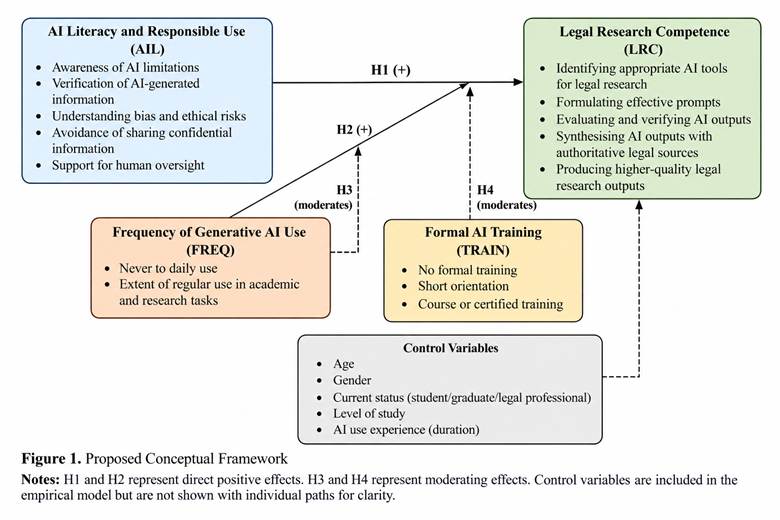
Figure 1 aligns the conceptual model directly with the four hypotheses and the regression specification. H1 represents the association between GenAI-use frequency and legal research competence; H2 represents the direct association of AI literacy/responsible use with competence; H3 represents the association of formal AI training with competence; and H4 tests whether AI literacy moderates the frequency–competence relationship. AI-use experience is included as a statistical control.
The framework therefore distinguishes exposure from capability. Frequency captures how often GenAI is used, whereas AI literacy captures verification, bias awareness, confidentiality, and human oversight. This distinction is theoretically consistent with self-regulated learning and contemporary AI-literacy scholarship, both of which emphasise monitoring, critical evaluation, and responsible human judgement (Zimmerman, 2002; Guan et al., 2025; Ditama et al., 2025).
3. Methodology
This section explains how the empirical investigation was designed and how the study dataset was analysed. Consistent with the research plan, the study adopts a quantitative cross-sectional approach and focuses on the variables directly relevant to Shopnil Islam’s research title. Particular attention is given to sampling, operationalisation, measurement diagnostics, ethical safeguards, and the choice of statistical procedures so that the analytical claims remain proportionate to the quality of the observed measurement properties (Cochran, 1977; Hair et al., 2022).
3.1 Research Design and Context
The research design specifies a quantitative, cross-sectional primary survey using a common five-point Likert questionnaire for Group 1, with reliability/validity testing and regression and/or SEM/PLS-SEM as justified by the measurement properties. The planned minimum sample is 385 completed responses under Cochran’s large/unknown-population design at 95% confidence, 5% margin of error, and p = .50. The study database contains 385 populated respondent rows. The questionnaire also specifies voluntary participation, adult eligibility, a common five-point scale, and pre-analysis checks for reliability and validity.
3.2 Respondents and Measures
The dataset includes demographic and AI-experience variables, five common AI-literacy/responsible-use items (AIL1-AIL5), five legal-research competence items (AULR1-AULR5), and additional blocks for the other two Group 1 student studies. For Shopnil Islam’s title, the focal outcome is AULR. GenAI use frequency (D7) is coded ordinally from 0 = never to 4 = daily/almost daily. Formal training (D8) is coded from 0 = none to 2 = course/certified training. AI-use experience (D6) is coded from 0 = never to 4 = more than two years.
Table 1 summarises the operational definitions, coding, and analytical roles of the focal constructs and control variables used in the study.
Table 1. Operationalisation of focal variables.
| Construct/Variable | Operationalisation | Items/Coding | Role |
| AI literacy/responsible use | Awareness of inaccuracy, verification, bias, confidentiality, human oversight | AIL1-AIL5, 1-5 Likert | Capability predictor |
| Legal research competence | Tool selection, prompting, source verification, research efficiency, retained judgement | AULR1-AULR5, 1-5 Likert | Outcome |
| GenAI use frequency | Frequency of generative-AI use | D7, ordinal 0-4 | Exposure predictor |
| Formal AI training | No training, short orientation, course/certified training | D8, ordinal 0-2 | Training predictor/control |
| AI-use experience | Length of AI-use experience | D6, ordinal 0-4 | Control |
3.3 Data Analysis Strategy
Analysis proceeded in five stages. First, respondent distributions and item-level descriptive statistics were examined. Second, internal consistency was assessed using Cronbach’s alpha. Third, mean composite scores were calculated for descriptive and exploratory association analysis. Fourth, Pearson correlations and one-way ANOVA were used to examine bivariate relationships and training-group differences. Fifth, a hierarchical moderated regression estimated legal research competence from standardised use frequency, AI literacy, their interaction, formal training, and AI-use experience. The interaction term was constructed from standardised use frequency and AI literacy, consistent with regression-based moderation analysis (Hayes, 2022).
A key diagnostic finding shaped the modelling strategy. Cronbach’s alpha was .302 for the AIL block and .283 for the AULR block, substantially below conventional thresholds for strong reflective-scale interpretation (Nunnally & Bernstein, 1994; Hair et al., 2022). Accordingly, PLS-SEM latent-variable results are not reported and established construct validity is not claimed. Composite scores are used only as exploratory summaries of the observed items, with item-level interpretation retained to avoid overstating measurement precision.
3.4 Ethical Considerations
Participation was described as voluntary and anonymous; no name was required, and respondents could discontinue at any time. The instrument also avoided unnecessary identifying information. These safeguards were designed to minimise privacy risk and support informed participation.
4. Results
This section presents the empirical findings in a staged sequence, moving from respondent characteristics and measurement diagnostics to bivariate associations, training-group differences, and multivariable hypothesis tests. Interpretation is deliberately limited here; the objective is to report the statistical evidence transparently before considering its theoretical and educational meaning in the Discussion section.
4.1 Respondent Profile
All 385 supplied rows recorded consent, adult eligibility, and AI awareness. The sample was predominantly composed of law students and undergraduates, with broad representation across Dhaka, other city corporations, district towns, and upazila/rural areas. Weekly or daily/almost-daily GenAI use was common, while formal AI training was less widespread.
Table 2 presents the principal demographic and AI-use characteristics of the 385 respondents, providing the context for interpreting the subsequent competence analyses.
Table 2. Selected respondent characteristics (N = 385).
| Characteristic | Category | n (%) |
| Gender | Male | 208 (54.0) |
| Gender | Female | 166 (43.1) |
| Current status | Law student | 237 (61.6) |
| Current status | Law graduate | 69 (17.9) |
| Current status | Advocate/legal professional | 46 (11.9) |
| Location | Dhaka | 168 (43.6) |
| Location | District town | 86 (22.3) |
| Location | Other city corporation | 77 (20.0) |
| GenAI frequency | Weekly | 175 (45.5) |
| GenAI frequency | Daily/almost daily | 100 (26.0) |
| Formal AI training | None | 230 (59.7) |
| Formal AI training | Short orientation | 105 (27.3) |
| Formal AI training | Course/certified | 50 (13.0) |
4.2 Descriptive and Measurement Diagnostics
The mean AI-literacy/responsible-use score was 3.806 (SD = 0.414), while mean legal research competence was 3.498 (SD = 0.407). Within AIL, the lowest item mean was awareness that GenAI can produce plausible but inaccurate information (M = 3.377); verification, bias awareness, confidentiality, and human-oversight items were all near or above 3.88. Within AULR, source verification was the strongest item (M = 3.894), whereas identifying appropriate GenAI tools for legal research had the lowest mean (M = 3.273).
Before testing the proposed relationships, the focal multi-item blocks were examined descriptively and for internal consistency; the resulting diagnostics are reported in Table 3.
Table 3. Descriptive statistics and internal-consistency diagnostics.
| Block | Mean | SD | Cronbach α | Interpretation |
| AIL | 3.806 | 0.414 | .302 | Low internal consistency |
| AULR | 3.498 | 0.407 | .283 | Low internal consistency |
| ACR | 3.476 | 0.385 | .209 | Low internal consistency |
| AILE | 3.576 | 0.398 | .240 | Low internal consistency |
4.3 Bivariate Relationships
GenAI use frequency had a statistically significant but small positive association with legal research competence (r = .138, p = .0066). AI literacy/responsible-use awareness showed a stronger positive association (r = .353, p < .001). The pattern indicates that frequency alone explains little of the variation in competence, whereas responsible-use knowledge is more closely aligned with the focal outcome.
Table 4 reports the principal bivariate associations used to assess the initial relationships between GenAI exposure, responsible-use literacy, and the focal competence outcome.
Table 4. Selected bivariate associations.
| Relationship | Statistic | p value | Result |
| GenAI use frequency ↔ AULR | r = .138 | .0066 | Positive, small |
| AI literacy ↔ AULR | r = .353 | < .001 | Positive, moderate |
| AI literacy ↔ ACR | r = .277 | < .001 | Positive |
| AI literacy ↔ AILE | r = .251 | < .001 | Positive |
4.4 Formal Training Differences
Legal research competence increased across the three formal-training categories. Respondents reporting no formal training had a mean AULR score of 3.445 (SD = 0.403), those with a short orientation averaged 3.558 (SD = 0.407), and those with course or certified training averaged 3.616 (SD = 0.393). A one-way ANOVA indicated a statistically significant overall difference, F = 5.29, p = .0054. The effect size was modest (η² = .027), indicating that training status accounted for approximately 2.7% of observed variance in the exploratory competence score.
4.5 Moderated Regression
The multivariable model explained 15.1% of the variance in legal research competence (R² = .151). AI literacy was the strongest predictor (unstandardised change in the competence scale per one-SD increase = 0.132, t = 6.62, p < .001). Formal training was also positive (b = 0.056, t = 2.89, p = .0041). Once these variables were included, use frequency was not statistically significant (b = 0.024, t = 1.16, p = .246), and AI-use experience was also non-significant (b = -0.025, t = -1.31, p = .190). The frequency × AI-literacy interaction was non-significant (b = 0.012, t = 0.60, p = .551).
To determine whether the bivariate relationships remained after accounting for training and AI-use experience, a moderated multivariable regression was estimated; Table 5 reports the model coefficients.
Table 5. Exploratory moderated regression predicting legal research competence (N = 385; R² = .151).
| Predictor | b | SE | t | p | Inference |
| GenAI use frequency | 0.024 | 0.021 | 1.16 | .246 | Not significant |
| AI literacy/responsible use | 0.132 | 0.020 | 6.62 | < .001 | Positive |
| Frequency × AI literacy | 0.012 | 0.019 | 0.60 | .551 | Not significant |
| Formal AI training | 0.056 | 0.019 | 2.89 | .004 | Positive |
| AI-use experience | -0.025 | 0.019 | -1.31 | .190 | Not significant |
4.6 Hypothesis Summary
H1 received bivariate support but not multivariable support: frequency correlated with competence, yet its unique effect disappeared after literacy and training were included. H2 was supported in the exploratory model. H3 was supported by both group comparisons and regression. H4 was not supported because the interaction term was non-significant. Given the low reliability of the multi-item blocks, these decisions should be treated as provisional rather than confirmatory.
5. Discussion
This section interprets the empirical results in relation to the research questions, the proposed capability-conversion framework, and the emerging literature on GenAI in higher and legal education. Rather than treating frequent use as synonymous with competence, the discussion considers whether responsible AI literacy and structured training provide the monitoring and verification mechanisms required for legally defensible research practice (Head & Willis, 2024; Bliss, 2024; Magesh et al., 2025; Guan et al., 2025).
5.1 Exposure Is Not the Same as Competence
The most important finding is the separation between use frequency and responsible capability. Frequent GenAI use showed only a small bivariate association with legal research competence and no independent effect in the multivariable model. This matters because technology-adoption narratives can implicitly assume that more use reflects greater capability. The present results do not support that assumption. A student may use GenAI often for convenience, drafting, or brainstorming without developing reliable legal-research practices. This interpretation is consistent with legal-education research cautioning that GenAI can support learning while also weakening foundational skill development when use substitutes for independent reasoning (Perdue, 2026; Head & Willis, 2024).
This distinction extends TAM in a domain where output quality is consequential. Perceived performance benefits can motivate use, but legal competence requires an additional validation layer. The findings therefore favour a capability-conversion interpretation: exposure creates opportunities, but responsible knowledge and structured learning determine whether those opportunities become competent practice.
5.2 AI Literacy as the Central Capability Factor
AI literacy was the strongest predictor in the exploratory regression. This pattern is theoretically consistent with self-regulated learning because the AIL items emphasise monitoring and control: recognising plausible inaccuracies, verifying outputs, identifying bias, protecting confidential information, and maintaining human oversight. These are not merely technical facts; they are metacognitive safeguards that govern how students decide whether an AI response should be accepted, rejected, or investigated further. This emphasis on monitoring and evaluation is consistent with contemporary reviews of AI-supported self-regulated learning, which identify AI literacy and pedagogical integration as important conditions for productive learner agency (Guan et al., 2025; An et al., 2026).
The item-level results reinforce this interpretation. Respondents reported relatively strong verification and oversight orientations, while awareness that GenAI can produce plausible but inaccurate information had the lowest mean within the literacy block. In legal education, that asymmetry is important because fluent AI output can mask substantive or citation-level errors (Ogunde, 2024; Magesh et al., 2025). Training should therefore include direct exercises in detecting hallucinated authorities and checking AI-generated propositions against primary and otherwise authoritative legal sources (Head & Willis, 2024).
5.3 The Role of Formal Training
Formal training was associated with higher competence, although the effect size was modest. This pattern is consistent with wider higher-education evidence emphasising structured AI induction, critical evaluation, and responsible-use education rather than reliance on informal experimentation alone (Ditama et al., 2025; An et al., 2026). The difference between no training and course/certified training was approximately 0.17 points on the five-point competence scale. Because the design is cross-sectional, the result should not be interpreted causally; students who seek training may already be more motivated or technologically confident. Nevertheless, the persistence of training in the regression after controlling for literacy, frequency, and experience makes the association educationally relevant.
5.4 Why the Moderation Hypothesis Was Not Supported
The non-significant interaction indicates that the association between AI literacy and competence did not vary detectably across levels of GenAI-use frequency. One interpretation is that responsible-use literacy contributes directly to competence rather than merely amplifying the association between frequent use and competence. A second explanation is methodological: low internal consistency can reduce measurement precision, while interaction effects in regression are often more difficult to estimate reliably than main effects (Hayes, 2022). Replication with refined and independently validated measures is therefore warranted.
5.5 Measurement Quality as a Substantive Finding
The low alpha coefficients are analytically important because they indicate that the five items within each block do not behave as a strongly unidimensional reflective scale in this dataset. Conceptual breadth may contribute to this pattern: AULR combines tool identification, prompting, source verification, efficiency, and independent judgement, while AIL combines factual awareness, verification behaviour, bias awareness, confidentiality, and governance beliefs. Future scale development should therefore consider multidimensional or formative specifications and use cognitive interviewing, pilot factor analysis, and item refinement before confirmatory SEM. Conventional psychometric guidance requires adequate measurement quality before strong reflective-scale or structural claims are made (Nunnally & Bernstein, 1994; Hair et al., 2022).
5.6 Integrated Interpretation
Taken together, the findings suggest a three-part pathway for legal education: access enables use, literacy supports responsible use, and training may help convert responsible use into research capability. The data do not support the proposition that frequent GenAI use alone corresponds to stronger legal research competence. Instead, the pattern is consistent with a human-centred model in which verification, source authority, confidentiality, and independent judgement remain central competencies (Head & Willis, 2024; Magesh et al., 2025).
6. Theoretical and Practical Implications
The findings have implications at three interconnected levels: theory development, legal-education practice, and institutional governance. This section therefore moves beyond restating the statistical results and explains how the study refines technology-adoption reasoning, informs the design of AI-integrated legal curricula, and supports policies that preserve verification, confidentiality, accountability, and independent legal judgement.
6.1 Theoretical Implications
First, the study differentiates adoption from competence. TAM explains why users may accept technology (Davis, 1989; Davis et al., 1989), but legal education requires an additional outcome layer: whether use corresponds to domain-specific capability. Second, the results position responsible AI literacy as a self-regulatory mechanism rather than a generic awareness construct; verification and human oversight are forms of performance monitoring that connect SRL to GenAI-supported legal work (Zimmerman, 2002; Guan et al., 2025). Third, the findings suggest that formal training should be considered as an institutional capability input alongside individual technology beliefs (Head & Willis, 2024; Ditama et al., 2025).
The non-significant moderation result is also theoretically useful. It implies that literacy may operate as a direct capability resource rather than only as a condition that amplifies frequent use. Future models can test sequential mechanisms such as training → AI literacy → verification behaviour → legal research competence, while separating efficiency-oriented competence from epistemic and ethical competence.
6.2 Practical Implications for Legal Education
Law schools should design GenAI instruction around verifiable legal tasks rather than generic prompting, consistent with emerging recommendations that legal curricula combine substantive legal knowledge, GenAI system knowledge, and ethical knowledge (Head & Willis, 2024; Bliss, 2024). Students can be required to use GenAI to generate an initial research map and then validate every proposition against statutes, reported cases, official databases, or other authoritative sources. Assessment rubrics should reward the quality of verification, source hierarchy, disclosure of AI assistance, and independent reasoning-not simply the fluency of the final text.
A tiered training model is appropriate because AI literacy encompasses technical, evaluative, and ethical competencies rather than tool operation alone (Ditama et al., 2025). Introductory sessions should cover hallucination, bias, confidentiality, and academic integrity. Intermediate training should focus on prompt design, jurisdictional constraints, citation checking, and comparison of AI-generated arguments with primary law. Advanced modules can address retrieval-augmented legal systems, explainability, professional responsibility, and documentation of AI-assisted workflows (Bliss, 2024; Head & Willis, 2024). The present results also support making at least a basic orientation widely available because the majority of respondents reported no formal training.
6.3 Policy and Professional Implications
Institutions should adopt clear policies distinguishing permitted assistance from inappropriate substitution of student judgement. Policies should require verification of legal authorities and careful handling of confidential or sensitive material when public AI systems are used. For professional preparation, students should learn that accountability remains with the human researcher even when an AI system produces text or suggests an authority, a principle consistent with emerging professional guidance on competent and responsible use of generative AI in legal practice (American Bar Association, 2024).
7. Conclusion, Limitations and Future Research
This study examined whether GenAI use is associated with legal research competence among respondents in Bangladesh and whether AI literacy and formal training help explain that relationship. The supplied 385-row dataset shows a clear pattern: use frequency has only a small bivariate relationship with competence, while responsible-use literacy is more strongly associated and formal training is positively related to competence. Once literacy and training are considered, frequency no longer has a statistically significant unique effect. The evidence therefore supports a capability-centred approach to GenAI in legal education: competence depends less on how often students use AI than on how critically and responsibly they use it.
Several limitations constrain interpretation. The cross-sectional design does not establish causality, and the self-reported measures may be affected by common-method and social-desirability bias. The available dataset does not itself document the institutional recruitment pathway, response rate, or sampling frame, which limits assessment of representativeness. Internal consistency is also low for the focal AIL and AULR blocks, so confirmatory latent-variable claims are not warranted. Before empirical submission, the research record should also verify that the 385 analysed cases are genuine field observations rather than simulated or pilot-generated records; only genuine participant data should be reported as empirical evidence.
Future research should refine the measurement model and distinguish technical prompting skill, epistemic verification competence, ethical/legal risk awareness, and independent legal judgement. A longitudinal design could examine competence before and after a structured legal-AI module. Experimental work could compare conventional legal research, unrestricted GenAI use, and verification-trained GenAI use using objective performance tasks. Multi-group analysis across universities, study levels, and professional status could test whether capability pathways differ by experience. Objective outcomes-such as citation accuracy, issue-spotting scores, research time, and quality of authority selection-would substantially strengthen the evidence base.
Declarations
Ethics and Informed Consent
The study questionnaire states that participation is voluntary and anonymous, no name is required, and participants may discontinue at any time.
Data Availability
The analytical dataset is held by the research team. Any public sharing should follow applicable consent, privacy, institutional, and journal requirements.
AI/Generative AI Disclosure
Generative AI tools were used for language refinement, structural editing, and analytical assistance. The author retains responsibility for the manuscript’s scholarly claims, interpretation, statistical reporting, reference verification, confidentiality, and compliance with the target journal’s disclosure policy. No AI system is listed as an author.
References
Davis, F. D. (1989). Perceived usefulness, perceived ease of use, and user acceptance of information technology. MIS Quarterly, 13(3), 319-340. https://doi.org/10.2307/249008
Davis, F. D., Bagozzi, R. P., & Warshaw, P. R. (1989). User acceptance of computer technology: A comparison of two theoretical models. Management Science, 35(8), 982-1003.
Zimmerman, B. J. (2002). Becoming a self-regulated learner: An overview. Theory Into Practice, 41(2), 64-70. https://doi.org/10.1207/S15430421TIP4102_2
Ogunde, F. (2024). Much ado about hallucinations: A brief assessment of the judicial response to large language model (LLM) hallucinations in the United States and Canada. International Journal of the Legal Profession, 31(2), 187-205. https://doi.org/10.1080/09695958.2024.2356084
Lorber, P. (2025). Generative AI, law schools and assessment: where next? The Law Teacher, 59(3), 372-390. https://doi.org/10.1080/03069400.2025.2535822
Lande, J. (2025). Faculty Use of Artificial Intelligence in Teaching. SSRN. https://doi.org/10.2139/ssrn.5598157
American Bar Association. (2024). Will generative AI ever fix its hallucination problem? ABA Journal.
Cochran, W. G. (1977). Sampling Techniques (3rd ed.). Wiley.
Nunnally, J. C., & Bernstein, I. H. (1994). Psychometric Theory (3rd ed.). McGraw-Hill.
Hair, J. F., Hult, G. T. M., Ringle, C. M., & Sarstedt, M. (2022). A Primer on Partial Least Squares Structural Equation Modeling (PLS-SEM) (3rd ed.). Sage.
An, Q., Koh, J. H. L., & Liu, Q. (2026). Generative artificial intelligence in higher education: A systematic review of student use and learning outcomes. Australasian Journal of Educational Technology. https://doi.org/10.14742/ajet.10561
Bliss, J. (2024). Teaching law in the age of generative AI. Jurimetrics, 64.
Chiu, T. K. F., et al. (2024). A scoping review on how generative artificial intelligence transforms assessment in higher education. International Journal of Educational Technology in Higher Education.
Guan, R., Raković, M., Chen, G., et al. (2025). How educational chatbots support self-regulated learning? A systematic review of the literature. Education and Information Technologies, 30, 4493-4518. https://doi.org/10.1007/s10639-024-12881-y
Head, A., & Willis, S. (2024). Assessing law students in a GenAI world to create knowledgeable future lawyers. International Journal of the Legal Profession, 31(3), 293-310. https://doi.org/10.1080/09695958.2024.2379785
Magesh, V., Surani, F., Dahl, M., Suzgun, M., Manning, C. D., & Ho, D. E. (2025). Hallucination-free? Assessing the reliability of leading AI legal research tools. Journal of Empirical Legal Studies. https://doi.org/10.1111/jels.12413
Perdue, A. L. (2026). An empirical examination of law student attitudes toward legal writing with generative AI. SMU Science and Technology Law Review, 29(1).
Hayes, A. F. (2022). Introduction to Mediation, Moderation, and Conditional Process Analysis: A Regression-Based Approach (3rd ed.). Guilford Press.
Ditama, D. M. C., Mutia, C., & Rahmaniyah, D. (2025). AI literacy in higher education: Concepts, competencies, and future directions. Nusantara Education Studies, 3(2), 111–133. https://doi.org/10.63208/21011-638
Appendix A. Item-Level Means for Focal Blocks
| Item | Mean | Analytical note |
| AIL1 | 3.377 | Awareness of plausible but inaccurate AI output |
| AIL2 | 3.925 | Verification before reliance |
| AIL3 | 3.878 | Bias/incomplete-data awareness |
| AIL4 | 3.935 | Confidentiality safeguard |
| AIL5 | 3.914 | Human oversight |
| AULR1 | 3.273 | Selecting appropriate GenAI tools |
| AULR2 | 3.455 | Prompt formulation |
| AULR3 | 3.894 | Verification against authoritative sources |
| AULR4 | 3.488 | Research efficiency |
| AULR5 | 3.382 | Competent use while retaining legal judgement |