Home
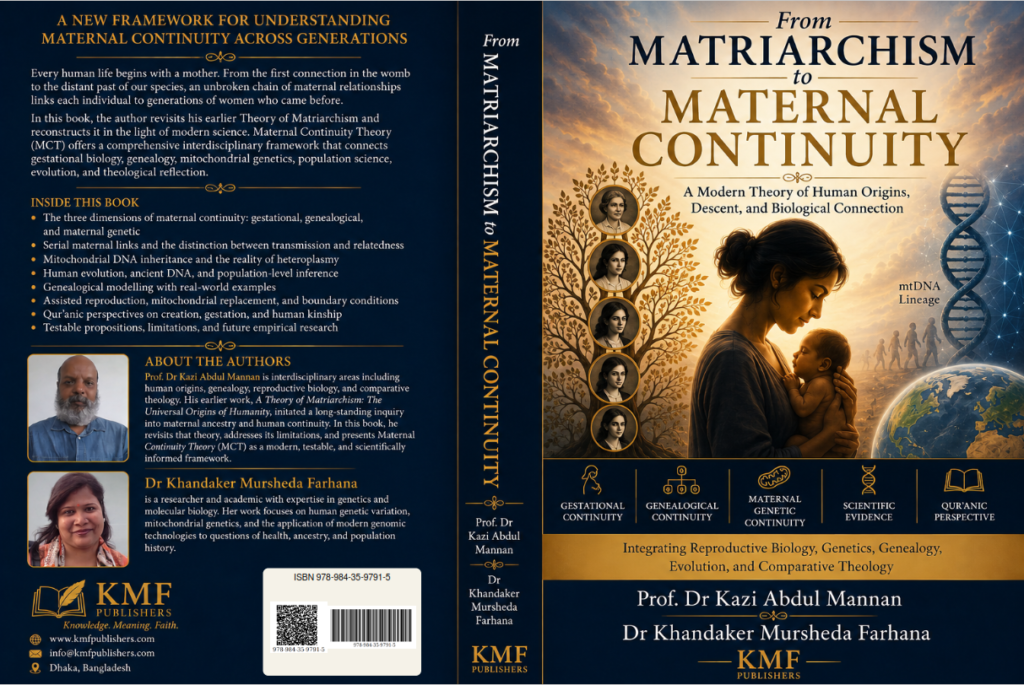
From Matriarchism to Maternal Continuity
A Modern Theory of Human Origins, Descent, and Biological Connection
By Kazi Abdul Mannan; Khandaker Mursheda Farhana
A pioneering interdisciplinary theory of human descent and biological continuity. Integrating gestational biology, genealogy, mitochondrial genetics, evolutionary science, and comparative theology, this book advances Maternal Continuity Theory (MCT) as a testable framework for understanding how maternal connections persist across generations-from individual human development to deep ancestral and population history.
| Download (PDF 5MB) Full Book (Click Here) (Free) 65 Downloads |
| Book Descriptions | |
| Edition | 1st Edition |
| First Published | 2026 |
| eBook Published | August 19, 2026 |
| Pub. Location | Bangladesh |
| Publisher | KMF Publishers (ISIN: 000000050389326X) |
| ISBN | 978-984-35-9791-5 |
| QR Code |  |
| Bar Code |  |
| Subject: Maternal Continuity Theory; gestational continuity; maternal genealogy; mitochondrial DNA; human origins; reproductive biology; population genetics; intergenerational descent |
Abstract
Maternal inheritance has been extensively investigated in reproductive biology, genetics, genealogy, and population science, yet these domains are rarely integrated within a single theoretical framework. This study develops Maternal Continuity Theory (MCT) as an interdisciplinary model for examining human intergenerational continuity across three analytically distinct but potentially convergent dimensions: gestational continuity, genealogical continuity, and maternal genetic continuity. The theory originates from the observable maternal-fetal relationship established during gestation and extends this relationship conceptually through serial mother-offspring links across generations. Unlike earlier formulations that risked conflating anatomical, genealogical, and genetic evidence, the revised MCT distinguishes each evidentiary domain and defines explicit boundaries between direct observation, documentary reconstruction, molecular corroboration, and population-level inference. The framework incorporates reproductive physiology, multigenerational pedigree modelling, predominantly maternal mitochondrial DNA transmission, evolutionary biology, and population genetics. An illustrative multigenerational family from Bangladesh is reanalysed to demonstrate how female-line gestational pathways, broader genealogical descent, and mitochondrial transmission may overlap while remaining biologically distinct. Eight theoretical propositions are advanced, including the Serial Maternal-Link Principle, Domain Independence Principle, Transmission-Relatedness Distinction, Maternal Continuity Convergence Principle, and Deep-Time Inference Boundary. MCT is positioned as complementary to, rather than competing with, evolutionary theory and biparental genetic ancestry. It does not equate mitochondrial coalescence with a unique first human female and does not treat theological interpretations as biomedical evidence. The theory generates a testable research programme based on verified pedigrees, reproductive histories, mtDNA sequencing, and evidence convergence. MCT therefore offers a falsifiable interdisciplinary framework for investigating a persistent maternal dimension of human descent across individual, family, molecular, and population scales.
Citation: Mannan, K.A., & Farhana, K.M. (2026). From Matriarchism to Maternal Continuity
A Modern Theory of Human Origins, Descent, and Biological Connection. KMF Publishers. Open Access (CC BY 4.0). DOI: https://doi.org/10.64907/xkmf.book.b3.19.08.26
Preface
Ideas rarely emerge in their final form. A theory may begin with a simple observation, develop through questioning and reflection, and then require substantial reconsideration as new knowledge, evidence, and methods become available. This book represents such an intellectual journey.
My earlier work, “A Theory of Matriarchism: The Universal Origins of Humanity,” began with a fundamental question concerning human continuity: if every person who has undergone gestation originates through an embodied relationship with a mother, and that mother herself emerged through an earlier reproductive relationship, how far can this sequence of maternal relationships be traced across generations? The visible umbilical legacy of prenatal life provided the initial point of observation, while family genealogy offered a means of thinking about the recurrence of maternal relationships across successive generations. From this starting point, I attempted to explore a much larger question concerning maternal ancestry and human origins.
Over time, however, I became increasingly aware that the original formulation required both preservation and reconstruction. Its central intuition remained important to me, but the scientific interpretation of that intuition needed to be reconsidered in light of contemporary reproductive biology, molecular genetics, mitochondrial inheritance, genealogy, population genetics, evolutionary science, and developments in assisted reproductive technology.
The result is Maternal Continuity Theory (MCT).
This book should therefore not be understood simply as a republication or expansion of my earlier theory. Nor do I regard it as a rejection of that work. Rather, it represents its modern reconstruction. The intellectual question that initiated the earlier theory remains, but the conceptual vocabulary, evidentiary architecture, theoretical boundaries, and testable propositions have been substantially reformulated.
The most important change concerns the meaning of continuity itself.
My earlier work placed considerable emphasis on the navel and umbilical relationship as evidence of maternal connection. In the present theory, I distinguish more carefully between the anatomical evidence of an individual’s prenatal history and the much broader question of ancestry. The umbilicus is evidence of a previous fetal-placental relationship, but it cannot by itself identify a mother, grandmother, remote ancestor, or prehistoric maternal lineage. The scientific journey from an observable gestational relationship to deep human ancestry therefore requires several distinct forms of evidence.
This realization led me to formulate three central dimensions of Maternal Continuity Theory: gestational continuity, genealogical continuity, and maternal genetic continuity.
Gestational continuity concerns the embodied relationship established during pregnancy. Genealogical continuity concerns relationships of descent that can be reconstructed across generations. Maternal genetic continuity concerns the particular forms of genetic transmission associated with maternal descent, especially mitochondrial DNA. These dimensions frequently overlap, but they are not identical. This distinction fundamentally changes the theoretical structure.
A woman may gestate a daughter who later gestates another child. These are not parts of one physically continuous pregnancy. They are separate biological events. Yet when placed genealogically in sequence, they constitute what I describe in this book as serial maternal links. Thus, maternal continuity is not the persistence of one umbilical cord, placenta, organ, or physiological connection across generations. It is the recurrence of identifiable maternal relationships within an intergenerational pathway.
Symbolically, this may be represented as:
Each arrow represents a distinct reproductive relationship. Together, however, they constitute a maternal pathway.
This reformulation also required me to reconsider the position of male descendants. A son does not become disconnected from his mother simply because his own children are gestated by another woman. He remains her genealogical descendant and carries genetic material inherited from her. What ordinarily does not continue through him is her direct mitochondrial transmission pathway to his offspring. The distinction between transmission and relatedness consequently became one of the central principles of the revised theory.
Mitochondrial genetics provided another important reason for modernization. The predominantly maternal transmission of mitochondrial DNA offers an extraordinary molecular means of investigating female-line ancestry. Yet mitochondrial ancestry must not be confused with total human ancestry. Human beings inherit the overwhelming majority of their genetic material through biparental processes, and every person’s genealogy expands through both maternal and paternal branches.
For this reason, this book makes a distinction that I consider fundamental:
Maternal Continuity Theory therefore does not propose maternal exclusivity. It identifies one biologically distinctive pathway within the vastly more complex network of human descent.
The same caution became necessary when considering the concept popularly known as “mitochondrial Eve.” The possibility of tracing surviving mitochondrial lineages toward a common maternal ancestor is highly relevant to the questions that originally motivated my theory. Nevertheless, mitochondrial coalescence does not identify the first woman, the only woman living at a particular time, or necessarily the first anatomically modern human female. A mitochondrial common ancestor represents a particular genetic coalescence point within surviving maternal lineages.
Accordingly, one of the most significant intellectual transitions represented by this book is the movement from the question of a single “first woman” toward the scientifically more defensible investigation of maternal lineage continuity and coalescence.
This change does not diminish my original question. In my view, it makes the question more precise.
The book also retains a Qur’anic dimension because the theological questions surrounding human creation, gestation, generations, kinship, and common human origin formed part of the intellectual context from which my original thinking developed. However, I have attempted here to establish a much clearer epistemological boundary. Qur’anic statements are considered within a comparative theological framework; they are not presented as substitutes for biomedical or genetic evidence. Similarly, contemporary discoveries in genetics or embryology should not automatically be treated as scientific proof of a particular scriptural interpretation.
I believe meaningful interdisciplinary inquiry becomes stronger, rather than weaker, when the boundaries between different forms of knowledge are made explicit.
For this reason, the book places reproductive medicine, genetics, genealogy, evolutionary science, population genetics, and theology into dialogue without assuming that they employ identical methods or answer identical questions. Biomedical science investigates mechanisms and testable relationships. Population genetics reconstructs demographic and genetic history probabilistically. Genealogy examines relationships of descent. Theology addresses questions that may include creation, meaning, human commonality, and purpose. Maternal Continuity Theory occupies a deliberately interdisciplinary position among these conversations.
An important part of this reconstruction is the multigenerational family example from Bangladesh that contributed to the development of my original thinking. In this book, that family is no longer presented as proof of universal maternal ancestry. Instead, it serves as an illustrative genealogical model through which different forms of continuity can be distinguished. Its female-line branches illustrate serial maternal relationships; its male-mediated branches demonstrate why genealogical relatedness must not be confused with mitochondrial transmission; and the pedigree as a whole provides a foundation for designing future empirical tests.
Indeed, perhaps the most important difference between my earlier work and this book concerns falsifiability.
I do not wish Maternal Continuity Theory to be accepted merely because its central idea appears intuitively compelling. A scientific theory should expose itself to evidence capable of supporting, modifying, or challenging it. For that reason, this book develops explicit propositions, boundary conditions, counterarguments, limitations, and possible empirical tests.
The next stage of this work should therefore occur not only in theoretical discussion but also in the laboratory, the clinic, the archive, and the field.
Multigenerational pedigrees can be independently reconstructed. Reproductive histories can be documented. Maternal relationships can be evaluated using autosomal evidence where appropriate. Complete mitochondrial genomes can be sequenced. Female-line branches can be compared with male-mediated genealogical branches. Multiple families and populations can be studied. Assisted reproductive technologies can provide important boundary cases in which gestational and genetic maternal relationships no longer coincide.
Such studies may support some propositions of MCT and require revision of others. I welcome both possibilities. This is why I regard this book not as the conclusion of the theory but as the beginning of a new phase of its development.
The intellectual transition represented here may be summarized as:
I have deliberately preserved the history of the earlier theory rather than concealing it. Scientific and scholarly development should permit authors to revisit their own ideas. To revise a theory in response to advances in knowledge is not to erase its intellectual history; it is to make that history visible.
The present work therefore records both continuity and change in my own thinking.
The continuity lies in the question that has remained with me: how should we understand the extraordinary recurrence of maternal relationships through human generations?
The change lies in how that question is now approached.
Rather than moving directly from an anatomical observation to universal human origins, the present framework proceeds through progressively different evidentiary levels:
At every stage, the strength of the conclusion must remain proportional to the strength and type of evidence available.
This principle is perhaps the most important lesson I have drawn from revisiting my earlier work.
I offer Maternal Continuity Theory neither as a final answer to the question of human origins nor as an alternative to evolutionary biology. I offer it as an interdisciplinary framework through which one distinctive dimension of human continuity-the recurring maternal pathway-can be described more precisely, investigated empirically, and situated within the broader complexity of human ancestry.
If this book succeeds, its contribution will not be measured by whether every proposition remains unchanged. Its value will lie in whether it generates better questions, clearer distinctions, testable hypotheses, and further empirical investigation.
I therefore invite scholars in reproductive medicine, genetics, genomics, genealogy, anthropology, evolutionary biology, population genetics, philosophy of science, and theology to engage critically with the theory. Agreement is not a prerequisite for productive scholarship. Careful criticism, independent testing, and alternative explanations are precisely what can determine whether Maternal Continuity Theory develops into a useful scientific framework.
This book represents my effort to reconsider an earlier idea in the light of contemporary knowledge while preserving the question that originally inspired it. It is, in that sense, both a continuation and a reconstruction-a movement from Matriarchism to Maternal Continuity.
Prof. Dr Kazi Abdul Mannan and Dr Khandaker Mursheda Farhana
Author
Publisher’s Note
KMF Publishers is pleased to present this scholarly work, which represents a significant intellectual development of the author’s earlier theoretical inquiry into maternal descent and human origins. In this volume, the original Theory of Matriarchism is revisited, critically reassessed, and substantially reconstructed as Maternal Continuity Theory (MCT)-an interdisciplinary framework bringing reproductive biology, genealogy, mitochondrial genetics, population genetics, evolutionary science, and comparative theological reflection into a structured scholarly dialogue.
An important characteristic of this book is the author’s willingness to return critically to his earlier theoretical propositions in light of advances in scientific knowledge. Rather than simply reproducing or defending the original theory, the present volume identifies areas requiring clarification, modifies earlier interpretations, establishes new conceptual boundaries, and develops propositions capable of future empirical investigation. This process of reassessment reflects an important principle of scholarship: theories should remain open to refinement when new evidence, methods, and perspectives become available.
At the centre of the revised framework is a distinction among three dimensions of maternal continuity: gestational continuity, genealogical continuity, and maternal genetic continuity. By separating these domains, the author seeks to distinguish the embodied biological relationship of pregnancy from broader genealogical descent and from the predominantly maternal transmission of mitochondrial DNA. The resulting framework also acknowledges the essential role of paternal ancestry and situates maternal continuity within the wider, complex, and population-based history of human descent.
The book is particularly noteworthy for establishing boundaries around its own claims. Maternal Continuity Theory is not presented as a replacement for evolutionary biology or population genetics, nor does it claim that mitochondrial ancestry constitutes the entirety of human ancestry. The distinction between mitochondrial coalescence and the concept of a unique “first woman,” the recognition of male-mediated genealogical descent, and the discussion of assisted reproduction and other boundary conditions demonstrate the author’s effort to make the revised theory scientifically testable rather than conceptually unrestricted.
The inclusion of the Bangladesh multigenerational family example provides continuity with the author’s earlier work while also illustrating the transition in his thinking. In the present volume, the family genealogy is employed as an illustrative model through which different forms of maternal relationship can be examined, rather than as independent proof of universal human ancestry. This shift from illustration to testable proposition is central to the modernization of the theory.
Another distinctive dimension of the book is its engagement with the Qur’anic perspective on human creation, gestation, kinship, and generations. The author treats this material as a comparative theological and epistemological perspective, while maintaining a methodological distinction between revelatory interpretation and empirical biomedical evidence. In doing so, the volume seeks interdisciplinary dialogue without treating different systems of knowledge as methodologically interchangeable.
From a publishing perspective, KMF Publishers considers the transition represented in this volume particularly significant:
This progression reflects the broader scholarly principle that theoretical development is not necessarily linear. Intellectual advancement may require scholars to revisit their own assumptions, acknowledge limitations, incorporate new knowledge, and formulate more precise and falsifiable propositions.
The present book should therefore be read neither as the final resolution of questions concerning maternal ancestry nor as a definitive account of human origins. It is better understood as the presentation of a developing interdisciplinary theory and an associated research programme. Its propositions invite examination through verified multigenerational pedigrees, reproductive histories, mitochondrial genome analysis, population-genetic methods, and other forms of independent empirical evidence.
KMF Publishers particularly welcomes this aspect of the work. Scholarly publishing should provide space not only for established knowledge but also for carefully formulated new theories that are transparent about their assumptions, evidence, limitations, and conditions for revision. The value of such theoretical scholarship ultimately depends upon the critical engagement it generates and the evidence produced by subsequent research.
We therefore publish this volume with an invitation to researchers and scholars in reproductive medicine, genetics and genomics, genealogy, anthropology, evolutionary biology, population genetics, philosophy of science, and comparative theology to examine Maternal Continuity Theory critically. Independent testing, constructive criticism, alternative interpretations, and empirical replication will be essential to determining the theory’s longer-term scholarly significance.
KMF Publishers recognizes this volume as an important stage in the evolution of an author’s original theoretical inquiry-from an earlier concept of Matriarchism toward the more differentiated and empirically oriented framework of Maternal Continuity. The book documents not only a theory of intergenerational relationships but also the process through which a theory itself can evolve.
It is our hope that this work will encourage further discussion, empirical investigation, and interdisciplinary scholarship concerning maternal relationships, genealogy, genetic inheritance, and the broader scientific and philosophical questions surrounding human continuity and origins.
KMF Publishers
Publisher
Contents
| SL | Contents | Page | |
| 1. | Introduction | 1 | |
| 1.1 | Problem Statement | 3 | |
| 1.2 | Research Gap | 4 | |
| 1.3 | Research Objectives | 5 | |
| 1.4 | Research Questions | 6 | |
| 2. | Literature Review | 7 | |
| 2.1 | Human Evolution and Biological Continuity | 7 | |
| 2.2 | Human Origins and Population Genetics | 8 | |
| 2.3 | Reproductive Biology and the Maternal-Fetal Interface | 10 | |
| 2.4 | Mitochondrial DNA and Maternal Genetic Continuity | 11 | |
| 2.5 | Genealogy and Intergenerational Maternal Descent | 13 | |
| 2.6 | Kinship, Biological Descent, and Social Relatedness | 14 | |
| 2.7 | Synthesis and Theoretical Positioning | 15 | |
| 3. | Conceptual Foundations | 16 | |
| 3.1 | Conceptualizing Maternal Continuity | 17 | |
| 3.2 | Gestational Continuity | 17 | |
| 3.3 | Genetic Continuity | 19 | |
| 3.4 | Genealogical Continuity | 20 | |
| 3.5 | Relationship Among the Three Forms of Continuity | 21 | |
| 3.6 | Convergence and Divergence within Maternal Continuity | 23 | |
| 3.7 | Temporal and Evidentiary Boundaries | 24 | |
| 3.8 | Boundary Conditions of the Theory | 25 | |
| 3.9 | Conceptual Definition of Maternal Continuity Theory | 26 | |
| 4. | The Maternal Continuity Theory | 26 | |
| 4.1 | The Central Theoretical Proposition | 27 | |
| 4.2 | From the Umbilical Observation to a Theory of Continuity | 28 | |
| 4.3 | The Serial Maternal-Link Principle | 29 | |
| 4.4 | The Maternal Continuity Pathway | 30 | |
| 4.5 | Ascending and Descending Maternal Analysis | 31 | |
| 4.6 | Transmission, Branching, and Termination | 32 | |
| 4.7 | The Three-Layer Maternal Continuity Model | 33 | |
| 4.8 | The Maternal Continuity Convergence Principle | 34 | |
| 4.9 | Maternal Continuity and the Question of Human Origins | 34 | |
| 4.10 | Maternal Continuity Does Not Replace Evolution | 36 | |
| 4.11 | The Original Contribution of MCT | 36 | |
| 5. | Propositions and Conceptual Model | 38 | |
| 5.1 | Proposition 1: Universal Gestational Predecessor Principle | 38 | |
| 5.2 | Proposition 2: Serial Maternal-Link Principle | 39 | |
| 5.3 | Proposition 3: Genealogical Reconstruction Principle | 40 | |
| 5.4 | Proposition 4: Maternal Genetic Transmission Principle | 40 | |
| 5.5 | Proposition 5: Domain Independence Principle | 41 | |
| 5.6 | Proposition 6: Maternal Continuity Convergence Principle | 42 | |
| 5.7 | Proposition 7: Transmission-Relatedness Distinction | 43 | |
| 5.8 | Proposition 8: Deep-Time Inference Boundary | 43 | |
| 5.9 | Integrated Conceptual Model of Maternal Continuity Theory | 44 | |
| 5.10 | Three-Level Evidence Architecture | 46 | |
| 5.11 | Falsifiability and Empirical Expectations | 46 | |
| 5.12 | Summary of Theoretical Propositions | 47 | |
| 6. | Methodology | 48 | |
| 6.1 | Study Design | 48 | |
| 6.2 | Methodological Framework | 49 | |
| 6.3 | Interdisciplinary Conceptual Synthesis | 50 | |
| 6.4 | Concept Identification and Operational Definition | 51 | |
| 6.5 | Unit of Analysis | 51 | |
| 6.6 | Construction of the Genealogical Model | 52 | |
| 6.7 | Branching and Transmission Rules | 53 | |
| 6.8 | Illustrative Genealogical Case | 53 | |
| 6.9 | Evidence Classification | 54 | |
| 6.10 | Convergence Analysis | 54 | |
| 6.11 | Proposition-Based Evaluation | 55 | |
| 6.12 | Boundary-Case Analysis | 56 | |
| 6.13 | Deep-Time Analysis and Inferential Limit | 56 | |
| 6.14 | Validity and Falsifiability | 57 | |
| 6.15 | Ethical Considerations | 57 | |
| 6.16 | Methodological Scope | 58 | |
| 7. | Illustrative Genealogical Analysis: The Bangladesh Family Example | 58 | |
| 7.1 | Purpose of the Illustrative Analysis | 59 | |
| 7.2 | Identification of the Focal Maternal Ancestor | 60 | |
| 7.3 | First Maternal Branching: Daughters and Sons | 60 | |
| 7.4 | Reconstruction of the Female-Line Pathway | 61 | |
| 7.5 | Gestational Continuity within the Family | 62 | |
| 7.6 | Genealogical Continuity within the Family | 62 | |
| 7.7 | Predicted Maternal Genetic Pattern | 63 | |
| 7.8 | An MCT Evidence Matrix for the Bangladesh Family | 64 | |
| 7.9 | Branching of the Maternal Network | 66 | |
| 7.10 | Line Persistence and Line Extinction | 67 | |
| 7.11 | Ascending Analysis from a Contemporary Descendant | 67 | |
| 7.12 | What the Bangladesh Example Demonstrates | 68 | |
| 7.13 | What the Bangladesh Example Does Not Demonstrate | 68 | |
| 7.14 | Revised Interpretation of the Original Family Model | 69 | |
| 7.15 | Implications for Empirical Testing | 70 | |
| 8. | Relationship with Evolutionary and Population-Genetic Evidence | 71 | |
| 8.1 | MCT within the Evolutionary Framework | 71 | |
| 8.2 | Human Origins as a Population Process | 72 | |
| 8.3 | Population Structure and Human Ancestry | 73 | |
| 8.4 | Genealogical Ancestry versus Genetic Ancestry | 74 | |
| 8.5 | Mitochondrial DNA as a Maternal-Line Marker | 74 | |
| 8.6 | Mitochondrial Coalescence and “Mitochondrial Eve” | 75 | |
| 8.7 | Lineage Coalescence versus the First Maternal Ancestor | 76 | |
| 8.8 | Why Maternal Lineages Disappear | 77 | |
| 8.9 | Maternal Continuity and Ancient DNA | 77 | |
| 8.10 | Population Structure and the Interpretation of Common Ancestry | 78 | |
| 8.11 | Compatibility with Natural Selection and Genetic Drift | 79 | |
| 8.12 | Maternal Continuity and Archaic Admixture | 79 | |
| 8.13 | Evolutionary Interpretation of the Serial Maternal-Link Principle | 80 | |
| 8.14 | An Integrated Evolutionary-MCT Model | 80 | |
| 8.15 | Theoretical Convergence with Population Genetics | 81 | |
| 8.16 | Theoretical Boundary between MCT and Evolutionary Evidence | 82 | |
| 8.17 | Implications for Maternal Continuity Theory | 82 | |
| 9. | Comparative and Theological Perspective: The Qur’anic Component | 83 | |
| 9.1 | Rationale for Including a Theological Perspective | 84 | |
| 9.2 | Epistemological Distinction between Revelation and Biomedical Evidence | 85 | |
| 9.3 | Qur’anic Representation of Human Creation | 85 | |
| 9.4 | Reproduction through Male and Female Contribution | 86 | |
| 9.5 | The Womb as a Site of Human Development | 87 | |
| 9.6 | Maternal Gestation, Birth, and Dependency | 87 | |
| 9.7 | The Qur’anic Concept of Arḥām and Genealogical Relatedness | 88 | |
| 9.8 | Humanity from a Common Origin: Interpreting Qur’an 4:1 | 89 | |
| 9.9 | Maternal Continuity and Qur’anic Genealogy | 89 | |
| 9.10 | A Qur’anic Reading of Serial Maternal Continuity | 90 | |
| 9.11 | Qur’anic Perspective and Mitochondrial Inheritance | 90 | |
| 9.12 | Qur’anic Perspective and Mitochondrial Eve | 91 | |
| 9.13 | Comparative Epistemological Model | 91 | |
| 9.14 | Areas of Conceptual Convergence and Distinction | 92 | |
| 9.15 | Theological Implications for Maternal Continuity Theory | 93 | |
| 9.16 | Position of the Qur’anic Component within MCT | 94 | |
| 10. | Discussion | 94 | |
| 10.1 | From Anatomical Observation to Embodied Maternal Continuity | 95 | |
| 10.2 | Serial Maternal Continuity as the Principal Theoretical Contribution | 95 | |
| 10.3 | Distinguishing Maternal Continuity from Maternal Exclusivity | 96 | |
| 10.4 | The Importance of Separating Transmission from Relatedness | 97 | |
| 10.5 | Interpretation of the Bangladesh Family Example | 98 | |
| 10.6 | Mitochondrial Genetics Provides Support but Also Defines a Boundary | 99 | |
| 10.7 | MCT and the Concept of Mitochondrial Eve | 99 | |
| 10.8 | Compatibility with Evolutionary Theory | 100 | |
| 10.9 | A Micro-to-Macro Bridge | 101 | |
| 10.10 | Assisted Reproduction as a Critical Test of MCT | 101 | |
| 10.11 | Medical and Biomedical Relevance | 102 | |
| 10.12 | The Qur’anic Component in an Interdisciplinary Framework | 103 | |
| 10.13 | Falsifiability and Scientific Status of MCT | 103 | |
| 10.14 | Theoretical Contributions | 104 | |
| 10.15 | Alternative Explanations and Potential Criticisms | 104 | |
| 10.16 | Future Empirical Direction | 105 | |
| 10.17 | Overall Interpretation | 106 | |
| 11. | Boundary Conditions, Counterarguments, and Limitations | 107 | |
| 11.1 | Boundary Condition 1: MCT Does Not Represent Complete Human Ancestry | 107 | |
| 11.2 | Boundary Condition 2: Gestational Continuity Is Not Genetic Continuity | 108 | |
| 11.3 | Boundary Condition 3: Genealogical Continuity Is Not Necessarily Genetic Detectability | 109 | |
| 11.4 | Boundary Condition 4: Maternal Genetic Continuity Is Not Molecular Identity | 109 | |
| 11.5 | Boundary Condition 5: Male Descendants Do Not Become Genealogically Disconnected | 110 | |
| 11.6 | Boundary Condition 6: The Umbilicus Has Limited Evidentiary Scope | 110 | |
| 11.7 | Boundary Condition 7: Maternal-Line Coalescence Is Not the Origin of Womanhood or Humanity | 110 | |
| 11.8 | Boundary Condition 8: Species Origins Cannot Be Reduced to a Single Genealogical Event | 111 | |
| 11.9 | Counterargument 1: MCT Merely Renames Established Biological Facts | 111 | |
| 11.10 | Counterargument 2: There Is No Genuine “Continuity” between Separate Pregnancies | 112 | |
| 11.11 | Counterargument 3: MCT Artificially Privileges the Maternal Line | 113 | |
| 11.12 | Counterargument 4: mtDNA Cannot Validate the Entire Theory | 113 | |
| 11.13 | Counterargument 5: Exceptional Paternal mtDNA Findings Challenge a Strict Maternal Rule | 114 | |
| 11.14 | Counterargument 6: Assisted Reproduction Complicates the Concept of “Mother” | 114 | |
| 11.15 | Counterargument 7: Genealogy Is Vulnerable to Documentary Error | 115 | |
| 11.16 | Limitation 1: The Present Study Is Primarily Conceptual | 115 | |
| 11.17 | Limitation 2: The Bangladesh Family Is Illustrative rather than Representative | 116 | |
| 11.18 | Limitation 3: Numerical Inconsistency in the Original Family Description | 116 | |
| 11.19 | Limitation 4: Absence of Molecular Verification in the Family Example | 117 | |
| 11.20 | Limitation 5: Deep-Time Genealogical Reconstruction Is Not Currently Possible | 117 | |
| 11.21 | Limitation 6: Population-Genetic Models Are Inferential | 117 | |
| 11.22 | Limitation 7: The Framework Does Not Fully Address Social and Cultural Kinship | 118 | |
| 11.23 | Limitation 8: The Theological Component Has a Different Evidentiary Status | 118 | |
| 11.24 | Limitation 9: Terminological Ambiguity Requires Continued Refinement | 119 | |
| 11.25 | Ethical and Privacy Limitations of Future Testing | 119 | |
| 11.26 | Falsification and Revision Criteria | 119 | |
| 11.27 | Overall Boundary of Maternal Continuity Theory | 120 | |
| 12. | Implications and Future Empirical Testing | 121 | |
| 12.1 | Implications for Reproductive Medicine | 121 | |
| 12.2 | Implications for Medical Genetics | 122 | |
| 12.3 | Implications for Pedigree Analysis | 123 | |
| 12.4 | Implications for Assisted Reproductive Medicine | 124 | |
| 12.5 | Implications for Genealogical Research | 125 | |
| 12.6 | Implications for Population Genetics | 126 | |
| 12.7 | Implications for Human-Origin Research | 127 | |
| 12.8 | Implications for Interdisciplinary Theory Development | 128 | |
| 12.9 | Future Empirical Testing: General Strategy | 128 | |
| 12.10 | Phase I: Validation of the Bangladesh Family Pedigree | 129 | |
| 12.11 | Phase II: mtDNA Testing of the Bangladesh Family | 129 | |
| 12.12 | Molecular Methods for Future Testing | 131 | |
| 12.13 | Phase III: Multi-Family Replication | 132 | |
| 12.14 | Phase IV: Cross-Population Validation | 132 | |
| 12.15 | Phase V: Testing Assisted-Reproduction Boundary Conditions | 133 | |
| 12.16 | Phase VI: Clinical Mitochondrial-Disease Applications | 134 | |
| 12.17 | Phase VII: Genealogy-Genomics Integration | 135 | |
| 12.18 | Developing a Maternal Continuity Confidence Index | 135 | |
| 12.19 | Phase VIII: Ancient DNA and Historical Maternal Lineages | 136 | |
| 12.20 | Phase IX: Population-Level Simulation | 137 | |
| 12.21 | Testing the Evidence Convergence Principle | 138 | |
| 12.22 | Falsification-Oriented Research | 138 | |
| 12.23 | Recommended Research Design for the First Empirical Study | 139 | |
| 12.24 | Statistical Approaches for Future Empirical Studies | 140 | |
| 12.25 | Ethical Priorities for Future Research | 140 | |
| 12.26 | Future Theoretical Development | 141 | |
| 12.27 | Potential Extension to Epigenetic and Developmental Continuity | 142 | |
| 12.28 | Potential Extension to Maternal Microchimerism | 142 | |
| 12.29 | Long-Term Research Programme | 143 | |
| 12.30 | Overall Implications | 144 | |
| 13. | Conclusion | 145 | |
| References | 149 | ||
| Master Bibliography | 151 | ||
TABLE OF CONTENTS