Journal Home
OPEN ACCESS
Employee Privacy and Human Review in AI Workplace Monitoring in Bangladesh
| Md. Assiful Islam Rehad ORCID: https://orcid.org/0009-0003-3378-4593 Mst. Rafia Mahmuda Laboni ORCID: https://orcid.org/0009-0005-9752-3370 Sadia Afrin Soma ORCID: https://orcid.org/0009-0000-2885-2692 Department of Law Shanto-Mariam University of Creative Technology Dhaka, Bangladesh |
| Prof. Dr Kazi Abdul Mannan Department of Business Administration Faculty of Business Shanto-Mariam University of Creative Technology Dhaka, Bangladesh Email: drkaziabdulmannan@gmail.com ORCID: https://orcid.org/0000-0002-7123-132X Corresponding author: Md. Assiful Islam Rehad: mmdrehadsorkar@gmail.com |
J. socioecon. contemp. rev. 2026, 6(4); https://doi.org/10.64907/xkmf.v6i4.jscr.1
Submission received: 20 September 2026 / Revised: 25 October 2026 / Accepted: 28 October 2026 / Published: 30 October 2026
Download PDF (507 KB)
Abstract
Artificial intelligence can expand the ability of employers to collect and analyse information about work. Whether such monitoring is acceptable depends on both informational safeguards and the procedures through which monitoring data affect employees. This study examines expectations of notice, proportionate purpose, data disclosure and human review in Bangladesh. It analyses 385 adult respondents who reported awareness of AI, using item-level distributions, paired endorsement comparisons and an exploratory proportional-odds model. The sample includes 238 law students and is not presented as representative of employed workers or the national workforce. Notice that AI monitors workplace activity was endorsed by 292 respondents (75.8%), while review before serious employment consequences was endorsed by 205 (53.2%). Their within-person difference was 22.6 percentage points (95% bootstrap interval 16.4-28.8; Holm-adjusted p < .001). Sixty-one respondents (15.8%) endorsed all four procedural safeguards. Privacy safeguards were said to affect acceptance of monitoring by 301 respondents (78.2%). In the adjusted model, the notice expectation showed a pointwise odds ratio of 1.35 (95% confidence interval 1.04-1.75), but its Holm-adjusted p-value was .102; the four focal associations therefore provide limited evidence after multiplicity adjustment. These findings describe distinctions between stated expectations, not the effect of actual monitoring, privacy violations or psychological-contract breach. Integrating legal safeguards with job demands-resources and psychological-contract perspectives, the article proposes a sequence connecting notice, purpose limitation, usable information and meaningful review. Longitudinal and experimental studies of employees and implemented systems are needed to examine whether these safeguards change perceived privacy and workplace outcomes.
Keywords: workplace surveillance; artificial intelligence; employee privacy; automated monitoring; human review; Bangladesh; labour law
1. Introduction
Digital systems can collect records of work activity, communications and organisational processes at considerable speed and scale. Some automated management systems use artificial intelligence to infer patterns or make predictions; others operate through fixed rules. Both can affect workers when the resulting information is used for supervision or employment decisions. The International Labour Organization (ILO) describes algorithmic management as a set of functions including monitoring, supervision and evaluation, while distinguishing AI-based systems from simpler rule-based tools. The distinction matters because the presence of digital monitoring does not itself establish that an AI model is involved.[1]
The growth of monitoring raises questions about privacy and organisational accountability. Employers may seek to protect assets, organise work or meet security obligations, but those purposes do not by themselves determine which data should be collected, for how long, or how they should influence individual decisions. A monitoring arrangement may be formally disclosed yet remain difficult for a worker to understand or contest. Conversely, a well-designed safeguard may make the collection and use of workplace data more visible and subject to scrutiny. The issue is thus not simply whether a worker has heard that monitoring occurs; it is how notice relates to the uses of information and the availability of meaningful review.[2]
This article studies stated expectations about those questions in Bangladesh. The supplied Group 9 questionnaire asks respondents whether employees should be informed of AI monitoring, whether monitoring should have legitimate and proportionate purposes, whether workers should receive clear information about collected data, and whether human review should precede serious employment consequences. It also asks whether privacy safeguards affect respondents’ acceptance of AI-enabled monitoring. These statements permit a differentiated analysis of governance expectations. They do not establish the prevalence or intensity of a deployed monitoring system, actual employee privacy harm, or the psychological effects of surveillance.
Bangladesh’s Personal Data Protection Act 2026 provides a relevant statutory setting for personal-data processing. Its provisions address, among other matters, access, correction, transparency and security. Section 1(3) specifies a commencement arrangement under which most provisions are deemed effective from 6 November 2025, while section 23 and sections 31-35 are subject to later commencement by notification after the period stated in the Act. Application in a particular employment relationship depends on the statutory text, applicable exceptions and implementation. This article uses the Act to frame questions for institutional design; it does not treat respondents’ survey answers as evidence that any employer has complied with or breached it.[3]
International instruments offer useful comparison without creating domestic obligations by themselves. The ILO code on workers’ personal data addresses advance information about monitoring and the conditions of its use. United Kingdom Information Commissioner’s Office guidance discusses transparency and meaningful human involvement in automated employment contexts. Their relevance is comparative: they illustrate how safeguards may be organised across the information lifecycle and decision process, rather than supplying a direct statement of Bangladeshi law.[4]
Research on electronic performance monitoring has examined associations with stress, job satisfaction and work outcomes. Meta-analyses show that monitoring arrangements and their implementation matter, and caution against assuming a universal productivity benefit. These studies do not establish that the respondents in the present survey have experienced AI monitoring. They do provide a reason to ask how people view safeguards before drawing conclusions about adoption or trust. The Bangladesh questionnaire offers a specific opportunity to compare responses to four safeguards within the same records.[5]
The gap addressed here has three elements. First, workplace privacy research can obscure the distinction between informing workers that monitoring occurs and giving them usable information about what is collected. Second, safeguards at the data-collection stage and review at the decision stage may receive different levels of support. Third, an aggregate expectation may not correspond to an independently measurable psychological construct. The questionnaire combines normative statements about employer practices with a statement that privacy safeguards affect acceptance. It does not contain separate validated scales for monitoring intensity, privacy-rights violation, organisational trust or contract breach. The analysis therefore preserves the meaning of each item rather than treating the five statements as interchangeable indicators of a latent construct.[6]
The article’s distinct contribution is a notice-review comparison: it asks whether the same respondents who support notification also support human review before serious consequences, and examines how expectations of four separate safeguards align with the privacy-acceptance statement. This focus is different from a study of job insecurity or career adaptation, even though those subjects appear elsewhere in the shared questionnaire. The comparison is also different from a causal evaluation: all five items are stated expectations, measured once, and their wording differs in the action and consequence described.
The study has four objectives. It describes the respondent profile and complete response distributions for the workplace-monitoring items; compares notice with purpose limitation, data disclosure and human review using paired responses; examines joint endorsement of safeguards; and estimates exploratory adjusted associations between each safeguard expectation and the privacy-acceptance statement. A fourth paired comparison contrasts the privacy-acceptance statement with human review. These comparisons offer descriptive evidence of how the propositions are answered within a sample, while leaving open why respondents answer them differently.
The research questions are: what proportion of respondents endorse each safeguard; how do their responses to notice compare with the other procedures; how often are safeguards endorsed jointly; and do stronger safeguard expectations align with the reported relevance of privacy to acceptance after adjustment? The answers can inform questions for workplace governance and future legal research. They cannot establish whether any safeguard causally improves acceptance or whether workers have a legally enforceable right to a particular measure in a specific employment setting.
Section 2 develops the theoretical and legal foundation. Section 3 explains the measurement choices and ethical safeguards. Section 4 reports the analyses, Section 5 interprets them, and Sections 6 and 7 examine implications and future research.
2. Literature Review and Theoretical Foundation
The literature connects monitoring technology, privacy, employment relationships and organisational procedure. These bodies of scholarship address related but distinct questions: how data are collected, how monitoring affects workers, what reciprocal expectations exist in an employment relationship, and how decision-making can be made accountable. The survey can illuminate selected expectations in this field. It cannot test a complete theory of employee stress, demonstrate a privacy violation, or measure the fulfilment of an actual employer’s promises. The review makes these boundaries explicit before developing the item-level propositions.
2.1 Workplace monitoring and the use of data
Electronic performance monitoring encompasses the collection or analysis of information related to employee performance through technological means. Ravid and colleagues synthesise evidence across a broad range of monitoring arrangements, not only those involving modern AI. Their findings are relevant because the psychological implications of observation can arise from design features such as transparency and intrusiveness. For the present study, AI describes the object of the questionnaire statements; the respondents were not asked to identify a particular model, workplace or technical implementation. A comparison between these results and the monitoring literature must therefore acknowledge the difference between a stated expectation and a measured workplace exposure.[7]
The design of a monitoring system involves choices throughout a data lifecycle. A tool may capture activity, infer a performance measure, store a record, communicate a result to a manager and contribute to a consequential decision. Informing a worker that monitoring exists addresses one point in this process. It does not necessarily disclose the categories of data, justify the purpose, control secondary use or ensure an opportunity to correct a mistaken inference. These questions are analytically separable even when they are presented together in an employer policy.[8]
The distinction is also important for the scope of privacy. Privacy safeguards may involve limits on collection, confidentiality, accuracy, access, retention and procedural recourse. WMP5 does not identify which safeguard a respondent has in mind. It states that safeguards affect acceptance, without asking whether that effect is positive, how large it is or whether the respondent would accept any particular system. Consequently, endorsement of WMP5 is not equivalent to willingness to be monitored. It indicates agreement that privacy considerations matter to acceptance under the broad wording used in the questionnaire.
2.2 Job demands-resources theory
Job demands-resources theory distinguishes features of work that require sustained effort from resources that can help people meet demands, achieve goals or reduce costs. Bakker and Demerouti describe a flexible framework in which specific demands and resources depend on the occupation and organisational context. In a monitoring setting, an intrusive or uncertain evaluation process might be studied as a demand, whereas an accessible explanation or opportunity for review might be studied as a resource. Those classifications are hypotheses for future research, not variables directly observed by the current survey.[9]
The theory’s buffering argument is often appealing in a governance discussion: a resource may alter the relationship between a demand and an outcome. A credible test, however, requires measures of the demand, resource, outcome and their interaction. The WMP items do not measure actual monitoring intensity, experienced strain, job performance or a moderation effect. An association between two agreement responses cannot be relabelled as evidence that notice buffers stress. The present analysis uses JD-R to motivate the importance of workplace conditions while declining to estimate a moderation model unsupported by the instrument.
This limitation also makes space for a more careful future design. The effect of a safeguard may depend on its accessibility, implementation and institutional setting. A written notice that is difficult to understand may provide little practical resource; a review right unavailable within a realistic time may be of limited use. A study seeking to apply JD-R would need measures of the worker’s actual access to these resources and of the work demands to which they relate. Such evidence would be distinct from endorsement of an abstract policy proposition.
2.3 Psychological contract and procedural expectations
Psychological-contract theory concerns perceived reciprocal obligations between an employee and an organisation. Rousseau’s account provides a way to think about expectations surrounding employment relationships and how people interpret organisational conduct. It can help generate questions about whether an undisclosed monitoring practice conflicts with a worker’s understanding of an employer’s commitments. It does not imply that every respondent who supports notice has experienced a breach, nor that a survey of students and legal stakeholders measures a specific employer-employee relationship.[10]
The present questionnaire offers no measure of an employer’s promise, the employee’s expectation, or a perceived breach. It also does not measure organisational trust. These measurement boundaries preclude estimating structural paths from monitoring intensity to contract breach and trust. The theory remains useful as a lens for considering how expectations might be formed and tested in a later employee-based design. Its role here is interpretive and prospective, not confirmatory.
Procedural justice scholarship similarly helps distinguish a favourable outcome from the fairness of the process through which decisions are made. The opportunity to be heard and the availability of review can affect how people evaluate procedures. Yet WMP4 is one normative statement about human review before serious employment consequences; it is not a full procedural-justice scale. It does not identify whether the reviewer has authority to change a decision, what evidence the employee can see, or whether the process is independent. Those questions are essential for translating a principle into an effective arrangement.[11]
2.4 The legal setting and comparative standards
The Personal Data Protection Act 2026 applies to personal-data processing subject to its scope and conditions. Section 11 addresses access to processed personal data, while section 12 addresses correction and updating in relevant cases. Section 15 addresses accountability and transparent processing, including information about categories and purposes of data collection, and section 17 addresses technical and organisational security measures. These are general statutory provisions; the survey does not establish how they apply to a particular employer, employee, automated tool or fact pattern. Some details depend on applicable regulations and institutional implementation.[12]
The Act’s staged commencement also needs precision. Section 1(3) treats most provisions as effective from 6 November 2025 and identifies specified sections for later commencement by government notification after the stated period. Referring to the entire Act as a future proposal would be inaccurate; asserting that every provision is already operative would also disregard the statutory text. The article’s legal discussion is confined to the provisions cited and is framed as analysis of the legislation, not an assessment of an employer’s compliance.[13]
The ILO code of practice on workers’ personal data provides a comparative normative reference for prior information, appropriate purposes and limits on monitoring. Its principles are not presented as automatically binding Bangladeshi law. The ICO’s guidance similarly concerns the United Kingdom legal framework and emphasises that human involvement must be meaningful rather than a routine endorsement of automated outputs. These materials support a design principle: notice, data governance and review answer different questions and should be considered together.[14]
A further issue is power asymmetry. Employees may have limited practical ability to refuse a condition imposed by an employer, making a signature on a notice an incomplete measure of autonomy. Consent, transparency and procedural review should therefore not be treated as synonyms. Whether a particular form of consent is legally valid in a particular employment setting depends on applicable law and facts. This article does not resolve that question through survey agreement; it instead identifies it as a matter for doctrinal and empirical investigation.[15]
2.5 Item-specific propositions
Four exploratory propositions concern WMP5, the statement that privacy safeguards affect acceptance of AI-enabled workplace monitoring. The first expectation is that endorsement of employee notification (WMP1) may align positively with WMP5 because notice can make the existence of a monitoring practice visible. Prior monitoring research associates implementation features with worker attitudes, but WMP5 does not measure actual acceptance, and WMP1 does not establish that any respondent received a notice. H1 is therefore a proposition about aligned survey responses, not an effect of issuing a notice.[16]
The second expectation is that endorsement of legitimate and proportionate purposes (WMP2) may align positively with the privacy-acceptance proposition. Purpose specification limits the field in which information may be used and can help distinguish a defined workplace need from an open-ended collection practice. H2 concerns the relationship between two stated expectations. The questionnaire does not ask respondents to assess a concrete monitoring purpose or identify a less intrusive alternative.[17]
The third expectation is that endorsement of clear information about the data collected (WMP3) may align positively with WMP5. A notice can announce that monitoring exists while remaining vague about the content of data collection. H3 recognises this difference by treating the disclosure item separately from the notice item. The difference between two coefficients cannot by itself establish which type of notice produces a stronger effect on behaviour; the model estimates concurrent responses to different statements.[18]
The fourth expectation is that endorsement of human review before serious employment consequences (WMP4) may align positively with WMP5. This safeguard addresses a later stage in the process, when a monitoring output is used in an individual decision. H4 therefore concerns the alignment of a decision-stage expectation with reported privacy relevance to acceptance. It does not measure whether a review actually occurred or whether a reviewer had the authority and information needed to correct an error.[19]
Figure 1 represents the four focal associations and contextual variables. Arrows indicate an exploratory statistical specification rather than a causal sequence. The framework keeps the privacy-acceptance statement distinct from actual acceptance, and it does not depict unmeasured mediation, psychological-contract breach or job strain. The four hypotheses yield a family of four focal coefficients, with multiplicity adjustment applied to that family.
Figure 1. Exploratory associations between workplace safeguard expectations and privacy relevance to acceptance. Arrows do not indicate causal effects.
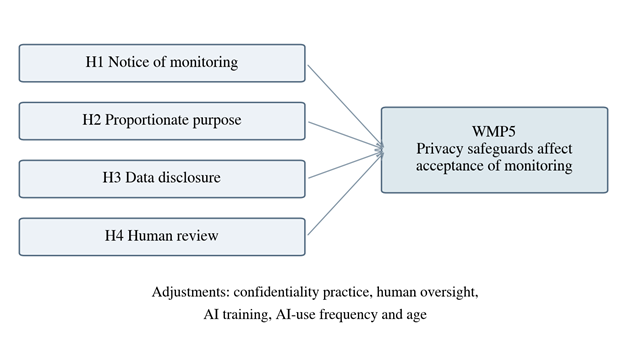
Figure 1. Exploratory associations between workplace safeguard expectations and privacy relevance to acceptance
Together, the theoretical perspectives inform the interpretation of privacy as both a data-governance and employment-process issue. The study’s contribution lies in distinguishing expectations at collection and decision stages, not in claiming to validate JD-R, psychological-contract or procedural-justice theory with single items.
3. Methodology
This cross-sectional study analyses the numerical Group 9 survey records supplied with the manuscript. It uses the questionnaire’s exact wording as the basis for variable selection and interpretation. The analysis is descriptive and exploratory: it describes responses and estimates associations but does not identify the effects of actual surveillance or establish a validated structural model. The same 385 records contribute to the descriptive, paired and primary regression analyses, with a restricted-use subset used for sensitivity assessment.
3.1 Data source and participants
The source is the Data sheet of Group-9-Law-SDG-Database, interpreted with its README and Codebook. The research team confirmed that the numerical responses were collected in a real survey. The Codebook labels the respondent sequence and optional contextual comments as synthetic; those labels are not treated as descriptions of the numerical responses. Respondent identifiers were used only for uniqueness checks, and contextual comments were excluded. The provenance and collection documentation remain the responsibility of the research team.
All 385 records contain affirmative consent, adult-eligibility and AI-awareness responses. These fields define the recorded analytical eligibility, not evidence that all respondents are currently employed or personally monitored. The data include law students, law graduates, advocates or legal professionals, and other relevant respondents. Recruitment procedures, the sampling frame, fieldwork dates, invitation count and response denominator are not documented in the supplied materials. A probability sample, response rate or population-wide margin of error cannot therefore be established from the workbook. The observed sample size should not be confused with a documented a priori calculation.
3.2 Measurements and analytical roles
WMP1-WMP4 represent expectations of notice, purpose limitation, data disclosure and human review. WMP5 asks whether privacy safeguards affect acceptance. AIL4 records reported care with confidential information in AI use, and AIL5 records an expectation of human oversight for important legal or rights-related decisions. All seven are five-category agreement items. Table 1 sets out their roles, and Appendix A reproduces their wording from the Codebook.
Table 1. Measurement items and analytical roles
| Code | Abbreviated content | Role |
| WMP1 | Notice of AI monitoring | Focal H1 |
| WMP2 | Legitimate, proportionate purpose | Focal H2 |
| WMP3 | Information on collected data | Focal H3 |
| WMP4 | Human review before serious consequences | Focal H4 |
| WMP5 | Privacy safeguards affect acceptance | Outcome |
| AIL4 | Care with confidential information | Adjustment |
| AIL5 | Human oversight for important decisions | Adjustment |
Source: Group 9 Codebook. Appendix A provides exact wording. Individual items are not presented as validated scales; WMP5 does not measure actual acceptance.
The main outcome is WMP5. Higher agreement is interpreted as stronger endorsement that safeguards affect acceptance, not higher acceptance or a positive direction of effect. The focal predictors are the four separate WMP expectations. AIL4 and AIL5 are contextual adjustment variables rather than indicators of an observed workplace monitoring process. No composite score, scale reliability, latent-variable validity index or unmeasured construct is inferred from these items.[20]
3.3 Screening and covariates
The data audit checks eligibility, missingness and permissible coding for all 20 agreement items, repeated identifiers, repeated full response vectors and uniform responding. All analytical agreement responses are complete. Eleven entries in the optional AI-tool field are missing; this field does not enter the models. The records include inconsistencies between never-use experience and non-never frequency, or the converse. All records are retained in the primary analysis because the contradiction does not invalidate the focal answers. A sensitivity analysis excludes the affected records.
The adjusted model includes the four focal items and AIL4-AIL5, each entered linearly per agreement point and centred at neutral. Other covariates are any AI training versus none, frequency of generative-AI use coded from zero to four, and age 27 or above versus younger. These choices provide a parsimonious description of association; they do not establish a causal adjustment set. Frequency and agreement codings impose equal-step assumptions, while the age grouping compresses information. A sensitivity model adds current law-student status to assess the influence of sample composition.
3.4 Descriptive and paired comparisons
Category counts, means and sample standard deviations are reported with endorsement defined as agreement or strong agreement. Pointwise 95% Wilson intervals accompany endorsement percentages. Means summarise the numerical coding and do not imply equal psychological distances between categories. Since sampling probabilities are unknown, the intervals are model-based descriptions of uncertainty and do not make the sample nationally representative.[21]
Four exploratory paired contrasts are calculated within records: WMP1 minus WMP4, WMP1 minus WMP3, WMP1 minus WMP2, and WMP5 minus WMP4. Exact McNemar tests use discordant pairs and Holm adjustment applies across the four contrasts. Percentage-point differences receive percentile intervals from 10,000 whole-record bootstrap resamples, with random seed 20261026. Resampling preserves the within-record relationship. The four pairs have different wording, so differences cannot be read as forced-choice priorities or estimated effects of replacing one safeguard with another.[22]
3.5 Ordinal regression and diagnostic checks
The primary model is a proportional-odds logistic regression for WMP5. No record selected category one, so categories one and two are treated as a single disagreement category for the model; original five-category frequencies remain visible in the descriptive table. The cumulative model is logit Pr(Y ≤ k | X) = αk − Xβ. The exponentiated slope is the odds ratio for a higher WMP5 response per unit increase in a predictor, assuming common slopes across the three cumulative thresholds. The model has nine slopes and three thresholds.[23]
The model uses maximum likelihood, analytic scores, a numerical observed Hessian and HC1 sandwich covariance with factor N/(N − 12). A second optimiser checks the coefficient estimates. A cumulative-logit diagnostic compares the nine slopes at the three cutpoints, accounting for within-record dependence; the joint Wald test has 18 degrees of freedom. A failure to reject that diagnostic is not proof that proportional odds holds exactly. Maximum variance inflation is examined for the design matrix.[24]
The four focal coefficients form a single Holm-adjusted family. Pointwise intervals and raw covariate estimates remain descriptive. Additional binary logistic models assess endorsement versus lower responses and strong agreement versus all lower categories. Those thresholds define different outcomes and are sensitivity checks, not replacement confirmatory tests. Independent logistic-regression software checks the binary coefficients. Ordinal specifications are also refitted with student status added and with inconsistent-use records excluded. None of the analyses can correct unknown recruitment selection or unrecorded clustering.[25]
3.6 Ethics and participant protection
Formal ethical approval was not obtained. The authors report that an accessible formal review mechanism applicable to this non-interventional adult questionnaire study was unavailable in their institutional setting at the time. This states their institutional context; it does not claim an official exemption or imply that all such research is exempt. The researchers retained responsibility for ethical conduct, and supervision does not replace independent review where a journal or institution requires it.
The reported safeguards include information about the study, affirmative informed consent before completion, voluntary participation, the opportunity to discontinue, an anonymous questionnaire and aggregate reporting. All analysed records contain affirmative consent and adult-eligibility entries. The analysis excludes the optional contextual-text field and does not reproduce individual narratives. Data requests are subject to confidentiality and applicable institutional requirements. The authors’ full declarations are reproduced in Section 8.
4. Results
The results describe four distinct workplace safeguards and their relationship with the privacy-acceptance proposition. The tables show the sample, complete category distributions, paired comparisons, joint responses and adjusted models. They should be read as responses to a questionnaire, rather than measurements of a particular employer’s practices or a before-and-after assessment of an intervention. All primary estimates use N = 385.
4.1 Respondent profile and data integrity
Table 2 reports the observed profile. Law students account for 238 respondents (61.8%); 61 (15.8%) are law graduates, 53 (13.8%) advocates or legal professionals, and 33 (8.6%) other relevant respondents. Current status is distinct from the education-level field. The questionnaire does not establish that everyone in the sample is currently employed or subject to AI monitoring.
Table 2. Respondent profile
| Characteristic | Recorded categories and counts |
| Age | 21-23: 159; 18-20: 74; 24-26: 69; 27-30: 47; 31+: 36 |
| Gender | Male: 212; Female: 163; Prefer not to say: 8; Other: 2 |
| Current status | Law student: 238; Law graduate: 61; Advocate or legal professional: 53; Other relevant respondent: 33 |
| Education | Undergraduate: 222; Graduate: 86; Professional: 42; Postgraduate: 35 |
| Location | Dhaka: 141; District town: 89; Other city corporation: 77; Upazila-rural area: 65; Other: 13 |
| AI experience | 1-2 years: 144; 6-12 months: 87; Less than 6 months: 77; More than 2 years: 68; Never: 9 |
| AI frequency | Weekly: 168; Daily or almost daily: 105; Monthly: 65; Less than monthly: 38; Never: 9 |
| AI training | No: 208; Yes, short orientation: 118; Yes, course or certified training: 59 |
N = 385. Counts sum to 385 within each field. Current status and education are separate measures. Current employment and monitoring exposure are not established.
The profile includes different age and location categories and varying degrees of AI use and training. Diversity within the recorded sample does not establish a probability-based national sample. All 20 agreement items are complete and in range. There are no duplicate identifiers, repeated complete 20-item vectors or records giving the same answer to every agreement item. Such checks describe observable data properties; they do not independently verify survey provenance or participant independence.
4.2 Distributions of monitoring and privacy expectations
Table 3 provides the original five response-category counts. Notice receives 292 endorsements (75.8%), purpose limitation 231 (60.0%), data disclosure 222 (57.7%), and human review 205 (53.2%). The privacy-acceptance statement receives 301 endorsements (78.2%). These percentages are not rankings from a forced-choice question: a respondent could endorse any number of statements.
Table 3. Workplace monitoring and privacy item distributions
| Item | Mean (SD) | Counts 1 / 2 / 3 / 4 / 5 | Endorsed n (%) | 95% CI % |
| WMP1 | 4.05 (0.81) | 0 / 12 / 81 / 169 / 123 | 292 (75.8%) | 71.3-79.9 |
| WMP2 | 3.67 (0.77) | 0 / 22 / 132 / 181 / 50 | 231 (60.0%) | 55.0-64.8 |
| WMP3 | 3.66 (0.84) | 1 / 26 / 136 / 160 / 62 | 222 (57.7%) | 52.7-62.5 |
| WMP4 | 3.54 (0.87) | 4 / 38 / 138 / 158 / 47 | 205 (53.2%) | 48.3-58.2 |
| WMP5 | 4.06 (0.79) | 0 / 13 / 71 / 181 / 120 | 301 (78.2%) | 73.8-82.0 |
N = 385. Categories: 1 strongly disagree; 2 disagree; 3 neutral; 4 agree; 5 strongly agree. Endorsement = 4 or 5. Intervals are pointwise Wilson intervals; means summarise numerical coding.
Neutral responses are substantial for several procedural items: 132 on purpose, 136 on data disclosure and 138 on human review. Non-endorsement therefore cannot be described as opposition. The wording of WMP5 is also directionally open: respondents agreeing that privacy affects acceptance may mean that good safeguards encourage it, inadequate safeguards reduce it, or some other relationship. The item does not distinguish those possibilities.
The two contextual items in Table 4 concern general AI practices and expectations, rather than actual workplace-monitoring events. Both confidentiality practice and human oversight receive 306 endorsements (79.5%). They provide context for the adjusted model and help distinguish general attitudes towards AI-related safeguards from the specific workplace statements.
Table 4. Contextual AI practice and oversight responses
| Item | Mean (SD) | Counts 1 / 2 / 3 / 4 / 5 | Endorsed n (%) | 95% CI % |
| AIL4 | 4.07 (0.73) | 0 / 5 / 74 / 195 / 111 | 306 (79.5%) | 75.2-83.2 |
| AIL5 | 4.08 (0.75) | 0 / 7 / 72 / 189 / 117 | 306 (79.5%) | 75.2-83.2 |
N = 385. Categories: 1 strongly disagree; 2 disagree; 3 neutral; 4 agree; 5 strongly agree. Endorsement = 4 or 5. Intervals are pointwise Wilson intervals; means summarise numerical coding.
The AIL4 response is a self-report, not an observed test of confidentiality practices. Likewise, agreement with AIL5 does not establish that oversight exists in any workplace. Their inclusion should not be mistaken for measurement of professional conduct or the quality of an actual monitoring system.
4.3 Within-person comparisons
Table 5 shows the four paired differences. Notice exceeds human review by 87 endorsements, a difference of 22.6 percentage points (95% bootstrap interval 16.4-28.8; Holm-adjusted p < .001). The contrast contains 129 notice-only and 42 review-only endorsements. Notice also exceeds data disclosure by 18.2 points and proportionate purpose by 15.8 points. The privacy-acceptance statement exceeds human review by 24.9 points. All four exact paired tests remain below .001 after Holm adjustment.
Table 5. Paired endorsement comparisons
| Contrast | First only / second only | Difference pp | 95% CI pp | Holm p |
| WMP1 − WMP4 | 129 / 42 | 22.6 | 16.4-28.8 | < .001 |
| WMP1 − WMP3 | 117 / 47 | 18.2 | 11.9-24.4 | < .001 |
| WMP1 − WMP2 | 114 / 53 | 15.8 | 9.4-22.3 | < .001 |
| WMP5 − WMP4 | 132 / 36 | 24.9 | 18.7-30.9 | < .001 |
N = 385; pp = percentage points. Pointwise percentile intervals use 10,000 whole-record bootstrap resamples. Exact McNemar tests are Holm-adjusted across four contrasts. Items differ in wording and institutional scope.
The comparisons identify differences in response to particular propositions, not an ordering of legal importance. WMP1 refers to awareness of monitoring, whereas WMP4 refers to review before serious employment consequences. Differences in complexity, perceived seriousness or interpretation could influence the responses. The tests do not reveal the reasons for the differences. The bootstrap intervals are pointwise rather than simultaneous intervals for the four contrasts.
Table 6 displays the joint notice and review responses and the wider configuration across four safeguards. Both notice and review are endorsed by 163 respondents (42.3%); 129 (33.5%) endorse notice but not review; 42 (10.9%) endorse review but not notice; and 51 (13.2%) endorse neither. Sixty-one respondents (15.8%) endorse all four safeguard statements, while 369 (95.8%) endorse at least one.
Table 6. Joint endorsement configurations
| Configuration | Count and percentage |
| Notice and review | 163 (42.3%) |
| Notice only | 129 (33.5%) |
| Review only | 42 (10.9%) |
| Neither notice nor review | 51 (13.2%) |
| All four safeguards | 61 (15.8%) |
| At least one of four safeguards | 369 (95.8%) |
N = 385. The first four rows partition respondents; the last two overlap those rows. Non-endorsement includes neutral responses. Configurations are descriptive rather than respondent types.
These figures show substantial overlap and variation within the sample. They should not be labelled mutually exclusive psychological types, because non-endorsement includes neutral responses and the questionnaire does not identify participants’ reasoning. In particular, notice-only endorsement does not establish rejection of review or acceptance of consequences without review.
4.4 Adjusted associations
The common-slope diagnostic yields Wald χ²(18) = 20.48, p = .306. Maximum variance inflation is 1.08 and the second-optimiser estimates differ by less than 0.000001. These checks support a numerically stable summary under the specified model; they do not rule out every form of misspecification or establish causal relationships.
Table 7 reports the four focal ordinal coefficients. The notice coefficient has an odds ratio of 1.35 (95% pointwise HC1 interval 1.04-1.75), but its Holm-adjusted p-value is .102. Purpose limitation, data disclosure and review have point estimates of 0.86, 1.09 and 1.00, respectively; their pointwise intervals include one. No focal coefficient is distinguishable from zero at the .05 level after adjustment across the four comparisons.
Table 7. Focal ordinal associations with privacy relevance to acceptance
| Safeguard | OR (95% CI) | Raw p | Holm p |
| Prior notification | 1.35 (1.04-1.75) | 0.025 | 0.102 |
| Proportionate purpose | 0.86 (0.69-1.08) | 0.192 | 0.575 |
| Data disclosure | 1.09 (0.88-1.36) | 0.439 | 0.878 |
| Human review | 1.00 (0.81-1.24) | 0.992 | 0.992 |
N = 385. OR = proportional odds ratio for a higher WMP5 response per one-point predictor increase. Adjusted for all focal items, AIL4, AIL5, training, AI frequency and age. Pointwise HC1 intervals; Holm correction across four focal coefficients.
The pointwise notice interval should be reported alongside the adjusted result, not converted into a claim that notice causes acceptance. The coefficient describes a higher ordinal WMP5 response for a one-point increase in the WMP1 response, holding the model’s other variables fixed. The model’s McFadden pseudo-R² is .018, a likelihood-based summary rather than a percentage of variance explained. It indicates limited improvement in fit over a threshold-only model, not a complete assessment of institutional outcomes.
Figure 2 displays the four focal estimates with their pointwise intervals, including the uncertainty around each association.
Figure 2. Adjusted ordinal associations between four expectations and WMP5. Pointwise 95% HC1 intervals; Holm correction covers four focal coefficients.
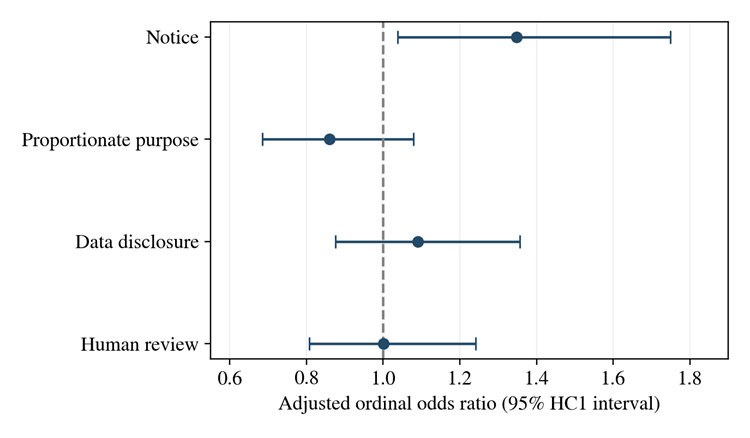
Figure 2 displays the four focal estimates with their pointwise intervals
The graph shows estimates conditional on the full model; the intervals do not incorporate the Holm correction applied to the four p-values.
Table 8 reports the contextual variables. The AI-use frequency coefficient is 1.27 (95% interval 1.04-1.54) per coded category; the intervals for the two AI-literacy items, training and age include one. These descriptive coefficients are outside the four-hypothesis family and should not be interpreted as established determinants of privacy or acceptance.
Table 8. Contextual associations in the ordinal model
| Contextual variable | OR (95% CI) | Raw p |
| Confidentiality practice | 1.06 (0.81-1.38) | 0.666 |
| Human oversight | 0.93 (0.71-1.23) | 0.621 |
| Any AI training | 1.04 (0.70-1.56) | 0.837 |
| Use frequency | 1.27 (1.04-1.54) | 0.017 |
| Age 27+ | 1.02 (0.63-1.66) | 0.926 |
N = 385. AIL4 and AIL5 are per agreement point, training compares any with none, frequency is per coded category and age compares 27+ with younger. Pointwise HC1 intervals and raw p-values are descriptive.
Frequency is a general AI-use measure, not a measure of workplace surveillance exposure. Its association with WMP5 could reflect many unmeasured differences between respondents. The cross-sectional survey supplies no evidence that increasing AI use would change an individual’s privacy expectation.
4.5 Sensitivity assessments
Table 9 compares focal ordinal estimates with student status added and after exclusion of inconsistent-use records. The number in the restricted analysis is reported in the table note. Estimates remain broadly similar in direction, while intervals quantify uncertainty under each model. These analyses do not establish that results generalise to currently employed people.
Table 9. Sensitivity of focal ordinal associations
| Safeguard | Student status added OR (95% CI) | Consistent use OR (95% CI) |
| Prior notification | 1.35 (1.04-1.74) | 1.33 (1.02-1.75) |
| Proportionate purpose | 0.85 (0.68-1.08) | 0.87 (0.69-1.10) |
| Data disclosure | 1.09 (0.87-1.35) | 1.11 (0.88-1.40) |
| Human review | 0.99 (0.80-1.23) | 1.02 (0.82-1.27) |
Student-status-added model: N = 385. Consistent-use model: n = 367; 18 inconsistent experience/frequency records excluded. Pointwise HC1 intervals; sensitivity estimates are descriptive.
The binary threshold models provide an additional check on the single proportional-odds summary. The notice odds ratio is 1.55 (95% interval 1.13-2.13) for endorsement and 1.19 (0.90-1.58) for strong agreement. These pointwise sensitivity estimates are not adjusted as a separate confirmatory family, and their difference does not by itself establish non-proportionality. Remaining focal intervals span one in both threshold models. Binary and ordinal estimates address different questions and should not be ranked by the number of nominally significant results.
The overall results thus combine a clear descriptive difference between notice and review responses with limited adjusted evidence about how the four safeguard expectations align with the privacy-acceptance item. Neither observation measures actual monitoring intensity, trust or psychological-contract breach. The interpretation follows these measurement boundaries.
5. Discussion
The findings suggest that respondents distinguish the fact of being informed about AI monitoring from more detailed or consequential safeguards. Notice is endorsed by approximately three quarters of the sample, while human review before serious employment consequences is endorsed by just over half. At the same time, agreement that privacy safeguards affect acceptance is more common than endorsement of the individual review item. The results provide a basis for discussing the architecture of safeguards, while leaving unanswered the causal and behavioural questions that would require observation of a real monitoring setting.
5.1 Notice and the decision stage
The 22.6-point paired difference between notice and review is the central descriptive finding. One possible interpretation is that the notice proposition is easier to endorse because it describes a general communication, whereas the review proposition refers to a specific and serious employment consequence. The data do not reveal whether respondents understood the two items in that way. Another possibility is that people are familiar with notification in digital services but less familiar with the practical meaning of review before an employment decision. Both explanations remain hypotheses for qualitative or experimental research.
The result is consistent with a need to distinguish stages of the information lifecycle. The ILO code addresses workers’ prior information about monitoring, while reviewability scholarship asks whether an affected person can obtain examination of a decision. These functions complement each other: notice can reveal that a process exists, and review can address an error or inappropriate use of its output. The survey provides evidence of different endorsement rates for these functions, not evidence that one can substitute for the other.[26]
The joint table strengthens this interpretation by showing that 163 respondents endorse both statements. At the same time, the notice-only group includes neutral and disagreeing responses on review. It would be inaccurate to infer that all 129 notice-only respondents oppose human review. Analysing the original categories preserves the distinction between uncertainty and disagreement, and prevents a descriptive binary contrast from being turned into a claim about rejection of employee rights.
5.2 Privacy safeguards and the meaning of acceptance
WMP5 receives the highest endorsement among the five workplace items, but its wording deserves care. It says that privacy safeguards affect acceptance, without specifying a positive relationship. It does not ask whether respondents accept a monitoring system, whether they would use one or whether safeguards changed their willingness to do so. The observed 78.2% is therefore evidence that privacy considerations are salient to the respondents’ stated views about acceptance, not an acceptance rate for AI monitoring.
This distinction matters for comparison with research on electronic monitoring. Ravid and colleagues and Siegel, König and Lazar synthesise studies of monitoring and workplace outcomes. Their evidence concerns exposure and organisational characteristics in settings that vary across the underlying research. The present sample supplies expectations about a possible practice. It neither replicates the meta-analyses nor contradicts their findings about stress and job satisfaction. The contribution is to identify which prospective safeguards respondents endorsed and where additional measurement is needed.[27]
A useful extension would distinguish privacy safeguards by content. For example, a participant could be shown a specific data-collection practice and then asked separately about purpose, retention, access, disclosure and review. Baseline acceptance could be recorded before the information is introduced, followed by behavioural or stated-choice measures. Such a design would permit a test of whether a particular safeguard increases or decreases acceptance and whether the change reflects improved comprehension or unwarranted reassurance. General AI trust research cautions against equating increased confidence with deserved reliance.[28]
5.3 Adjusted findings and multiplicity
The notice expectation shows a positive pointwise association with WMP5, but its adjusted p-value is .102 across four focal coefficients. This difference between a pointwise interval and an adjusted test is not a contradiction: the interval was not constructed as a simultaneous interval for the family. The other three focal intervals include one. The appropriate conclusion is that the analysis offers limited adjusted evidence about the proposed response relationships, not that notice has been proved effective or that review and purpose limitation are irrelevant.[29]
The sensitivity models help delimit this conclusion. The endorsement-threshold model yields a positive pointwise notice interval, whereas the strong-agreement model is less precise. Their estimands differ, and a comparison of statistical significance between them is not a formal test of coefficient heterogeneity. The additional specifications provide a check on whether the conclusion depends entirely on one coding decision; they do not resolve unmeasured selection, wording overlap or common-source response tendencies.[30]
The modest pseudo-R² is also compatible with several interpretations. The four policy expectations may not capture the considerations respondents have in mind when thinking about privacy; a respondent may interpret WMP5 in a different direction from another; or relevant factors such as employment status, prior experience and institutional trust may not be adequately measured. The study cannot determine which explanation is correct. The result suggests a need for richer measurement rather than an invitation to add variables solely to improve statistical fit.
5.4 Theoretical interpretation without overclaiming
Job demands-resources theory helps formulate questions about conditions under which monitoring becomes demanding and safeguards act as resources. The present responses do not measure demands, resources as experienced at work, strain or a buffering interaction. They therefore cannot validate the theory’s mechanism. They do show why notice and decision-stage review should be measured separately before assessing their possible roles in an employee study.[31]
Psychological-contract theory directs attention to expectations in employment relationships. But a respondent’s support for a general rule does not establish a promise by an employer, an employee’s reliance on that promise or a perceived breach. Similarly, the questionnaire does not measure organisational trust. The contribution to theory is a measurement proposition: workplace governance should be examined at the distinct points where expectations about information, purpose and consequences arise. Testing whether those expectations are linked to perceived breach requires data from a defined employment relationship.[32]
The findings also fit a procedural account of accountability. An organisation that provides notice can still leave workers unable to inspect the data, correct an error or challenge an outcome. Conversely, a formally available review procedure may be ineffective if the worker lacks the information needed to use it or if the reviewer cannot change the result. Research on meaningful oversight reinforces the importance of authority, competence and access to evidence. These are institutional design inferences informed by the literature; the survey did not assess implementation.[33]
5.5 Bangladesh context and limits
The legal analysis should start from the existing Personal Data Protection Act 2026 rather than characterising personal-data legislation as merely forthcoming. The Act’s provisions on access, correction, transparency and security provide relevant questions for monitoring arrangements, subject to scope, exceptions and implementation. A specific employment dispute would require assessment of the actual processing, relevant legal grounds and applicable procedural requirements. The questionnaire cannot determine compliance or the existence of a breach.[34]
The sample is predominantly composed of law students and includes a smaller group of advocates or legal professionals. It is therefore valuable for studying stated expectations among this recorded respondent group, including future participants in legal and professional work. It cannot stand for judges, employers, all workers or Bangladesh’s workforce. Undocumented recruitment, dates and response denominator limit evaluation of selection and generalisability. These limitations do not invalidate the descriptive counts; they define the population and claims to which the counts can responsibly be attached.
The next research stage should recruit employees in documented industries, establish whether they have experienced a particular monitoring system and measure actual policies. It should also identify the effect of safeguards through longitudinal, experimental or mixed-method designs. Worker interviews could clarify why notice, data disclosure and review receive different responses; a controlled vignette could distinguish wording effects from preferences about safeguards. Such work would complement the present analysis without treating its cross-sectional associations as causal findings.
6. Theoretical and Practical Implications
The implications centre on a sequential view of workplace monitoring: workers may need to know that monitoring exists, understand what data are collected and why, and have a usable route for review when information contributes to a serious decision. These are connected functions, but agreement with one does not establish implementation of the others. The findings inform a programme of institutional and empirical design rather than a conclusion that any particular employer has complied with, or violated, employee privacy rights.
6.1 Theoretical contribution
The article contributes a differentiated vocabulary for workplace safeguards. Notice identifies the existence of monitoring; data disclosure concerns its informational scope; purpose limitation addresses why it is undertaken; and human review concerns consequential use. A single privacy or transparency score could obscure their different institutional roles. Their separate analysis reveals both joint endorsement and notable differences in response rates, while leaving the content and effectiveness of actual practices to future research.[35]
JD-R and psychological-contract theory are complementary but should be tested with appropriate measures. JD-R suggests examining monitoring-related demands and resources alongside outcomes such as strain and performance. Psychological-contract theory suggests examining promises, expectations and perceived breach in a defined employment relationship. A future integrated model could ask whether understandable notice and meaningful review alter the relationship between experienced monitoring and employee outcomes. The present survey provides item-level starting points for such a design, not estimates of that mechanism.[36]
A further implication concerns the outcome itself. WMP5 captures perceived relevance of privacy to acceptance without specifying direction. New measures should separate actual acceptance, perceived privacy, attitudes to a specified safeguard and observed choices. Validity work should assess content and dimensionality before structural paths are estimated. The most useful next model is one grounded in distinct constructs and a defensible research design, rather than one built from labels that exceed item wording.[37]
6.2 Practical and policy implications
An organisation considering AI-enabled monitoring can prepare a clear account of its purpose, the data categories collected, who can access them, the duration of retention and how results may be used. This information should be understandable to the people affected and available before use where required or appropriate. A notice alone should not be treated as proof that a practice is necessary or proportionate. Review of the proposed data flows, alternatives and applicable legal basis must be carried out in context.[38]
Human review should be designed around an actual decision process. A reviewer needs sufficient time and competence, access to relevant evidence and authority to depart from the automated output. The affected employee needs an understandable way to raise an error and receive a response. The ICO’s guidance offers a comparative example of meaningful involvement; its UK legal requirements are not automatically Bangladeshi law. The survey supports investigating such a process but does not establish that any particular design will work.[39]
Training for managers and workers can explain the limits of monitoring tools and the distinction between an observed activity, an inferred performance indicator and a decision. For legal education, case-based exercises could require participants to identify what additional facts are needed to assess a monitoring practice and to design a review path. Training outcomes should be evaluated rather than presumed from attendance. The predominantly student sample gives this educational application relevance, while requiring caution about extending the findings to all occupations.
For policy and future research, Bangladesh’s existing data-protection framework should be read with its staged commencement and implementing arrangements. The survey can inform questions for consultation about accessible information and review, but it cannot settle the legal interpretation of the Act or determine the prevalence of privacy violations. A stronger evidence base would combine documented recruitment, sector-specific worker experience and evaluation of actual institutional arrangements.[40]
7. Conclusion, Limitations and Future Research
This study examined stated expectations about AI-enabled workplace monitoring in 385 adult, AI-aware respondents in Bangladesh. Notice of monitoring was endorsed by 75.8%, while human review before serious employment consequences was endorsed by 53.2%. The paired difference was 22.6 percentage points. The comparison identifies a distinction between responses to two safeguards; differences in wording and the absence of a forced-choice task prevent interpretation as a causal or definitive ranking of their importance.
Privacy safeguards were reported to affect acceptance by 78.2%, but the questionnaire does not specify the direction of that effect or measure actual acceptance. The adjusted analysis produced a positive pointwise notice association with the privacy-acceptance proposition, while the four focal coefficients did not receive clear support after Holm adjustment. Sensitivity analyses provide complementary estimates and retain the uncertainty in those relationships. The findings do not establish that monitoring increased privacy concerns or breached psychological contracts.
The main conceptual contribution is to distinguish notice, purpose, information about collected data and human review as separate points in the governance of workplace monitoring. This distinction relates privacy to the consequences of data use and to the possibility of correction. The analysis also shows why theory and measurement must remain aligned: JD-R, psychological-contract and procedural-justice perspectives can motivate research questions, but their mechanisms require measures absent from this questionnaire.
The main limitations are the predominantly student sample, undocumented recruitment and fieldwork details, reliance on self-report, single-item measures and the absence of information about actual employer systems or monitoring exposure. The data cannot support national workforce prevalence estimates, causal claims or a determination of legal compliance. Formal ethical approval was not obtained; the authors describe the institutional context and participant-protection safeguards in Section 8.
Future studies should recruit workers in identifiable employment settings with documented procedures, assess the monitoring practices they actually encounter and distinguish baseline privacy perceptions from subsequent changes. Vignette experiments can vary notice, data scope, purpose and review independently. Interviews can investigate the reasons behind neutral and differing responses. Longitudinal designs can examine whether safeguards influence trust, perceived obligations and employee outcomes over time. Such research would test the mechanisms that the present item-level analysis can only identify as important questions.
Declarations
Ethical approval and oversight
Formal ethical approval was not obtained because, at the time of the study, the authors’ institutional setting did not provide an accessible formal review mechanism applicable to this non-interventional adult questionnaire research. The study nevertheless followed participant-protection safeguards, including informed consent, voluntary participation, the opportunity to discontinue, an anonymous questionnaire and aggregate reporting. The methodological safeguards are detailed in Section 3.6.
Informed consent
Informed consent was obtained from adult participants before questionnaire completion. The questionnaire explained the study purpose, voluntary participation, anonymity and the option to discontinue. All analysed records contain affirmative consent and adult-eligibility responses.
Data availability
The numerical data supporting the reported analyses are held by the research team. Requests for de-identified data and analytical specifications may be directed to the corresponding author. Any sharing is subject to participant confidentiality and applicable institutional requirements. The contextual-text field was excluded from the analysis.
Author contributions
Md. Assiful Islam Rehad: Lead student researcher; conceptualisation; preparation of study materials; organisation and curation of survey data; manuscript development. The project was conducted under the supervision of Prof. Dr Kazi Abdul Mannan.
Kazi Abdul Mannan: Conceptual and methodological guidance; supervision; interpretation of statistical findings; critical review and editing of the manuscript.
Generative AI disclosure
Generative AI assisted manuscript drafting, language editing, organisation and the development of analytical code. Statistical estimates were computed programmatically from the numerical survey data. Responsibility for the study’s analysis, interpretation and reporting rests with the authors.
Bibliography
Altman DG and Bland JM, ‘Absence of Evidence Is Not Evidence of Absence’ (1995) 311 BMJ 485
Bakker AB and Demerouti E, ‘Job Demands-Resources Theory: Taking Stock and Looking Forward’ (2017) 22 Journal of Occupational Health Psychology 273
Boateng GO and others, ‘Best Practices for Developing and Validating Scales for Health, Social, and Behavioral Research: A Primer’ (2018) 6 Frontiers in Public Health 149
Bovens M, ‘Analysing and Assessing Accountability: A Conceptual Framework’ (2007) 13 European Law Journal 447
Brant R, ‘Assessing Proportionality in the Proportional Odds Model for Ordinal Logistic Regression’ (1990) 46 Biometrics 1171
Cobbe J, Lee MSA and Singh J, ‘Reviewable Automated Decision-Making: A Framework for Accountable Algorithmic Systems’ in Proceedings of the 2021 ACM Conference on Fairness, Accountability, and Transparency (ACM 2021) 598
Diamantopoulos A and Winklhofer HM, ‘Index Construction with Formative Indicators: An Alternative to Scale Development’ (2001) 38 Journal of Marketing Research 269
Efron B and Tibshirani RJ, An Introduction to the Bootstrap (Chapman & Hall 1993)
Green B, ‘The Flaws of Policies Requiring Human Oversight of Government Algorithms’ (2022) 45 Computer Law & Security Review 105681
Hendrickx F, Protection of Workers’ Personal Data: General Principles (ILO Working Paper 62, 2022) <https://doi.org/10.54394/VBKR9991> accessed 27 October 2026
Hoff KA and Bashir M, ‘Trust in Automation: Integrating Empirical Evidence on Factors That Influence Trust’ (2015) 57 Human Factors 407
Holm S, ‘A Simple Sequentially Rejective Multiple Test Procedure’ (1979) 6 Scandinavian Journal of Statistics 65
Information Commissioner’s Office, ‘What Do We Need to Do If We Use Monitoring Tools That Use Solely Automated Processes?’ <https://ico.org.uk/for-organisations/uk-gdpr-guidance-and-resources/employment/monitoring-workers/what-do-we-need-to-do-if-we-use-monitoring-tools-that-use-solely-automated-processes/> accessed 27 October 2026
International Labour Office, Protection of Workers’ Personal Data: An ILO Code of Practice (ILO 1997), para 6.14 <https://www.ilo.org/media/270771/download> accessed 27 October 2026
International Labour Organization, Algorithmic Management in the Workplace <https://www.ilo.org/algorithmic-management-workplace> accessed 27 October 2026
Lee JD and See KA, ‘Trust in Automation: Designing for Appropriate Reliance’ (2004) 46 Human Factors 50
McCullagh P, ‘Regression Models for Ordinal Data’ (1980) 42 Journal of the Royal Statistical Society Series B 109
McNemar Q, ‘Note on the Sampling Error of the Difference between Correlated Proportions or Percentages’ (1947) 12 Psychometrika 153
Podsakoff PM and others, ‘Common Method Biases in Behavioral Research: A Critical Review of the Literature and Recommended Remedies’ (2003) 88 Journal of Applied Psychology 879
Ravid DM and others, ‘A Meta-Analysis of the Effects of Electronic Performance Monitoring on Work Outcomes’ (2023) 76 Personnel Psychology 5
Rousseau DM, Psychological Contracts in Organizations: Understanding Written and Unwritten Agreements (Sage 1995)
Siegel R, König CJ and Lazar V, ‘The Impact of Electronic Monitoring on Employees’ Job Satisfaction, Stress, Performance, and Counterproductive Work Behavior: A Meta-Analysis’ (2022) 8 Computers in Human Behavior Reports 100227
Stefanski LA and Boos DD, ‘The Calculus of M-Estimation’ (2002) 56 American Statistician 29
Tyler TR, Why People Obey the Law (Yale University Press 1990)
Wasserstein RL and Lazar NA, ‘The ASA Statement on p-Values: Context, Process, and Purpose’ (2016) 70 American Statistician 129
Wilson EB, ‘Probable Inference, the Law of Succession, and Statistical Inference’ (1927) 22 Journal of the American Statistical Association 209
Appendix A. Analytical item wording
Table A1 presents the exact questions used in the analysis. Its wording makes clear that the workplace items record expectations rather than exposure to a specific system.
Table A1. Exact analytical item wording
| Code | Statement |
| WMP1 | Employees should be informed when AI is used to monitor workplace activities. |
| WMP2 | AI monitoring should be limited to legitimate and proportionate purposes. |
| WMP3 | Employees should have clear information about what workplace data are collected. |
| WMP4 | Human review should be available before serious employment consequences are based on automated monitoring. |
| WMP5 | Privacy safeguards affect my acceptance of AI-enabled workplace monitoring. |
| AIL4 | I avoid sharing confidential or sensitive information with AI tools unless appropriate safeguards are in place. |
| AIL5 | I believe meaningful human oversight is necessary when AI affects important legal or rights-related decisions. |
Source: Group 9 Codebook. One strongly disagree; two disagree; three neutral; four agree; five strongly agree.
All items use the five agreement categories in the Group 9 Codebook. No item was reverse-coded or combined into a composite for this analysis.
Table of legislation
Personal Data Protection Act 2026 (Bangladesh Act No 63 of 2026)
[1] International Labour Organization, Algorithmic Management in the Workplace <https://www.ilo.org/algorithmic-management-workplace> accessed 27 October 2026.
[2] International Labour Office, Protection of Workers’ Personal Data: An ILO Code of Practice (ILO 1997), para 6.14 <https://www.ilo.org/media/270771/download> accessed 27 October 2026; Information Commissioner’s Office, ‘What Do We Need to Do If We Use Monitoring Tools That Use Solely Automated Processes?’ <https://ico.org.uk/for-organisations/uk-gdpr-guidance-and-resources/employment/monitoring-workers/what-do-we-need-to-do-if-we-use-monitoring-tools-that-use-solely-automated-processes/> accessed 27 October 2026.
[3] Personal Data Protection Act 2026 (Bangladesh Act No 63 of 2026), s 1; Personal Data Protection Act 2026 (Bangladesh Act No 63 of 2026), s 11; Personal Data Protection Act 2026 (Bangladesh Act No 63 of 2026), s 15; Personal Data Protection Act 2026 (Bangladesh Act No 63 of 2026), s 17.
[4] ILO, Code of Practice (n 2); ICO, Monitoring Tools (n 2).
[5] Daniel M Ravid and others, ‘A Meta-Analysis of the Effects of Electronic Performance Monitoring on Work Outcomes’ (2023) 76 Personnel Psychology 5; Rudolf Siegel, Cornelius J König and Veronika Lazar, ‘The Impact of Electronic Monitoring on Employees’ Job Satisfaction, Stress, Performance, and Counterproductive Work Behavior: A Meta-Analysis’ (2022) 8 Computers in Human Behavior Reports 100227.
[6] Godfred O Boateng and others, ‘Best Practices for Developing and Validating Scales for Health, Social, and Behavioral Research: A Primer’ (2018) 6 Frontiers in Public Health 149; Adamantios Diamantopoulos and Heidi M Winklhofer, ‘Index Construction with Formative Indicators: An Alternative to Scale Development’ (2001) 38 Journal of Marketing Research 269.
[7] Ravid and others (n 5).
[8] ILO, Code of Practice (n 2); Mark Bovens, ‘Analysing and Assessing Accountability: A Conceptual Framework’ (2007) 13 European Law Journal 447.
[9] Arnold B Bakker and Evangelia Demerouti, ‘Job Demands–Resources Theory: Taking Stock and Looking Forward’ (2017) 22 Journal of Occupational Health Psychology 273.
[10] Denise M Rousseau, Psychological Contracts in Organizations: Understanding Written and Unwritten Agreements (Sage 1995).
[11] Tom R Tyler, Why People Obey the Law (Yale University Press 1990); Jennifer Cobbe, Michelle Seng Ah Lee and Jatinder Singh, ‘Reviewable Automated Decision-Making: A Framework for Accountable Algorithmic Systems’ in Proceedings of the 2021 ACM Conference on Fairness, Accountability, and Transparency (ACM 2021) 598.
[12] Personal Data Protection Act 2026 (Bangladesh Act No 63 of 2026), s 11; Personal Data Protection Act 2026 (Bangladesh Act No 63 of 2026), s 12; Personal Data Protection Act 2026 (Bangladesh Act No 63 of 2026), s 15; Personal Data Protection Act 2026 (Bangladesh Act No 63 of 2026), s 17.
[13] Personal Data Protection Act 2026 (Bangladesh Act No 63 of 2026), s 1.
[14] ILO, Code of Practice (n 2); ICO, Monitoring Tools (n 2).
[15] Frank Hendrickx, Protection of Workers’ Personal Data: General Principles (ILO Working Paper 62, 2022) <https://doi.org/10.54394/VBKR9991> accessed 27 October 2026.
[16] Ravid and others (n 5).
[17] ILO, Code of Practice (n 2).
[18] Hendrickx (n 15).
[19] Cobbe, Lee and Singh (n 11); Ben Green, ‘The Flaws of Policies Requiring Human Oversight of Government Algorithms’ (2022) 45 Computer Law & Security Review 105681.
[20] Boateng and others (n 6); Diamantopoulos and Winklhofer (n 6).
[21] Edwin B Wilson, ‘Probable Inference, the Law of Succession, and Statistical Inference’ (1927) 22 Journal of the American Statistical Association 209.
[22] Quinn McNemar, ‘Note on the Sampling Error of the Difference between Correlated Proportions or Percentages’ (1947) 12 Psychometrika 153; Sture Holm, ‘A Simple Sequentially Rejective Multiple Test Procedure’ (1979) 6 Scandinavian Journal of Statistics 65; Bradley Efron and Robert J Tibshirani, An Introduction to the Bootstrap (Chapman & Hall 1993).
[23] Peter McCullagh, ‘Regression Models for Ordinal Data’ (1980) 42 Journal of the Royal Statistical Society Series B 109.
[24] Leonard A Stefanski and Dennis D Boos, ‘The Calculus of M-Estimation’ (2002) 56 American Statistician 29; Rollin Brant, ‘Assessing Proportionality in the Proportional Odds Model for Ordinal Logistic Regression’ (1990) 46 Biometrics 1171.
[25] Ronald L Wasserstein and Nicole A Lazar, ‘The ASA Statement on p-Values: Context, Process, and Purpose’ (2016) 70 American Statistician 129; Douglas G Altman and J Martin Bland, ‘Absence of Evidence Is Not Evidence of Absence’ (1995) 311 BMJ 485.
[26] ILO, Code of Practice (n 2); Cobbe, Lee and Singh (n 11).
[27] Ravid and others (n 5); Siegel, König and Lazar (n 5).
[28] John D Lee and Katrina A See, ‘Trust in Automation: Designing for Appropriate Reliance’ (2004) 46 Human Factors 50; Kevin Anthony Hoff and Masooda Bashir, ‘Trust in Automation: Integrating Empirical Evidence on Factors That Influence Trust’ (2015) 57 Human Factors 407.
[29] Holm (n 22); Wasserstein and Lazar (n 25).
[30] Philip M Podsakoff and others, ‘Common Method Biases in Behavioral Research: A Critical Review of the Literature and Recommended Remedies’ (2003) 88 Journal of Applied Psychology 879; Altman and Bland (n 25).
[31] Bakker and Demerouti (n 9).
[32] Rousseau (n 10).
[33] Bovens (n 8); Green (n 19); ICO, Monitoring Tools (n 2).
[34] Personal Data Protection Act 2026 (Bangladesh Act No 63 of 2026), s 11; Personal Data Protection Act 2026 (Bangladesh Act No 63 of 2026), s 12; Personal Data Protection Act 2026 (Bangladesh Act No 63 of 2026), s 15; Personal Data Protection Act 2026 (Bangladesh Act No 63 of 2026), s 17.
[35] ILO, Code of Practice (n 2); Bovens (n 8).
[36] Bakker and Demerouti (n 9); Rousseau (n 10).
[37] Boateng and others (n 6); Diamantopoulos and Winklhofer (n 6).
[38] Hendrickx (n 15); Personal Data Protection Act 2026 (Bangladesh Act No 63 of 2026), s 15.
[39] ICO, Monitoring Tools (n 2); Green (n 19).
[40] Personal Data Protection Act 2026 (Bangladesh Act No 63 of 2026), s 1; Personal Data Protection Act 2026 (Bangladesh Act No 63 of 2026), s 11; Personal Data Protection Act 2026 (Bangladesh Act No 63 of 2026), s 17.