Journal Home Page
OPEN ACCESS
Climate Justice and Conditions for Trustworthy AI Risk Information in Bangladesh
| Md. Emon Mridha ORCID: https://orcid.org/0009-0000-1117-7838 Sorubi Akter ORCID: https://orcid.org/0009-0004-2697-3086 Torikul Islam ORCID: https://orcid.org/0009-0003-2452-9929 Department of Law Shanto-Mariam University of Creative Technology Dhaka, Bangladesh |
| Prof. Dr Kazi Abdul Mannan Department of Business Administration Faculty of Business Shanto-Mariam University of Creative Technology Dhaka, Bangladesh Email: drkaziabdulmannan@gmail.com ORCID: https://orcid.org/0000-0002-7123-132X |
Corresponding author: Md. Emon Mridha: emonmirdha721@gmail.com
J. pandemic disaster recess. 2026, 6(4); https://doi.org/10.64907/xkmf.v6.i4.jpdr.1
Submission received: 20 September 2026 / Revised: 25 October 2026 / Accepted: 28 October 2026 / Published: 30 October 2026
Download PDF (664 KB)
Abstract
AI-based climate-risk information raises questions about who can access it, how uncertainty is communicated and whether affected communities can participate in decisions. This study examines these distinct conditions for trustworthy information in the supplied Group 13 Law-SDG database rather than presuming that general technological approval measures trust. Climate justice and usable-knowledge scholarship guide an item-level analysis of all 385 records. The analysis combines descriptive distributions, paired endorsement contrasts, 10,000 complete-record bootstrap resamples and exploratory covariate-adjusted logistic models. Accessibility for vulnerable communities is endorsed in 259 records (67.3%), uncertainty disclosure in 219 (56.9%) and participation and review in 237 (61.6%). Accessibility endorsement exceeds uncertainty-disclosure endorsement by 10.4 percentage points (95% bootstrap interval 3.6-16.9; Holm-adjusted exact paired p = 0.009). Only 92 records (23.9%) endorse all three conditions. Perceived community benefit is not clearly associated with uncertainty disclosure (adjusted odds ratio 1.00, 95% interval 0.76-1.32) or participation (0.95, 0.71-1.27). Low internal consistency precludes treating the climate block as a validated reflective scale, and the questionnaire contains no direct trust measure. The contribution is to distinguish support for informational access from endorsement of uncertainty communication and procedural voice, without inferring a causal trust mechanism. Recommendations concern usable uncertainty information, community participation and accountable review. Recruitment is undocumented, and codebook labels identify respondent sequences and contextual comments as synthetic; numeric-response provenance remains unresolved. Results therefore describe the supplied records and require provenance verification before they can be represented as evidence from a human population.
Keywords: climate justice; artificial intelligence; climate-risk information; uncertainty communication; participation; trustworthiness; Bangladesh; SDG 13
1. Introduction
Climate-risk information can influence how people prepare for hazards, identify adaptation needs and contest the allocation of public resources. Its value depends on more than the sophistication of a prediction. People need information they can reach and understand, a realistic account of its limits and an opportunity to influence consequential decisions made in its name. These requirements make the governance of AI-based climate information a question of climate justice as well as technical performance.
Bangladesh provides an important setting for this question. The World Bank’s country climate and development assessment identifies the interaction of climate exposure, development choices and resilience priorities. That assessment establishes the relevance of considering information alongside institutions and resources. It does not establish which AI systems are currently deployed in particular communities or how the supplied database was recruited. The present analysis uses the national context to frame a research problem, while keeping claims about the records separate from claims about the country.[1]
The IPCC’s synthesis assessment places equity, inclusion and climate justice within climate-resilient development. This implies that an information service should be evaluated partly through the opportunities it creates for affected people to act and participate. A technically successful model can remain inaccessible to people facing practical barriers. A widely accessible interface can also communicate unwarranted certainty or exclude local knowledge. These are different failures and require different evidence.[2]
Machine learning has substantial potential across climate-related applications, but its relevance depends on the problem and the surrounding decision process. Research identifies opportunities in mitigation and adaptation while acknowledging that technology cannot replace collective decisions and policy. The present study concerns the governance preferences surrounding AI climate-risk information. It does not test a prediction system, compare forecast skill or claim that AI has improved disaster outcomes in Bangladesh.[3]
A further distinction separates weather forecasts from longer-term climate projections and risk assessments. Work on neural weather forecasting demonstrates technical advances under specified evaluation conditions. Those achievements do not establish that a local climate-risk message is calibrated, understandable or fair in its effects. Risk also depends on exposure, vulnerability and the decisions connected to a forecast. Survey respondents were not shown a named system, so their answers cannot be interpreted as evaluations of a particular operational model.[4]
The research problem begins with a measurement question. The original research topic connects trust in AI climate information with climate justice perceptions. The accompanying CRJ items, however, ask about perceived community benefit, accessibility, uncertainty disclosure, participation and fair access. None directly asks whether the respondent trusts a named source or would rely on its advice under vulnerability. The article therefore examines conditions relevant to trustworthy information rather than asserting that a trust construct or mediator has been measured.
This distinction is consequential. A person can endorse access for vulnerable communities without trusting a particular authority. Another can believe AI information helps communities while still requiring disclosure of uncertainty. Endorsement of participation is also not evidence that participation occurs. Combining these statements into a single trust or justice score would obscure their different objects of judgement. The low internal consistency of the supplied block reinforces the decision to retain them separately.
The first contribution is a comparison of informational and procedural conditions within the same records. Accessibility, uncertainty disclosure and participation are examined as distinct propositions, with paired contrasts preserving their dependence. This identifies whether broad agreement with one safeguard extends to another. It does not assume that their wording defines a calibrated hierarchy of rights or that a percentage difference measures the strength of an individual’s commitment to justice.
The second contribution asks whether perceived community benefit accompanies endorsement of uncertainty disclosure and participation after adjustment for recorded circumstances. A positive association is theoretically plausible, but it should not be assumed. Useful information and fair governance are different evaluations, and technological optimism may not supply a common explanation for both. The analysis reports uncertainty and multiplicity-adjusted results rather than selecting favourable relationships or describing unsupported paths as established mechanisms.
The third contribution is an explicit boundary between theoretical relevance and empirical measurement. Climate justice, usable-knowledge scholarship and institutional legitimacy inform the interpretation of the items. Value-belief-norm and risk-perception perspectives help locate questions for subsequent research. The available survey does not contain the full measures required to test these theories. The article consequently contributes a focused analysis and a clearer measurement agenda, rather than claiming to validate several theories simultaneously.
Three research questions organise the study. RQ1 asks how endorsement of accessibility, uncertainty disclosure and participation is distributed and differs within records. RQ2 asks whether perceived community benefit and accessibility endorsement are associated with uncertainty-disclosure and participation endorsement under a specified adjustment model. RQ3 asks how robust those associations are to response thresholds and selected sample restrictions. All primary analyses retain the full N = 385; subset analyses report their own denominators.
The scope remains the supplied workbook. Recruitment dates, selection probabilities and institutional clusters are not documented, and the codebook labels identifiers and comments synthetic. Those labels do not alone establish the origin of every numeric answer, but they require verification before population claims are made. The article treats statistical precision as conditional on an analytical model and reports the provenance limitation directly, alongside the substantive findings.
2. Literature Review and Theoretical Foundation
This section links climate justice with the practical use and institutional governance of climate information. It defines the observable concepts before drawing analytical expectations. The theories guide distinctions among usefulness, access, uncertainty and voice; they are not presented as validated latent constructs in the current questionnaire. This approach preserves the relationship between what a statement asks and what a result can mean.
2.1 Climate justice and information
Climate justice addresses the unequal distribution of climate-related burdens and benefits and the processes through which affected people are recognised and heard. Schlosberg and Collins trace how environmental justice concerns inform climate justice, including vulnerability, community voice and local experience. Their analysis supports treating information governance as part of a wider justice problem, rather than reducing fairness to the equal distribution of a technical product.[5]
The present questionnaire touches several aspects of that problem. CRJ2 concerns accessibility for vulnerable and underserved communities, while CRJ4 concerns participation and review for people affected by climate decisions. CRJ5 connects fair access to climate justice. These statements are related but not interchangeable. Access can be provided without influence over decisions; participation can be formally offered while practical barriers prevent attendance or comprehension. Agreement with a norm also differs from a report that an institution has fulfilled it.
Informational justice is used here as an analytical lens on who can obtain, interpret and question relevant knowledge. It is not asserted to be a validated scale in the workbook. The lens makes accessibility substantive: the availability of a web page does not demonstrate language accessibility, disability accommodation, affordable connectivity or the resources needed to act. Similarly, providing uncertainty figures does not establish that the people facing the risk can interpret them.
The SDG connection follows the same logic. SDG 13 includes climate action and adaptive capacity, while inclusive institutions and participation are relevant to SDG 16. The present responses can help identify questions for evaluating information services, but they are not official indicators of national progress. Neither a favourable mean score nor agreement with accessibility establishes that resilience, equitable adaptation or effective participation has improved.[6]
2.2 Usable knowledge and institutional legitimacy
Cash and colleagues distinguish salience, credibility and legitimacy in knowledge systems for sustainable development. These dimensions provide a strong organising perspective: information should address relevant decisions, meet standards of evidence and be produced through processes regarded as appropriate. The framework also highlights communication and mediation across knowledge-action boundaries. It motivates the present separation of useful information, honest uncertainty communication and procedural inclusion without implying that one automatically produces the others.[7]
The co-production literature develops the role of interaction between knowledge producers and intended users. Lemos and Morehouse examine integrated climate assessments and the conditions that support usable knowledge through interdisciplinary work and stakeholder engagement. This perspective makes participation more than a final communication exercise. It raises questions about who defines the problem, how local experience is incorporated and whether a product fits the decision it is meant to inform.[8]
Norström and colleagues provide principles for knowledge co-production in sustainability research and emphasise the quality of relationships between academic and non-academic participants. Applied to AI climate services, this suggests that an accessible output is only one part of a legitimate process. The design of the service and the interpretation of its consequences also deserve scrutiny. The present survey measures endorsement of participation, not the quality of an actual co-production process or its outcomes.[9]
Institutional legitimacy offers a complementary distinction. Suchman differentiates pragmatic, moral and cognitive forms of legitimacy. An institution might be valued because a tool appears useful, because its procedures are regarded as appropriate or because its operation is comprehensible. These are possible interpretive categories, not mechanisms identified by this dataset. They caution against interpreting a positive usefulness response as evidence that a provider’s authority is accepted or its procedures are fair.[10]
2.3 Trust and trustworthiness
Trust typically involves a relationship in which a person accepts vulnerability in relation to another actor or system. Organisational trust scholarship distinguishes that relationship from antecedents such as beliefs about competence or integrity. The distinction matters when discussing AI-generated information because the relevant trustee might be a meteorological agency, a software provider, a local authority or a community intermediary. A generic AI statement does not identify which of these actors is being evaluated.[11]
Work on formalising trust in AI similarly calls for specifying the capability on which reliance is based and the context of that reliance. Trustworthiness concerns whether reliance is justified by evidence and governance conditions; trust concerns the person’s relation to the system or provider. Raising reported trust is not necessarily a desirable objective when a model is poorly calibrated or its institutional use is inappropriate. These distinctions support the title’s focus on conditions for trustworthy information.[12]
None of CRJ1-CRJ5 is a direct measure of current trust. CRJ1 states that AI information can help communities understand environmental threats, and CRJ3 asks whether models should communicate uncertainty. The latter is a normative preference about how a model should behave. It cannot be coded as distrust, and an individual’s non-endorsement cannot establish trust. The analysis therefore estimates neither a trust score nor an indirect pathway through trust.
This measurement decision also protects against causal language. If trust were to be examined as a mediator, a future design would require valid measures of its antecedents and consequences, evidence about temporal ordering and assumptions addressing confounding. A cross-sectional association among similarly worded attitude items would not, on its own, establish that trust connects technology with climate justice outcomes. The present article treats that connection as a theoretical question requiring better evidence.
2.4 Uncertainty communication and risk perception
Uncertainty in climate information can concern data, models, scenarios and how an output maps onto a local decision. Recognising these sources is compatible with taking a risk seriously. CRJ3 asks whether uncertainty should be communicated rather than whether a particular message contains the right quantity of detail. It consequently measures endorsement of disclosure, not comprehension of probability, calibration or confidence intervals.
Experimental research by van der Bles and colleagues examines the effects of communicating uncertainty on trust in facts, numbers and sources. It challenges the blanket assumption that openness about uncertainty inevitably destroys credibility, while showing that format matters. The present survey does not replicate those experiments. Its contribution is to ask whether a general norm of disclosure accompanies accessibility and participation preferences within the supplied records.[13]
Slovic’s work on risk perception highlights how people evaluate hazards and technologies through judgements that require attention to public understandings. This perspective discourages treating uncertainty-related responses as simple knowledge deficits. A respondent may interpret the word uncertainty differently depending on familiarity with models, the consequences of an error and the perceived responsibilities of an institution. Those interpretations were not elicited qualitatively in this study and remain plausible explanations for subsequent investigation.[14]
Disclosure should also be distinguished from explanation and review. An explanation may identify why a model produces an output; uncertainty communication describes limitations or ranges; review permits a decision or its use to be questioned. Transparent information is not automatically usable knowledge. Scholarship on the limits of transparency supports attention to the institutional practices that make information intelligible and actionable.[15]
2.5 Value-belief-norm reasoning and analytical expectations
The original research plan proposes value-belief-norm theory. Stern’s account relates environmental values, beliefs and norms to environmentally significant behaviour while distinguishing different behaviours and their causes. The supplied questionnaire includes normative statements but does not contain a complete values-beliefs-personal-norm sequence or an observed environmental behaviour. The theory is therefore retained as background for distinguishing evaluative domains, not claimed as empirically confirmed.[16]
This boundary suggests two competing possibilities. People who regard AI information as beneficial may endorse several governance safeguards because they see responsible design as part of useful deployment. Alternatively, benefit expectations and procedural preferences may vary independently, because people evaluate them through different experiences and obligations. The study examines their associations while acknowledging that its measures cannot identify which psychological mechanism, if any, produces an observed pattern.
RQ1 is addressed through three contrasts selected for this analysis: accessibility minus uncertainty disclosure, accessibility minus participation, and participation minus uncertainty disclosure. These contrasts are selected for their conceptual relevance, not because the items form an ordered difficulty scale. The expectation is that their distributions may differ. No direction is justified strongly enough to treat a higher accessibility rate as inevitable or a lower uncertainty rate as evidence that respondents oppose scientific candour.
For RQ2, two exploratory hypotheses are stated. H1 proposes a positive association between perceived community benefit, CRJ1, and uncertainty-disclosure endorsement, CRJ3. H2 proposes a positive association between CRJ1 and participation-and-review endorsement, CRJ4. CRJ2 is entered separately to describe whether a broad accessibility norm accompanies these two more specific conditions. The hypotheses are associations among recorded statements, not predictions about actual reliance or climate outcomes.
The hypotheses were formulated for this secondary analysis after the database was available and were not preregistered. Holm adjustment is applied across the two benefit coefficients and separately across the two accessibility coefficients. Paired tests form their own three-comparison family. These boundaries make the exploratory scope visible and reduce the temptation to treat any favourable coefficient among many calculations as the study’s central discovery.
2.6 Conceptual framework
Figure 1 places perceived benefit alongside accessibility, uncertainty disclosure and participation. The analytical models examine associations with the latter two outcomes, with adjustment for recorded AI awareness and contextual characteristics. Trust and realised climate justice remain outside the measured model. They explain why the questions matter, but their roles as mediators or outcomes cannot be estimated without direct measures of those constructs.
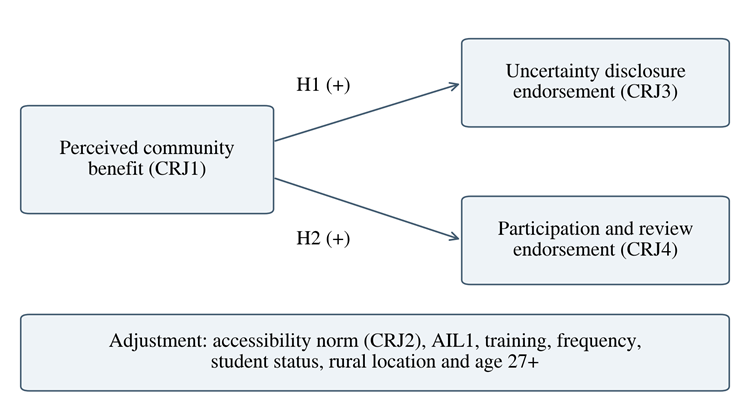
Figure 1. Conceptual scope of the exploratory item-level models. H1 and H2 are hypothesised positive associations, not causal pathways. Trust and realised climate outcomes are not measured.
The framework accordingly has a bounded theoretical contribution. It asks whether approval of informational benefits and endorsement of accessible tools are sufficient descriptive signals of broader governance preferences. It does not test whether one safeguards the other, whether participation increases trust or whether AI improves adaptation. Those questions require service-specific and preferably longitudinal or experimental evidence, alongside technical evaluation of the information being communicated.
3. Methodology
The study is a secondary cross-sectional analysis of the supplied Group 13 Law-SDG workbook, interpreted alongside the common questionnaire. The workflow checks measurement content before estimation, retains all eligible recorded rows and separates normative responses from experienced institutional performance. It reports uncertainty under stated analytical assumptions without recreating undocumented fieldwork procedures.
3.1 Source materials and study population
The Data sheet contains 385 records and 35 variables. README identifies the three Group 13 research topics, while Codebook provides the wording and coding of the variables. The common questionnaire supplies the response scale, adult eligibility and intended consent information. The current article focuses on CRJ1-CRJ5; environmental compliance and sustainable-business blocks belong primarily to the other group topics and are not substituted for the missing trust construct.[17]
The recorded population includes law students, graduates, legal professionals and other relevant respondents. It is not a sample documented as consisting of climate-risk service users, affected coastal communities or disaster-management officials. Residence categories are broad and do not identify hazard exposure. The descriptive unit is therefore a supplied record. Any interpretation as evidence about particular human communities depends on verifying numeric-response provenance and recruitment.
A material qualification applies to that verification. The codebook labels the respondent sequence and optional contextual comment synthetic. Those labels do not by themselves determine whether all numeric responses are simulated, but they preclude assuming verified human origin. Comments are excluded. If the numeric records are confirmed as generated, the analysis can only be represented as a methodological demonstration; population claims and assertions of participant findings would be inappropriate.
3.2 Sample size and record retention
All 385 rows record consent, adult eligibility and AI awareness, and all are retained in primary descriptions and models. The questionnaire recommends approximately 385 observations under Cochran’s large-population planning assumptions. Matching that target does not establish probability sampling, a five-per-cent national margin of error or sufficient precision for every regression coefficient. The present article does not report a response rate or invitation count because the required recruitment information is absent.[18]
No collection dates, geographic sampling frame, inclusion probabilities, institutional clusters or weighting scheme accompany the file. The analysis is unweighted and assumes independent records for its inferential summaries. Bootstrap and sandwich intervals do not resolve unknown selection or provenance. They communicate conditional analytical precision, rather than design-based uncertainty for the Bangladeshi population. Sample restrictions used as sensitivity checks are expressly distinguished from the full N = 385.
3.3 Measures and measurement assessment
Table 1 identifies the focal items and their analytical roles. All statements use one strongly disagree through five strongly agree. Endorsement is defined as four or five; neutrality and disagreement are combined only for that binary summary. Full category counts and means remain visible to show what thresholding omits. CRJ1 and CRJ2 enter models per one-score increment, with the linear-in-score log-odds assumption stated rather than treated as a property of validated interval scales.
Table 1. Measurement content and analytical roles
| Code | Abbreviated content | Role and interpretation |
| CRJ1 | AI information helps communities understand threats | Perceived benefit; focal predictor |
| CRJ2 | Tools accessible to vulnerable communities | Accessibility norm; separate predictor |
| CRJ3 | Models communicate uncertainty | Disclosure norm; outcome |
| CRJ4 | Participation and review for affected communities | Procedural norm; outcome |
| CRJ5 | Fair access matters for climate justice | Justice-related access proposition |
| AIL1 | Awareness of plausible AI inaccuracies | Adjustment item; not objective literacy |
Source: supplied questionnaire and codebook. No focal item directly measures current trust, observed service access or realised climate justice. Appendix A gives exact wording.
Cronbach’s alpha is 0.195 for CRJ, 0.280 for AIL, 0.181 for ECM and 0.157 for SBC. These values do not support reliable reflective scales in this analysis. Alpha is not a complete test of validity, and the statements deliberately address different norms and beliefs. The response is to retain item-level meanings rather than calculate a composite trust or justice score, estimate mediation or manufacture latent-variable fit statistics.[19]
The common questionnaire recommends pilot testing and measurement checks. No completed pilot report, translation record, expert validation or factor analysis accompanies the file. Recommended procedures are not reported as completed. In particular, a valid trust measure cannot be reconstructed by relabelling usefulness or uncertainty preferences. These choices preserve the distinction between item content and the claims it can support.
3.4 Data screening and descriptive estimation
The audit checks missing agreement scores, out-of-range values, identifier duplication, repeated complete 20-item vectors and uniform responses across those items. It finds no violations on these checks. Seventeen tool-name responses are missing; tool name does not enter the models. These results describe technical properties of the workbook and cannot establish whether responses are authentic, attentive or independently recruited.
Two experience fields disagree. Fourteen records report never-use experience with a non-never frequency, while 13 report never frequency with a non-never experience. No record reports never in both fields. Primary analyses retain these rows because the data do not establish which field is correct. A sensitivity restriction excludes either never code, leaving 358 records. The audit does not use synthetic contextual comments to infer or repair experience histories.
Descriptive endorsement intervals use the Wilson method and are pointwise. Paired differences subtract one binary item response from another within each record. Ten thousand whole-record bootstrap resamples preserve the pairing and provide percentile 95% intervals. Exact McNemar tests use discordant pairs; Holm correction applies across the three selected contrasts. Intervals are not simultaneous and do not account for unknown recruitment clusters.[20]
3.5 Exploratory models and robustness
Separate logistic models estimate endorsement of CRJ3 and CRJ4. Both include CRJ1, CRJ2, AIL1 awareness of plausible AI inaccuracies, any formal training, ordered AI frequency, current law-student status, upazila-rural location and age 27 or above. Scores are centred at three and frequency at monthly; centring changes the intercept rather than the focal slope. Covariates describe recorded circumstances and do not establish causal confounding control.
Models use maximum likelihood and HC1 sandwich covariance, with the n/(n−k) correction. Coefficient intervals are pointwise, and the two benefit p-values and two accessibility p-values receive separate Holm corrections. The difference between benefit coefficients across the two models uses their record-level score influences to account for shared respondents. Its ratio concerns odds-ratio associations across outcomes, not an interaction with a randomised intervention.[21]
Sensitivity checks fit the same model among consistent-use records, among current law students with the invariant status indicator removed, and with strong agreement alone as the outcome. Spearman correlations retain the original ordering as supplementary, unadjusted summaries. These checks are exploratory and are not additional confirmatory tests. No alternative specification is selected for producing a desired p-value, and sparse-category subgroup models are not used to claim differences among small gender groups.
Computation uses Python, pandas, NumPy and SciPy with random seed 20261025. Each primary logistic fit is independently checked against a scikit-learn unpenalised-limit fit. Maximum coefficient discrepancies are below 0.000001, as are maximum score components. The largest predictor variance-inflation factor is 1.06. Appendix B specifies the design matrix and estimators; Appendix C reports all contextual coefficients. Numerical agreement verifies calculation, not data authenticity.
3.6 Ethical considerations
The supplied draft reports that no formal ethics approval was obtained because the authors lacked an accessible institutional review mechanism applicable to the project. This is presented as the authors’ account, not an official exemption or a claim that such research is universally exempt in Bangladesh. The questionnaire specifies adult, voluntary participation, avoidance of names and reporting in aggregate. All rows record affirmative eligibility and consent, while the implementation of these procedures requires the original field documentation.
The secondary analysis applies protections within its control: contextual comments are excluded, no identifying information is introduced, all primary results are aggregated and small gender categories are not profiled. Participation preferences are not interpreted as deficiencies of affected communities. The article discloses measurement and provenance limitations and avoids unsupported causal or legal conclusions. Interpretation as human-participant evidence remains conditional on documentation of numeric-response provenance, consent implementation, access permissions and the applicable ethics-review position. The absence of an accessible approval route does not remove those responsibilities.
4. Results
The results distinguish five item distributions, paired comparisons among three governance conditions and exploratory associations with perceived community benefit. All primary analyses use N = 385. The section reports what is recorded without interpreting a safeguard preference as evidence that a service exists, an institution is trusted or a climate outcome has improved.
4.1 Recorded sample profile
Table 2 describes the complete database. The largest current-status category is other relevant respondent, followed by law student. This composition differs from a student-only survey and prevents treating educational level as interchangeable with legal status. The other relevant category is not further specified; its members cannot be assumed to be climate-service users, affected-community representatives or professionals with particular expertise.
Table 2. Profile of the complete supplied database (N = 385)
| Characteristic | Recorded categories and counts |
| Age | 21-23: 153; 24-26: 85 |
| 18-20: 61; 31+: 47 | |
| 27-30: 39 | |
| Gender | Male: 196; Female: 182 |
| Prefer not to say: 5; Other: 2 | |
| Current status | Other relevant respondent: 154; Law student: 118 |
| Law graduate: 64; Advocate or legal professional: 49 | |
| Education | Undergraduate: 212; Graduate: 87 |
| Postgraduate: 46; Professional: 40 | |
| Location | Dhaka: 147; District town: 88 |
| Upazila-rural area: 73; Other city corporation: 69 | |
| Other: 8 | |
| AI frequency | Weekly: 160; Daily or almost daily: 109 |
| Monthly: 70; Less than monthly: 33 | |
| Never: 13 | |
| Training | No: 208; Yes, short orientation: 125 |
| Yes, course or certified training: 52 |
Counts are unweighted and sum to 385 within each characteristic. Education and current legal status are different variables. The other relevant respondent category and hazard exposure are not further documented.
There are 196 male, 182 female, two other and five prefer-not-to-say records. Location categories include 73 upazila-rural records, but no variable directly measures climate exposure or community vulnerability. Frequency indicates weekly or daily AI use in 269 records, whereas formal training is absent in 208. These are broad AI variables and should not be described as experience with a climate-risk model.
The concentration of age in the 21-23 category and the mixture of legal statuses help delimit the audience represented by the file. They do not reveal the sampling design. No weighting, calibration to population totals or extrapolation to all Bangladeshi adults is performed. The descriptive table therefore provides context for the analytical records rather than evidence of national representativeness.
4.2 Benefit and justice-related item distributions
Table 3 gives all five category counts, score summaries and endorsement proportions. Perceived community benefit, CRJ1, is endorsed in 245 records (63.6%). Accessibility for vulnerable and underserved communities, CRJ2, has the highest endorsement at 259 (67.3%). Uncertainty disclosure, CRJ3, is endorsed in 219 (56.9%), participation and review, CRJ4, in 237 (61.6%), and the fair-access climate-justice proposition, CRJ5, in 225 (58.4%).
Table 3. Climate-risk information responses (N = 385)
| Statement abbreviated | Mean (SD) | Counts 1 / 2 / 3 / 4 / 5 | Endorsed n (%) | 95% interval (%) |
| CRJ1: Community benefit | 3.77 (0.76) | 0 / 12 / 128 / 181 / 64 | 245 (63.6%) | 58.7-68.3 |
| CRJ2: Accessible tools | 3.79 (0.79) | 1 / 18 / 107 / 193 / 66 | 259 (67.3%) | 62.4-71.8 |
| CRJ3: Uncertainty disclosure | 3.63 (0.80) | 0 / 26 / 140 / 168 / 51 | 219 (56.9%) | 51.9-61.7 |
| CRJ4: Participation and review | 3.72 (0.76) | 0 / 15 / 133 / 180 / 57 | 237 (61.6%) | 56.6-66.3 |
| CRJ5: Fair-access importance | 3.66 (0.76) | 0 / 20 / 140 / 177 / 48 | 225 (58.4%) | 53.5-63.3 |
Scores range from one strongly disagree to five strongly agree; three is neutral. Endorsed means four or five. Intervals are pointwise and conditional on the stated independent-record model, not a representative sampling design.
Neutral responses are substantial: 128 for perceived benefit, 107 for accessibility, 140 for uncertainty disclosure, 133 for participation and 140 for the fair-access proposition. A binary non-endorsement category consequently includes many neutral answers. It should not be described as rejection of justice, opposition to participation or a preference for hiding uncertainty. The full counts are retained to make that distinction visible.
Mean scores range from 3.63 for uncertainty disclosure to 3.79 for accessibility. These are descriptive summaries of agreement categories, not values of validated trust or justice scales. Their relatively narrow spread does not remove differences in item content or establish a common latent dimension. The low internal consistency reported in Section 3.3 is consistent with treating the block as a set of distinct responses.
4.3 Paired differences in governance preferences
Table 4 reports the selected within-record comparisons. Accessibility endorsement exceeds uncertainty-disclosure endorsement by 10.4 percentage points, with a pointwise 95% bootstrap interval of 3.6-16.9. The discordant counts are 107 accessibility-only and 67 uncertainty-only records. The exact paired p-value is 0.003 and the Holm-adjusted value is 0.009. This is evidence of a difference in endorsement of these two statements within the supplied records under the stated analytical model.
Table 4. Paired governance-condition contrasts (N = 385)
| First minus second | First only / second only | Gap pp | 95% bootstrap interval pp | Exact p | Holm p |
| Accessibility − uncertainty | 107 / 67 | 10.4 | 3.6-16.9 | 0.003 | 0.009 |
| Accessibility − participation | 102 / 80 | 5.7 | -1.0-12.5 | 0.119 | 0.239 |
| Participation − uncertainty | 99 / 81 | 4.7 | -2.1-11.4 | 0.205 | 0.239 |
Paired differences use complete records and 10,000 whole-record bootstrap resamples. Exact tests use discordant responses. Holm correction covers the three displayed comparisons; intervals are pointwise. The statements do not define an ordered psychological scale.
Accessibility exceeds participation by 5.7 points, with an interval of −1.0 to 12.5 and adjusted p = 0.239. Participation exceeds uncertainty disclosure by 4.7 points, with an interval of −2.1 to 11.4 and adjusted p = 0.239. The latter two estimates are positive but imprecise. Their intervals allow differences in either direction, so they are not used to assert a definite three-level ordering of governance priorities.
Figure 2 places the paired contrasts alongside the model associations. The figure shows why the accessibility-uncertainty contrast deserves attention while the other comparisons remain uncertain. It does not turn the different statements into a psychological scale or imply that a ten-point difference represents a directly measured deficit in public knowledge.
Figure 2. Paired endorsement contrasts and adjusted perceived-benefit associations. Panel A uses whole-record percentile bootstrap intervals; panel B uses HC1 model intervals. All analyses use N = 385 and pointwise 95% intervals.
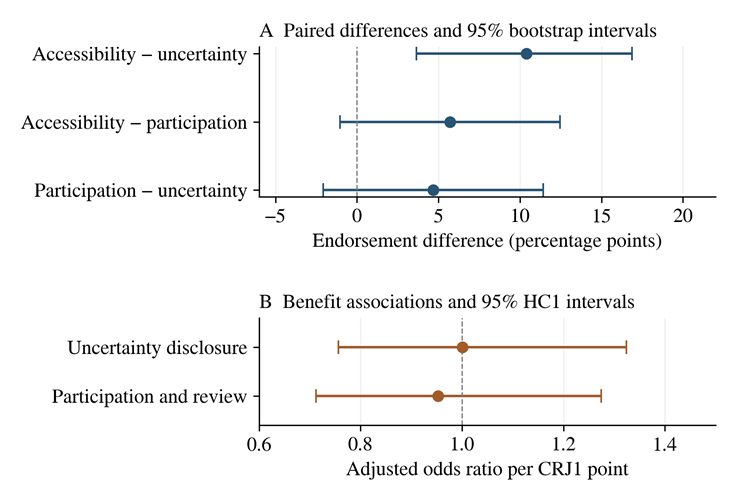
Figure 2. Paired endorsement contrasts and adjusted perceived-benefit associations.
4.4 Joint accessibility and uncertainty responses
Table 5 displays the joint endorsement of accessibility and uncertainty disclosure. Of the 259 accessibility endorsers, 152 also endorse uncertainty disclosure and 107 do not. Thus 41.3% of accessibility endorsers fall outside uncertainty endorsement, with neutrality and disagreement combined in that category. Conversely, 67 records endorse uncertainty disclosure without endorsing accessibility, and 59 endorse neither statement.
Table 5. Joint accessibility and uncertainty endorsement
| Accessible tools endorsed | Uncertainty disclosure endorsed | n |
| Yes | Yes | 152 |
| Yes | No | 107 |
| No | Yes | 67 |
| No | No | 59 |
N = 385. No includes neutrality and disagreement, not necessarily opposition. Among accessibility endorsers, 107/259 (41.3%) do not endorse uncertainty disclosure. All-three endorsement including participation is 92/385 (23.9%).
Only 92 records, or 23.9% of the complete database, endorse accessibility, uncertainty disclosure and participation together. This all-three summary is a content-defined conjunction of three norms, not a reliability-tested scale or a classification of respondents as just or unjust. It shows that majority endorsement of each separate item does not imply that the same majority endorses their combination.
The joint table also clarifies the paired contrast. The difference comes from an imbalance between the two discordant categories rather than from treating two independent samples as comparable. It leaves open why records differ: interpretation, experience, item wording and the data-generating process are not separately identified. No qualitative comment is used to infer those explanations.
4.5 Exploratory adjusted associations
Table 6 reports the focal model coefficients. For uncertainty-disclosure endorsement, the adjusted odds ratio per CRJ1 point is 1.00 (95% HC1 interval 0.76-1.32). For participation-and-review endorsement it is 0.95 (0.71-1.27). Both Holm-adjusted benefit p-values equal 1.000 after truncation. H1 and H2 are therefore not supported by these analyses; the results do not establish that the underlying relationships are exactly zero.
Table 6. Adjusted benefit and accessibility associations (N = 385)
| Outcome | n | CRJ1 OR (95% CI) | Holm p | CRJ2 OR (95% CI) | Holm p |
| Uncertainty disclosure | 219 | 1.00 (0.76-1.32) | 1.000 | 1.07 (0.82-1.39) | 1.000 |
| Participation and review | 237 | 0.95 (0.71-1.27) | 1.000 | 0.94 (0.72-1.23) | 1.000 |
n is the number endorsing the outcome. Models use HC1 covariance and all eight non-intercept predictors. CRJ1 is perceived benefit and CRJ2 accessibility. Odds ratios are per score point. Each predictor has a separate two-outcome Holm family; intervals are pointwise. H1 and H2 are not supported; this does not establish absence of association.
The accessibility coefficients are likewise imprecise: 1.07 (0.82-1.39) for uncertainty disclosure and 0.94 (0.72-1.23) for participation, with Holm-adjusted p = 1.000 in their separate two-coefficient family. Broad accessibility endorsement is consequently not a clear proxy for either outcome within the fitted specification. These associations do not test whether improving real-world access would change behaviour or institutional trust.
A comparison of the CRJ1 coefficients across the two outcomes yields an odds-ratio ratio of 1.05 (95% interval 0.69-1.61; raw p = 0.821). Because both outcomes come from the same records, the covariance calculation preserves that dependence. The result gives no clear evidence that the benefit association differs between outcomes, while the interval remains compatible with appreciable differences.
Unadjusted Spearman correlations between CRJ1 and the original outcome scores are 0.052 for CRJ3 and 0.023 for CRJ4. These small estimates complement the adjusted results without supplying an equivalence test. Appendix C provides the complete regression coefficients, including contextual variables, so that the specification and uncertainty remain inspectable.
4.6 Sensitivity and summary of findings
Table 7 reports the benefit coefficients under the specified robustness checks. The consistent-use subset retains 358 records and produces odds ratios of 0.98 for uncertainty disclosure and 1.02 for participation, both with intervals spanning one. Among 118 current law-student records, estimates are 1.13 and 0.74, with wider intervals. Those subset sizes do not replace the full N = 385.
Table 7. Sensitivity of perceived-benefit associations
| Specification or subset | n | CRJ3 OR (95% CI) | CRJ4 OR (95% CI) |
| Neither experience field says never | 358 | 0.98 (0.73-1.32) | 1.02 (0.75-1.39) |
| Current law students | 118 | 1.13 (0.60-2.15) | 0.74 (0.39-1.40) |
| Strong agreement as outcome | 385 | 1.20 (0.81-1.80) | 1.16 (0.80-1.68) |
All rows concern the CRJ1 coefficient. The student model omits invariant student status. The strict threshold uses 51 CRJ3 and 57 CRJ4 events. Intervals use HC1 covariance and are descriptive sensitivity summaries.
Defining endorsement as strong agreement alone gives 51 uncertainty-disclosure events and 57 participation events. The corresponding benefit odds ratios are 1.20 (0.81-1.80) and 1.16 (0.80-1.68). The estimates differ from the primary threshold but remain imprecise. Threshold sensitivity is therefore reported as a limitation of a simple endorsement summary, not as a reason to select the most favourable coefficient.
The principal result is the paired accessibility-uncertainty difference. The primary models and selected sensitivity analyses do not provide clear support for benefit-safeguard associations. Taken together, the calculations favour a differentiated account of the five statements over a claim that general approval of AI establishes trust or a uniform climate-justice orientation. The provenance and sampling qualifications apply equally to this summary and to every table.
5. Discussion
The analysis identifies a specific distinction in the supplied responses: endorsement of accessible climate-risk tools is more common than endorsement of communicating model uncertainty. Perceived community benefit is not clearly associated with uncertainty disclosure or participation after adjustment. These findings distinguish conditions relevant to trustworthy information without treating trust as an empirically measured mediator.
5.1 Access is necessary but does not describe the whole information process
Accessibility is the most frequently endorsed focal safeguard, but the paired and joint results show that it cannot stand in for all other governance preferences. A person may endorse wider reach while remaining neutral about how uncertainty should be presented. Similarly, fair access can be treated as a distributive aspiration without specifying the procedures through which affected communities can challenge the information’s use.[22]
This finding matters because institutional evaluations often begin with reach: whether a tool is available, how many people receive a message or whether an interface works on a mobile device. These are important questions, but the present comparison suggests the value of assessing the content and governance of the message separately. An accessible service should also be examined for comprehension, honest representation of limitations and practical opportunities to question consequential applications. This separation accords with the distinction between salience, credibility and legitimacy in usable-knowledge research, which evaluates more than the availability of an information product.[23]
The interpretation must remain proportional to the measurement. The survey does not establish that respondents prioritise access after deliberating about competing safeguards. Each statement is independently rated, and differences in wording or familiarity may affect the responses. The result is an endorsement difference, not a ranking of rights, a budget-allocation preference or evidence that communities would trade away uncertainty information for access.
5.2 Uncertainty disclosure requires its own evidence
The 10.4-point accessibility-uncertainty contrast and the substantial neutral category make uncertainty communication a distinct question for future service design. They do not justify describing the public as resistant to uncertainty. CRJ3 supplies no example, numeric range or decision context. Some respondents may understand uncertainty as a lack of competence; others may see it as an honest account of scientific limits. The study cannot distinguish these interpretations. Experimental evidence indicates that communicating uncertainty does not uniformly undermine trust and that communication format affects its reception.[24]
A useful next step would test specific message formats with a named decision. A flood-risk map might communicate a range, a probability and a statement about the relevant time horizon, alongside practical guidance. Evaluation could then ask whether people understand the message and make appropriately cautious decisions. That would examine communication quality rather than assume that agreement with a general norm predicts comprehension or action. Experiments on COVID-19 statistics likewise distinguish quantified ranges from unquantified uncertainty statements; they motivate format testing without establishing the best climate-risk message for Bangladesh.[25]
Uncertainty disclosure also has institutional implications. A statement of uncertainty should identify what remains uncertain and why it matters for the decision, rather than merely append a disclaimer. The present data cannot establish the optimal format or whether disclosure increases trust. They support the narrower conclusion that access and uncertainty norms warrant separate measurement and should not be collapsed into a general favourable attitude toward AI.[26]
5.3 Perceived benefit does not establish trust or procedural commitment
The adjusted benefit coefficients are close to one, with intervals spanning both lower and higher odds of the outcomes. These results constrain a narrative in which seeing AI as useful necessarily produces demands for responsible governance, or in which usefulness itself demonstrates trust. A record can endorse perceived community benefit without endorsing all the conditions examined. That pattern is compatible with conceptual separation, although it does not identify the reason for the separation. This interpretation is consistent with distinguishing the pragmatic value of a technology from normative approval of its governance.[27]
The null pattern should not be treated as evidence that useful information has no relationship with justice preferences in any population. Single-item content, neutral responses, the selected covariates and the undocumented recruitment process can all affect estimates. Nor does low internal consistency establish that respondents answered carelessly: the block combines different propositions. The defensible response is to refine measures and estimate uncertainty, rather than force a common construct to support a preferred model.[28]
The study also separates what makes reliance warranted from whether people actually rely. A service could be useful yet poorly governed, or trustworthy for one task and unsuitable for another. Future trust research should identify a provider, a capability and the decision at stake. It should then measure reliance and its calibration against independently assessed performance. That design could test the trust question that the current questionnaire leaves unanswered.[29]
5.4 Participation is a procedural condition
Participation and review are endorsed in 61.6% of records, and only 23.9% endorse all three principal conditions together. These figures should not be used to deny participation to those who did not endorse a survey item. Procedural rights and inclusion cannot depend on whether a survey sample expresses a majority preference. The analytical value is in identifying how distinctly participation is represented in the instrument and in the response patterns.[30]
Co-production scholarship supplies a practical interpretation: affected communities can help define relevant risks, identify missing local information and evaluate whether a service fits decisions. Participation also creates a route to question how a forecast becomes a decision about land, aid or adaptation priorities. Such opportunities are institutionally different from receiving an output, even when that output is accessible and technically credible.[31]
The study measures neither those opportunities nor their effectiveness. It does not establish that community voice is currently excluded or that a proposed consultation process would succeed. Service-specific work should document who is invited, whose knowledge changes the product and how a disagreement is resolved. This would connect a participation norm to observable practices rather than infer institutional legitimacy from a general agreement score.[32]
5.5 Bangladesh context and the limits of interpretation
The national relevance of climate-risk information is clear, but the recorded sample does not permit conclusions about the experiences of all affected people. Broad residence categories cannot identify coastal exposure, displacement, livelihood dependence or previous disaster losses. The other relevant respondent category lacks a substantive definition. The results should therefore inform a research agenda and cautious service questions rather than a national profile of public trust.[33]
The experience-field discordance and the sensitivity restrictions show why basic audit work matters. Removing either never code leaves the main benefit associations imprecise, but this numerical stability does not reveal which original response was correct. The student subset produces wider intervals and represents a different audience. Neither restriction repairs recruitment or establishes that any record comes from a particular climate-vulnerable group.
The provenance issue is more fundamental than these modelling decisions. If the numeric values are confirmed as simulated, the results are an analytical demonstration and must be represented accordingly. If the synthetic labels apply only to identifiers and comments, the original collection and processing records should establish that distinction. The article retains this boundary because statistical consistency cannot determine whether an undocumented workbook is human-participant evidence.
6. Theoretical and Practical Implications
The implications concern how climate-information research defines its constructs and how institutions evaluate a service. They arise from the separation of the measured statements and from uncertainty around the exploratory associations. They do not claim that the database demonstrates the effectiveness of a particular legal rule, communication format or participation intervention.
6.1 Theoretical implications
First, the analysis supports treating information access, uncertainty disclosure and participation as distinct analytical objects. It does not demonstrate that they are independent in a population or exhaust the meaning of climate justice. It shows that a general favourable climate-AI score would conceal important differences in the available responses. A theory-informed questionnaire should state which dimension each item addresses and what relationship is being tested.
Second, the study distinguishes conditions for trustworthy information from measured trust. This avoids a common inferential shortcut in which approval of transparency or usefulness is renamed confidence in an institution. Trust research would be strengthened by specifying the trustee and the task and by distinguishing perceived trustworthiness, willingness to rely and actual reliance. The current absence of a direct trust measure is an opportunity for clearer instrument development rather than a reason to infer an indirect effect.
Third, usable-knowledge and institutional perspectives encourage attention to the process connecting model output with public decisions. A service can be technically credible without being salient to a local task or legitimate in how it incorporates affected people. Future work should measure those dimensions directly, alongside resources and constraints that shape use. The present item-level approach supplies a bounded starting point for that design, not an empirical confirmation of the full theoretical frameworks.
6.2 Implications for information providers
Providers should evaluate access and comprehension separately. Language, disability accommodation, low-bandwidth delivery and trusted intermediaries are possible design considerations, but their effectiveness must be assessed with intended users. A usage count or download statistic cannot reveal whether a vulnerable community can understand the output, act on it or identify an error. Testing should examine realistic tasks and report which populations remain outside coverage.
Uncertainty communication should be designed around decisions and validated against the model’s actual performance. Providers can identify time horizons, data limitations and relevant ranges without suggesting that every uncertain prediction is useless. They should assess whether the presentation leads to appropriate understanding rather than aim simply to maximise reported confidence. The survey offers no evidence that one format is best, so local testing and independent technical review remain necessary.
Participation and review should also be operationally specific. Providers can document how affected people raise a concern, who responds, what information is available for review and whether feedback changes the service. Accountability scholarship emphasises responsibilities and answerability, while reviewable-decision frameworks connect scrutiny to the systems and records needed for it. These approaches inform recommendations without implying that their implementation has been observed in this database.[34]
6.3 Governance and sustainable development
AI governance frameworks offer principles for identifying risks, documenting limitations and assigning responsibility across a system’s lifecycle. Their relevance here is methodological and normative; they are not presented as binding Bangladeshi law or proof of a provider’s compliance. Risk management should connect technical evaluation with the social setting in which information is distributed and used. An institution should be able to explain both the model’s limits and the decisions it makes using the model.[35]
For climate and development reporting, indicators should distinguish reach, comprehension, justified reliance, participation and realised outcomes. The present percentages belong to the level of stated preferences. They cannot establish climate resilience, successful adaptation or achievement of an SDG target. The practical recommendation is therefore to connect future attitude research with observable service performance and community decision processes, while keeping its own claims proportionate to the evidence.
7. Conclusion, Limitations and Future Research
This study re-examines the conditions relevant to trustworthy AI climate-risk information through five distinct questionnaire statements. In the supplied 385 records, accessibility endorsement is 67.3%, uncertainty-disclosure endorsement 56.9% and participation endorsement 61.6%. Accessibility exceeds uncertainty disclosure by 10.4 percentage points in a paired comparison, while the other selected contrasts remain uncertain after multiplicity adjustment. Only 92 records endorse all three conditions together.
The exploratory models do not provide clear support for positive perceived-benefit associations with uncertainty disclosure or participation. This finding does not establish equivalence or the absence of relationships in a population. Its main implication is that usefulness, normative safeguards and trust should not be treated as interchangeable measures. The questionnaire contains no direct trust scale, so claims that trust mediates climate justice outcomes are not sustained.
The article contributes a measurement-conscious approach to a substantively important topic. It combines paired comparisons, joint responses and adjusted item-level models while retaining the full database and reporting subset denominators explicitly. It also connects the measured distinctions to climate justice and usable-knowledge scholarship without claiming to validate theories for which the required variables are absent. This provides a clearer foundation for subsequent empirical and service-evaluation work.
Several limitations constrain the findings. The design is cross-sectional; the items are broad statements rather than evaluations of a named information provider. No realised climate outcome, hazard exposure, service comprehension or reliance behaviour is measured. Low internal consistency limits composite interpretation, and the five-point scale does not ensure equal psychological spacing. Endorsement thresholds simplify the original responses, while single items provide limited content coverage.
Recruitment, field dates, institutional clustering and selection probabilities are undocumented. The independent-record model for intervals and covariance cannot repair those omissions. The other relevant respondent category is unspecified, and broad age and location variables cannot identify affected populations. Experience fields are discordant, and sensitivity exclusions cannot establish their correct original values. Exploratory adjustment does not resolve omitted variables, selection or causal ordering.
Numeric-response provenance remains unresolved because the codebook labels respondent sequences and contextual comments synthetic. The comments are excluded, and human-population claims require documentary verification. If the numbers are simulated, this work must be presented as a methodological demonstration. This boundary is essential to the status of the article and cannot be removed through statistical refinement or editorial wording.
Future studies should recruit transparently across intended users and affected communities, validate service-specific trust and justice measures and examine practical access barriers. Experiments could compare uncertainty formats while measuring comprehension and calibrated reliance. Longitudinal or participatory evaluations could examine how review experiences change service use and whether community feedback affects decisions. Combining these designs with technical model audits would provide stronger evidence about when AI information supports climate justice and when its institutional use requires correction.
8. Declarations
Ethical approval and oversight
Formal ethical approval was not obtained because, at the time of the study, the authors’ institutional setting did not provide an accessible formal review mechanism applicable to this non-interventional adult questionnaire research. The study nevertheless followed participant-protection safeguards, including informed consent, voluntary participation, the opportunity to discontinue, an anonymous questionnaire and aggregate reporting. The methodological safeguards are detailed in Section 3.6. The absence of an accessible review mechanism describes the institutional context; responsibility for ethical conduct remained with the researchers.
Informed consent
Informed consent was obtained from adult participants before questionnaire completion. The questionnaire explained the study purpose, voluntary participation, anonymity and the option to discontinue. All analysed records contain affirmative consent and adult-eligibility responses.
Data availability
The numerical data supporting the reported analyses are held by the research team. Requests for de-identified data and analytical specifications may be directed to the corresponding author. Any sharing is subject to participant confidentiality and applicable institutional requirements. The contextual-text field was excluded from the analysis.
Author contributions
Md. Emon Mridha: Lead student researcher; conceptualisation; preparation of study materials; organisation and curation of survey data; manuscript development. The project was conducted under the supervision of Prof. Dr Kazi Abdul Mannan.
Kazi Abdul Mannan: Conceptual and methodological guidance; supervision; interpretation of statistical findings; critical review and editing of the manuscript.
Generative AI disclosure
Generative AI assisted manuscript drafting, language editing, organisation and the development of analytical code. Statistical estimates were computed programmatically from the numerical survey data. Responsibility for the study’s analysis, interpretation and reporting rests with the authors.
Bibliography
Altman DG and Bland JM, ‘Absence of Evidence Is Not Evidence of Absence’ (1995) 311 BMJ 485
Ananny M and Crawford K, ‘Seeing without Knowing: Limitations of the Transparency Ideal and Its Application to Algorithmic Accountability’ (2018) 20 New Media & Society 973
Bi K and others, ‘Accurate Medium-Range Global Weather Forecasting with 3D Neural Networks’ (2023) 619 Nature 533
Bovens M, ‘Analysing and Assessing Accountability: A Conceptual Framework’ (2007) 13 European Law Journal 447
Cash DW and others, ‘Knowledge Systems for Sustainable Development’ (2003) 100 Proceedings of the National Academy of Sciences 8086
Cobbe J, Lee MSA and Singh J, ‘Reviewable Automated Decision-Making: A Framework for Accountable Algorithmic Systems’ in Proceedings of the 2021 ACM Conference on Fairness, Accountability, and Transparency (ACM 2021) 598
Cochran WG, Sampling Techniques (3rd edn, John Wiley & Sons 1977)
Cronbach LJ, ‘Coefficient Alpha and the Internal Structure of Tests’ (1951) 16 Psychometrika 297
Efron B and Tibshirani RJ, An Introduction to the Bootstrap (Chapman & Hall 1993)
Group 13 Law-SDG project, ‘Group-13-Law-SDG-Database’ (unpublished supplied workbook, Summer 2026), Data and Codebook sheets
Holm S, ‘A Simple Sequentially Rejective Multiple Test Procedure’ (1979) 6 Scandinavian Journal of Statistics 65
Intergovernmental Panel on Climate Change, Climate Change 2023: Synthesis Report (IPCC 2023)
Jacovi A and others, ‘Formalizing Trust in Artificial Intelligence: Prerequisites, Causes and Goals of Human Trust in AI’ in Proceedings of the 2021 ACM Conference on Fairness, Accountability, and Transparency (ACM 2021) 624
Kerr J and others, ‘The Effects of Communicating Uncertainty around Statistics, on Public Trust’ (2023) 10 Royal Society Open Science 230604
Law-SDG research project, ‘Full Questionnaires for 17 AI-Integrated Legal Research Groups’ (unpublished supplied questionnaire, Summer 2026), Group 13, CRJ1-CRJ5
Lemos MC and Morehouse BJ, ‘The Co-Production of Science and Policy in Integrated Climate Assessments’ (2005) 15 Global Environmental Change 57
Mayer RC, Davis JH and Schoorman FD, ‘An Integrative Model of Organizational Trust’ (1995) 20 Academy of Management Review 709
McNemar Q, ‘Note on the Sampling Error of the Difference between Correlated Proportions or Percentages’ (1947) 12 Psychometrika 153
National Institute of Standards and Technology, Artificial Intelligence Risk Management Framework (AI RMF 1.0) (NIST AI 100-1, NIST 2023)
Norström AV and others, ‘Principles for Knowledge Co-Production in Sustainability Research’ (2020) 3 Nature Sustainability 182
Rolnick D and others, ‘Tackling Climate Change with Machine Learning’ (2022) 55(2) ACM Computing Surveys 42
Rousseau DM and others, ‘Not So Different After All: A Cross-Discipline View of Trust’ (1998) 23 Academy of Management Review 393
Schlosberg D and Collins LB, ‘From Environmental to Climate Justice: Climate Change and the Discourse of Environmental Justice’ (2014) 5 WIREs Climate Change 359
Sijtsma K, ‘On the Use, the Misuse, and the Very Limited Usefulness of Cronbach’s Alpha’ (2009) 74 Psychometrika 107
Slovic P, ‘Perception of Risk’ (1987) 236 Science 280
Stefanski LA and Boos DD, ‘The Calculus of M-Estimation’ (2002) 56 American Statistician 29
Stern PC, ‘Toward a Coherent Theory of Environmentally Significant Behavior’ (2000) 56 Journal of Social Issues 407
Suchman MC, ‘Managing Legitimacy: Strategic and Institutional Approaches’ (1995) 20 Academy of Management Review 571
UN General Assembly, ‘Transforming Our World: The 2030 Agenda for Sustainable Development’ (25 September 2015) UN Doc A/RES/70/1
UNESCO, Recommendation on the Ethics of Artificial Intelligence (UNESCO 2022)
van der Bles AM and others, ‘The Effects of Communicating Uncertainty on Public Trust in Facts and Numbers’ (2020) 117 Proceedings of the National Academy of Sciences 7672
Wilson EB, ‘Probable Inference, the Law of Succession, and Statistical Inference’ (1927) 22 Journal of the American Statistical Association 209
World Bank Group, Bangladesh Country Climate and Development Report (World Bank 2022)
Appendix A. Exact focal item wording
Table A1 reproduces the supplied CRJ statements and AIL1 adjustment item. The retained wording explains why a perceived-benefit statement and normative safeguards cannot be relabelled as a direct trust measure. All response categories use the same one-to-five agreement coding.
Table A1. Exact focal and adjustment questionnaire statements
| Code | Statement |
| CRJ1 | AI-based climate-risk information can help communities understand environmental threats. |
| CRJ2 | Climate-risk tools should be accessible to vulnerable and underserved communities. |
| CRJ3 | AI climate models should communicate uncertainty rather than present estimates as certainty. |
| CRJ4 | Communities affected by climate decisions should have opportunities for participation and review. |
| CRJ5 | Fair access to AI climate information is important for climate justice. |
| AIL1 | I understand that generative AI can produce plausible but inaccurate information. |
Original agreement scale: one strongly disagree, two disagree, three neutral, four agree and five strongly agree. The same wording appears in the supplied Group 13 questionnaire.
The wording is reproduced from the supplied common questionnaire and codebook. No reverse coding or new trust item is introduced. Blocks concerning environmental compliance monitoring and sustainable business remain outside the focal model, preserving the distinction between the three Group 13 research topics.
Appendix B. Reproducibility specification
Read all 385 rows from the Data sheet and retain the original codes. Describe CRJ1-CRJ5 with means, sample standard deviations and counts at scores one to five. Define endorsement as a score of four or five. For the paired comparisons, order the three binary columns as CRJ2, CRJ3 and CRJ4, then compute differences for column pairs (0,1), (0,2) and (2,1). Resample 385 whole records with replacement in each of 10,000 replicates using NumPy default_rng seed 20261025; use the 2.5th and 97.5th percentiles of each mean paired difference. Test discordant cells with a two-sided exact binomial test and apply Holm adjustment across three tests.
The primary logistic design matrix is: intercept; CRJ1 minus three; CRJ2 minus three; AIL1 minus three; any-training indicator; frequency coded zero never through four daily, minus two; current-law-student indicator; upazila-rural indicator; age-27-plus indicator. Estimate CRJ3 endorsement and CRJ4 endorsement separately. Use the Bernoulli likelihood, BFGS and an analytical score. HC1 covariance is the inverse information matrix multiplied on both sides of the score outer-product sum, with n/(n−k) scaling. Apply Holm correction separately to the two CRJ1 p-values and the two CRJ2 p-values.
For the across-outcome CRJ1 contrast, stack the two models’ CRJ1 influence vectors, compute their paired covariance with the same HC1 correction and evaluate the coefficient difference. Exponentiate for the odds-ratio ratio. Sensitivity models retain the same coding; the student-only model removes invariant student status, and the strict model defines events as score five. These analyses use the complete data for primary estimates and do not infer missing trust measures. All confidence intervals are pointwise and conditional on independent records.
Appendix C. Complete primary model coefficients
Table C1 gives the complete non-intercept coefficients for the two primary outcomes. These contextual associations are included for transparency and are not presented as additional causal discoveries. The coefficients concern endorsement of statements rather than actual access, participation or climate outcomes.
Table C1. Complete adjusted non-intercept coefficients (N = 385)
| Predictor | CRJ3 OR (95% HC1 interval) | CRJ4 OR (95% HC1 interval) |
| CRJ1 perceived benefit | 1.00 (0.76-1.32) | 0.95 (0.71-1.27) |
| CRJ2 accessibility norm | 1.07 (0.82-1.39) | 0.94 (0.72-1.23) |
| AIL1 inaccuracy awareness | 1.04 (0.79-1.36) | 1.26 (0.97-1.65) |
| Any formal AI training | 1.14 (0.74-1.75) | 1.02 (0.66-1.57) |
| AI frequency category | 1.08 (0.88-1.32) | 1.08 (0.87-1.33) |
| Current law student | 1.03 (0.65-1.63) | 0.80 (0.51-1.28) |
| Upazila-rural location | 0.61 (0.36-1.03) | 0.80 (0.47-1.36) |
| Age 27+ | 0.59 (0.36-0.97) | 1.07 (0.64-1.80) |
Training compares any formal training with none; status compares current law students with others; location compares upazila-rural with other locations; age compares 27+ with younger groups. Frequency is per category. Intervals are pointwise; contextual terms are not a separate confirmatory discovery family.
Both models use N = 385 and eight predictors. Weights, random effects and cluster corrections are omitted because design information is unavailable. Provenance qualifications apply throughout.
[1] World Bank Group, Bangladesh Country Climate and Development Report (World Bank 2022).
[2] Intergovernmental Panel on Climate Change, Climate Change 2023: Synthesis Report (IPCC 2023).
[3] David Rolnick and others, ‘Tackling Climate Change with Machine Learning’ (2022) 55(2) ACM Computing Surveys 42.
[4] Kaifeng Bi and others, ‘Accurate Medium-Range Global Weather Forecasting with 3D Neural Networks’ (2023) 619 Nature 533.
[5] David Schlosberg and Lisette B Collins, ‘From Environmental to Climate Justice: Climate Change and the Discourse of Environmental Justice’ (2014) 5 WIREs Climate Change 359.
[6] UN General Assembly, ‘Transforming Our World: The 2030 Agenda for Sustainable Development’ (25 September 2015) UN Doc A/RES/70/1.
[7] David W Cash and others, ‘Knowledge Systems for Sustainable Development’ (2003) 100 Proceedings of the National Academy of Sciences 8086.
[8] Maria Carmen Lemos and Barbara J Morehouse, ‘The Co-Production of Science and Policy in Integrated Climate Assessments’ (2005) 15 Global Environmental Change 57.
[9] Albert V Norström and others, ‘Principles for Knowledge Co-Production in Sustainability Research’ (2020) 3 Nature Sustainability 182.
[10] Mark C Suchman, ‘Managing Legitimacy: Strategic and Institutional Approaches’ (1995) 20 Academy of Management Review 571.
[11] Roger C Mayer, James H Davis and F David Schoorman, ‘An Integrative Model of Organizational Trust’ (1995) 20 Academy of Management Review 709; Denise M Rousseau and others, ‘Not So Different After All: A Cross-Discipline View of Trust’ (1998) 23 Academy of Management Review 393.
[12] Alon Jacovi and others, ‘Formalizing Trust in Artificial Intelligence: Prerequisites, Causes and Goals of Human Trust in AI’ in Proceedings of the 2021 ACM Conference on Fairness, Accountability, and Transparency (ACM 2021) 624.
[13] Anne-Marthe van der Bles and others, ‘The Effects of Communicating Uncertainty on Public Trust in Facts and Numbers’ (2020) 117 Proceedings of the National Academy of Sciences 7672.
[14] Paul Slovic, ‘Perception of Risk’ (1987) 236 Science 280.
[15] Mike Ananny and Kate Crawford, ‘Seeing without Knowing: Limitations of the Transparency Ideal and Its Application to Algorithmic Accountability’ (2018) 20 New Media & Society 973.
[16] Paul C Stern, ‘Toward a Coherent Theory of Environmentally Significant Behavior’ (2000) 56 Journal of Social Issues 407.
[17] Group 13 Law–SDG project, ‘Group-13-Law-SDG-Database’ (unpublished supplied workbook, Summer 2026), Data and Codebook sheets; Law–SDG research project, ‘Full Questionnaires for 17 AI-Integrated Legal Research Groups’ (unpublished supplied questionnaire, Summer 2026), Group 13, CRJ1–CRJ5.
[18] William G Cochran, Sampling Techniques (3rd edn, John Wiley & Sons 1977).
[19] Lee J Cronbach, ‘Coefficient Alpha and the Internal Structure of Tests’ (1951) 16 Psychometrika 297; Klaas Sijtsma, ‘On the Use, the Misuse, and the Very Limited Usefulness of Cronbach’s Alpha’ (2009) 74 Psychometrika 107.
[20] Edwin B Wilson, ‘Probable Inference, the Law of Succession, and Statistical Inference’ (1927) 22 Journal of the American Statistical Association 209; Bradley Efron and Robert J Tibshirani, An Introduction to the Bootstrap (Chapman & Hall 1993); Quinn McNemar, ‘Note on the Sampling Error of the Difference between Correlated Proportions or Percentages’ (1947) 12 Psychometrika 153; Sture Holm, ‘A Simple Sequentially Rejective Multiple Test Procedure’ (1979) 6 Scandinavian Journal of Statistics 65.
[21] Leonard A Stefanski and Dennis D Boos, ‘The Calculus of M-Estimation’ (2002) 56 American Statistician 29.
[22] Schlosberg and Collins (n 5).
[23] Cash and others (n 7); Ananny and Crawford (n 15).
[24] van der Bles and others (n 13); Slovic (n 14).
[25] John Kerr and others, ‘The Effects of Communicating Uncertainty around Statistics, on Public Trust’ (2023) 10 Royal Society Open Science 230604; van der Bles and others (n 13).
[26] van der Bles and others (n 13); Ananny and Crawford (n 15).
[27] Suchman (n 10); Mayer, Davis and Schoorman (n 11).
[28] Douglas G Altman and J Martin Bland, ‘Absence of Evidence Is Not Evidence of Absence’ (1995) 311 BMJ 485; Sijtsma (n 19).
[29] Jacovi and others (n 12); Mayer, Davis and Schoorman (n 11).
[30] Schlosberg and Collins (n 5).
[31] Lemos and Morehouse (n 8); Norström and others (n 9).
[32] Norström and others (n 9); Suchman (n 10).
[33] World Bank Group (n 1); IPCC (n 2).
[34] Mark Bovens, ‘Analysing and Assessing Accountability: A Conceptual Framework’ (2007) 13 European Law Journal 447; Jennifer Cobbe, Michelle Seng Ah Lee and Jatinder Singh, ‘Reviewable Automated Decision-Making: A Framework for Accountable Algorithmic Systems’ in Proceedings of the 2021 ACM Conference on Fairness, Accountability, and Transparency (ACM 2021) 598.
[35] National Institute of Standards and Technology, Artificial Intelligence Risk Management Framework (AI RMF 1.0) (NIST AI 100-1, NIST 2023); UNESCO, Recommendation on the Ethics of Artificial Intelligence (UNESCO 2022).