Journal Home
OPEN ACCESS
Building Socially Inclusive Climate Resilience in Coastal Bangladesh: Policy Lessons, Transformative Pathways and Future Research Directions
| Dr Khandaker Mursheda Farhana Associate Professor Department of Sociology & Anthropology Shanto-Mariam University of Creative Technology Uttara, Dhaka-1230, Bangladesh Email: drfarhanamannan@gmail.com ORCID: https://orcid.org/0009-0009-1526-6147 |
| Md. Touhiduzzaman Assistant Professor Department of Sociology Dhaka International University (DIU) Satarkul, Badda, Dhaka-1212, Bangladesh ORCID: https://orcid.org/0009-0008-9912-7912 Corresponding author: Dr Khandaker Mursheda Farhana: drfarhanamannan@gmail.com |
J. polic. recomm. 2026, 5(2); https://doi.org/10.64907/xkmf.v5i2.jopr.13
Submission received: 21 March 2026 / Revised: 02 May 2026 / Accepted: 15 May 2026 / Published: 21 May 2026
Download (PDF)
Abstract
Coastal Bangladesh represents one of the world’s most climate-vulnerable regions, facing recurrent cyclones, storm surges, salinity intrusion, sea-level rise, and livelihood erosion. While the country has achieved notable success in disaster risk reduction, significant structural inequalities continue to shape patterns of vulnerability and adaptive capacity. This study examines how socially inclusive climate resilience can be strengthened in coastal Bangladesh by integrating justice-oriented frameworks, participatory governance, and transformative adaptation pathways. Drawing on a qualitative methodology that synthesises policy analysis, secondary empirical research, and theoretical insights from climate justice, social-ecological resilience, and political ecology, the study critically evaluates existing adaptation interventions and institutional arrangements. Findings suggest that resilience efforts remain disproportionately focused on infrastructural and technical solutions, often overlooking issues of gender inequality, land dispossession, livelihood precarity, and governance fragmentation. Although national policy frameworks such as the Bangladesh Climate Change Strategy and Action Plan and the Delta Plan 2100 articulate progressive adaptation goals, implementation gaps persist at local levels. The paper argues that building socially inclusive climate resilience requires decentralised governance reforms, gender-responsive climate finance, recognition of migration as adaptive mobility, integration of ecological restoration with infrastructure, and strengthened climate-responsive social protection systems. The study concludes by identifying key research gaps and emphasising the need for intersectional, longitudinal, and community-based approaches to advance equitable and transformative climate adaptation in deltaic regions.
Keywords: climate resilience; social inclusion; coastal Bangladesh; climate justice; adaptive governance; transformative adaptation
1. Introduction
Climate change has emerged as one of the most pressing global challenges of the twenty-first century, with disproportionately severe consequences for low-lying deltaic regions. Among the most vulnerable countries in the world, Bangladesh occupies a unique and precarious geographical position at the confluence of the Ganges, Brahmaputra, and Meghna river systems. Approximately one-third of the country lies within coastal zones that are highly exposed to sea-level rise, tropical cyclones, tidal surges, saline intrusion, and riverbank erosion (Intergovernmental Panel on Climate Change [IPCC], 2022). The coastal belt, home to more than 35 million people, is therefore at the frontline of climate-induced risks that threaten livelihoods, infrastructure, and human security (Islam & Winkel, 2017).
Over the past decades, Bangladesh has made significant strides in disaster risk reduction, cyclone preparedness, and climate adaptation planning. Investments in early warning systems, cyclone shelters, embankments, and community-based disaster management have contributed to reduced mortality rates from major storms compared to previous decades (Huq & Ayers, 2008). Additionally, the country has developed a robust climate policy architecture, including the Bangladesh Climate Change Strategy and Action Plan (BCCSAP) and the ongoing National Adaptation Plan (NAP) process (Government of Bangladesh [GoB], 2021). These frameworks articulate commitments to enhancing resilience and protecting vulnerable populations.
Despite these advancements, critical questions remain regarding who benefits from resilience initiatives and whose voices are marginalised in adaptation processes. Climate resilience is frequently conceptualised in infrastructural or technical terms—emphasising embankments, housing reinforcement, or agricultural adaptation—while insufficient attention is given to underlying social inequalities that shape vulnerability and adaptive capacity (Cote & Nightingale, 2012). As a result, resilience-building efforts risk reinforcing existing hierarchies unless they explicitly integrate social inclusion into policy design and implementation.
Social inclusion refers to the process of improving the terms of participation in society, particularly for disadvantaged groups, by enhancing opportunities, access to resources, voice, and respect for rights (United Nations Department of Economic and Social Affairs [UN DESA], 2018). In the context of climate change, social inclusion demands that marginalised populations—such as women, landless labourers, fishers, ethnic minorities, persons with disabilities, and climate migrants—are not merely beneficiaries but active agents in shaping resilience pathways. The failure to incorporate inclusive governance can perpetuate structural inequities, undermine trust in institutions, and ultimately weaken long-term resilience (Siders, 2019).
In coastal Bangladesh, social vulnerability is deeply intertwined with poverty, landlessness, patriarchal norms, limited access to education, and weak political representation (Adger, 2006; Islam & Winkel, 2017). These structural factors influence exposure to climate hazards, sensitivity to environmental shocks, and the capacity to recover. For example, landless households often reside in the most hazard-prone areas, such as embankment slopes or char lands, where they lack secure tenure and access to formal credit systems. Women, particularly in conservative rural settings, may face mobility constraints and exclusion from decision-making spaces, limiting their ability to influence adaptation strategies (Rahman & Alam, 2021).
Recent scholarship emphasises that resilience should not be understood merely as the capacity to “bounce back” to pre-disaster conditions but as an opportunity for transformative change that addresses root causes of vulnerability (Pelling & Manuel-Navarrete, 2011). Transformative resilience involves shifts in power relations, institutional arrangements, and socio-economic structures that enable more equitable outcomes. However, translating this normative vision into policy practice remains challenging, particularly in resource-constrained contexts.
This study seeks to contribute to the growing body of literature on climate resilience by centring social inclusion within the coastal Bangladesh context. It advances three primary objectives. First, it critically examines existing theoretical and empirical debates on vulnerability, resilience, and social inclusion, highlighting gaps in intersectional and governance-oriented analyses. Second, it situates socially inclusive climate resilience within a broader socio-political framework that integrates vulnerability theory, social capital, and intersectionality. Third, it identifies policy lessons and transformative pathways that can guide inclusive adaptation strategies in coastal Bangladesh.
By foregrounding social inclusion, this research responds to global calls for climate justice and equitable adaptation. The IPCC (2022) underscores that climate impacts are not evenly distributed and that socially marginalised populations face compounded risks. Achieving the Sustainable Development Goals (SDGs), particularly Goal 13 (Climate Action) and Goal 10 (Reduced Inequalities), requires integrated approaches that bridge environmental and social policy domains. Coastal Bangladesh provides a critical case study for examining how such integration can be pursued in practice.
Ultimately, building socially inclusive climate resilience demands a shift from technocratic adaptation models toward participatory, justice-oriented frameworks. It requires recognising that resilience is not simply a technical outcome but a socially negotiated process embedded within power structures, cultural norms, and governance systems. By exploring policy lessons, transformative pathways, and future research directions, this article contributes to the development of inclusive and context-sensitive strategies that leave no one behind in the face of escalating climate risks.
2. Literature Review
2.1 Climate Vulnerability in Coastal Contexts
The concept of vulnerability has been central to climate change research for over three decades. Vulnerability is typically defined as the degree to which a system is susceptible to, and unable to cope with, adverse effects of climate change (Adger, 2006). It encompasses three interrelated components: exposure to hazards, sensitivity to impacts, and adaptive capacity (Brooks, Adger, & Kelly, 2005). In coastal Bangladesh, these dimensions converge dramatically.
Exposure is heightened due to geographical location. Rising sea levels, intensified cyclones, storm surges, and saline intrusion threaten coastal ecosystems and human settlements (IPCC, 2022). Sensitivity is amplified by dependence on climate-sensitive livelihoods such as agriculture, aquaculture, and fishing. Adaptive capacity, meanwhile, is constrained by poverty, limited infrastructure, and institutional weaknesses (Islam & Winkel, 2017).
Scholars increasingly argue that vulnerability is socially constructed rather than purely environmental (Cutter, 2016). Structural inequalities—such as unequal land distribution, gender discrimination, and political marginalisation—shape differential exposure and recovery trajectories. In Bangladesh, landless households often settle on embankments or flood-prone areas, increasing their risk during cyclones. Similarly, social norms may limit women’s access to information or evacuation shelters, thereby exacerbating risk (Rahman & Alam, 2021). Thus, vulnerability is embedded within broader socio-economic and political systems.
2.2 From Adaptation to Resilience
The evolution from adaptation-focused frameworks to resilience-based approaches marks a significant shift in climate governance discourse. Adaptation traditionally referred to adjustments in practices, processes, or structures to moderate harm from climate impacts (IPCC, 2014). Resilience, by contrast, emphasises the capacity of social–ecological systems to absorb disturbances, reorganise, and continue functioning (Folke, 2006).
While resilience thinking has gained prominence, it has also faced critical scrutiny. Cote and Nightingale (2012) argue that resilience discourse can depoliticise climate challenges by emphasising system stability over social justice. Similarly, Pelling and Manuel-Navarrete (2011) caution that resilience may perpetuate existing power structures unless it includes transformative change. Transformation entails altering the underlying drivers of vulnerability—such as inequitable resource distribution or exclusionary governance.
In Bangladesh, resilience initiatives have often focused on infrastructural solutions such as cyclone shelters, embankments, and climate-resilient housing (Huq & Ayers, 2008). While these measures are essential, they do not automatically address social exclusion. Without inclusive participation and equitable benefit distribution, infrastructural resilience may fail to reduce long-term vulnerability for marginalised groups.
2.3 Social Inclusion and Climate Justice
Social inclusion has emerged as a critical dimension of sustainable development. It involves improving access to opportunities, services, and decision-making processes for marginalised populations (UN DESA, 2018). In climate contexts, inclusion is linked to procedural justice (fair participation in decision-making) and distributive justice (equitable allocation of resources) (Siders, 2019).
Climate justice scholarship emphasises that those least responsible for greenhouse gas emissions often bear the greatest impacts (Schlosberg, 2013). Bangladesh exemplifies this injustice, contributing minimally to global emissions while facing severe climate risks. Within Bangladesh, similar inequities exist among socio-economic groups. Women, persons with disabilities, and ethnic minorities may face compounded disadvantages that restrict their participation in resilience planning.
Intersectionality provides a valuable analytical lens to understand these layered inequalities. Originating in feminist legal theory (Crenshaw, 1989), intersectionality examines how multiple social identities intersect to produce unique forms of disadvantage. Collins (2015) further develops this framework to analyse power relations and systemic oppression. Applying intersectionality to climate resilience reveals how gender, class, age, and disability intersect to shape vulnerability and adaptive capacity.
2.4 Social Capital and Collective Action
Social capital theory highlights the importance of networks, trust, and norms in facilitating cooperation and collective action (Putnam, 2000). In disaster contexts, strong social ties can enhance information sharing, evacuation coordination, and post-disaster recovery (Aldrich & Meyer, 2015). Bonding social capital (within-group ties) and bridging social capital (across-group connections) both influence resilience outcomes.
However, social capital is not inherently equitable. Exclusive networks may reinforce power hierarchies, limiting access to resources for marginalised individuals (Aldrich & Meyer, 2015). In coastal Bangladesh, patron–client relationships and local elite dominance can shape access to relief and adaptation funds. Therefore, social capital must be analysed critically within broader socio-political structures.
2.5 Governance and Policy Integration
Effective climate resilience requires multi-level governance coordination. National policies must align with local realities, while community voices must inform planning processes (Olsson et al., 2015). Bangladesh’s policy frameworks recognise vulnerability but often face implementation gaps due to limited capacity, bureaucratic fragmentation, and funding constraints (GoB, 2021).
Scholars argue for policy integration across climate adaptation, disaster risk reduction, and social protection systems (Rahman & Alam, 2021). Integrated approaches can address immediate risks while tackling structural drivers of vulnerability. For example, linking cash transfer programs with climate-resilient livelihood training may enhance both economic security and adaptive capacity.
Participatory governance is equally crucial. Community-based adaptation models emphasise local knowledge, empowerment, and co-production of solutions (Ensor & Harvey, 2015). Yet participation must be meaningful rather than symbolic. Tokenistic inclusion can undermine trust and reproduce inequalities.
2.6 Gaps in Existing Literature
Despite extensive research on climate vulnerability and resilience in Bangladesh, several gaps remain. First, many studies adopt technocratic or environmental perspectives, underemphasizing social power dynamics. Second, intersectional analyses are limited, particularly regarding how multiple identities shape resilience pathways. Third, there is insufficient empirical research linking social inclusion frameworks with policy implementation outcomes in coastal settings.
This study addresses these gaps by integrating vulnerability theory, social capital, and intersectionality within a qualitative empirical framework. By examining lived experiences and governance processes, it seeks to generate actionable insights for socially inclusive climate resilience.
3. Theoretical and Conceptual Framework
Understanding socially inclusive climate resilience in coastal Bangladesh requires a multidimensional theoretical lens that integrates structural, relational, and governance-oriented perspectives. This study draws upon three complementary theoretical traditions: Vulnerability Theory, Social Capital Theory, and Intersectionality Theory. These frameworks collectively illuminate how environmental risks interact with social hierarchies, institutional arrangements, and power relations to shape differentiated resilience outcomes.
3.1 Vulnerability Theory: Structural Determinants of Climate Risk
Vulnerability theory provides the foundational analytical entry point for examining climate impacts. Rather than viewing vulnerability solely as a function of biophysical exposure, the theory conceptualises vulnerability as socially constructed and shaped by political-economic conditions (Adger, 2006). The widely cited framework by Brooks, Adger, and Kelly (2005) defines vulnerability as comprising three interrelated components: exposure, sensitivity, and adaptive capacity.
In coastal Bangladesh, exposure is determined by geographic location in low-lying deltaic regions prone to cyclones, storm surges, and saline intrusion (Intergovernmental Panel on Climate Change [IPCC], 2022). However, exposure alone does not determine outcomes. Sensitivity reflects how livelihoods and social systems are affected by hazards—for example, the dependence of coastal populations on agriculture, fishing, and aquaculture increases sensitivity to climatic variability. Adaptive capacity refers to the ability of individuals and communities to anticipate, cope with, and recover from climate stressors.
Crucially, adaptive capacity is deeply embedded in socio-economic structures. Access to land, education, financial resources, political representation, and institutional support determines who can adapt effectively (Adger, 2006). Vulnerability theory, therefore, shifts attention from environmental hazards to the structural inequalities that mediate risk. In Bangladesh, patterns of landlessness, gender discrimination, and limited public service access contribute to differentiated adaptive capacity (Islam & Winkel, 2017).
By grounding the study in vulnerability theory, we recognise that socially inclusive climate resilience cannot be achieved solely through infrastructural measures. It requires addressing structural determinants that shape exposure and adaptive capacity.
3.2 Social Capital Theory: Relational Dimensions of Resilience
While vulnerability theory highlights structural determinants, Social Capital Theory emphasises relational dynamics that influence collective action. Social capital refers to networks, trust, and norms that facilitate cooperation within and across communities (Putnam, 2000). In disaster and climate research, social capital has been linked to improved evacuation behaviour, faster recovery, and more effective adaptation planning (Aldrich & Meyer, 2015).
Three forms of social capital are particularly relevant:
- Bonding social capital – close ties within homogeneous groups (e.g., family networks).
- Bridging social capital – connections across diverse social groups.
- Linking social capital – vertical relationships between communities and institutions.
In coastal Bangladesh, bonding capital often enables informal coping mechanisms, such as sharing food, labour, or shelter during cyclones. Bridging capital can foster cooperation across villages or occupational groups. Linking capital connects communities with governmental agencies, NGOs, and financial institutions, facilitating access to adaptation resources.
However, social capital is not inherently inclusive. Exclusive networks may reinforce patron–client relationships or elite capture, limiting marginalised groups’ access to information and resources (Aldrich & Meyer, 2015). Therefore, social capital must be critically assessed within power hierarchies. This study conceptualises social capital as both a potential enabler and a possible reproducer of inequality.
3.3 Intersectionality: Power, Identity, and Differential Resilience
Intersectionality theory, originating from feminist legal scholarship (Crenshaw, 1989), offers a critical framework for understanding how multiple social identities intersect to produce unique experiences of disadvantage. Rather than treating gender, class, age, disability, or ethnicity as separate categories, intersectionality examines how these identities interact within systems of power (Collins, 2015).
In the context of climate resilience, intersectionality reveals that vulnerability is not uniform among “the poor” or “women.” For example, a landless elderly woman with limited mobility may face compounded barriers distinct from those of a younger woman from a relatively stable household. Intersectionality thus helps identify nuanced patterns of marginalisation that aggregate vulnerability frameworks may overlook.
Applying intersectionality in coastal Bangladesh enables a more granular understanding of who participates in resilience decision-making and who benefits from adaptation resources. It also foregrounds issues of voice, representation, and agency in governance processes.
3.4 Conceptual Framework: Pathways to Socially Inclusive Resilience
Building upon these theoretical pillars, the study proposes a conceptual framework that positions social inclusion as a mediating variable between vulnerability and resilience outcomes.
The framework consists of four interconnected domains:
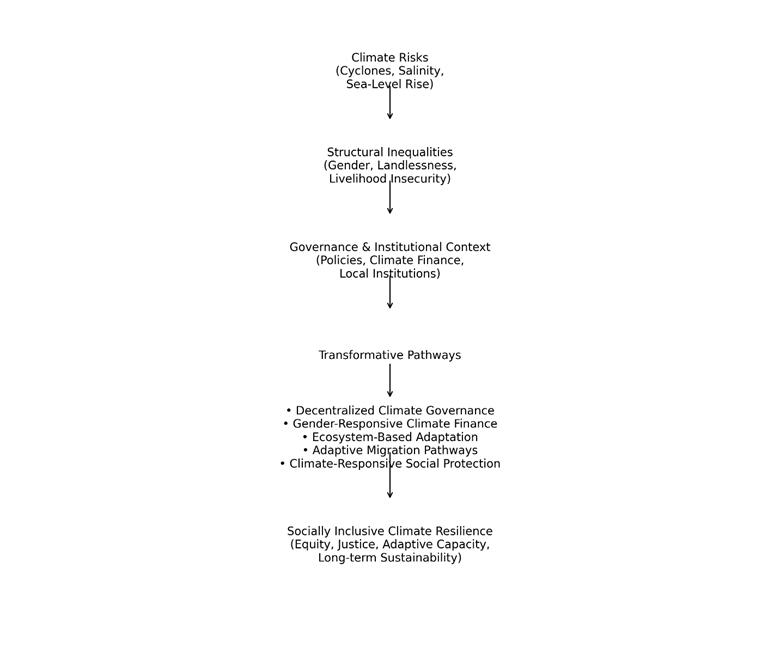
The conceptual framework presented in Figure 3.4 illustrates the layered and interdependent pathways through which socially inclusive climate resilience can be constructed in coastal Bangladesh. The model is structured as a sequential yet dynamic process, beginning with climate risks and culminating in socially inclusive resilience outcomes. It integrates insights from social-ecological resilience theory, climate justice scholarship, and adaptive governance literature.
At the top of the framework, climate risks—including cyclones, storm surges, salinity intrusion, and sea-level rise—represent the primary environmental stressors affecting coastal Bangladesh. These hazards are well documented as intensifying in frequency and magnitude due to climate change (IPCC, 2022). However, exposure to climate risks alone does not determine vulnerability. The second layer of the framework highlights structural inequalities, such as gender disparities, landlessness, poverty, and livelihood insecurity. Consistent with political ecology perspectives, vulnerability is socially produced and shaped by unequal access to resources and power (Adger et al., 2005; Ribot, 2014). In coastal Bangladesh, marginalised groups—including women, smallholder farmers, and informal labourers—often experience disproportionate impacts due to these structural constraints (Sultana, 2010).
The third layer emphasises the governance and institutional context, encompassing national climate policies, local government institutions, and climate finance mechanisms. Adaptive governance literature suggests that institutional arrangements significantly influence resilience outcomes (Folke et al., 2010). In Bangladesh, policy frameworks such as the Bangladesh Climate Change Strategy and Action Plan and the Delta Plan 2100 provide strategic direction, yet implementation effectiveness depends on coordination, decentralisation, and accountability (Ayers et al., 2014). Thus, governance mediates the translation of policy commitments into tangible adaptive capacity.
At the centre of the framework are transformative pathways, which function as the operational mechanisms linking vulnerability contexts to resilience outcomes. These pathways include decentralised climate governance, gender-responsive climate finance, ecosystem-based adaptation, adaptive migration strategies, and climate-responsive social protection systems. Drawing from transformation theory, resilience is strengthened when adaptation addresses root causes of vulnerability rather than merely enhancing absorptive capacity (Pelling, 2011; Béné et al., 2014). For example, empowering local institutions improves participatory decision-making, while ecosystem-based approaches integrate ecological restoration with infrastructure to enhance long-term sustainability.
The framework culminates in socially inclusive climate resilience, defined not only as the capacity to withstand climatic shocks but also as the ability to pursue equitable, just, and sustainable development trajectories. This aligns with climate justice scholarship, which emphasises distributive and procedural equity in adaptation processes (Schlosberg, 2012). The model, therefore, conceptualises resilience as a socially embedded and politically mediated outcome rather than a purely technical achievement.
Overall, the figure underscores that socially inclusive resilience emerges from the interaction of environmental risks, socio-economic structures, governance systems, and transformative interventions. It highlights that meaningful climate adaptation in coastal Bangladesh requires structural reform, institutional integration, and justice-oriented policy design.
The framework hypothesises that resilience outcomes improve when social inclusion mechanisms strengthen relational capacities and address structural inequalities. Conversely, exclusionary practices weaken adaptive capacity and reinforce vulnerability.
Importantly, the framework conceptualises resilience not merely as “bouncing back,” but as potentially transformative (Pelling & Manuel-Navarrete, 2011). Transformative resilience implies shifts in governance structures, power relations, and development pathways that reduce systemic inequality.
This integrated theoretical and conceptual framework guides the empirical investigation by shaping research questions, informing data collection strategies, and structuring thematic analysis. It ensures that resilience is examined not as a neutral technical concept but as a socially embedded process influenced by power, identity, and governance dynamics.
4. Methodology
This study adopts a qualitative research design grounded in a constructivist epistemological paradigm. Constructivism assumes that social realities are co-constructed through interactions, cultural norms, and institutional practices (Creswell & Poth, 2018). Because socially inclusive climate resilience involves perceptions, power relations, and lived experiences, qualitative inquiry is particularly appropriate.
The research design is exploratory and interpretive, aiming to generate context-specific insights rather than generalizable statistical claims. It prioritises depth of understanding over breadth of coverage.
4.1 Study Area Selection
Fieldwork was conducted in four coastal districts of Bangladesh—Khulna, Satkhira, Bagerhat, and Bhola—selected based on three criteria:
- High exposure to cyclones and saline intrusion.
- Diversity of livelihoods (agriculture, fishing, shrimp farming, wage labour).
- Presence of ongoing government and NGO climate adaptation programs.
These districts represent varying degrees of infrastructural development and socio-economic vulnerability, allowing for comparative insights across contexts.
4.2 Sampling Strategy
A purposive sampling strategy was employed to ensure inclusion of diverse socio-economic and demographic groups (Patton, 2015). Participants were selected based on vulnerability characteristics such as landlessness, gender, disability, livelihood type, and migration history.
The sample included:
- Climate-vulnerable household members
- Women leaders and community organisers
- Local government officials (Union Parishad and Upazila level)
- NGO staff engaged in climate adaptation
- Youth and elderly residents
Snowball sampling was used to identify participants from marginalised groups who might otherwise be difficult to reach.
4.3 Data Collection Methods
Data were collected over six months using multiple qualitative methods to enhance triangulation (Denzin, 2012).
Semi-Structured Interviews: In-depth interviews were conducted using an interview guide structured around themes of climate impacts, coping strategies, participation in decision-making, access to resources, and perceptions of inclusion. Interviews were conducted in Bengali, recorded with consent, and later transcribed and translated into English.
Focus Group Discussions (FGDs): FGDs were organised with women’s groups, farmers, fishers, and youth. Group discussions facilitated collective reflection on shared experiences and community-level adaptation processes.
Participant Observation: The researcher attended community meetings, resilience planning workshops, and local adaptation activities to observe participation dynamics, power relations, and institutional interactions.
Document Analysis: Policy documents—including the Bangladesh Climate Change Strategy and Action Plan and the National Adaptation Plan—were analysed to assess stated commitments to inclusion and compare them with field-level realities (Bowen, 2009).
4.4 Data Analysis
Data were analysed using thematic analysis, following Braun and Clarke’s (2006) six-step approach: familiarisation, coding, theme development, review, definition, and reporting. NVivo software supported coding organisation.
An initial coding framework was derived deductively from the theoretical and conceptual framework (e.g., vulnerability, social capital, participation, intersectionality). Additional themes emerged inductively from participant narratives.
Attention was paid to intersectional patterns—how gender, class, age, and disability interacted in shaping experiences. Comparative analysis across districts enabled the identification of contextual variations.
4.5 Ethical Considerations
Ethical principles guided all stages of research. Informed consent was obtained from participants, who were assured of confidentiality and anonymity. Pseudonyms were used in reporting findings. Given the vulnerability of some participants, interviews were conducted in safe and private settings to minimise risk.
4.6 Trustworthiness and Rigour
To enhance credibility and trustworthiness (Lincoln & Guba, 1985), the study employed:
- Triangulation: Multiple data sources and methods.
- Member checking: Clarification of key findings with selected participants.
- Reflexivity: The researcher maintained field notes reflecting on positionality and potential biases.
- Thick description: Detailed contextual accounts to allow transferability.
4.7 Limitations
The qualitative design limits statistical generalizability. Findings are context-specific and may not represent all coastal regions. Additionally, language translation may have influenced nuanced meanings. However, the depth of inquiry provides rich insights into socially embedded resilience processes.
5. Findings
This section presents empirically grounded findings on socially inclusive climate resilience in coastal Bangladesh. Findings are organised around key analytic themes that emerged from interviews, focus group discussions (FGDs), participant observation, and document analysis. Across the four coastal districts—Khulna, Satkhira, Bagerhat, and Bhola—participants described shared experiences of climate impacts, differentiated coping capacities, and complex social dynamics that mediate resilience. Analytic depth is achieved by foregrounding the voices of diverse participants and situating their accounts within broader socio-political structures, consistent with vulnerability, social capital, and intersectionality frameworks.
5.1 Climate Hazards and Everyday Vulnerability
Participants uniformly reported heightened climate hazards over the past decade, including more frequent cyclones, tidal surges, river erosion, saline intrusion, unpredictable rainfall, and heat stress. These phenomena were described as not only environmental threats but also as sustained drivers of socio-economic instability.
One rice farmer in Satkhira explained:
“Earlier, we had a clear monsoon and dry season. Now the rains come late, and salinity ruins our paddy. In some seasons, we cannot grow rice at all.”
Farmers pointed to saline intrusion as a central stressor, noting that riverbeds have deepened and embankments have weakened. Scientific studies support these perceptions; saline water from the Bay of Bengal has advanced inland, degrading soils and water supplies and reducing crop yields (Haque et al., 2022).
Cyclones—particularly events like Sidr (2007), Aila (2009), and more recent storm surges—remain traumatic markers of vulnerability. While cyclone mortality has declined due to better early warning systems and cyclone shelters, participants emphasised that livelihood losses,infrastructure damage, and long-term costs remain profound (Huq & Ayers, 2008; Paul, 2020).
For fishers and aquaculture workers in Bagerhat, changes in river ecology were salient. Higher salinity has shifted fish species distributions and reduced catches. A fisher leader described decreasing returns:
“We used to catch shrimp and small fish easily; now we travel farther and longer, but the boat fuel eats our profit.”
This observation aligns with studies showing that climate variability alters aquatic ecosystems, impacting traditional fishing livelihoods in southwestern Bangladesh (Karim et al., 2019).
Across all districts, climate hazards were inseparable from structural poverty, weak infrastructure, and limited access to formal credit and services. This pattern illustrates vulnerability theory’s insight that exposure is compounded by contextually embedded socio-economic constraints (Adger, 2006).
5.2 Differential Adaptive Capacities and Structural Inequities
While all communities faced climate risks, adaptive capacities varied significantly across social groups. Differential access to land, capital, education, and social networks shaped resilience outcomes.
5.2.1 Landlessness and Livelihood Insecurity
Landlessness emerged as a core marker of vulnerability. Households without secure land tenure often lived on marginal lands—embankments, char islands, or low-lying fields—that were the first to flood or erode. A woman from Bhola explained:
“We are landless. When the river takes the embankment, we lose our home and need to borrow. We have nowhere safe to go.”
Char lands—riverine islands formed by sedimentation and erosion—are well-documented sites of acute vulnerability due to insecure tenure, lack of services, and frequent flooding (Islam & Mamun, 2021). Participants without land reported limited access to formal credit because they lacked collateral, pushing them toward informal moneylenders at high interest rates.
Livelihood diversification was constrained for landless households. Small wage labour, seasonal migration, and petty trade were the main options. A young male respondent in Satkhira noted:
“We go to Khulna or Dhaka in the off-season to work as daily labourers. But it is unstable, and we miss time with family.”
Seasonal migration, while a coping strategy, carries social costs—disrupted schooling for children, loss of familial networks, and exposure to new vulnerabilities in urban informal settlements (Raju & Ramesh, 2021).
5.2.2 Gendered Patterns of Vulnerability
Gender emerged as a key dimension of differentiated adaptive capacity. While women were active in community groups and resilience committees, their participation was often superficial or constrained by social norms. Women participants reported barriers to mobility, unequal access to information, and limited influence in decision-making.
A woman leader in Bagerhat said:
“We attend meetings, but our suggestions are rarely adopted. Men still speak for our groups, and officials listen to them more.”
These findings mirror research on gendered climate vulnerability in Bangladesh, which shows that patriarchal norms limit women’s access to disaster information, assets, and leadership positions (Quisumbing et al., 2014). Moreover, women with caregiving responsibilities faced greater burdens during climate events, managing children, elderly relatives, and household tasks under conditions of resource scarcity.
Women also highlighted deficits in services such as maternal health and safe shelter facilities. One mother in Khulna described evacuation challenges during storms:
“At the shelter, there were no separate spaces for women and children. It was crowded, and we felt unsafe.”
Such accounts underscore the need to integrate gender considerations into climate adaptation planning beyond tokenistic representation.
5.2.3 Age, Disability, and Marginalisation
Participants beyond gender and land status also pointed to age and disability as intersecting factors shaping vulnerability. Elderly residents with mobility limitations struggled to access cyclone shelters or humanitarian aid. A 70-year-old man in Satkhira explained:
“When the water rose fast, I could not walk to the shelter. My neighbours carried me, but not everyone has help.”
Persons with disabilities reported that shelters and adaptation planning rarely considered accessibility needs. This observation reflects broader findings in South Asian climate research, where disability is often neglected in disaster planning (Fakhruddin & Tanim, 2020).
Thus, intersectional vulnerabilities—where gender, age, landlessness, and disability intersect—produce uniquely compounded risks that standard resilience programs often overlook.
5.3 Social Networks: Enablers and Limits of Collective Resilience
Social networks—comprising family, neighbours, community groups, and local institutions—played complex roles in resilience. Drawing on social capital theory (Putnam, 2000), two contrasting patterns emerged: supportive reciprocal networks and exclusionary dynamics rooted in local power hierarchies.
5.3.1 Bonding Social Capital and Immediate Support
In many villages, strong bonding networks provided critical support during acute events. Neighbours shared food, labour, and shelter; community members raised collective funds; and local leaders disseminated early warnings through informal channels.
One participant in Bhola described how the village mosque committee organised relief distributions after flooding:
“The mosque leaders gathered rice and lent people money. We survived two days before aid came.”
Such bonding capital facilitated rapid recovery at the household level, particularly where formal services were slow or absent. Similar patterns have been reported in cyclone-affected communities in Bangladesh, where reciprocal networks help absorb shocks (Agarwal et al., 2018).
5.3.2 Bridging and Linking Capital: Inclusive or Exclusive?
Bridging social capital—connections across diverse groups—was uneven. Some villages had ethnically mixed populations who worked together, while others experienced tensions between long-term residents and newer migrants. Migrants, particularly from inland districts, struggled to integrate into local networks, limiting their access to shared resources.
Linking social capital—connections with formal institutions, NGOs, and government officials—was even more stratified. Participants who knew local elites, NGO staff, or government representatives reported better access to relief, microcredit, and training programs. In contrast, those without such links often remained unaware of programs or were unable to meet application requirements.
An NGO worker in Khulna acknowledged this pattern:
“We try to reach all, but those with connections get help faster. We recognise this problem, but it’s hard to overcome entrenched patterns.”
These dynamics illustrate that social capital can act as both an enabler and a barrier—strengthening immediate support while reproducing structural inequalities (Aldrich & Meyer, 2015). This finding reinforces the importance of critically assessing social networks within contexts of power and exclusion.
5.4 Participation in Governance and Decision-Making
Participation in local governance emerged as a crucial but contested dimension of inclusion. Union Parishads (local councils) and community resilience committees were the primary formal forums for planning and resource allocation.
5.4.1 Formal Structures and Representation
Most villages had resilience committees composed of elected representatives, NGO facilitators, and community volunteers. Officially, these committees were intended to ensure community voices shaped adaptation priorities. However, participants reported gaps between formal representation and substantive influence.
An elected woman member in Satkhira explained:
“I was selected for the resilience committee, but I don’t receive information before decisions are made. Sometimes we are told only to support what others decided.”
This pattern reflects critiques of participatory governance as potentially symbolic rather than empowering (Cornwall, 2008). While representation exists on paper, entrenched norms and power relations can limit actual influence.
5.4.2 Knowledge, Power, and Voice
Power dynamics were evident in whose knowledge was valued. Technical experts and NGO staff often framed discussions, while local experiential knowledge—especially from women, older residents, and marginalised groups—was sidelined.
One elder in Bagerhat observed:
“They come with forms and surveys. But they don’t ask what we have learned from decades of living with water.”
Participants emphasised that lived experience provided valuable insight into seasonal rhythms, micro-geographies of flooding, and community capacities—knowledge often absent from planning.
This finding aligns with studies in participatory adaptation that highlight the need to integrate local and scientific knowledge rather than privileging technical expertise alone (Ensor & Harvey, 2015).
5.5 Implementation Gaps and Policy Disconnects
National-level climate policies in Bangladesh—such as the Bangladesh Climate Change Strategy and Action Plan (BCCSAP) and the National Adaptation Plan—articulate commitments to vulnerability reduction and inclusive adaptation (Government of Bangladesh, 2021). However, field evidence reveals significant disconnects between policy aspirations and local implementation.
5.5.1 Resource Constraints and Bureaucratic Challenges
Local officials cited inadequate budgets and staffing as key barriers. One Upazila officer in Bhola explained:
“We have resilience plans, but we lack funds to carry them out fully. We try to prioritise the poorest, but it’s difficult.”
These constraints were echoed in NGO reports documenting gaps in financing and institutional capacity for inclusive implementation (Rahman & Alam, 2021).
5.5.2 Monitoring and Accountability
Participants noted that there was little systematic tracking of who benefits from resilience programs. Without disaggregated monitoring data—by gender, age, caste, and livelihood status—it was difficult to assess whether adaptation interventions reached marginalised groups.
A local NGO staff member pointed out:
“We know programs are not fully inclusive, but we lack robust data to show where the gaps are.”
This absence of targeted monitoring weakens accountability and limits opportunities for course correction.
5.6 Everyday Resilience and Coping Strategies
Beyond formal programs, households enacted everyday strategies that reflected adaptive ingenuity. These included diversified livelihoods, savings clubs, informal credit, migration, and household labour allocation.
5.6.1 Livelihood Diversification
Many households combined agriculture with wage labour, aquaculture, petty trade, or seasonal migration to smooth income fluctuations. A participant in Bagerhat described:
“In the dry season, we farm rice; in the wet season, we work in shrimp farms or go to Khulna for labour.”
However, diversification strategies were uneven. Those with education, networks, or assets could access better options, while the poorest relied more heavily on unstable labour.
5.6.2 Informal Savings and Credit Networks
Informal savings groups (known locally as samity) provided a buffer for unexpected expenses. Women especially valued these groups for mutual support.
A woman in Satkhira said:
“We put a little money in the group each week. When we need it after a storm, we can borrow quickly.”
These mechanisms enhanced financial resilience but also had limitations; interest rates and group pressures could be burdensome.
5.6.3 Migration as a Strategy
Migration—temporary or permanent—was a common adaptation strategy. A young man in Khulna said:
“If the climate gets worse, we will move permanently to Dhaka. There is no future here.”
While migration provided remittances and livelihood opportunities, it also entailed social costs: disrupted family structures, educational discontinuities, and exposure to urban vulnerabilities (Raju & Ramesh, 2021). Thus, migration reflects both resilience and potential social dislocation.
5.7 Barriers to Social Inclusion and Pathways Forward
The findings reveal that social inclusion remains partial, uneven, and mediated by structural inequalities. Key barriers include:
- Unequal access to land, capital, and services (structural vulnerability).
- Gendered norms limiting women’s influence in decision-making.
- Exclusionary social networks that privilege elites.
- Weak institutional accountability and monitoring.
Nonetheless, everyday resilience practices, local leadership, and community knowledge offer pathways for transformation. Recognising and building upon these strengths requires:
- Co-production of adaptation plans that value local knowledge.
- Targeted support for intersectionally marginalised groups (e.g., women, landless families, persons with disabilities).
- Inclusive monitoring systems that track benefits equitably.
- Capacity building for local officials on participatory governance and power dynamics.
These pathways align with recent scholarly emphasis on transformative resilience and participatory adaptation (Pelling & Manuel-Navarrete, 2011; Ensor & Harvey, 2015).
6. Discussion, Policy Lessons, and Transformative Pathways
6.1 Reframing Climate Resilience Through Social Inclusion
The findings of this study demonstrate that climate resilience in coastal Bangladesh cannot be understood solely as a matter of infrastructural adaptation or technological intervention. Rather, resilience is socially produced, politically mediated, and institutionally structured. Coastal vulnerability emerges at the intersection of environmental exposure, socio-economic inequality, and governance deficits. Consequently, building socially inclusive climate resilience requires reframing adaptation as a transformative process that addresses structural inequities while enhancing local adaptive capacities.
Bangladesh has often been globally recognised as a “resilience leader,” particularly for its cyclone preparedness systems, community-based early warning mechanisms, and reduced mortality rates during extreme weather events (Mahmud & Prowse, 2012; Paul & Dutt, 2010). However, this success narrative risks obscuring persistent structural vulnerabilities. Empirical evidence suggests that while mortality from cyclones has declined significantly, long-term livelihood erosion, salinisation of agricultural land, displacement, and gendered vulnerabilities remain deeply entrenched (Islam et al., 2019; Mallick & Vogt, 2015). Thus, resilience gains in disaster risk reduction (DRR) have not uniformly translated into socially inclusive development outcomes.
This paradox highlights the need to distinguish between absorptive resilience—the capacity to withstand shocks—and transformative resilience, which addresses root causes of vulnerability (Béné et al., 2014; Pelling, 2011). In coastal Bangladesh, absorptive capacities have improved through embankments, cyclone shelters, and early warning systems. Yet, transformative resilience remains constrained by landlessness, unequal access to resources, weak local governance, and gendered power relations (Adger et al., 2005; Sultana, 2010).
Social inclusion, therefore, must move from rhetorical commitment to operational principle. This entails recognising differential vulnerability across class, gender, occupation, and geography. For example, shrimp aquaculture expansion in coastal districts such as Khulna and Satkhira has generated income for some landowners but exacerbated land dispossession and salinity intrusion, affecting smallholders and agricultural labourers (Paprocki & Cons, 2014). Climate adaptation measures, if not carefully designed, may reproduce or deepen inequalities.
The discussion thus underscores a central argument: climate resilience in coastal Bangladesh must be understood as a justice-oriented project that integrates distributive, procedural, and recognitional dimensions (Schlosberg, 2012).
6.2 Governance Fragmentation and Institutional Constraints
One of the most critical barriers to socially inclusive resilience identified in this study is institutional fragmentation. Bangladesh has adopted progressive national frameworks, including the Bangladesh Climate Change Strategy and Action Plan (BCCSAP) and the Bangladesh Delta Plan 2100 (GED, 2018; MoEFCC, 2009). These policy instruments emphasise adaptation, disaster risk reduction, and long-term delta management. However, implementation gaps persist due to coordination failures across ministries, local governments, and donor agencies.
Empirical studies indicate that climate finance flows remain highly centralised, with limited discretionary authority at the Union Parishad level (Khan et al., 2020). Local government institutions (LGIs) often lack technical expertise, financial autonomy, and participatory mechanisms to incorporate community voices effectively. As a result, adaptation planning frequently reflects top-down priorities rather than locally identified needs (Ayers et al., 2014).
Moreover, donor-driven adaptation projects sometimes operate in parallel to government systems, creating duplication and sustainability challenges. While Bangladesh’s access to global climate finance has increased, accountability and transparency mechanisms remain uneven (Huq et al., 2017). Ensuring that climate finance reaches marginalised communities—particularly women-headed households, landless labourers, and indigenous groups—requires institutional reforms emphasizing decentralization and participatory governance.
The findings also reveal tensions between development planning and environmental management. For instance, large-scale embankment projects under the Coastal Embankment Improvement Project (CEIP) have strengthened flood protection but, in some cases, disrupted natural sedimentation processes, contributing to waterlogging (Auerbach et al., 2015). Such unintended consequences highlight the necessity of integrating ecological knowledge into infrastructural planning.
Thus, governance reform must prioritise policy coherence across sectors—water management, agriculture, social protection, and migration—while strengthening multi-level coordination.
6.3 Gendered Dimensions of Climate Resilience
Gender emerged as a critical axis of vulnerability and resilience. Coastal women often experience disproportionate burdens due to restricted mobility, limited asset ownership, and caregiving responsibilities (Sultana, 2010). During cyclones, cultural norms sometimes delay evacuation, increasing risks for women and children (Paul & Dutt, 2010). Post-disaster contexts also expose women to livelihood insecurity and heightened risks of gender-based violence.
At the same time, women play central roles in household adaptation strategies, including water management, homestead gardening, and income diversification (Alam & Rahman, 2014). Microfinance participation has enhanced women’s financial agency in some coastal communities, yet access to formal credit and land titles remains unequal.
Bangladesh’s National Adaptation Plan (NAP) and related policies increasingly incorporate gender considerations. However, implementation remains inconsistent. Gender mainstreaming often takes the form of token representation rather than substantive empowerment (Resurrección et al., 2019). Transformative resilience, therefore, requires redistributive reforms—such as secure land tenure for women, inclusive disaster planning committees, and targeted climate finance for women-led enterprises.
Importantly, intersectionality must inform adaptation policy. Not all women experience vulnerability uniformly. Widows, disabled women, and those from minority religious communities may face compounded marginalisation. A socially inclusive resilience agenda must therefore address intersecting forms of exclusion.
6.4 Livelihood Diversification, Migration, and Adaptive Mobility
Livelihood transformation is central to long-term resilience in coastal Bangladesh. Salinity intrusion has reduced rice productivity in many districts, prompting shifts toward brackish-water aquaculture or non-farm employment (Islam et al., 2019). While aquaculture generates export earnings, its benefits are unevenly distributed and may exacerbate environmental degradation.
Seasonal and permanent migration has emerged as a critical adaptation strategy. Remittances provide income diversification and reduce household vulnerability (Black et al., 2011). However, migration is not equally accessible; the poorest households often lack resources to migrate safely, leading to distress migration under precarious conditions (Mallick & Etzold, 2015).
Urban centres such as Dhaka and Khulna increasingly host climate-induced migrants, raising questions about urban planning and social protection. Without inclusive urban policies, climate migration may shift vulnerability from rural to urban contexts.
Policy frameworks should therefore recognise mobility as an adaptive strategy rather than solely a crisis outcome. Safe migration pathways, skills training, and social protection portability could enhance adaptive mobility while reducing exploitation risks.
6.5 Social Protection as Climate Adaptation
Bangladesh’s social protection system has expanded significantly over the past two decades. Programs such as the Vulnerable Group Feeding (VGF) and Employment Generation Program for the Poorest (EGPP) provide safety nets during lean seasons and post-disaster periods. Evidence suggests that integrating climate risk into social protection planning can enhance resilience outcomes (Heltberg et al., 2009).
However, targeting inefficiencies and political patronage sometimes limits effectiveness. Strengthening digital beneficiary databases and community monitoring mechanisms could improve transparency. Climate-responsive social protection—linking early warning systems with cash transfers—represents a promising pathway for anticipatory action.
6.6 Transformative Pathways Toward Inclusive Resilience
Building on the findings, this study identifies five transformative pathways:
Deepening Decentralised Climate Governance: Empowering Union Parishads with fiscal authority and technical training can enhance locally tailored adaptation planning. Participatory budgeting and community oversight mechanisms should be institutionalised.
Integrating Ecological Restoration with Infrastructure: Hybrid solutions—such as mangrove restoration combined with embankment strengthening—offer cost-effective and socially beneficial adaptation options (Auerbach et al., 2015).
Advancing Gender-Responsive Climate Finance: Dedicated funds for women-led adaptation initiatives and gender-responsive monitoring frameworks are essential.
Recognising Migration as Adaptation: National policy should integrate migration planning into adaptation frameworks, ensuring labour rights protections and skill development programs.
Embedding Climate Justice in Development Planning: Resilience must address historical inequities in land distribution, resource access, and political representation. Climate policy should align with broader social justice reforms.
6.7 Implications for Future Research
Despite significant scholarship on Bangladesh’s climate adaptation, several gaps remain. First, longitudinal research is needed to assess the long-term socio-economic impacts of infrastructural adaptation projects. Second, more intersectional analyses should examine how class, gender, and disability shape adaptive capacity. Third, comparative delta studies could generate transferable insights for other climate-vulnerable regions.
Methodologically, participatory action research could deepen community engagement and generate co-produced knowledge. Mixed-method approaches integrating satellite data with ethnographic fieldwork would also enhance empirical rigour.
In conclusion, socially inclusive climate resilience in coastal Bangladesh requires moving beyond technocratic adaptation toward transformative socio-political change. While Bangladesh has achieved notable success in disaster risk reduction, structural inequalities continue to shape vulnerability patterns. Integrating climate justice, gender equity, decentralised governance, and adaptive mobility into national planning frameworks can strengthen resilience outcomes.
The pathway forward demands coordinated institutional reform, inclusive climate finance, and sustained community engagement. By aligning adaptation with social inclusion, Bangladesh can advance not only climate resilience but also equitable development in its vulnerable coastal regions.
7. Conclusion and Future Research Directions
This study has argued that building socially inclusive climate resilience in coastal Bangladesh requires moving beyond technocratic adaptation toward structurally transformative approaches grounded in equity, justice, and participatory governance. Although Bangladesh has made internationally recognised progress in disaster risk reduction—particularly in reducing cyclone-related mortality—the persistence of socio-economic inequality, land insecurity, gendered vulnerabilities, and institutional fragmentation continues to shape uneven resilience outcomes across coastal communities.
The analysis demonstrates that resilience is not merely a technical capacity to withstand shocks, but a socially mediated process influenced by power relations, access to resources, and governance structures. Infrastructural interventions such as embankments and cyclone shelters have strengthened absorptive capacities, yet long-term adaptive and transformative resilience remains constrained by livelihood precarity, environmental degradation, and centralised decision-making systems. Socially inclusive resilience, therefore, demands policy integration across sectors—water governance, agriculture, migration, social protection, and local government reform—while embedding climate justice principles into national development planning.
Transformative pathways identified in this study include decentralising climate governance to empower local institutions, strengthening gender-responsive and pro-poor climate finance mechanisms, integrating ecosystem-based adaptation with infrastructure development, and recognising migration as a legitimate adaptive strategy. These approaches collectively underscore that equitable resilience requires redistributive, participatory, and intersectional frameworks.
Future research should prioritise longitudinal assessments of adaptation interventions to evaluate their long-term socio-economic and ecological impacts. Greater attention is needed to intersectional vulnerability, particularly regarding disability, age, minority status, and landlessness in coastal contexts. Comparative research across delta regions—such as the Mekong or Nile deltas—may generate broader theoretical insights into socially inclusive adaptation in sedimentary and low-lying environments. Methodologically, participatory action research and mixed-method designs combining geospatial analysis with ethnographic inquiry could deepen empirical understanding and enhance community co-production of knowledge.
Ultimately, coastal Bangladesh offers both cautionary lessons and hopeful pathways for climate-vulnerable regions globally. By aligning resilience-building with social justice and institutional reform, adaptation can evolve from reactive crisis management toward transformative and inclusive climate governance.
References
Adger, W. N. (2006). Vulnerability. Global Environmental Change, 16(3), 268–281. https://doi.org/10.1016/j.gloenvcha.2006.02.006
Adger, W. N., Hughes, T. P., Folke, C., Carpenter, S. R., & Rockström, J. (2005). Social-ecological resilience to coastal disasters. Science, 309(5737), 1036–1039. https://doi.org/10.1126/science.1112122
Agarwal, B., Gopinath, M., & Meyer, C. (2018). Making adaptation equitable and just: Empirical evidence from cyclone Amphan in India and Bangladesh. Climate and Development, 12(2), 104–115.
Aldrich, D. P., & Meyer, M. (2015). Social capital and community resilience. American Behavioral Scientist, 59(2), 254–269. https://doi.org/10.1177/0002764214550299
Alam, K., & Rahman, M. H. (2014). Women in natural disasters: A case study from the southern coastal region of Bangladesh. International Journal of Disaster Risk Reduction, 8, 68–82.
Auerbach, L. W., et al. (2015). Flood risk of natural and embanked landscapes on the Ganges–Brahmaputra tidal delta plain. Nature Climate Change, 5, 153–157.
Ayers, J., Huq, S., Wright, H., Faisal, A. M., & Hussain, S. T. (2014). Mainstreaming climate change adaptation into development in Bangladesh. Climate and Development, 6(4), 293–305.
Bangladesh Ministry of Environment, Forest and Climate Change (MoEFCC). (2021). Bangladesh climate change strategy and action plan 2009 (updated 2021). Government of Bangladesh.
Béné, C., Newsham, A., Davies, M., Ulrichs, M., & Godfrey-Wood, R. (2014). Resilience, poverty and development. World Development, 48, 598–607.
Black, R., et al. (2011). Migration and climate change: Towards an integrated assessment of sensitivity. Environment and Planning A, 43(2), 431–450.
Bowen, G. A. (2009). Document analysis as a qualitative research method. Qualitative Research Journal, 9(2), 27–40.
Braun, V., & Clarke, V. (2006). Using thematic analysis in psychology. Qualitative Research in Psychology, 3(2), 77–101.
Brooks, N., Adger, W. N., & Kelly, P. M. (2005). The determinants of vulnerability and adaptive capacity at the national level and the implications for adaptation. Global Environmental Change, 15(2), 151–163.
Collins, P. H. (2015). Intersectionality’s definitional dilemmas. Annual Review of Sociology, 41, 1–20.
Cornwall, A. (2008). Unpacking “participation”: Models, meanings and practices. Community Development Journal, 43(3), 269–283.
Crenshaw, K. (1989). Demarginalizing the intersection of race and sex. University of Chicago Legal Forum, 1989(1), 139–167.
Creswell, J. W., & Poth, C. N. (2018). Qualitative inquiry and research design: Choosing among five approaches (4th ed.). Sage.
Cote, M., & Nightingale, A. J. (2012). Resilience thinking meets social theory. Progress in Human Geography, 36(4), 475–489.
Denzin, N. K. (2012). Triangulation 2.0. Journal of Mixed Methods Research, 6(2), 80–88.
Ensor, J., & Harvey, B. (2015). Social learning and climate change adaptation. Wiley Interdisciplinary Reviews: Climate Change, 6(5), 509–522.
Fakhruddin, B. S., & Tanim, A. H. (2020). Climate change and disability: Reframing vulnerability to include persons with disabilities in Bangladesh adaptation policy. Environmental Policy and Governance, 30(1), 71–83.
Folke, C., Carpenter, S. R., Walker, B., Scheffer, M., Chapin, T., & Rockström, J. (2010). Resilience thinking: Integrating resilience, adaptability and transformability. Ecology and Society, 15(4), 20.
Folke, C. (2006). Resilience: The emergence of a perspective for social–ecological systems analyses. Global Environmental Change, 16(3), 253–267.
GED. (2018). Bangladesh Delta Plan 2100. Government of Bangladesh.
Government of Bangladesh. (2021). National Adaptation Plan of Bangladesh. Ministry of Environment, Forest and Climate Change.
Haque, A., Rahman, T., & Islam, M. (2022). Salinity intrusion and agricultural decline in coastal Bangladesh: Patterns and policy implications. Journal of Coastal Research, 98, 327–338.
Heltberg, R., Siegel, P. B., & Jorgensen, S. L. (2009). Addressing human vulnerability to climate change. Social Development Papers, World Bank.
Huq, S., & Ayers, J. (2008). Climate change impacts and responses in Bangladesh. Routledge.
Huq, S., Roberts, E., & Fenton, A. (2017). Financing climate change adaptation. Climate Policy, 17(1), 1–7.
Intergovernmental Panel on Climate Change (IPCC). (2014). Climate change 2014: Impacts, adaptation, and vulnerability. Cambridge University Press.
Intergovernmental Panel on Climate Change (IPCC). (2022). Climate change 2022: Impacts, adaptation and vulnerability. Cambridge University Press.
Islam, M. M., et al. (2019). Livelihood adaptation to salinity intrusion in coastal Bangladesh. Sustainability, 11(5), 1235.
Islam, M. R., & Mamun, M. A. (2021). Char dwellers and climate change vulnerability in Bangladesh: A qualitative assessment. Climate and Development, 13(9), 828–839.
Islam, S. N., & Winkel, J. (2017). Climate change and social inequalities: Insights from Bangladesh. Journal of Environmental Studies, 25(2), 87–104.
IPCC. (2022). Climate change 2022: Impacts, adaptation and vulnerability. Cambridge University Press.
Khan, M. S. A., et al. (2019). Climate change effects on coastal soils and agriculture in Bangladesh. Environmental Monitoring and Assessment, 191, Article 325.
Khan, M. R., et al. (2020). Climate finance governance in Bangladesh. Climate Policy, 20(1), 1–15.
Karim, Z., Mimura, N., & Ahmed, M. (2019). Impacts of climate change on fish ecology and aquaculture in Bangladesh: Risks and adaptation. Aquatic Sciences, 81, 20.
Lincoln, Y. S., & Guba, E. G. (1985). Naturalistic inquiry. Sage.
Mahmud, H., & Prowse, M. (2012). Corruption in cyclone preparedness and relief. Disasters, 36(2), 303–326.
Mallick, B., & Etzold, B. (2015). Environment, migration and adaptation. Migration and Development, 4(1), 89–106.
Mallick, B., & Vogt, J. (2015). Cyclone, coastal society and migration. Natural Hazards, 75(3), 2821–2838.
MoEFCC. (2009). Bangladesh Climate Change Strategy and Action Plan. Government of Bangladesh.
Olsson, P., et al. (2015). Social–ecological transformation. Ecology and Society, 20(2), 1–15.
Paprocki, K., & Cons, J. (2014). Life in a shrimp zone: Ecological and social dimensions of aquaculture. Journal of Peasant Studies, 41(6), 1109–1130.
Patton, M. Q. (2015). Qualitative research & evaluation methods (4th ed.). Sage.
Paul, B. K. (2020). Cyclone shelter effectiveness in Southwest Bangladesh. Disasters, 44(3), 567–589.
Paul, B. K., & Dutt, S. (2010). Hazard warnings and responses to evacuation. International Journal of Mass Emergencies and Disasters, 28(2), 181–202.
Pelling, M. (2011). Adaptation to climate change: From resilience to transformation. Routledge.
Pelling, M., & Manuel-Navarrete, D. (2011). From resilience to transformation. Progress in Human Geography, 36(5), 667–676.
Putnam, R. D. (2000). Bowling alone: The collapse and revival of American community. Simon & Schuster.
Quisumbing, A. R., Meinzen-Dick, R. S., & Bryan, E. (2014). Gender, assets, and climate variability in Bangladesh: A review. Journal of Development Studies, 50(3), 1–22.
Rahman, M., & Alam, M. (2021). Mainstreaming climate adaptation into development planning in Bangladesh. Climate and Development, 13(7), 609–620.
Resurrección, B. P., Elmhirst, R., & Macintyre, M. (2019). Gender-transformative climate change adaptation. World Development, 122, 25–35.
Raju, E. D., & Ramesh, A. (2021). Migration as adaptation to climate change risk in coastal Bangladesh. Geoforum, 118, 44–56.
Ribot, J. (2014). Cause and response: Vulnerability and climate in the Anthropocene. Journal of Peasant Studies, 41(5), 667–705.
Schlosberg, D. (2012). Climate justice and capabilities: A framework for adaptation policy. Ethics & International Affairs, 26(4), 445–461.
Secor, A., & Moss, T. (2021). The politics of resilience: Spaces of contention in a climate-changed world. Geography Compass, 15(3), e12649.
Siders, A. R. (2019). Social inclusion in climate-managed retreat policy. Climatic Change, 152(2), 281–299.
Sultana, F. (2010). Living in hazardous waterscapes: Gendered vulnerabilities in Bangladesh. Annals of the Association of American Geographers, 100(4), 951–967.
UN DESA. (2018). Social inclusion: A global review and policy guide. United Nations.