Journal Home
OPEN ACCESS
Copyright Risk Orientations and Reported Safeguards for AI Assisted Content Creation in a Bangladesh Sample
| Suniya Khatun ORCID: https://orcid.org/0009-0001-9995-858X Sabbir Ahmed ORCID: https://orcid.org/0009-0006-3828-1532 Mikat Jahan Sony ORCID: https://orcid.org/0009-0008-7794-9464 Department of Law Shanto-Mariam University of Creative Technology Dhaka, Bangladesh |
| Prof. Dr Kazi Abdul Mannan Department of Business Administration Faculty of Business Shanto-Mariam University of Creative Technology Dhaka, Bangladesh Email: drkaziabdulmannan@gmail.com ORCID: https://orcid.org/0000-0002-7123-132X Corresponding author: Suniya Khatun: soniahaque94@gmail.com |
J. curric. dev. stud. 2026, 5(4); https://doi.org/10.64907/xkmf.v5i4.jocds.2
Submission received: 20 September 2026 / Revised: 25 October 2026 / Accepted: 28 October 2026 / Published: 30 October 2026
Download (PDF)
Abstract
Generative artificial intelligence raises copyright questions that require users to distinguish awareness of risk from the safeguards they report using. This study examines that relationship in a Bangladesh questionnaire database containing 385 consenting, AI-aware adults. Exploratory unweighted summaries distinguish risk-oriented responses, fairness-related responses and four reported safeguards; none is treated as an objective knowledge test or validated latent construct. Checking for protected material was endorsed by 79.5%, avoidance of potentially infringing imitation by 82.1%, contribution records by 63.6% and permission or guidance under substantial uncertainty by 58.7%. Paired endorsement differences between checking or avoidance and documentation or escalation ranged from 15.8 to 23.4 percentage points, all retained after Holm correction. In an adjusted model with categorical controls, the risk summary was positively associated with the safeguard summary (b = 0.269; HC3 95% interval 0.144-0.394; Holm-adjusted p < 0.001), as was the fairness summary (b = 0.163; 0.052-0.274; adjusted p = 0.004). The risk association persisted after removing generic verification, using copyright-specific items and restricting analysis to law students. The fairness association was not retained in the student subset. Individual-safeguard models retained risk associations for checking and seeking guidance, but not for avoidance or record-keeping after correction. The results support a bounded association among mixed self-reports rather than a causal knowledge-to-compliance mechanism. Property-rights and behavioural perspectives guide interpretation, while domestic copyright law and comparative guidance inform proposed workflow evaluations. Findings motivate creator-specific sampling, objective legal scenarios and observation of rights-checking practices before stronger claims about responsible creation are made.
Keywords: copyright awareness; generative artificial intelligence; rights checking; contribution records; intellectual property; Bangladesh
1. Introduction
Generative AI allows users to produce or revise expressive material through prompts, selection and editing. A resulting work may involve human conception and curation alongside system-generated elements. These different contributions raise questions about authorship, ownership and possible use of protected material. Copyright scholarship distinguishes the allocation of rights in a new output from concerns about other works involved in its production. A user-facing account of responsibility must preserve that distinction rather than treating AI output as automatically protected or automatically free to use.[1]
Institutional guidance also separates these questions. The US Copyright Office’s 2025 copyrightability report addresses the human contribution required for protection under US law, including the limits of relying on prompts alone. WIPO’s guidance frames organisational adoption as an exercise in identifying IP risks and considering safeguards. These sources make checking and documentation relevant practical questions, but neither establishes that a favourable attitude questionnaire measures copyright knowledge or proves lawful publication.[2]
The Bangladesh setting requires its own legal analysis. The Copyright Act 2023 defines information-technology-based digital works and contains both a general first-ownership provision and a particular rule for that category. Applying these provisions to a specific AI-assisted workflow requires attention to facts and statutory scope. They should not be reduced to an assurance that every person prompting a system owns all resulting content. Comparative scholarship examines possible approaches for Bangladesh, while the survey in this article does not test respondents’ mastery of the legislation.[3]
The practical question is how users respond when a workflow may implicate copyright. The Group 15 questionnaire asks about checking for protected material, avoiding potentially infringing imitation, keeping contribution records and seeking permission or guidance under uncertainty. These are different activities, and several contain conditions about appropriateness or intended use. A person may endorse checking without having encountered a situation requiring permission, or may retain records only for particular projects. Their responses therefore cannot be interpreted as a direct audit of legal compliance.
A related problem concerns the meaning of literacy. The supplied risk-oriented items combine general AI awareness, a reported verification practice, copyright awareness and expectations about reviewing terms. They do not form an objective test with legally correct and incorrect answers. Calling their mean “knowledge” would conceal the distinction between awareness, normative expectation and reported conduct. Responsible-AI-literacy scholarship supports attention to evaluation and ethical context, while reviews document substantial variation in what literacy instruments measure.[4]
The empirical task is consequently twofold: describe which safeguards are endorsed, and assess whether a transparently defined summary of risk-oriented responses is associated with a summary of safeguards. A statistically retained relationship can be reported without claiming that literacy causes lawful behaviour or that all component practices represent one validated trait.
The study addresses user-oriented risk management rather than technology adoption. It examines an available Bangladesh sample with substantial legal representation, not a verified population of young creators. Creator occupation, recent publication activity and actual AI-assisted outputs were not recorded. This boundary matters because the opportunity to undertake a safeguard depends on whether a person creates or publishes material and on the risks of the intended use.
The analytical contribution is to combine paired endorsement contrasts with transparent summary construction and content sensitivity. Rather than choosing a latent model solely because a questionnaire contains blocks of five items, we distinguish component meaning, inspect reliability and test whether associations persist when generic verification is removed or copyright-specific items are used. Methodological work on construct specification supports basing the interpretation on content and conceptual relations; low alpha alone does not validate a formative replacement.[5]
The contribution is deliberately limited. The study neither identifies a new copyright rule nor establishes a general causal pathway from legal knowledge to conduct. It provides evidence about the pattern and association of the measured responses, and identifies where the same aggregate association does not hold uniformly across practices or populations.
The general objective is to examine copyright-risk orientations and reported safeguards in the supplied Bangladesh database. The first question asks how checking, avoidance, documentation and escalation are distributed and paired within respondents. The second asks whether risk-oriented and fairness-related summaries are associated with the safeguard summary after adjustment for generic AI frequency, training, status and location. The third examines whether the risk association persists under alternative predictor content and whether it extends to individual safeguards. A student-restricted analysis assesses population sensitivity without redefining all respondents as creators or students.
Three features distinguish the analysis. First, reported safeguard endorsement is separated from observed legal compliance. Second, the equal-weight summaries remain explicit descriptive constructions rather than claimed validated measures of knowledge, fairness or responsibility. Third, sensitivity analysis changes both the content of the risk predictor and the coding of profile controls. This allows a positive aggregate result to be evaluated alongside weaker item-specific or subgroup findings.
The article proceeds from conceptual and legal distinctions to methods, results and discussion. The final sections propose educational and workflow evaluations, identify the limits of the achieved sample and set out a research agenda involving verified creators and observable decisions.
2. Literature Review and Theoretical Foundation
Copyright-risk management involves the relationship between legal boundaries, a user’s understanding and the actions available in a workflow. This section develops that relationship while distinguishing its normative logic from the limited variables observed in a questionnaire. Property-rights reasoning supplies the principal lens; behavioural and fairness perspectives help identify plausible associations without being presented as fully measured causal models.
2.1 Authorship ownership and third party rights
Authorship and ownership concern the basis and allocation of rights in a work. Infringement and permitted use concern whether another person’s protected interests are implicated by an activity. These questions can overlap without being identical. A user may make a substantial human contribution to a new work while still needing to assess material incorporated from elsewhere. Conversely, absence of copyright in a particular generated element would not by itself resolve every third-party-rights question arising from publication.
Ginsburg and Budiardjo’s conception-and-execution account focuses on the relationship between human contributions and resulting expression. It provides an analytical reason to preserve records of substantive contributions, but it does not make record-keeping a universal test of copyrightability. The US Copyright Office’s report similarly distinguishes assistive uses and human expressive contributions from situations in which prompts alone do not establish authorship of output. Those conclusions concern US doctrine and are used here comparatively, not as governing Bangladesh law.
Copyright protection also has limits. Litman’s examination of the public domain cautions against an account of creativity that disregards the materials on which authors draw. A responsible workflow should consider applicable rights, licences and permitted uses rather than presume that every resemblance requires permission. This is consistent with the questionnaire’s qualified reference to imitation “in ways that may infringe rights”; the wording should not be shortened into a blanket prohibition on influence or imitation.[6]
2.2 Domestic and comparative legal context
Bangladesh’s Copyright Act 2023 is the domestic statutory starting point. Its definition of information-technology-based digital work and first-ownership provisions make digital production relevant to the rights analysis. The precise application to generative tools requires interpretation of the workflow and the applicable provision. Ahmed’s comparative analysis considers approaches for Bangladesh; a survey endorsement cannot settle those doctrinal questions.
The EU provides a different regulatory example. Article 53(1)(c)-(d) of the AI Act concerns a copyright-compliance policy and a public summary of training content for providers of general-purpose AI models. These are provider obligations within that regime, not a checklist imposed on every individual user in Bangladesh. Their relevance here is that user behaviour is only one part of a wider information and governance environment.[7]
WIPO’s organisational guidance provides another comparison by identifying questions and safeguards around GenAI adoption. The appropriate empirical implication is to ask what information and processes a user has available, rather than assume that individual awareness can resolve every upstream uncertainty. The present study measures neither model-provider compliance nor actual access to training information.
2.3 Risk orientation and AI literacy
AI literacy can encompass recognising capabilities and limitations, evaluating outputs and interacting appropriately with systems. Long and Magerko’s competency framing is broader than frequency of tool use. Cox further locates responsible GenAI literacy in ethical and role-related understanding rather than effective prompting alone. These perspectives motivate a domain-sensitive analysis but do not validate the particular Group 15 items as a copyright-knowledge scale.
Reviews by Lintner and by Almatrafi, Johri and Lee document varied conceptualisations, constructs and assessments. This variation makes the distinction between self-report and tested knowledge central. An answer agreeing that copyright questions can arise is not evidence that the respondent can distinguish infringement, authorship and licensing in a legal scenario. A normative statement that users should review terms is also different from a report that those terms were reviewed.[8]
For that reason, this article uses “risk-oriented responses” as a descriptive label. Its six components mix recognition of possible error, generic verification, awareness of bias, recognition of copyright issues, terms-review expectations and caution about third-party rights. Their mean summarises endorsement across those contents. It is not a claim that the contents are interchangeable or exhaust copyright-risk competence. A useful next distinction is between recognising a possible issue and selecting an appropriate response. A user might correctly recognise uncertainty yet reasonably decide that a particular use is permitted. Another could endorse caution while misunderstanding which interest is protected. The present agreement items cannot distinguish those cases. A domain-specific assessment would need factual scenarios, defensible legal criteria and a way to record reasons for the decision. That would also help separate uncertainty about the law from uncertainty about the facts of an AI-assisted workflow.
2.4 Property rights and behavioural interpretation
Demsetz explains property rights as institutions structuring incentives and consequences of resource use. Siebrasse’s copyright analysis addresses rights and their limits, making it relevant to questions of boundaries rather than a presumption that broader control is always preferable. Applied to the present topic, a user who recognises a possible protected interest may have more reason to check the intended use. This is an interpretation of why awareness and safeguards might be associated, not an individual-level causal proposition established by property-rights theory alone.[9]
The Theory of Planned Behavior adds a different distinction: behaviour is connected to intentions and perceived control, while intention also involves attitudes and subjective norms. The current questionnaire lacks a complete intention, norms and control battery. It therefore cannot test the full theory or show how information is translated through its mechanisms. Behavioural theory serves as a boundary on causal interpretation and a guide for future measurement.[10]
A rights-respecting workflow also requires opportunity and resources. A participant may know that substantial uncertainty warrants advice yet lack access to advice or may not have encountered that situation. These possibilities make an unconditional knowledge-to-action account incomplete. The survey does not measure those constraints, so they remain research questions rather than explanations assigned to respondents.
2.5 Fairness related expectations
The IPF block includes fair protection, transparent rules, complaint mechanisms, transparency about practices and the perceived relevance of fairness to acceptance. It therefore combines normative and evaluative contents. Its mean is called a fairness-related summary rather than a direct measure of whether an institution currently behaves fairly. The distinction prevents agreement with a desirable principle from being interpreted as satisfaction with actual copyright enforcement.
Rawls provides a normative reference for analysing institutional arrangements and the distribution of benefits and burdens. The present study does not operationalise his principles of justice or claim a test of justice as fairness. A more limited expectation is that people who endorse fairness-related propositions may also endorse safeguards that respect protected interests. Any retained association would remain compatible with common response tendencies and reverse direction.[11]
Fairness is also distinct from assigning all uncertainty to creators. Transparent rules and available review could shape what safeguards are feasible, but their availability was not recorded. The legal comparisons therefore inform proposed evaluations of institutional support; they do not establish that the respondents had such support or that its absence explains a lower score.
2.6 Measurement and exploratory expectations
The content of the outcome supports a descriptive portfolio of practices: checking, avoiding potentially infringing imitation, keeping appropriate records and seeking advice under substantial uncertainty. Equal weighting makes the summary reproducible, while allowing one high response to compensate numerically for another low response. Such compensation does not establish that the practices are legally substitutable. Jarvis and colleagues’ construct-specification criteria support stating this choice explicitly, rather than using a low reliability statistic as a reason to declare the mean a validated formative construct.
E1 expects a positive adjusted association between the risk-oriented summary and the safeguard summary. Recognition of copyright issues and caution about rights could make checking and escalation more salient. The predictor also contains generic verification, creating potential content overlap with the outcome’s checking item. We therefore assess copyright-specific and verification-removed alternatives rather than treating any initial positive estimate as proof of a knowledge mechanism.
E2 expects a positive adjusted association between the fairness-related summary and safeguards. Fair protection and transparent rules may be conceptually compatible with respecting rights in one’s own activity. Yet normative agreement need not indicate current institutional legitimacy, and a relation could reflect shared favourable response style. The estimate is therefore an association among summaries, with subgroup sensitivity used to assess its reach.
Neither expectation was preregistered, and the available materials did not contain a dated analysis plan preceding database inspection. Both are exploratory. Training and generic AI use are adjustment variables rather than interventions; no mediation or causal moderation claim is made. Item-specific models and paired contrasts examine patterns that an overall mean could hide.
2.7 Analytical framework
Figure 1 links the two focal summaries with the reported-safeguard summary. Categorical controls account for observed differences in generic AI frequency, training, current status and location. The arrows represent estimated associations. Separate analyses change predictor content, examine individual practices and restrict the population to law students. These analyses assess the stability and scope of the descriptive relationship without creating an unmeasured latent model.
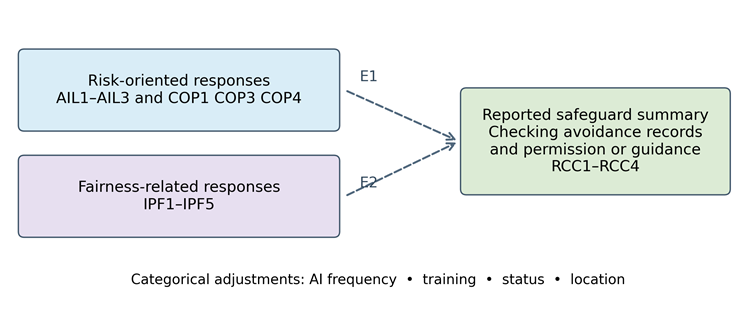
Figure 1. Exploratory associations among risk fairness and reported safeguards
Dashed arrows denote exploratory associations, not causal effects. Summaries are unweighted observed means, not validated latent constructs or objective knowledge measures. RCC5 is excluded from the outcome. Alternative-content analyses examine the scope of the risk-summary association.
3. Methodology
The analysis uses the supplied Group 15 numerical questionnaire records and preserves the distinctions between awareness, expectations and reported conduct. We first examine data integrity and item meanings, then report summary associations and sensitivity analyses. The scope is a mixed, legally oriented Bangladesh sample, with no assumption that all respondents are active creators.
3.1 Design and population
The design is a cross-sectional adult questionnaire study. All 385 records affirm informed consent, adult eligibility and AI awareness. Current status identifies 241 law students, 62 law graduates, 49 advocates or legal professionals and 33 other relevant respondents. No creator-status, creative occupation or recent publishing measure is available. We therefore retain all records in the primary analysis and describe the population as the achieved sample. A student-only sensitivity analysis concerns 241 overlapping records. Reporting distinguishes participants, measurements and interpretation.[12]
3.2 Sampling and collection
The research team confirmed that data collection was conducted in person. Exact fieldwork dates, recruitment sites, invitation totals and sampling probabilities were not supplied. We do not infer those details from the semester label, the file date or a conventional sample-size calculation. The 385 records establish the available analytical size, not proof of random selection, a target of 400 or a national margin of error.
Because recruitment probabilities and an institution-level frame are undocumented, findings are interpreted without national weights or a response-rate estimate. Participant clustering cannot be assessed from the available fields. Uncertainty estimates treat records as independent; robust standard errors do not remove selection bias or dependence from unobserved recruitment groups.
3.3 Questionnaire and score construction
The common questionnaire supports three Group 15 topics involving copyright ownership, IP fairness and responsible creation. The shared data are not an independent replication of companion analyses. This article’s focus is the distribution of safeguards and their association with explicitly defined summaries. All analysed items use 1 strongly disagree to 5 strongly agree. Table 1 states the component rules; Appendix A reproduces exact wording. Sources establishing validated item adaptations, a completed pilot or translation validation were unavailable, so none is claimed.
Table 1. Construction and interpretation of the analytical summaries
| Summary | Components | Scope and limitation |
| Risk-oriented responses | AIL1-AIL3; COP1, COP3, COP4 | Mean of six mixed awareness, verification and expectation statements; not tested knowledge |
| Reported safeguards | RCC1-RCC4 | Mean of four self-reported practices; not observed compliance |
| Fairness-related responses | IPF1-IPF5 | Mean of five normative or evaluative statements; not measured legal effectiveness |
| Copyright-specific sensitivity | COP1, COP3, COP4 | Mean excluding generic AI components |
| Verification-removed sensitivity | AIL1, AIL3; COP1, COP3, COP4 | Mean excluding the generic checking-practice item AIL2 |
All components use 1-5 agreement; higher means indicate stronger endorsement. Equal weighting is a transparent descriptive choice, not validation of a formative construct. RCC5 is excluded because it states the proposed knowledge-behaviour relationship itself. Exact wording is reproduced in Appendix A.
The outcome is the mean of RCC1-RCC4. RCC5 is reported descriptively but excluded from the outcome because it asserts that knowledge improves behaviour. Including that statement would incorporate the proposed explanatory relationship into the criterion. The risk predictor is the six-item mean listed in Table 1, and the fairness predictor is the IPF1-IPF5 mean. All weights are equal. These are exploratory observed summaries, not latent scores or legal compliance ratings.
3.4 Measurement diagnostics
Raw alpha was calculated for the original blocks and the four safeguard items. Values were low, and item wording covered substantively different propositions. We therefore did not estimate a reflective SEM or report invented loadings, composite reliability, AVE or HTMT. Low alpha does not establish that an index is formative or validate its content. We use the means as transparent descriptive constructions, state their mixed content and examine alternative definitions. This distinction follows the separation of reliability from construct specification.[13]
3.5 Data screening and provenance
Literal text categories were preserved, including 18 F1 responses of “None”; these are not missing values. No blank fields were found in the supplied records, and analysed agreement responses were within 1-5. No duplicate numerical/profile response was found after excluding row sequence and contextual text. Eight respondents were constant across RCC1-RCC5, while none was constant across all 20 agreement items. They were retained because a constant block alone is insufficient evidence of invalid responding. Completion-time and validated attention-check data were unavailable.
The research team supplied the numerical records as real data and clarified that two Codebook uses of “synthetic” were clerical labels. Contextual comments were excluded from substantive analysis, and the sequence field only distinguished records. No values were generated, imputed or altered to improve an association. Provenance relies on the team’s research records rather than an independent fieldwork audit.
3.6 Statistical analysis
Item endorsements combine categories 4 and 5 and use pointwise Wilson intervals. Four paired contrasts compare checking or avoidance with documentation or escalation. Exact McNemar tests use a four-comparison Holm correction; difference intervals use 10,000 respondent bootstrap resamples. The count endorsing all four safeguards is descriptive and is not a threshold for lawful or responsible conduct.[14]
Primary OLS regresses the safeguard summary on the two focal summaries, with HC3 covariance. Generic AI frequency, training, status and location enter as categorical indicators. Reference categories are never use, no training, law student and Dhaka. This avoids assuming equally spaced effects of training or frequency. The two focal p values form a Holm family; intervals remain pointwise. Joint training and frequency Wald tests and individual control coefficients are exploratory and unadjusted. HC3 addresses heteroskedasticity-related uncertainty, not measurement error or causality.[15]
3.7 Sensitivity prediction and uncertainty
Sensitivity models reproduce ordinal frequency/training coding, remove generic verification, use only copyright-specific predictor items and restrict the sample to students. Each has its own two-focal-coefficient Holm family. Four separate outcome-item models use the same categorical controls and fairness summary, with Holm correction across their four risk coefficients. Numerical 1-5 item scores are treated as approximately interval for these exploratory OLS associations, not as observed frequencies of behaviour.
A fixed-seed ten-fold split evaluates prediction within the achieved sample. The same category definitions are used across folds, with coefficients estimated only on training records. We report pooled out-of-fold R², mean fold R² and root mean squared error. These internal estimates are not external validation or national predictive performance.[16]
No preregistration, mediation mechanism or causal intervention is claimed. Intervals and adjusted p values address model-based uncertainty and the stated families, not unknown sampling bias. Different predictor definitions have different scales, so raw coefficients are not directly comparable effect sizes. Statistical interpretation considers magnitude and uncertainty rather than a threshold alone.[17]
3.8 Ethics and participant protection
Every analysed record affirms consent and adult eligibility. The questionnaire describes voluntary, anonymous participation, the ability to discontinue and aggregate academic reporting. This non-interventional study analysed attitudes and reported practices; no creative output, private account or copyrighted source file was assessed. Excluding contextual text and reporting aggregates limits exposure of identifying information. Sharing remains subject to confidentiality safeguards.
4. Results
The results distinguish the sample profile, item endorsement and associations among the unweighted summaries. Paired comparisons concern different safeguards within the same respondents. Regression results then assess the two focal summaries while preserving categorical profile information. Neither a high mean nor a retained coefficient is interpreted as proof of actual copyright compliance.
4.1 Respondent profile and data integrity
Table 2 reports current status and formal AI training. Law students account for 241 records (62.6%), followed by law graduates (16.1%), advocates or legal professionals (12.7%) and other relevant respondents (8.6%). The full N = 385 is retained in the primary model. The database does not identify which respondents are active creators or whether they have recently published AI-assisted material.
Table 2. Respondent status and AI training
| Measure | Category | Count (%) |
| Status | Law student | 241 (62.6%) |
| Law graduate | 62 (16.1%) | |
| Advocate or legal professional | 49 (12.7%) | |
| Other relevant respondent | 33 (8.6%) | |
| Training | No | 211 (54.8%) |
| Yes, short orientation | 120 (31.2%) | |
| Yes, course or certified training | 54 (14.0%) |
N = 385. Current creator status, publication activity and a creator-specific sampling frame are not recorded. Law students constitute 241 records; student sensitivity is an overlapping subgroup analysis.
The largest age group is 21-23 (157; 40.8%), followed by 24-26 (82; 21.3%), 18-20 (66; 17.1%), 27-30 (44; 11.4%) and 31 or older (36; 9.4%). There are 208 men (54.0%), 168 women (43.6%), six preferring not to say and three selecting other. Undergraduate level accounts for 253 records (65.7%). Dhaka contributes 151 (39.2%), district towns 92, other city corporations 81, upazila/rural areas 52 and other locations nine.
Weekly or daily/almost-daily generic AI use is reported by 290 respondents (75.3%). No formal training is recorded for 211 (54.8%); 120 report orientation and 54 a course or certified training. Twelve select never for frequency, 14 never for experience and 18 the tool category “None”. These fields describe different aspects of exposure; none is treated as a creator-status measure or a blank response. No numerical record was excluded for missingness or duplicate profile/response patterns.
4.2 Safeguard endorsement
Table 3 reports the original category counts. Checking for protected material is endorsed by 306 respondents (79.5%; Wilson interval 75.2-83.2%). Avoidance of potentially infringing imitation has 316 endorsements (82.1%; 77.9-85.6%). Contribution record-keeping has 245 (63.6%; 58.7-68.3%), while seeking permission or guidance has 226 (58.7%; 53.7-63.5%). The conditional wording in the latter two items remains part of their interpretation.
Table 3. Reported safeguard and knowledge benefit statement distributions
| Item | Counts 1 / 2 / 3 / 4 / 5 | Mean (SD) | Endorsed | 95% CI (%) |
| RCC1 | 0 / 15 / 64 / 164 / 142 | 4.12 (0.82) | 306 (79.5%) | 75.2 to 83.2 |
| RCC2 | 0 / 10 / 59 / 188 / 128 | 4.13 (0.76) | 316 (82.1%) | 77.9 to 85.6 |
| RCC3 | 1 / 21 / 118 / 186 / 59 | 3.73 (0.79) | 245 (63.6%) | 58.7 to 68.3 |
| RCC4 | 0 / 28 / 131 / 165 / 61 | 3.67 (0.83) | 226 (58.7%) | 53.7 to 63.5 |
| RCC5 | 0 / 4 / 71 / 172 / 138 | 4.15 (0.75) | 310 (80.5%) | 76.3 to 84.2 |
N = 385. Endorsement = response 4 or 5; categories run from strongly disagree to strongly agree. Wilson intervals are pointwise. RCC3 and RCC4 contain conditional wording about appropriateness and uncertainty; opportunity to perform the practice is not measured. RCC5 is descriptive only.
Non-endorsement is largely neutrality. Record-keeping has 118 neutral responses and 22 disagreements or strong disagreements; escalation has 131 neutral responses and 28 disagreements. The data therefore do not establish that these respondents refused documentation or advice when it was required. The opportunity and appropriateness of each action were not measured.
The separate RCC5 proposition that copyright-risk knowledge improves responsible creation is endorsed by 310 (80.5%; 76.3-84.2%). This describes an attributed benefit of knowledge; it is not part of the outcome summary or independent confirmation of the hypothesised relationship. All four RCC1-RCC4 safeguards are endorsed together by 109 respondents (28.3%), while three endorse none. Joint endorsement is not used as a legal compliance threshold.
Copyright-specific responses are less uniformly favourable. COP1 copyright-issue awareness has 191 endorsements (49.6%), COP3 expectation of reviewing terms has 224 (58.2%) and COP4 caution about third-party rights has 225 (58.4%). These figures refer to different contents and are not scored as correct answers on a knowledge test.
4.3 Within respondent contrasts
Table 4 compares checking and avoidance with documentation and escalation. Checking exceeds record-keeping endorsement by 15.8 percentage points (bootstrap interval 9.6-22.1), and avoidance exceeds record-keeping by 18.4 points (12.5-24.2). The corresponding discordant counts are 110 versus 49 and 111 versus 40. These contrasts preserve respondent matching rather than comparing independent samples.
Table 4. Paired contrasts between checking avoidance documentation and escalation
| Contrast | First only / second only | Difference pp | 95% CI pp | Holm p |
| RCC1 − RCC3 | 110 / 49 | 15.8 | 9.6 to 22.1 | <0.001 |
| RCC2 − RCC3 | 111 / 40 | 18.4 | 12.5 to 24.2 | <0.001 |
| RCC1 − RCC4 | 122 / 42 | 20.8 | 14.5 to 27.0 | <0.001 |
| RCC2 − RCC4 | 120 / 30 | 23.4 | 17.7 to 29.1 | <0.001 |
N = 385; pp = percentage points. Exact McNemar tests corrected across four contrasts. Pointwise intervals use 10,000 respondent bootstrap resamples. These contrasts compare differently worded self-reports, not the quality or effectiveness of actual safeguards.
Checking exceeds escalation by 20.8 points (14.5-27.0), and avoidance exceeds escalation by 23.4 points (17.7-29.1). All four exact tests remain below 0.001 after Holm correction. The contrasts show differences in endorsement, not differences in actual legal adequacy. Because record-keeping and escalation are conditional statements, the results do not identify why an individual endorsed one action but not another.
4.4 Summary distributions and reliability
Table 5 reports the observed summary means and ranges. The risk summary has mean 3.774 (SD 0.382), the fairness summary 4.007 (0.400) and the safeguard summary 3.914 (0.442). The copyright-specific alternative has mean 3.621, while the verification-removed alternative has mean 3.711. Different contents and dispersions prevent treating their means as directly comparable measures of competence.
Table 5. Descriptive statistics of unweighted summaries
| Summary | Mean | SD | Observed range |
| Risk-oriented summary | 3.774 | 0.382 | 2.67 to 4.83 |
| Fairness-related summary | 4.007 | 0.400 | 2.60 to 5.00 |
| Reported-safeguard summary | 3.914 | 0.442 | 2.50 to 5.00 |
| Copyright-specific summary | 3.621 | 0.518 | 2.33 to 5.00 |
| Verification-removed summary | 3.711 | 0.410 | 2.60 to 4.80 |
N = 385; theoretical range 1-5. These means are exploratory summaries of different contents. A higher summary mean does not establish objectively superior knowledge, legal compliance or a common latent trait.
Raw alpha values are 0.250 for AIL, 0.317 for COP, 0.324 for IPF, 0.221 for all five RCC items and 0.239 for RCC1-RCC4. These values do not support a homogeneous reflective interpretation; they do not by themselves validate an alternative formative specification. The summaries remain explicit equal-weight constructions. Risk and safeguards correlate at r = 0.320; fairness and safeguards at 0.253; risk and fairness at 0.324. These are associations among reported scores, not evidence of a causal sequence.
4.5 Primary adjusted model
Table 6 reports the focal estimates and training coefficients. The risk summary has b = 0.269 (HC3 interval 0.144-0.394; standardised β = 0.232; Holm p < 0.001). The fairness summary has b = 0.163 (0.052-0.274; β = 0.148; adjusted p = 0.004). Thus E1 and E2 are retained as exploratory associations in the full sample. A one-point risk-summary difference corresponds to a 0.269-point safeguard-summary difference conditional on the model, not a 26.9% improvement in behaviour.
Table 6. HC3 regression of reported safeguard summary
| Predictor | b | 95% CI | Std β | Raw p | Holm p |
| Risk-oriented summary | 0.269 | 0.144 to 0.394 | 0.232 | <0.001 | <0.001 |
| Fairness-related summary | 0.163 | 0.052 to 0.274 | 0.148 | 0.004 | 0.004 |
| Short orientation versus no training | -0.056 | -0.154 to 0.041 | — | 0.257 | — |
| Course/certified versus no training | 0.129 | 0.004 to 0.255 | — | 0.044 | — |
N = 385; R² = 0.175; adjusted R² = 0.142. b is unstandardised; β standardises the two continuous summary predictors. Pointwise HC3 intervals. Holm correction covers the two focal summaries. Model also adjusts for categorical AI frequency, status and location. Training coefficients are exploratory controls with unadjusted p values. References: never AI use, no training, law student and Dhaka.
Model R² is 0.175 and adjusted R² is 0.142. Focal variance inflation factors are 1.221 and 1.233. Frequency-indicator values are higher, reaching 9.159, in a design with only 12 never-use reference records. Maximum leverage is 0.158 and maximum Cook distance 0.042; no record was removed on those diagnostics alone. Additional control estimates appear in Appendix B.
Training as a two-indicator block has an exploratory Wald p = 0.023; frequency as a four-indicator block has p = 0.107. Course/certified training versus no training has b = 0.129 (0.004-0.255; raw p = 0.044), while orientation has b = −0.056 (−0.154-0.041; raw p = 0.257). These unadjusted control results should not be read as a causal comparison of training programmes.
4.6 Sensitivity and individual safeguards
Table 7 changes control coding, predictor content and population. Ordinal control coding gives risk b = 0.279 and fairness b = 0.157. The categorical primary model avoids those equal-spacing assumptions. With the copyright-specific predictor, risk b = 0.130 (0.039-0.220; adjusted p = 0.005). Removing generic verification gives b = 0.207 (0.092-0.322; adjusted p < 0.001). The risk association is therefore not confined to inclusion of the generic checking item.
Table 7. Sensitivity to predictor content control coding and population
| Specification | Focal summary | b | 95% CI | Holm p |
| Ordinal control coding | Risk summary | 0.279 | 0.150 to 0.407 | <0.001 |
| Fairness summary | 0.157 | 0.045 to 0.270 | 0.006 | |
| Copyright-specific predictor | Risk summary | 0.130 | 0.039 to 0.220 | 0.005 |
| Fairness summary | 0.189 | 0.079 to 0.299 | 0.002 | |
| Generic verification removed | Risk summary | 0.207 | 0.092 to 0.322 | <0.001 |
| Fairness summary | 0.181 | 0.071 to 0.291 | 0.001 | |
| Law-student subset | Risk summary | 0.327 | 0.163 to 0.490 | <0.001 |
| Fairness summary | 0.071 | -0.071 to 0.214 | 0.327 |
N = 385 except law-student n = 241. HC3 pointwise intervals; separate two-coefficient Holm families. Ordinal-control specification codes frequency 0-4 and training 0-2; other specifications use categorical controls. Student model omits status indicators. Predictor scales differ, so raw b values are not directly comparable effect sizes. Subgroup differences were not tested as interactions.
In the 241 students, risk b = 0.327 (0.163-0.490; adjusted p < 0.001), while fairness b = 0.071 (−0.071-0.214; adjusted p = 0.327). This is not a formal test that coefficients differ between students and others. It limits a claim that the fairness association is uniformly retained across populations.
Table 8 reports the risk coefficient for each individual safeguard. The four models retain the fairness summary and categorical controls; their risk p values form a separate four-test family. The analysis checks whether the aggregate relation extends equally to the component outcomes.
Table 8. Risk summary associations with individual safeguards
| Outcome | b | 95% CI | Raw p | Holm p | R² |
| RCC1 | 0.333 | 0.109 to 0.556 | 0.004 | 0.014 | 0.099 |
| RCC2 | 0.265 | 0.008 to 0.521 | 0.043 | 0.087 | 0.064 |
| RCC3 | 0.198 | -0.048 to 0.444 | 0.114 | 0.114 | 0.078 |
| RCC4 | 0.281 | 0.057 to 0.504 | 0.014 | 0.041 | 0.065 |
N = 385 in each model. Outcomes retain numerical 1-5 ordering; OLS provides exploratory score associations with HC3 intervals. Same categorical controls and fairness summary as the primary model. Holm correction covers four risk-summary coefficients. Intervals are pointwise. No causal or observed publishing outcome is measured.
Checking (b = 0.333; adjusted p = 0.014) and escalation (b = 0.281; adjusted p = 0.041) are retained. Avoidance has raw p = 0.043 but adjusted p = 0.087; record-keeping has adjusted p = 0.114. These results do not support a uniformly retained four-practice relationship. Internal ten-fold prediction is modest: pooled out-of-fold R² = 0.098, mean fold R² = 0.048 and RMSE = 0.419. Three folds have negative R². The model should not be presented as a validated prediction tool.
5. Discussion
The study identifies two related patterns: reported checking and avoidance are endorsed more often than documentation and escalation, and the broad risk-oriented summary is positively associated with the safeguard summary. The second result persists under alternative predictor definitions, but it does not extend uniformly to every practice. This section interprets the patterns while separating measured endorsement from legal knowledge, compliance and institutional effectiveness.
5.1 A retained association with limited construct meaning
The primary risk coefficient is positive and retained after correction. Property-rights reasoning offers a possible interpretation: recognising that a workflow may affect another person’s protected interests can make checking or guidance relevant. Yet the risk summary contains expectations and a reported practice as well as awareness. The association therefore concerns an orientation reflected in mixed responses, rather than a demonstrated effect of knowing the law.[18]
The content sensitivities strengthen a narrower conclusion. The relationship persists with only copyright-specific items and after generic verification is removed. It is not wholly dependent on placing a general checking practice in the predictor. Those checks do not remove shared-method influences or turn the copyright-specific items into an objective test. A respondent can endorse cautious propositions without correctly applying copyright doctrine to a concrete output.
Responsible-AI-literacy literature provides a reason to look beyond technical frequency, but it also makes measurement specificity necessary. Cox’s responsible-literacy framing and Lintner’s assessment review support examining what a purported literacy measure actually contains. The present result is most defensible when labelled as a risk-orientation association and used to motivate a more direct assessment of copyright reasoning.[19]
5.2 The meaning of lower documentation and escalation endorsement
The paired contrasts are substantial, with every checking/avoidance comparison against documentation/escalation retained. This identifies a distributional difference within respondents. It does not establish that documentation is the single “weak link”, because escalation has lower endorsement and the items contain different qualifications. A participant may not have encountered substantial uncertainty, may consider records inappropriate for a particular use or may interpret the statements differently. None of these explanations was measured.
WIPO’s guidance treats IP risks and safeguards as questions to consider in an organisational context. It supports examining workflows rather than merely asking whether users know that copyright exists. A contribution log or a clear route to advice could be tested as part of such a workflow, but this survey has not shown that a missing template or unavailable adviser caused the endorsement difference.[20]
The 28.3% endorsing all four safeguards likewise describes a configuration rather than a responsible minority. Equal weighting also permits numerical compensation among practices in the outcome mean. For that reason, neither a high mean nor endorsement of all four is presented as a legal certificate. Future observation should distinguish whether a safeguard was relevant, available and completed, and whether it addressed the actual risk.
5.3 Fairness expectations and population sensitivity
The fairness summary is positively associated with safeguards in the full sample and under two alternative risk definitions. It is not retained in the student subset. These results permit a full-sample association but limit claims of a uniform legitimacy mechanism. A subgroup interval crossing zero is not proof that students differ from other respondents, because no coefficient-difference test was conducted.[21]
The contents also constrain interpretation. IPF items ask about desirable protection, rules and complaints, not only about the fairness of an existing institution. Rawls supplies a normative perspective on arrangements and burdens, but the questionnaire cannot test his theory or establish that an institution’s legitimacy causes compliance. The observed relation could involve related normative orientations, common response tendencies or experiences not recorded in the dataset.[22]
The policy implication is therefore to evaluate institutional information and support directly. An accessible complaint mechanism or a transparent licence explanation could be relevant, but their actual presence and effect require separate evidence. The association does not demonstrate that respondents currently regard Bangladesh’s copyright administration as fair or that perceived fairness mediates a knowledge-behaviour pathway.
5.4 Training is sensitive to model specification
The categorical model qualifies a simple assertion that training has no association. The training block has an exploratory p = 0.023, and the course/certified contrast is positive with raw p = 0.044. Collapsing training to 0-1-2 imposes an equal-spacing linear pattern that can obscure differences between orientation and courses. It would therefore be inaccurate to treat the non-significant ordinal coefficient as proof that training does not matter.
These control estimates still do not identify a programme effect. Participants selected or received training under unrecorded conditions; programme content, duration and timing were not observed. More experienced or cautious users may be more likely to take a course. The estimates suggest a question for a designed training evaluation, not a conclusion that certification produces responsible creation or that orientation is ineffective.
Behavioural theory also cautions against attributing the result solely to information. Intention, social norms, perceived control and opportunity could matter, but they were not adequately measured. No mediation or moderation mechanism should be supplied retrospectively to explain a coefficient.[23]
5.5 The component outcomes qualify the aggregate finding
The adjusted item analysis retains risk associations for checking and seeking guidance after four-test correction. Avoidance has a nominal raw result but is not retained after adjustment; record-keeping is also unresolved. Thus the aggregate mean should not be described as evidence that risk orientation predicts all safeguards equally. The items address actions with different informational and situational requirements.
This distinction improves the educational interpretation. An intervention might help users identify protected material yet have little effect on record-keeping, or affect seeking guidance only where advice is available. Those are hypotheses for further study. The current pattern does not establish that cognitive awareness translates more easily into one action than another, because translation over time was not observed.
Statistical interpretation should also preserve the testing family. Reporting avoidance as a confirmed association on the basis of its raw p = 0.043 would ignore the corrected p = 0.087. The pointwise interval, adjusted p value and exploratory design answer related but different questions; none alone establishes an effective safeguard.[24]
5.6 Legal scope and integrated interpretation
Domestic and comparative sources demonstrate why safeguards require context. Bangladesh’s statutory provisions must be interpreted on their own terms; the US human-authorship analysis and EU provider duties are not substitute domestic rules. A contribution record can document a workflow without itself proving ownership, and a public training-content summary does not establish that a particular user’s publication is lawful.[25]
Common-method bias and reverse direction remain plausible because all focal responses were obtained in one questionnaire. More cautious users may report both risk awareness and safeguards. Content sensitivity and HC3 intervals do not eliminate that possibility. Research on common-method effects supports future designs involving separate assessments and observable decisions.[26]
The integrated conclusion is a bounded association accompanied by unequal safeguard endorsement and modest internal prediction. It supports investigating risk recognition alongside practical opportunities to check, document and obtain advice. It does not establish a causal “knowledge-legitimacy-routine” chain, a validated formative literacy instrument or a national model of creator compliance.
6. Theoretical and Practical Implications
The implications follow from the distinction between legal principles, mixed self-report summaries and observable safeguards. They concern measurement refinement and proposed workflow evaluation. The recommendations below are not interventions proven effective by the survey and do not turn every potential copyright question into a requirement to obtain permission.
6.1 Theoretical implications
First, the study distinguishes risk orientation from tested knowledge. The alternative-content results show that the summary association is not entirely dependent on generic verification, but they do not identify which legal competencies matter. A future model should separate knowledge of authorship, third-party rights and licensing from attitudes about caution. This would make an individual-level application of property-rights reasoning more precise.
Second, related normative agreement should be separated from perceived institutional fairness. The current fairness summary includes expectations about what rules and remedies should provide. An account of institutional legitimacy would require direct questions about experienced procedures, reasons for confidence and actual access to review. The student sensitivity indicates why a broad, universal fairness mechanism cannot be inferred from one full-sample coefficient.
Third, the measurement contribution is to retain component meaning while testing transparent summaries. Weak alpha discourages a homogeneous reflective claim; it does not authorize an automatic formative conversion. Jarvis and colleagues’ distinction supports choosing and validating a construct before claiming that its indicators define it. The present equal-weight means remain exploratory tools whose scope is made explicit.[27]
6.2 Educational and workflow implications
Universities and professional bodies could evaluate short copyright scenarios rather than assess competence solely through agreement. A task might distinguish the user’s human contribution, a third-party element and the intended publication. Learners could explain what information is missing and whether a licence, permitted use or further advice is relevant. Their reasoning would provide evidence that the present questionnaire cannot supply.
A second evaluation could test a proportionate contribution record. Users might record the tool, significant source materials, substantial human changes and reasons for final selection when relevant to a project. The record would document process; it would not automatically establish authorship or resolve infringement. Its usefulness and burden should be evaluated with actual creators rather than inferred from lower endorsement of RCC3.
For escalation, organisations could identify where users can obtain clarification and how uncertain cases are assessed. The survey motivates examining that route because permission/guidance endorsement is lower than checking and avoidance. It does not show that lack of advice caused the difference. WIPO’s risk-management framing provides a comparative resource for developing such evaluations without assuming that every output needs legal review.[28]
Training evaluations should record content, duration, prior knowledge and later practice. Categorical associations in this dataset warrant more careful assessment than a simple conclusion about whether training “works”. Objective scenarios and follow-up workflow observations would distinguish a change in awareness from a change in relevant safeguards. Evaluation should also record the time and resources required, so a proposed safeguard can be assessed for both relevance and practical burden.
6.3 Legal and policy implications
Bangladesh-focused guidance should distinguish domestic rules from comparative developments and explain uncertainty without promising blanket ownership of generated material. The US Copyright Office’s analysis concerns copyrightability under US law, while EU Article 53 concerns general-purpose model providers. These distinctions can help users ask appropriate questions without importing foreign obligations mechanically.[29]
Policy evaluation should also preserve lawful access and the public domain. Litman’s analysis provides a reason to avoid defining responsibility solely as increased restriction. A useful guidance exercise would help users distinguish protected expression, applicable permissions and other lawful uses, while acknowledging when a case-specific assessment is necessary. The present results identify relevant reported orientations; they do not prescribe the outcome of a copyright dispute.[30]
7. Conclusion Limitations and Future Research
This study examined copyright-risk orientations and reported safeguards in 385 adult questionnaire records from Bangladesh. Checking and avoidance attracted higher endorsement than contribution records and seeking permission or guidance. The paired differences ranged from 15.8 to 23.4 percentage points and remained after correction. At the same time, the items’ conditional wording and unmeasured publishing activity prevent interpreting those differences as demonstrated compliance failures.
The risk-oriented and fairness-related summaries were positively associated with the safeguard summary in the full categorical-control model. The risk relation persisted after excluding generic verification, using copyright-specific items and restricting the sample to students. Fairness was not retained in the student subset, and only checking and escalation retained item-specific risk associations after correction. These qualifications are part of the finding, not exceptions to an otherwise universal knowledge-to-behaviour claim.
The contribution is to examine the association while making summary construction, population scope and content overlap visible. Equal-weight scores can be useful descriptive tools without being presented as objective knowledge or validated latent constructs. Paired contrasts and component models also identify variation that a single mean would hide.
The analysis links a legal question about recognising rights boundaries with a measurable question about reported safeguards, while preserving their different evidential status. Its practical value is to specify what should be observed next: the relevance of a check, the information used, the decision reached and the records or advice available.
Recruitment probabilities, sites, exact dates and invitation totals were unavailable. The achieved sample has substantial legal representation and no verified creator-status measure. Generic AI exposure does not establish publishing experience. Self-report, low internal consistency and mixed item content constrain construct interpretation; common-method effects and reverse direction remain possible. Conditional practices lack an opportunity denominator. OLS imposes additive score relationships, and model-based uncertainty does not address unknown recruitment dependence. A single internal cross-validation split is not external validation. Real-data provenance follows the research team’s clarification rather than an independent fieldwork audit.
These limitations prevent national estimates of creator responsibility or causal claims about training, knowledge and compliance. They do not negate the observed endorsement contrasts and conditional score associations within the available sample.
Future studies should recruit verified creators across forms of expression and document actual projects and publishing opportunities. Cognitive interviews could clarify what respondents understand by protected material, appropriate records and substantial uncertainty. A validated legal-scenario assessment could separate knowledge from expectations and reported practice.
A prospective training study could compare clearly specified programmes with a comparison condition, measure knowledge before and after instruction and examine later relevant safeguards. Workflow records could establish whether a check was warranted, completed and effective. Institutional information and access to advice should be measured directly. Recruitment should identify the type of creative activity and stage of publication, enabling comparisons based on relevant opportunities rather than age or AI awareness alone. Such designs would test the mechanisms that this cross-sectional analysis leaves unresolved and support more specific guidance for AI-assisted creation.
Declarations
Ethical approval and oversight
No study-specific formal ethical approval or exemption was documented in the supplied materials, and none is claimed. Section 3.8 details consent, participant protection and analytical safeguards.
Informed consent
All analysed records affirm informed consent and adult eligibility. The questionnaire describes voluntary, anonymous participation, the ability to discontinue and aggregate academic reporting.
Data availability
The research team holds the numerical data and analytical specifications. De-identified material may be requested from the corresponding author, subject to confidentiality and applicable requirements. Contextual text was excluded.
Funding and competing interests
No external funding source or competing interest was disclosed in the study materials supplied for manuscript preparation.
Author contributions
Suniya Khatun: lead student researcher; conceptualisation; preparation of study materials; data organisation and curation; manuscript development. The project was conducted under the supervision of Prof. Dr Kazi Abdul Mannan.
Kazi Abdul Mannan: conceptual and methodological guidance; supervision; interpretation of statistical findings; critical review and editing; corresponding authorship.
Generative AI disclosure
Generative AI assisted literature retrieval, drafting, language editing, organisation and analytical-code development. Statistical estimates were computed programmatically from the numerical survey data. Responsibility for analysis, interpretation and reporting rests with the authors.
Bibliography
Ahmed T, ‘A Comparative Legal Analysis of Copyright and Patent of Outputs Generated by Artificial Intelligence: In Search of Possible Approaches for Bangladesh’ (2025) 2 Chinese Journal of Transnational Law 39
Ajzen I, ‘The Theory of Planned Behavior’ (1991) 50 Organizational Behavior and Human Decision Processes 179
Almatrafi O, Johri A and Lee H, ‘A Systematic Review of AI Literacy Conceptualization, Constructs, and Implementation and Assessment Efforts (2019-2023)’ (2024) 6 Computers and Education Open 100173
Altman DG and Bland JM, ‘Absence of Evidence Is Not Evidence of Absence’ (1995) 311 BMJ 485
Cox A, ‘Algorithmic Literacy, AI Literacy and Responsible Generative AI Literacy’ (2024) 18 Journal of Web Librarianship 93
Demsetz H, ‘Toward a Theory of Property Rights’ (1967) 57 American Economic Review 347
Efron B and Tibshirani RJ, An Introduction to the Bootstrap (Chapman & Hall 1993)
Ginsburg JC and Budiardjo LA, ‘Authors and Machines’ (2019) 34 Berkeley Technology Law Journal 343
Greenland S and others, ‘Statistical Tests, P Values, Confidence Intervals, and Power: A Guide to Misinterpretations’ (2016) 31 European Journal of Epidemiology 337
Hastie T, Tibshirani R and Friedman J, The Elements of Statistical Learning: Data Mining, Inference, and Prediction (2nd edn, Springer 2009)
Holm S, ‘A Simple Sequentially Rejective Multiple Test Procedure’ (1979) 6 Scandinavian Journal of Statistics 65
Jarvis CB, MacKenzie SB and Podsakoff PM, ‘A Critical Review of Construct Indicators and Measurement Model Misspecification in Marketing and Consumer Research’ (2003) 30 Journal of Consumer Research 199
Lintner T, ‘A Systematic Review of AI Literacy Scales’ (2024) 9 npj Science of Learning 50
Litman J, ‘The Public Domain’ (1990) 39 Emory Law Journal 965
Long D and Magerko B, ‘What Is AI Literacy? Competencies and Design Considerations’ in Proceedings of the 2020 CHI Conference on Human Factors in Computing Systems (ACM 2020) 1
MacKinnon JG and White H, ‘Some Heteroskedasticity-Consistent Covariance Matrix Estimators with Improved Finite Sample Properties’ (1985) 29 Journal of Econometrics 305
McNemar Q, ‘Note on the Sampling Error of the Difference between Correlated Proportions or Percentages’ (1947) 12 Psychometrika 153
Podsakoff PM and others, ‘Common Method Biases in Behavioral Research: A Critical Review of the Literature and Recommended Remedies’ (2003) 88 Journal of Applied Psychology 879
Rawls J, A Theory of Justice (Harvard University Press 1971)
Samuelson P, ‘Generative AI Meets Copyright’ (2023) 381 Science 158
Siebrasse N, ‘A Property Rights Theory of the Limits of Copyright’ (2001) 51 University of Toronto Law Journal 1
Sijtsma K, ‘On the Use, the Misuse, and the Very Limited Usefulness of Cronbach’s Alpha’ (2009) 74 Psychometrika 107
US Copyright Office, Copyright and Artificial Intelligence, Part 2: Copyrightability (January 2025) <https://www.copyright.gov/ai/Copyright-and-Artificial-Intelligence-Part-2-Copyrightability-Report.pdf> accessed 2 November 2026
von Elm E and others, ‘The Strengthening the Reporting of Observational Studies in Epidemiology (STROBE) Statement: Guidelines for Reporting Observational Studies’ (2007) 4 PLOS Medicine e296
Wasserstein RL and Lazar NA, ‘The ASA Statement on p-Values: Context, Process, and Purpose’ (2016) 70 American Statistician 129
White H, ‘A Heteroskedasticity-Consistent Covariance Matrix Estimator and a Direct Test for Heteroskedasticity’ (1980) 48 Econometrica 817
Wilson EB, ‘Probable Inference, the Law of Succession, and Statistical Inference’ (1927) 22 Journal of the American Statistical Association 209
World Intellectual Property Organization, Generative AI: Navigating Intellectual Property (WIPO 2024) <https://www.wipo.int/publications/en/details.jsp?id=4713> accessed 2 November 2026
Appendix A Questionnaire wording
Table A1 reproduces every statement used in the focal and supporting analyses. Their analytical roles follow the wording rather than a claim of validated scale equivalence.
Table A1. Exact wording of analysed statements
| Code | Questionnaire statement |
| RCC1 | I check whether AI-assisted content may reproduce protected material before publication. |
| RCC2 | I avoid deliberately prompting AI to imitate protected content in ways that may infringe rights. |
| RCC3 | I keep records of significant human and AI contributions when appropriate. |
| RCC4 | I seek permission or legal guidance when intended use creates substantial copyright uncertainty. |
| RCC5 | Knowledge of AI-related copyright risks improves my responsible content-creation behaviour. |
| COP1 | I understand that copyright questions can arise when generative AI is used to create content. |
| COP2 | I believe the role of human creative contribution matters when considering authorship or ownership. |
| COP3 | Users should review the terms governing AI-generated content before commercial use. |
| COP4 | I avoid assuming that all AI-generated content is automatically free of third-party rights. |
| COP5 | Clear copyright guidance would improve my responsible use of generative AI. |
| AIL1 | I understand that generative AI can produce plausible but inaccurate information. |
| AIL2 | I verify important AI-generated information before relying on it. |
| AIL3 | I understand that AI outputs may reflect bias or incomplete data. |
| IPF1 | Creators should receive fair protection when their protected works are used in ways governed by applicable law. |
| IPF2 | AI innovation and creator rights should be balanced through transparent rules. |
| IPF3 | People should have effective ways to raise legitimate IP complaints involving AI-generated content. |
| IPF4 | Transparency about relevant training-data and content-use practices can improve perceived fairness. |
| IPF5 | Perceived fairness affects my acceptance of AI-generated creative content. |
Source: supplied Group 15 Codebook. Responses range from 1 strongly disagree to 5 strongly agree. No substantive item is reverse-coded.
Table 1 states the scoring rules. RCC5 describes a belief in the benefit of knowledge and is not included in the safeguard outcome. COP2 and COP5 provide context but do not enter the risk summary. No item is a scored legal-knowledge question or observation of a published output.
Appendix B Additional model estimates
Table B1 completes the primary adjustment specification alongside the focal and training coefficients in Table 6. All estimates use the same 385 records and HC3 covariance.
Table B1. Additional adjustment coefficients in the primary model
| Control category | b | 95% CI | Raw p |
| Frequency: Less than monthly | -0.038 | -0.299 to 0.222 | 0.773 |
| Frequency: Monthly | 0.171 | -0.075 to 0.417 | 0.174 |
| Frequency: Weekly | 0.160 | -0.072 to 0.392 | 0.177 |
| Frequency: Daily or almost daily | 0.098 | -0.140 to 0.336 | 0.421 |
| Status: Law graduate | 0.114 | -0.013 to 0.241 | 0.078 |
| Status: Advocate or legal professional | 0.066 | -0.049 to 0.182 | 0.261 |
| Status: Other relevant respondent | 0.090 | -0.093 to 0.274 | 0.334 |
| Location: District town | 0.008 | -0.114 to 0.129 | 0.901 |
| Location: Other city corporation | 0.071 | -0.032 to 0.173 | 0.177 |
| Location: Upazila-rural area | -0.056 | -0.186 to 0.074 | 0.397 |
| Location: Other | 0.050 | -0.248 to 0.348 | 0.742 |
N = 385; HC3 pointwise intervals. References: never AI use, law student and Dhaka. Training contrasts appear in Table 6. Control p values are exploratory and unadjusted. b values are score differences conditional on the other model terms; no intervention effect is identified.
These coefficients account for recorded profile differences. They do not identify causal effects of exposure, status or residence. The small never-use reference category contributes to uncertainty in frequency contrasts.
Table of Legislation
Copyright Act 2023 (Bangladesh), Act No 34 of 2023, ss 2(10) and 15
Regulation (EU) 2024/1689 (Artificial Intelligence Act) [2024] OJ L2024/1689, art 53(1)(c)-(d)
[1] Jane C Ginsburg and Luke Ali Budiardjo, ‘Authors and Machines’ (2019) 34 Berkeley Technology Law Journal 343; Pamela Samuelson, ‘Generative AI Meets Copyright’ (2023) 381 Science 158.
[2] US Copyright Office, Copyright and Artificial Intelligence, Part 2: Copyrightability (January 2025) <https://www.copyright.gov/ai/Copyright-and-Artificial-Intelligence-Part-2-Copyrightability-Report.pdf> accessed 2 November 2026; World Intellectual Property Organization, Generative AI: Navigating Intellectual Property (WIPO 2024) <https://www.wipo.int/publications/en/details.jsp?id=4713> accessed 2 November 2026.
[3] Copyright Act 2023 (Bangladesh), Act No 34 of 2023, ss 2(10) and 15; Tanveer Ahmed, ‘A Comparative Legal Analysis of Copyright and Patent of Outputs Generated by Artificial Intelligence: In Search of Possible Approaches for Bangladesh’ (2025) 2 Chinese Journal of Transnational Law 39.
[4] Duri Long and Brian Magerko, ‘What Is AI Literacy? Competencies and Design Considerations’ in Proceedings of the 2020 CHI Conference on Human Factors in Computing Systems (ACM 2020) 1; Andrew Cox, ‘Algorithmic Literacy, AI Literacy and Responsible Generative AI Literacy’ (2024) 18 Journal of Web Librarianship 93; Tomáš Lintner, ‘A Systematic Review of AI Literacy Scales’ (2024) 9 npj Science of Learning 50.
[5] Cheryl Burke Jarvis, Scott B MacKenzie and Philip M Podsakoff, ‘A Critical Review of Construct Indicators and Measurement Model Misspecification in Marketing and Consumer Research’ (2003) 30 Journal of Consumer Research 199.
[6] Jessica Litman, ‘The Public Domain’ (1990) 39 Emory Law Journal 965.
[7] Regulation (EU) 2024/1689 (Artificial Intelligence Act) [2024] OJ L2024/1689, art 53(1)(c)–(d).
[8] Omaima Almatrafi, Aditya Johri and Hyuna Lee, ‘A Systematic Review of AI Literacy Conceptualization, Constructs, and Implementation and Assessment Efforts (2019–2023)’ (2024) 6 Computers and Education Open 100173.
[9] Harold Demsetz, ‘Toward a Theory of Property Rights’ (1967) 57 American Economic Review 347; Norman Siebrasse, ‘A Property Rights Theory of the Limits of Copyright’ (2001) 51 University of Toronto Law Journal 1.
[10] Icek Ajzen, ‘The Theory of Planned Behavior’ (1991) 50 Organizational Behavior and Human Decision Processes 179.
[11] John Rawls, A Theory of Justice (Harvard University Press 1971).
[12] Erik von Elm and others, ‘The Strengthening the Reporting of Observational Studies in Epidemiology (STROBE) Statement: Guidelines for Reporting Observational Studies’ (2007) 4 PLOS Medicine e296.
[13] Klaas Sijtsma, ‘On the Use, the Misuse, and the Very Limited Usefulness of Cronbach’s Alpha’ (2009) 74 Psychometrika 107; Jarvis, MacKenzie and Podsakoff (n 5).
[14] Edwin B Wilson, ‘Probable Inference, the Law of Succession, and Statistical Inference’ (1927) 22 Journal of the American Statistical Association 209; Quinn McNemar, ‘Note on the Sampling Error of the Difference between Correlated Proportions or Percentages’ (1947) 12 Psychometrika 153; Bradley Efron and Robert J Tibshirani, An Introduction to the Bootstrap (Chapman & Hall 1993); Sture Holm, ‘A Simple Sequentially Rejective Multiple Test Procedure’ (1979) 6 Scandinavian Journal of Statistics 65.
[15] Halbert White, ‘A Heteroskedasticity-Consistent Covariance Matrix Estimator and a Direct Test for Heteroskedasticity’ (1980) 48 Econometrica 817; James G MacKinnon and Halbert White, ‘Some Heteroskedasticity-Consistent Covariance Matrix Estimators with Improved Finite Sample Properties’ (1985) 29 Journal of Econometrics 305.
[16] Trevor Hastie, Robert Tibshirani and Jerome Friedman, The Elements of Statistical Learning: Data Mining, Inference, and Prediction (2nd edn, Springer 2009).
[17] Ronald L Wasserstein and Nicole A Lazar, ‘The ASA Statement on p-Values: Context, Process, and Purpose’ (2016) 70 American Statistician 129; Sander Greenland and others, ‘Statistical Tests, P Values, Confidence Intervals, and Power: A Guide to Misinterpretations’ (2016) 31 European Journal of Epidemiology 337.
[18] Demsetz (n 9); Siebrasse (n 9).
[19] Cox (n 4); Lintner (n 4).
[20] WIPO, Generative AI (n 2).
[21] Douglas G Altman and J Martin Bland, ‘Absence of Evidence Is Not Evidence of Absence’ (1995) 311 BMJ 485.
[22] Rawls (n 11).
[23] Ajzen (n 10).
[24] Wasserstein and Lazar (n 17); Greenland and others (n 17).
[25] Copyright Act 2023 (Bangladesh), ss 2(10) and 15; US Copyright Office, Copyrightability (n 2); Artificial Intelligence Act, art 53(1)(c)–(d).
[26] Philip M Podsakoff and others, ‘Common Method Biases in Behavioral Research: A Critical Review of the Literature and Recommended Remedies’ (2003) 88 Journal of Applied Psychology 879.
[27] Jarvis, MacKenzie and Podsakoff (n 5).
[28] WIPO, Generative AI (n 2).
[29] US Copyright Office, Copyrightability (n 2); Artificial Intelligence Act, art 53(1)(c)–(d).
[30] Litman (n 6).