Journal Home
OPEN ACCESS
Population Dynamics and Workforce Absorption in Bangladesh: Bridging the Gap
| Muhammad Helal Uddin MSS Student Department of Sociology & Anthropology Shanto-Mariam University of Creative Technology Uttara, Dhaka-1230, Bangladesh ORCID: https://orcid.org/0009-0007-4298-9215 |
| Dr Khandaker Mursheda Farhana Associate Professor Department of Sociology & Anthropology Shanto-Mariam University of Creative Technology Uttara, Dhaka-1230, Bangladesh Email: drfarhanamannan@gmail.com ORCID: https://orcid.org/0009-0009-1526-6147 Corresponding author: Muhammad Helal Uddin, Email: muhammadhelaluddin5@gmail.com |
J. form. informal sect. 2026, 6(2); https://doi.org/10.64907/xkmf.v6i2.jfis.1
Submission received: 21 April 2026 / Revised: 27 May 2026 / Accepted: 30 May 2026 / Published: 5 June 2026
Download PDF (757 KB)
Abstract
This study examines the relationship between population dynamics and workforce absorption in Bangladesh, focusing on how rapid demographic expansion influences labour market outcomes. Using a mixed-methods approach, the research integrates quantitative secondary data with qualitative insights from key informant interviews and focus group discussions. The findings reveal that although Bangladesh possesses a large and growing working-age population, the labour market has struggled to generate sufficient employment opportunities to absorb this expanding workforce. Key challenges include persistent skill mismatches, limited industrial diversification, and the dominance of informal employment. Youth unemployment remains particularly significant, reflecting structural weaknesses in education and training systems. The study further highlights the lack of coordination between population policies and labour market strategies, which constrains effective workforce integration. Despite these challenges, the findings suggest that Bangladesh has the potential to harness its demographic advantage through targeted investments in human capital, expansion of technical and vocational education, and promotion of diversified economic growth. The study concludes that bridging the gap between population growth and employment opportunities requires integrated policy interventions aimed at enhancing productivity, improving labour market efficiency, and ensuring inclusive economic development.
Keywords: Population dynamics; Workforce absorption; Youth unemployment; Skill mismatch; Informal employment; Labour market transformation; Bangladesh
1. Introduction
Population growth remains one of the most critical determinants of economic and social transformation in developing countries. The interaction between demographic change and labour market dynamics is particularly significant in countries like Bangladesh, where rapid population expansion has coincided with structural economic transformation. Since gaining independence in 1971, Bangladesh has experienced substantial demographic changes characterised by declining mortality rates, improvements in healthcare, and increased life expectancy. While these achievements reflect positive development outcomes, they have also contributed to sustained population growth, placing increasing pressure on the country’s labour market and economic resources (Haq & Akhter, 2012).
The concept of a “population explosion” generally refers to a rapid increase in population size that exceeds the capacity of an economy to generate sufficient resources and employment opportunities. Classical economic theory, particularly the work of Malthus (1798), emphasised the potential negative consequences of unchecked population growth, arguing that population increases tend to outpace food production and resource availability, ultimately leading to poverty and economic stagnation. Although Malthusian concerns remain relevant in certain contexts, modern development theory provides a more nuanced perspective. Contemporary scholars argue that population growth can catalyse economic development if accompanied by effective human capital formation, technological advancement, and employment generation (Todaro & Smith, 2015).
In the context of Bangladesh, population growth has produced a large and youthful labour force, often referred to as a “demographic dividend.” This demographic structure offers significant economic potential, as a higher proportion of working-age individuals can contribute to productivity, savings, and investment. However, realising this potential depends heavily on the economy’s ability to absorb the growing labour force into productive employment. Without adequate job creation, a large youth population may instead lead to rising unemployment, underemployment, and social instability (Sattar, 2018).
Over the past few decades, Bangladesh has achieved notable economic progress, including steady GDP growth, poverty reduction, and expansion of key industries. The country’s economy has undergone structural transformation, shifting from an agriculture-dominated system toward increased industrialisation and service sector development. The ready-made garments (RMG) industry has played a particularly significant role in employment generation, especially for women, and has positioned Bangladesh as a major player in the global apparel market (Kabeer, 2016). Despite these achievements, the pace of employment creation has not kept up with the rapid expansion of the labour force.
One of the major challenges facing Bangladesh is the persistent mismatch between labour supply and labour demand. Each year, a large number of young individuals enter the labour market, many of whom possess formal education but lack the technical and practical skills required by employers. This mismatch contributes to structural unemployment, where job vacancies coexist with a shortage of qualified candidates (Amin & Islam, 2021). Additionally, a significant proportion of the workforce remains engaged in informal employment, which is often characterised by low productivity, limited job security, and a lack of social protection.
The dominance of informal employment reflects deeper structural constraints within the economy. Limited industrial diversification, inadequate investment in high-value sectors, and insufficient technological advancement restrict the capacity of the formal sector to generate jobs. As a result, many individuals are compelled to seek livelihoods in low-paying and unstable informal activities. This situation not only affects individual well-being but also limits overall economic productivity and growth (World Bank, 2020).
Furthermore, regional disparities and rural-urban migration have intensified labour market pressures in urban areas. Industrial zones such as Gazipur and Dhaka attract large numbers of job seekers from rural regions, leading to increased competition for limited employment opportunities. While urbanisation can contribute to economic growth, unplanned urban expansion may strain infrastructure, housing, and public services, thereby creating additional socio-economic challenges.
Policy responses to employment challenges in Bangladesh have included initiatives such as microfinance programs, technical and vocational education and training (TVET), and entrepreneurship development schemes. While these initiatives have shown some success, their impact has often been limited by weak coordination, insufficient scale, and a lack of alignment with broader demographic trends (Mahmud, 2017; Chowdhury, 2022). In particular, population policies and labour market strategies are often developed in isolation, reducing their overall effectiveness.
Given these complexities, understanding the relationship between population growth and employment opportunities is essential for sustainable development planning in Bangladesh. This study seeks to examine how demographic expansion influences labour market dynamics and to identify the structural and policy-related factors that affect employment generation. By integrating demographic analysis with labour market perspectives, the research aims to provide a comprehensive understanding of how Bangladesh can transform its population growth from a potential burden into a valuable economic asset.
2. Literature Review
The literature on population dynamics and employment provides a broad analytical foundation for understanding the relationship between demographic change and labour market outcomes. In the context of developing countries, scholars have long debated whether rapid population growth acts as a constraint on economic development or as a potential driver of growth when supported by appropriate policies and institutions. In Bangladesh, this debate is particularly relevant due to its high population density, ongoing demographic transition, and evolving labour market structure. Existing studies highlight key issues such as the youth bulge, structural transformation, skill mismatch, and the prevalence of informal employment. However, much of the literature examines these dimensions in isolation. This section reviews relevant theoretical and empirical contributions to identify key trends, gaps, and insights that inform the present study.
2.1 Population Dynamics in Bangladesh
Bangladesh is widely recognised as one of the most densely populated countries in the world, and its demographic trajectory has been the subject of extensive academic research. Over the past several decades, the country has undergone a demographic transition characterised by declining mortality rates and gradually decreasing fertility rates. Despite reductions in fertility, population growth remains significant due to demographic momentum, as a large base of young people continues to enter reproductive age (Sattar, 2018).
The concept of population momentum is particularly relevant in the Bangladeshi context. Even when fertility declines to replacement levels, the population continues to grow because of the age structure. This phenomenon has important implications for labour markets, as it results in a sustained increase in the working-age population. Studies have shown that Bangladesh’s youth population constitutes a substantial proportion of the total population, creating both opportunities for economic growth and challenges for employment generation (Haq & Akhter, 2012).
2.2 Theoretical Perspectives on Population and Economic Growth
The relationship between population growth and economic development has long been debated in economic theory. Malthus (1798) argued that population growth tends to outstrip resource availability, leading to diminishing returns and declining living standards. This pessimistic view suggests that rapid population growth can hinder economic progress.
In contrast, modern development theories offer a more optimistic perspective. According to Todaro and Smith (2015), population growth can contribute to economic development by expanding the labour force, increasing market size, and стимулиating innovation. The concept of the demographic dividend highlights the potential economic benefits of a large working-age population, provided that appropriate policies are implemented to enhance human capital and create employment opportunities.
Empirical studies suggest that the impact of population growth on economic development depends largely on the institutional and policy environment. Countries that invest in education, healthcare, and job creation are more likely to benefit from demographic changes, whereas those that fail to do so may experience increased unemployment and poverty.
2.3 Employment Structure and Labour Market Transformation
The labour market in Bangladesh has undergone significant structural changes over time. Historically, agriculture was the dominant source of employment, absorbing the majority of the workforce. However, with economic development and urbanisation, there has been a gradual shift toward industrial and service sectors (World Bank, 2020).
The ready-made garments (RMG) sector has emerged as a key driver of employment and economic growth. This industry has created millions of jobs, particularly for women, thereby contributing to gender empowerment and poverty reduction (Kabeer, 2016). In addition to the RMG sector, the expansion of services such as retail, transportation, and information technology has also contributed to employment generation.
Despite these positive developments, the pace of structural transformation has been uneven. A significant portion of the workforce remains employed in low-productivity sectors, and the transition to high-value industries has been limited. This imbalance constrains the overall capacity of the economy to generate quality employment opportunities.
2.4 Unemployment, Underemployment, and Informality
Unemployment and underemployment are persistent challenges in Bangladesh’s labour market. Official unemployment rates may not fully capture the extent of the problem, as many individuals are engaged in informal or part-time work that does not provide adequate income or job security.
Youth unemployment is particularly concerning, as young people often face difficulties in transitioning from education to employment. Studies indicate that the mismatch between educational outcomes and labour market requirements is a major contributing factor (Amin & Islam, 2021). Graduates frequently lack practical skills and work experience, making it difficult for them to secure formal employment.
The informal sector plays a dominant role in Bangladesh’s economy, providing livelihoods for a large proportion of the population. Informal employment includes activities such as small-scale trading, day labour, and self-employment. While the informal sector offers flexibility and accessibility, it is often associated with low wages, poor working conditions, and a lack of social protection (World Bank, 2020).
The prevalence of informal employment reflects structural limitations in the economy, including limited industrial diversification and weak regulatory frameworks. Addressing informality requires comprehensive policy interventions aimed at formalising enterprises, improving labour standards, and expanding social protection systems.
2.5 Skill Mismatch and Human Capital Development
Human capital development is widely recognised as a key determinant of employment outcomes. In Bangladesh, however, there is a significant gap between the skills provided by the education system and those required by the labour market. This mismatch contributes to both unemployment and underemployment.
Research suggests that the education system in Bangladesh places greater emphasis on theoretical knowledge than on practical and technical skills. As a result, graduates often lack the competencies needed for modern industries, particularly in areas such as information technology, engineering, and advanced manufacturing (Amin & Islam, 2021).
Technical and vocational education and training (TVET) programs have been introduced to address this gap, but their coverage and effectiveness remain limited. Expanding and improving TVET programs is essential for enhancing workforce skills and increasing employability.
2.6 Policy Responses and Institutional Frameworks
The government of Bangladesh has implemented various policies and programs to address employment challenges. Microfinance initiatives, for example, have been widely used to promote self-employment and entrepreneurship, particularly among low-income populations (Mahmud, 2017). Similarly, efforts have been made to expand vocational training and support small and medium enterprises (SMEs).
However, the effectiveness of these initiatives has been constrained by several factors, including limited coordination among different policy areas. Population policies, education policies, and labour market strategies are often developed independently, resulting in fragmented approaches to employment generation (Chowdhury, 2022).
Strengthening institutional coordination and aligning policies with demographic trends are critical for improving employment outcomes. Public-private partnerships can also play an important role in bridging the gap between education and employment by facilitating skill development and job placement.
2.7 Research Gap
Although a substantial body of literature exists on population dynamics and labour market issues in Bangladesh, many studies treat these topics separately. There is a lack of integrated research that examines the direct relationship between population growth and employment opportunities within a unified analytical framework.
This study aims to address this gap by providing a comprehensive analysis of how demographic expansion influences labour market dynamics. By combining demographic and economic perspectives, the research seeks to contribute to a deeper understanding of the challenges and opportunities associated with population growth in Bangladesh.
3. Theoretical Framework
The relationship between population dynamics and workforce absorption is grounded in multiple theoretical perspectives drawn from development economics, labour economics, and demographic transition theory. This study adopts an integrated theoretical framework that combines classical population theory, demographic dividend theory, human capital theory, and labour market segmentation theory to explain how population growth influences employment outcomes in Bangladesh.
One of the earliest theoretical perspectives on population growth is provided by Malthus (1798), who argued that population increases geometrically while food production grows arithmetically, leading to inevitable resource constraints. From this perspective, rapid population growth is seen as a barrier to economic development, as it creates pressure on limited resources and reduces per capita income. Although this theory has been criticised for its pessimistic assumptions and lack of consideration for technological advancement, it remains relevant in highlighting the risks associated with unchecked population growth, particularly in developing economies with limited institutional capacity.
In contrast to the Malthusian perspective, modern development theories emphasise the potential benefits of population growth under appropriate conditions. The demographic transition theory explains how countries move from high fertility and mortality rates to lower levels as they develop economically (Todaro & Smith, 2015). During the transitional phase, a country may experience a “youth bulge,” where a large proportion of the population is of working age. This demographic structure creates the possibility of a demographic dividend, which refers to the economic growth that can result from a favourable age dependency ratio (Bloom, Canning, & Sevilla, 2003).
However, the realisation of a demographic dividend is not automatic. It depends on the ability of the economy to generate productive employment opportunities and effectively utilise its labour force. In the absence of sufficient job creation, a large working-age population may instead lead to increased unemployment and social instability. This perspective is particularly relevant to Bangladesh, where rapid population growth has resulted in a large youth population entering the labour market each year (Sattar, 2018).
Human capital theory provides another important lens for understanding workforce absorption. According to this theory, investments in education, training, and health enhance the productivity of individuals, thereby improving their employability and earning potential (Becker, 1993). In the context of Bangladesh, human capital development plays a critical role in determining whether the growing labour force can be effectively absorbed into the economy. A well-educated and skilled workforce is more likely to contribute to economic growth and innovation, whereas a lack of relevant skills can result in structural unemployment.
The issue of skill mismatch in Bangladesh highlights the limitations of human capital development. Although access to education has expanded significantly, the quality and relevance of education remain concerns. Many graduates lack the practical and technical skills required by employers, leading to a gap between labour supply and labour demand (Amin & Islam, 2021). This mismatch reduces the efficiency of the labour market and limits the ability of the economy to fully utilise its human resources.
Labour market segmentation theory further explains the structural characteristics of employment in developing countries. This theory divides the labour market into formal and informal sectors, each with distinct characteristics (Doeringer & Piore, 1971). The formal sector typically offers stable employment, higher wages, and social protection, while the informal sector is characterised by low wages, job insecurity, and a lack of regulation. In Bangladesh, a significant proportion of the workforce is engaged in informal employment, reflecting the limited capacity of the formal sector to absorb the growing labour force (World Bank, 2020).
The persistence of informal employment suggests that labour markets in Bangladesh are not fully integrated. Barriers such as limited access to education, lack of skills, and institutional constraints prevent workers from transitioning to the formal sector. As a result, many individuals remain trapped in low-productivity jobs, which limits overall economic growth and development.
Another relevant theoretical perspective is structural transformation theory, which emphasises the shift of labour from low-productivity sectors such as agriculture to higher-productivity sectors such as industry and services (Lewis, 1954). According to this model, economic development involves the gradual absorption of surplus labour into modern sectors. In Bangladesh, this process has been partially realised through the expansion of the ready-made garments industry and the service sector. However, the pace of structural transformation has not been sufficient to accommodate the rapidly growing labour force.
This study integrates these theoretical perspectives to develop a comprehensive framework for analysing population dynamics and workforce absorption in Bangladesh. The framework suggests that population growth affects employment outcomes through multiple pathways, including labour supply expansion, human capital development, and structural transformation. At the same time, institutional factors such as education systems, labour market policies, and economic diversification play a crucial role in mediating this relationship.
In summary, the theoretical framework highlights that population growth can be both an opportunity and a challenge. Its impact on employment depends on the interaction between demographic trends, economic structure, and policy interventions. By applying this integrated framework, the study seeks to provide a deeper understanding of how Bangladesh can bridge the gap between population growth and employment opportunities.
3.1 The Conceptual Model
The conceptual model of this study illustrates the pathways through which population dynamicsinfluence workforce absorption and broader development outcomes in Bangladesh. It is structured as a multi-layered framework consisting of four key components: independent variables, mediating factors, labour market outcomes, and development outcomes, with an embedded feedback mechanism.
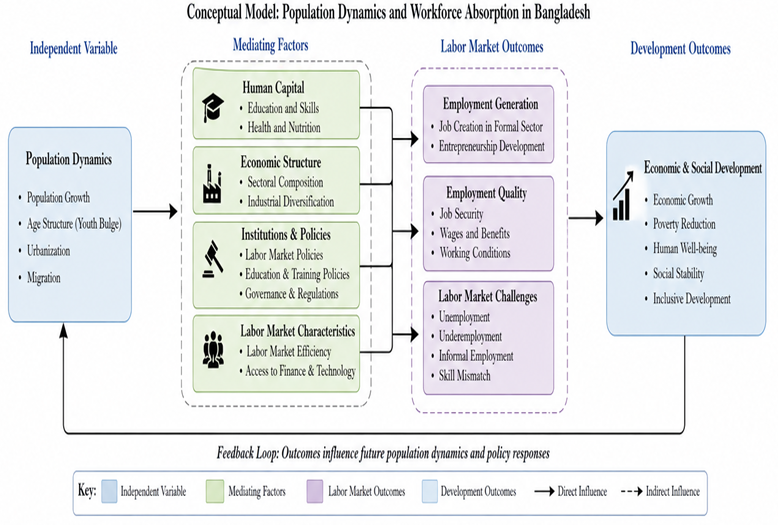
At the core of the model, population dynamics function as the independent variable. These include factors such as population growth, age structure (particularly the youth bulge), urbanisation, and migration. These demographic elements directly shape the size and composition of the labour force. For instance, a large youth population increases labour supply, while rural-to-urban migration intensifies labour market competition in urban centres. However, population dynamics alone do not determine employment outcomes; their effects are mediated by several structural and institutional factors.
The second component of the model highlights mediating factors, which play a critical role in transforming demographic potential into actual employment outcomes. These include human capital (education, skills, and health), economic structure (sectoral composition and industrial diversification), institutional and policy frameworks (labour regulations, education policies, governance), and labour market characteristics (efficiency, access to finance and technology). These mediators determine whether the expanding labour force can be productively absorbed. For example, strong human capital development enhances employability, while diversified industries create more job opportunities.
The third component represents labour market outcomes, which are the immediate results of the interaction between population dynamics and mediating factors. These outcomes include employment generation, employment quality, and labour market challenges. Positive outcomes involve job creation and improved working conditions, whereas negative outcomes include unemployment, underemployment, informal employment, and skill mismatch. The model emphasises that without effective mediating mechanisms, population growth may lead to adverse labour market conditions rather than economic benefits.
The fourth component focuses on development outcomes, including economic growth, poverty reduction, social stability, human well-being, and inclusive development. These outcomes reflect the broader impact of labour market performance on national development. Effective workforce absorption contributes to higher productivity and improved living standards, while poor absorption can exacerbate inequality and social tensions.
Finally, the model incorporates a feedback loop, indicating that development outcomes can influence future population dynamics and policy decisions. For example, improved economic conditions may affect fertility rates, migration patterns, and investments in education and health. This dynamic interaction highlights the cyclical and evolving nature of the relationship between population and employment.
Overall, the conceptual model demonstrates that workforce absorption is not determined solely by population growth but by the complex interplay of demographic, economic, and institutional factors.
4. Methodology
This study adopts a mixed-methods research design to examine the relationship between population dynamics and workforce absorption in Bangladesh. The use of both quantitative and qualitative approaches allows for a comprehensive analysis of the research problem by combining statistical trends with in-depth insights into labour market experiences and institutional challenges (Creswell & Creswell, 2018).
4.1 Research Design
The research follows an explanatory sequential mixed-methods design. In this approach, quantitative data are analysed first to identify patterns and trends in population growth and employment, followed by qualitative data collection to explain and interpret these findings. This design is particularly suitable for complex socio-economic issues such as employment, where numerical data alone may not capture the underlying causes and contextual factors (Bryman, 2016).
The study also incorporates elements of exploratory research, as it seeks to investigate the relatively underexplored link between population growth and workforce absorption within a unified framework. By combining explanatory and exploratory approaches, the research provides both breadth and depth of analysis.
4.2 Study Area
The study is conducted in selected regions of Bangladesh that reflect diverse socio-economic conditions. Industrial areas such as Gazipur are included to capture the dynamics of urban labour markets and industrial employment. In contrast, rural areas such as Tangail are selected to understand the role of agriculture and informal employment in workforce absorption. This comparative approach allows for a more comprehensive understanding of regional variations in employment patterns.
4.3 Data Sources
The study utilises both secondary and primary data sources.
Secondary Data: Secondary data are collected from reputable national and international sources, including the Bangladesh Bureau of Statistics (BBS), labour force surveys, and World Bank databases. These data provide information on population growth, labour force participation, employment distribution, and sectoral trends. Secondary data are used primarily for quantitative analysis and trend identification.
Primary Data: Primary data are collected through qualitative methods, including key informant interviews (KII) and focus group discussions (FGD). A total of 65 participants are included in the study, consisting of 50 young job seekers and 15 key informants such as policymakers, employers, and labour market experts. These participants are selected to provide diverse perspectives on employment challenges and opportunities.
4.4 Sampling Technique
The study employs purposive sampling, a non-probability sampling technique commonly used in qualitative research. This method involves selecting participants based on their relevance to the research objectives (Patton, 2015). Purposive sampling allows the researcher to gather detailed and context-specific information from individuals with direct experience of the labour market.
4.5 Data Collection Methods
Key Informant Interviews: In-depth interviews are conducted with policymakers, economists, and business representatives. These interviews focus on issues such as labour market policies, skill requirements, and the impact of population growth on employment. The semi-structured format of the interviews allows for flexibility and deeper exploration of relevant topics.
Focus Group Discussions: Focus group discussions are conducted with young job seekers to explore their experiences, perceptions, and challenges in accessing employment. These discussions provide valuable insights into issues such as skill gaps, job search processes, and expectations from the labour market.
Document Analysis: In addition to primary data, the study includes document analysis of policy reports, government publications, and international development reports. This method helps to contextualise the findings and identify existing policy frameworks related to employment and population management.
4.6 Data Analysis
Quantitative data are analysed using descriptive statistical techniques to identify trends in population growth and employment. Indicators such as labour force participation rate, unemployment rate, and sectoral employment distribution are examined to understand the overall structure of the labour market.
Qualitative data are analysed using thematic analysis, a widely used method for identifying patterns and themes within qualitative data (Braun & Clarke, 2006). The analysis involves several steps, including data familiarisation, coding, theme development, and interpretation. Key themes identified in this study include labour market pressure, skill mismatch, informal employment, and policy challenges.
4.7 Ethical Considerations
The study adheres to established ethical standards in social research. Participants are informed about the purpose of the study, and their consent is obtained before data collection. Confidentiality and anonymity are maintained throughout the research process. Participants are also assured that their responses will be used solely for academic purposes.
4.8 Limitations of the Study
Despite its strengths, the study has several limitations. The use of purposive sampling limits the generalizability of the findings, as the sample may not fully represent the entire population. Additionally, qualitative analysis involves a degree of subjectivity, which may influence the interpretation of data. However, these limitations are mitigated through careful data collection and triangulation of multiple data sources.
In conclusion, the mixed-methods approach adopted in this study provides a robust framework for analysing the complex relationship between population dynamics and workforce absorption. By integrating quantitative trends with qualitative insights, the methodology enables a comprehensive understanding of the challenges and opportunities associated with employment in Bangladesh.
5. Findings and Analysis
The findings of this study provide a comprehensive understanding of how population dynamics influence workforce absorption in Bangladesh. Drawing on both quantitative trends and qualitative insights, the analysis reveals a complex interaction between demographic expansion, labour market structures, skill formation, and institutional capacity. The findings are organised into five major thematic areas: labour supply expansion and market pressure, structural transformation and sectoral employment, skill mismatch and employability constraints, youth unemployment and informality, and policy and institutional challenges.
5.1 Labour Supply Expansion and Labour Market Pressure
One of the most prominent findings is that rapid population growth has significantly expanded the labour supply, creating persistent pressure on the labour market. Bangladesh’s demographic transition has resulted in a large working-age population, with millions of individuals entering the labour force annually. While this trend presents an opportunity for economic growth, it has also intensified competition for limited employment opportunities.
Quantitative data indicate that the growth rate of the labour force consistently exceeds the rate of job creation. This imbalance leads to a surplus of labour, particularly among young job seekers. Participants in focus group discussions expressed strong concerns about this issue. One respondent stated,
“Every year, thousands of graduates are coming into the market, but the number of jobs is not increasing at the same pace.” Another participant noted, “Even getting an entry-level job now requires experience, which is very difficult for fresh graduates.”
The pressure on the labour market is further exacerbated by regional disparities. Urban centres attract a large influx of job seekers from rural areas, resulting in labour market congestion. A young migrant worker explained,
“I came to the city thinking there would be more opportunities, but here competition is even higher, and living costs are also very high.”
These findings reinforce the argument that population growth without corresponding economic expansion creates structural imbalances in labour markets (Todaro & Smith, 2015; World Bank, 2020).
5.2 Structural Transformation and Sectoral Employment Patterns
The study reveals that Bangladesh has undergone partial structural transformation, with a gradual shift from agriculture to industry and services. However, this transformation has not been sufficient to absorb the growing labour force effectively. While the share of employment in agriculture has declined, a substantial proportion of workers remain engaged in low-productivity activities.
The industrial sector, particularly the ready-made garments (RMG) industry, has played a crucial role in job creation. However, reliance on a limited number of sectors poses challenges. An industry representative commented,
“The garments sector has created many jobs, but we cannot depend on one sector forever. We need more industries to grow.”
The service sector has also expanded, but many jobs are characterised by low wages and limited job security. A participant working in informal services stated,
“I work long hours, but the income is uncertain. Some days I earn enough, some days I do not.”
These findings indicate that structural transformation has been uneven, limiting the capacity for quality employment generation (Lewis, 1954).
5.3 Skill Mismatch and Employability Constraints
A critical finding of the study is the persistent mismatch between the skills possessed by job seekers and the requirements of the labour market. This mismatch represents a major barrier to workforce absorption.
Employers consistently emphasised the lack of practical skills among graduates. One employer noted,
“Many applicants have degrees, but they do not have the skills needed for real work. We have to train them from the beginning.”
Similarly, a recent graduate expressed frustration, stating,
“We studied many subjects, but none of them prepared us for actual jobs.”
This mismatch is particularly evident in technical sectors. Employers reported difficulties in finding qualified candidates despite available vacancies, highlighting the structural nature of unemployment (Amin & Islam, 2021). Furthermore, participation in technical and vocational education remains limited. A participant remarked,
“Vocational training is often seen as less prestigious, so many students avoid it.”
These findings underscore the importance of aligning education systems with labour market needs to improve employability (Becker, 1993).
5.4 Youth Unemployment and Informal Employment
Youth unemployment emerges as a significant concern in the study. Many young individuals experience prolonged job searches after completing their education. This situation often leads to frustration and uncertainty. One respondent shared,
“After graduation, I applied to many jobs, but I did not get any response for months.”
Due to the lack of formal employment opportunities, many young people enter the informal sector. Informal employment includes activities such as small-scale trading, day labour, and freelance work. While these activities provide income, they often lack stability. A young worker explained,
“I am working, but it is not secure. I do not know if I will have work next month.”
The dominance of informal employment reflects structural limitations in the economy. Another participant stated,
“Formal jobs are very limited. Most people have no choice but to work informally.”
These insights align with labour market segmentation theory and highlight the persistence of inequality in employment opportunities (Doeringer & Piore, 1971).
5.5 Policy and Institutional Challenges
The study identifies several policy and institutional challenges that hinder effective workforce absorption. Although various employment initiatives exist, their implementation remains inconsistent.
Participants highlighted the lack of coordination between policies. A policymaker noted,
“We have different programs for population, education, and employment, but they are not well connected.”
Similarly, an academic expert stated, “Policy fragmentation is one of the main reasons why employment challenges persist.”
There is also a perceived gap between education and industry needs. An employer remarked,
“Universities should work more closely with industries to prepare students for real jobs.”
Additionally, limited institutional capacity and weak enforcement of labour regulations further constrain job creation.
Overall, the qualitative insights reinforce the quantitative findings, demonstrating that workforce absorption in Bangladesh is influenced by a combination of demographic pressures, structural constraints, and policy limitations (Chowdhury, 2022).
6. Discussion
The findings of this study provide important insights into the relationship between population dynamics and workforce absorption in Bangladesh. By integrating empirical evidence with theoretical perspectives, the discussion highlights the broader implications of the findings for economic development and policy formulation.
One of the central issues identified in this study is the tension between demographic opportunity and labour market capacity. The large and growing working-age population in Bangladesh represents a potential demographic dividend. However, the realisation of this dividend depends on the ability of the economy to generate sufficient employment opportunities. The findings suggest that this condition has not yet been fully met, resulting in a gap between labour supply and labour demand.
From a theoretical perspective, this outcome reflects the conditional nature of the demographic dividend. As emphasised by Bloom et al. (2003), demographic advantages can only be realised when supported by appropriate policies and institutional frameworks. In the absence of such conditions, population growth may instead lead to increased unemployment and social challenges.
The persistence of skill mismatch further underscores the importance of human capital development. While Bangladesh has made significant progress in expanding access to education, the quality and relevance of education remain critical concerns. The findings suggest that the current education system does not adequately prepare individuals for the demands of the labour market. This limitation reduces the effectiveness of human capital investments and constrains economic productivity.
The discussion also highlights the role of structural transformation in shaping employment outcomes. Although Bangladesh has experienced some degree of industrialisation, the pace of transformation has been insufficient to absorb the growing labour force. The concentration of employment in a limited number of sectors, particularly the RMG industry, indicates a lack of diversification. This structural imbalance limits the resilience of the economy and restricts opportunities for high-quality employment.
The dominance of informal employment represents another key challenge. Informality is both a symptom and a cause of structural weaknesses in the economy. On one hand, it reflects the inability of the formal sector to generate sufficient jobs. On the other hand, it perpetuates low productivity and limits economic growth. Addressing informality requires comprehensive policy interventions, including the formalisation of enterprises, the expansion of social protection, and the improvement of labour standards.
The findings also emphasise the importance of institutional coordination. Effective workforce absorption requires the integration of population policies, education systems, and labour market strategies. However, the current policy framework in Bangladesh is characterised by fragmentation and a lack of coordination. This limits the effectiveness of individual policy initiatives and reduces their overall impact.
Public-private partnerships emerge as a critical mechanism for addressing these challenges. By fostering collaboration between government institutions and the private sector, such partnerships can help align education and training programs with industry needs. They can also facilitate job placement and support entrepreneurship development.
Another important implication of the study is the need to focus on youth employment. The large youth population represents both a challenge and an opportunity. Targeted policies aimed at improving youth employability, such as skill development programs and entrepreneurship support, can play a crucial role in harnessing this potential.
The discussion also points to the broader socio-economic implications of employment challenges. High levels of unemployment and underemployment can lead to increased poverty, inequality, and social unrest. Therefore, addressing employment issues is not only an economic priority but also a social imperative.
In conclusion, the findings of this study reinforce the idea that population growth is not inherently problematic but becomes a challenge when not accompanied by adequate economic and institutional responses. Bangladesh has the potential to transform its demographic dynamics into a driver of economic growth. However, achieving this goal requires a comprehensive and coordinated approach that addresses structural constraints, enhances human capital, and promotes inclusive employment opportunities.
7. Conclusion
This study has explored the complex relationship between population dynamics and workforce absorption in Bangladesh, emphasising both the opportunities and challenges associated with rapid demographic expansion. The findings demonstrate that while Bangladesh has made notable progress in economic growth and structural transformation, the pace of employment generation has not kept up with the increasing labour supply. As a result, a significant gap persists between the number of individuals entering the workforce and the availability of productive employment opportunities.
One of the central conclusions of this study is that population growth in itself is not inherently detrimental to economic development. Rather, its impact depends on the capacity of the economy and institutions to effectively utilise the available human resources. Bangladesh’s large working-age population represents a potential demographic dividend, but this potential remains underutilised due to structural constraints within the labour market. These constraints include skill mismatches, limited industrial diversification, and the dominance of informal employment.
The study also highlights the critical importance of human capital development in improving workforce absorption. Expanding access to education alone is insufficient; there is a need to enhance the quality and relevance of education to align with labour market demands. Technical and vocational education and training programs must be strengthened to equip individuals with practical skills that increase employability. At the same time, policies should focus on fostering innovation, entrepreneurship, and sectoral diversification to create new employment opportunities.
Another key conclusion is the need for greater policy integration and institutional coordination. Population policies, education systems, and labour market strategies must be aligned to ensure that demographic trends are effectively translated into economic gains. Strengthening collaboration between government institutions, the private sector, and educational organisations can play a crucial role in addressing employment challenges.
In conclusion, Bangladesh stands at a critical juncture where its demographic structure can either become a driver of economic growth or a source of socio-economic strain. By adopting comprehensive and forward-looking policies that promote inclusive and sustainable employment, the country can bridge the gap between population growth and workforce absorption. Such efforts will be essential for achieving long-term economic stability and social development.
References
Amin, R., & Islam, F. (2021). Youth unemployment and skill mismatch in Bangladesh. Journal of Development Studies.
Becker, G. S. (1993). Human capital: A theoretical and empirical analysis (3rd ed.). University of Chicago Press.
Bloom, D. E., Canning, D., & Sevilla, J. (2003). The demographic dividend: A new perspective on the economic consequences of population change. RAND Corporation.
Braun, V., & Clarke, V. (2006). Using thematic analysis in psychology. Qualitative Research in Psychology, 3(2), 77–101.
Bryman, A. (2016). Social research methods (5th ed.). Oxford University Press.
Chowdhury, S. (2022). Population policy and labour market reforms. Academic Press.
Creswell, J. W., & Creswell, J. D. (2018). Research design: Qualitative, quantitative, and mixed methods approaches (5th ed.). Sage Publications.
Doeringer, P. B., & Piore, M. J. (1971). Internal labour markets and manpower analysis. Lexington Books.
Haq, M., & Akhter, S. (2012). Demographic trends in Bangladesh. Population Journal.
Kabeer, N. (2016). Gender, labour markets and poverty in Bangladesh. Routledge.
Lewis, W. A. (1954). Economic development with unlimited supplies of labour. The Manchester School, 22(2), 139–191.
Mahmud, T. (2017). Microfinance and employment generation. Economic Review.
Mannan, K.A., & Farhana, K.M. (2026). The Principles of Qur’anic Research Methodology: Deriving the Process of Knowledge from Revelation. KMF Publishers. Open Access (CC BY 4.0). DOI: https://doi.org/10.64907/xkmf.book.pqrm.26.02.12
Malthus, T. R. (1798). An essay on the principle of population.
Patton, M. Q. (2015). Qualitative research and evaluation methods (4th ed.). Sage Publications.
Sattar, S. (2018). Population momentum and development. Dhaka University Press.
Todaro, M. P., & Smith, S. C. (2015). Economic development (12th ed.). Pearson.
World Bank. (2020). Bangladesh labour market update. World Bank Publications.