Journal Home
OPEN ACCESS
AI Literacy and Its Perceived Contribution to Digital Agricultural Service Use in Bangladesh
| Mahia Sarkar Turna ORCID: https://orcid.org/0009-0001-8889-9369 Sumtahin Pushpita ORCID: https://orcid.org/0009-0003-5573-0684 Md. Nasim ORCID: https://orcid.org/0009-0007-7312-2243 Department of Law Shanto-Mariam University of Creative Technology Dhaka, Bangladesh |
| Prof. Dr Kazi Abdul Mannan Department of Business Administration Faculty of Business Shanto-Mariam University of Creative Technology Dhaka, Bangladesh Email: drkaziabdulmannan@gmail.com ORCID: https://orcid.org/0000-0002-7123-132X Corresponding author: Mahia Sarkar Turna: mahiasarkarturna@gmail.com |
Asian microecon. rev. 2026, 6(4); https://doi.org/10.64907/xkmf.v6i4.amr.3
Submission received:20 September 2026 / Revised: 25 October 2026 / Accepted: 28 October 2026 / Published: 30 October 2026
Download PDF (1 MB)
Abstract
Digital agricultural services require users to evaluate information and make decisions about personal and farm data. However, endorsement of responsible AI practices may differ from perceived ability to recognise limitations or assess risks. This study analyses 385 adult questionnaire responses from Bangladesh to examine that distinction and respondents’ belief that AI literacy increases their intention to use trustworthy digital agricultural services. Five literacy-related statements are analysed separately because their internal consistency does not support a validated reflective composite. Governance responses are examined through paired endorsement contrasts and joint configurations. A proportional-odds diagnostic rejects a common-slope restriction, motivating separate logistic models for endorsement and strong agreement with the literacy-intention proposition. Confidentiality safeguards receive 88.8% endorsement, compared with 56.4% for recognising plausible AI inaccuracies. Transparency-related confidence and intended data-protection practices receive 83.4% and 84.9% endorsement, respectively, exceeding data-collection awareness and reported risk-evaluation capability by 19.0-23.4 percentage points. All four paired governance comparisons remain below p = .001 after Holm correction. The literacy-intention proposition receives 66.0% endorsement, but none of the five literacy facets has a clear adjusted association at either response threshold after correction across ten coefficients. These findings distinguish broad support for safeguards from more uneven self-reported evaluative capability. They do not establish a causal effect of literacy, actual service adoption or farmer-specific attitudes. The article develops a governance-sensitive interpretation of AI acceptance in which understandable data practices and practical evaluation skills are assessed separately. It proposes task-based training and service evaluation that measures competence, intention and observed use independently.
Keywords: AI literacy; digital agriculture; data governance; behavioural intention; confidentiality; Bangladesh; technology acceptance
1. Introduction
Digital agricultural services increasingly organise advice, market information and interactions between users and service providers through data. AI can add an automated layer to those interactions by producing explanations, recommendations and summaries. Its usefulness depends partly on whether people can recognise uncertain information and judge which data to disclose. The governance question therefore extends beyond access to technology: it concerns how users understand a service’s limitations, how providers explain data practices and how responsibility remains visible when information is incomplete or wrong. Social-science research on agricultural digitalisation locates adoption alongside changes in knowledge, work, power and institutions.[1]
Bangladesh provides a relevant setting for examining these questions. A July 2026 World Bank account describes agricultural initiatives combining advice, digital tools and market linkages through locally anchored service arrangements. Such developments show why skills and service governance deserve attention together. They do not establish that all agricultural advice is AI-generated or that the respondents in the present survey use those initiatives. The study examines beliefs about digital agricultural services in a mixed adult sample, rather than evaluating the performance of a named agricultural programme.[2]
The legal context is also developing. Bangladesh’s official ICT Division portal lists the Personal Data Protection Act 2026 and the National Data Management Act 2026. These instruments make data governance a concrete institutional context rather than a purely hypothetical concern. Nevertheless, this survey does not measure knowledge of particular statutory provisions, implementation or compliance. Their presence cannot be used as evidence that respondents know the law or that legal change caused their responses. The article uses current legislation to contextualise the problem and distinguishes that context from the associations estimated from questionnaire data.[3]
A central difficulty concerns what AI literacy means in an adoption study. Understanding that AI can generate plausible inaccuracies is different from reporting that one verifies important information. Awareness of bias is different from protecting confidentiality, and support for human oversight is a normative judgement as well as a possible literacy-related orientation. Combining these statements into one score can conceal their different meanings. A favourable average might describe broad endorsement of responsible practice without demonstrating that a respondent can evaluate an actual answer. This study consequently treats the five statements as distinct facets of reported understanding and orientation.
The outcome requires equal care. ADG5 states that AI literacy increases the respondent’s intention to use trustworthy digital agricultural services. This wording asks respondents to endorse a perceived relationship. It is not a conventional measure that simply asks whether they intend to use a service, and it does not compare intention before and after literacy training. Agreement may express a favourable belief about the contribution of literacy even when current adoption intention is uncertain. The article therefore calls ADG5 the literacy-intention proposition and interprets it as a perceived contribution, preserving both its reference to intention and its attribution to literacy.
This distinction creates a focused research opportunity. An individual may strongly endorse confidentiality and data protection but feel less able to identify inaccurate output or assess risks. The same person may also believe that literacy would help them use trustworthy services. Such responses are neither equivalent nor necessarily contradictory. Their combination can reveal which expectations are widely shared and which capabilities require closer investigation. The article examines this pattern using 385 adult responses in the Group 16 database, with numerical records confirmed by the research team as collected survey observations.
The study addresses four questions. First, how are the five literacy-related statements and five agricultural data-governance statements distributed? Second, are transparency-related confidence and intended data-protection practices endorsed more often than data-collection awareness and perceived risk-evaluation capability within the same respondents? Third, how often do strong governance expectations coexist with non-endorsement of evaluative capability? Fourth, are the five literacy facets associated with endorsement and strong agreement with ADG5 after selected contextual adjustments? These questions separate descriptive prevalence, paired differences, joint responses and adjusted association.
The theoretical starting point is technology acceptance, supplemented by trust and governance perspectives. UTAUT2 motivates attention to intention and the context of use, while AI-literacy scholarship encourages a distinction between competencies and general approval of technology. The present questionnaire does not measure the full UTAUT2 construct set and cannot establish its proposed mechanisms. Trust is also not directly measured as an outcome here. These perspectives guide an exploratory analysis without turning the available statements into substitutes for established scales.[4]
The article contributes a substantive distinction between support for safeguards and reported evaluative capability, together with a measurement-specific account of the literacy-intention proposition. Its empirical contribution is the use of paired records to quantify governance differences and threshold-specific models to avoid an unsupported common-slope interpretation. Its practical contribution is an evaluation agenda that separates confidence in data practices, competence in evaluating AI and actual use. This focus differs from an assessment of farmers’ legal-rights awareness or trust in a particular advisory service, neither of which is the present outcome.
The remaining sections develop this argument in sequence. Section 2 explains the conceptual and theoretical foundation and five exploratory hypotheses. Section 3 describes the database, sample scope, measurement decisions, ethics and statistical procedures. Section 4 reports distributions, paired and joint patterns, diagnostics and adjusted estimates. Section 5 interprets the results in relation to responsible digital agriculture, while Section 6 develops theoretical and practical implications. Section 7 concludes with the study’s contribution and the research needed to connect stated beliefs to demonstrated capability and observed behaviour.
2. Literature Review and Theoretical Foundation
The literature review links three questions that are often treated separately: what people understand about AI, what they believe makes digital services trustworthy and what an intention-related survey statement actually measures. Technology-acceptance theory provides a framework for examining service use, literacy research specifies relevant competencies, and agricultural-governance scholarship situates those competencies within data relationships. Their integration guides the interpretation of the available items rather than implying that the questionnaire constitutes a complete test of any one theory.
2.1 Digital agricultural services and the meaning of literacy
Digital agriculture includes diverse information and management arrangements, so an attitude towards AI cannot stand for acceptance of every agricultural technology. A conversational explanation, a recommendation system and a data-intensive platform can require different kinds of judgement. Klerkx, Jakku and Labarthe’s review helps position these questions within a broader sociotechnical field. The implication for this study is to keep the empirical object specific: adults’ responses to statements about AI literacy and agricultural services, without treating them as observations of farming practice.[5]
AI literacy concerns capacities for understanding and engaging critically with AI. Long and Magerko’s competency framework provides a foundation for moving beyond simple familiarity, while Ng and colleagues’ exploratory review supports attention to conceptual understanding, application, evaluation and ethical considerations. These sources motivate the distinctions among the survey’s statements. They do not establish that five locally supplied statements reproduce either framework comprehensively or constitute a validated short version of an existing instrument.[6]
Published measurement work also demonstrates the importance of instrument-specific validation. Wang, Rau and Yuan develop and evaluate an AI-literacy scale, illustrating that claims about competence require evidence concerning the particular measure. The present five-item block is different in wording and response format. Its connection to that literature is conceptual, not a claim of direct scale replication. It is therefore described as literacy-related self-report rather than a validated test of AI knowledge.[7]
The agricultural setting adds a distinction between general critical judgement and domain competence. A person may recognise that AI can be inaccurate without knowing whether a recommendation fits a crop, location or production stage. Conversely, practical agricultural expertise does not automatically include knowledge of platform data practices. The present sample does not provide measures of agronomic expertise or verified service use. These boundaries keep the study focused on the reported orientations it can analyse.
2.2 Technology acceptance and the perceived contribution outcome
UTAUT and its consumer extension distinguish behavioural intention from subsequent use and situate both within a wider set of determinants. UTAUT2 adds constructs including habit, price value and hedonic motivation, while considering individual differences. The current analysis draws on its attention to intention and context, but does not estimate its full structure. Frequency of general AI use is included as a contextual covariate; it is not relabelled as an established habit scale or as use of an agricultural service.[8]
A related lesson follows from the theory of planned behaviour: intention is a specific construct, and its relationship with action cannot be assumed from a broadly favourable statement. ADG5 embeds an attribution to literacy and a condition of trustworthiness within the same sentence. The measured response therefore differs from a direct intention item. Analysing it can illuminate respondents’ beliefs about literacy’s role, provided that the resulting coefficients are not presented as effects of literacy on independently measured adoption intention.[9]
This distinction also changes the meaning of an association. A respondent who recognises inaccuracies may agree more strongly that literacy matters for service use, but the survey does not show whether they intend to use the service more often. The relationship could express recognition of literacy’s importance, a general orientation towards technology or shared response tendencies. The model examines alignment among statements; it cannot distinguish these explanations causally.
The primary acceptance framework is thus intentionally bounded. It directs attention to the perceived role of capabilities, contextual exposure and intention-related beliefs. It does not supply unmeasured constructs such as performance expectancy, social influence or facilitating conditions. A future design could measure those constructs independently and assess intention prospectively. In the present analysis, theoretical clarity depends on retaining the limited meaning of the outcome.
2.3 Trust and data governance
Trust theories connect willingness to accept vulnerability with expectations about another actor. For digital agriculture, users may depend on providers whose data processing and recommendation practices are not directly visible. The literature therefore offers a reason to examine governance conditions alongside individual capability. Yet a reference to trustworthy services in ADG5 does not itself measure trust in an identifiable provider. Trust remains a contextual theoretical lens, not a latent outcome estimated in this article.[10]
Data governance further concerns who collects information, who decides how it is used and who can challenge a decision. Carbonell’s agricultural-data analysis draws attention to unequal control over information and the implications of concentrated data resources. This motivates separating a user’s willingness to follow data-protection practices from a provider’s responsibility for creating understandable and accountable arrangements. The study does not investigate a particular firm’s conduct or infer an agricultural data-power relationship from survey agreement.[11]
Accountability scholarship provides a complementary institutional perspective. Bovens’ relational account concerns explanation and assessment, while algorithmic-accountability research addresses the arrangements through which automated systems can be scrutinised. These ideas help interpret why governance cannot be reduced to an individual literacy score. A knowledgeable user may still lack a practical route to obtain clarification or correction. The current instrument records related expectations but does not measure the operation of such routes.[12]
Bangladesh’s legal setting requires precision. The Personal Data Protection Act 2026 is Act No 63, while the National Data Management Act 2026 is Act No 80. Section 1 of the former provides differentiated commencement, including delayed commencement for specified provisions. It would therefore be inaccurate to infer immediate operation of every provision from the appearance of the Acts on a government portal. This article treats them as the legal context for further service-specific assessment, not as a compliance checklist tested by the questionnaire.[13]
2.4 Literacy facets and exploratory hypotheses
Five hypotheses concern the association between each literacy-related response and ADG5. They are developed for this reanalysis and are not represented as preregistered fieldwork hypotheses. The underlying expectation is that recognising responsible AI use may align with belief in literacy’s contribution to service use. Because several statements are normative or self-reported behaviours, support for a hypothesis would still concern response alignment rather than validated competence or an intervention effect.
Recognition of plausible inaccuracies is a foundation for questioning an answer that appears fluent. Literacy frameworks support treating critical evaluation as more demanding than simple tool familiarity. Someone recognising this limitation may place greater value on the contribution of literacy to using a trustworthy service. The expectation remains conditional because greater awareness could also make a person more cautious about adopting AI. H1: Higher agreement with AIL1 is positively associated with agreement with the literacy-intention proposition.[14]
Verification extends recognition towards a reported practice. A person who says they check important AI information may regard literacy as useful for deciding when a service is trustworthy. Appropriate-reliance research helps explain why checking can coexist with acceptance rather than imply rejection. Nevertheless, AIL2 is a self-report and does not establish that verification occurs or succeeds. H2: Higher agreement with AIL2 is positively associated with agreement with the literacy-intention proposition.[15]
Awareness of bias and incomplete data concerns a different limitation. It may help users recognise that an answer reflects the information and conditions from which it was produced, and that an agricultural recommendation may require contextual interpretation. This reasoning links evaluation to the perceived value of literacy without assuming that bias awareness guarantees correct judgement. H3: Higher agreement with AIL3 is positively associated with agreement with the literacy-intention proposition.[16]
Confidentiality protection addresses information supplied to a tool rather than information received from it. A respondent attentive to sensitive information may see literacy as enabling more selective participation in digital services. At the same time, the statement permits disclosure when safeguards are appropriate, so it should not be interpreted as unconditional privacy refusal. H4: Higher agreement with AIL4 is positively associated with agreement with the literacy-intention proposition.
Human oversight concerns the role of people in consequential legal or rights-related decisions. A respondent may regard literacy as useful partly because it helps identify when human judgement is needed. However, endorsing oversight does not demonstrate that such support is available or effective. The hypothesis therefore concerns a stated orientation rather than an observed governance arrangement. H5: Higher agreement with AIL5 is positively associated with agreement with the literacy-intention proposition.
2.5 Safeguards and reported evaluative capability
The four governance-context statements address separate questions. ADG1 concerns awareness that agricultural services may collect personal or farm data. ADG2 expresses greater confidence if data practices are transparent. ADG3 concerns perceived ability to evaluate benefits and risks. ADG4 expresses an intention to follow appropriate protection and consent practices. The distinction between awareness, conditional confidence, evaluation and intended conduct is important because a broad positive response could otherwise be mistaken for one coherent governance capability.
The study compares ADG2 and ADG4 with ADG1 and ADG3 to examine whether safeguard-related responses receive broader endorsement than the two capability-related responses. ADG2 and ADG4 are themselves different, so their combination is used only for a clearly labelled joint configuration. A difference in endorsement is not a calibrated skills deficit: item wording and normative attractiveness can affect responses. It nevertheless identifies a substantive contrast that a future performance-based study can investigate.
2.6 Conceptual framework
Figure 1 summarises the five focal associations and four contextual adjustments. Governance statements provide a descriptive context and an extended sensitivity specification. No mediator or moderator is introduced because the data do not establish the temporal ordering or validated measures required for such a mechanism. The framework distinguishes the substantive question of capability from the narrower question answered by ADG5: whether respondents believe literacy increases their intention to use trustworthy services.
Figure 1. Exploratory associations between literacy facets and ADG5. Arrows do not indicate causal effects. ADG5 measures a perceived contribution to intention.
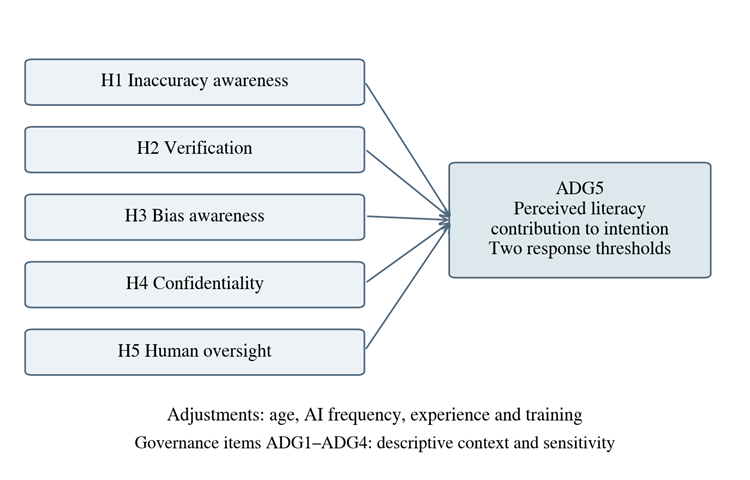
Figure 1. Exploratory associations between literacy facets and ADG5
The framework therefore integrates acceptance and governance through measurement distinctions. It permits strong endorsement of safeguards alongside weak or uncertain adjusted relationships with the literacy-intention proposition. Such a result would qualify an assumed direct capability pathway and motivate a study that independently measures competence, trust, intention and behaviour. It would not demonstrate that literacy is irrelevant or that a particular governance intervention is effective.
3. Methodology
This cross-sectional quantitative study analyses the complete Group 16 numerical survey database. Descriptive comparisons precede adjusted models, with item roles determined by wording. The methods specify sample scope, screening, uncertainty and ethical safeguards while retaining the distinction between perceived literacy contributions and observed behaviour.
3.1 Research design and source
The workbook contains README, Data and Codebook sheets. The Data sheet has 385 records and 35 fields. The research team confirmed that the numerical answers are collected survey responses. The sequential identifier and contextual-comment field are not used as substantive evidence; the contextual text is excluded from every analysis. All records contain affirmative consent, adult-eligibility and AI-awareness entries. The analysis concerns one record per respondent and uses N = 385 throughout primary reporting.
3.2 Population and scope
The recorded sample includes law students, law graduates, legal professionals and other relevant respondents in Bangladesh. Farm ownership, agricultural employment and use of a named agricultural service are not recorded. Consequently, respondents are described as adults evaluating agricultural-service propositions, rather than verified farmers or a rural-user cohort. The location field includes 60 upazila-rural records but does not establish an agricultural occupation.
The workbook does not document a probability sampling frame, invitation denominator or fieldwork dates. No response rate, target recruitment count or survey weights are reconstructed. Although 385 is a common large-population planning number, sample size cannot establish representativeness. Uncertainty estimates are conditional on the recorded sample and model assumptions.[17]
3.3 Measurement and item roles
All ten focal AIL and ADG statements use five ordered response categories from strongly disagree to strongly agree. AIL1-AIL5 enter the adjusted models separately. ADG5 is the outcome, while ADG1-ADG4 are reported individually and added jointly only in extended sensitivity models. Table 1 specifies these analytical roles, and Appendix A reproduces exact wording. The sources listed in the literature are conceptual foundations, not evidence that the supplied items directly reproduce validated scales.
Table 1. Measurement content and analytical roles
| Code | Abbreviated content | Role |
| AIL1 | Recognition of plausible inaccuracies | Focal H1 |
| AIL2 | Reported verification | Focal H2 |
| AIL3 | Bias and incomplete-data awareness | Focal H3 |
| AIL4 | Confidentiality safeguards | Focal H4 |
| AIL5 | Human oversight expectation | Focal H5 |
| ADG1-4 | Awareness, transparency, evaluation, intended protection | Context and sensitivity |
| ADG5 | Belief that literacy increases service-use intention | Outcome proposition |
Source: Group 16 Codebook. Appendix A supplies exact wording. None of the blocks is presented as a validated reflective scale; ADG5 is not an observed change in intention.
The response categories are retained in descriptive tables, with endorsement defined as agree or strongly agree. Strong agreement is also examined separately. Means and sample standard deviations summarise the numerical coding but do not replace the full distributions. ADG5 combines an attribution to literacy, a reference to intention and a trustworthiness condition. Its single-item form cannot separate those components.
3.4 Measurement assessment and instrument documentation
Cronbach’s alpha is calculated for AIL1-AIL5 and ADG1-ADG4 as a diagnostic of covariance within the proposed blocks. Neither block is treated as an established reflective scale. Alpha alone cannot establish dimensionality or validity, and conceptually different items need not be interchangeable. The low observed values support avoiding a composite interpretation in this sample, while content analysis determines what each statement can mean.[18]
Instrument pretesting and expert-panel assessments were not documented. A latent measurement model was not estimated, so composite reliability, AVE and HTMT are inapplicable. The analysis follows the distinction between defining item content and validating a scale rather than inferring validity from a thematic grouping.[19]
3.5 Screening and coding
The 20 substantive agreement items have no missing or out-of-range values. Identifiers and complete 20-item response vectors are unique, and no record uses one category for all 20 items. Block-level uniform responding is retained because no validated exclusion criterion or timing information is available. These checks do not establish absence of response bias. The optional AI-tool field has 16 missing entries and is omitted from modelling.
Experience and frequency differ in 29 never-use classifications: 16 records report never having used AI but some frequency, and 13 report some experience but never-use frequency. One further record reports never in both fields. The full sample is retained; a sensitivity subset excludes anyone reporting never in either field, leaving n = 355. A law-student subset of n = 136 is additionally examined as an exploratory composition check.
Agreement predictors are centred at three. Frequency is coded zero for never through four for daily use; experience zero for never through four for more than two years. Both are centred at two. Any short orientation or course is coded as training, compared with none; age 27+ is compared with younger recorded groups. Thus the primary specification contains five focal and four contextual slopes. Ordinal covariate coding assumes a common increment and is interpreted as a parsimonious trend rather than equal psychological distance.
3.6 Descriptive comparisons and joint patterns
Endorsement rates receive pointwise 95% Wilson intervals. Four paired comparisons contrast ADG2 with ADG1 and ADG3, and ADG4 with ADG1 and ADG3. Exact McNemar tests condition on discordant responses, with Holm adjustment across four tests. Percentage-point differences receive percentile intervals from 10,000 whole-record bootstrap resamples using seed 20261026. Whole-record resampling retains the respondent pairing. Intervals are pointwise rather than simultaneous.[20]
Joint configurations count endorsement of both safeguard-related statements, both capability-related statements, all four statements and both safeguards without risk-evaluation endorsement. Configurations overlap. Non-endorsement includes neutrality and disagreement; it is not interpreted as opposition or failed competence. The contrasts describe responses to differently worded items and do not place capabilities on a common externally calibrated scale.
3.7 Regression diagnostics and final models
A proportional-odds model is initially fitted to ADG5, pooling the single strongly disagree response with disagree for that diagnostic model. A Brant-style comparison of cumulative binary slopes tests common slopes across three cutpoints using stacked respondent-level influence covariance. The lower diagnostic split has only 17 records on its smaller side, so the asymptotic result is interpreted cautiously. It rejects the restriction, motivating separate logistic models for endorsement, ADG5 ≥ 4, and strong agreement, ADG5 = 5. These models use the original responses and do not require the diagnostic pooling.[21]
Both models contain the same nine slopes and an intercept, without stepwise selection. Odds ratios and pointwise 95% HC1 sandwich intervals are reported. Holm correction covers the ten focal coefficients across the two thresholds; contextual coefficients are descriptive. Numerical estimation is checked against an independent logistic-regression implementation. Variance inflation factors assess linear collinearity among covariates. Conditional independence remains an assumption because recruitment clusters are not documented.[22]
Sensitivity models add ADG1-ADG4, repeat both thresholds in the consistent-use subset and examine students separately. They are descriptive checks rather than new confirmatory families. The analysis does not interpret a change from below to above .05 as proof that effects differ. Effect sizes, interval widths and model assumptions guide interpretation; uncertain associations are retained in the report.[23]
3.8 Ethical safeguards and oversight
Formal ethical approval was not obtained. The authors’ institutional setting did not provide an accessible formal review mechanism applicable to this non-interventional adult questionnaire study. This describes the institutional context; it is not an official exemption or a claim that ethical review is unnecessary across Bangladesh. Ethical responsibility remained with the research team, under the supervision of Prof. Dr Kazi Abdul Mannan.
The study followed informed-consent, voluntary-participation, anonymity and aggregate-reporting safeguards. Participants were informed of the study purpose and could discontinue before completing the questionnaire. All analysed records contain affirmative consent and adult-eligibility responses. Because anonymous records cannot necessarily be linked back to individuals, the opportunity to discontinue is distinguished from a promise of identifiable withdrawal after submission. No approval identifier or retrospective authorisation is asserted.
The analysis excludes contextual comments and reports numerical responses in aggregate. It does not classify respondents as legally compliant, competent farmers or ready adopters. Data sharing remains subject to confidentiality and applicable institutional requirements. Accurate scope is also an ethical safeguard: the authors distinguish participant statements from measured behaviour and refrain from attributing an agricultural occupation or knowledge of specific legislation to respondents whose records do not establish those characteristics.
4. Results
The results show a contrast between broad endorsement of safeguards and more uneven reported awareness and evaluation. They also show that the literacy-intention proposition cannot be summarised reliably by one common ordinal slope. The following subsections report the sample, all focal response categories, measurement diagnostics, paired and joint governance patterns, and the final threshold-specific associations. The findings describe the recorded sample and do not estimate farmer-population prevalence.
4.1 Respondent profile
Table 2 presents every recorded demographic and AI-experience category. Respondents aged 21-23 form the largest age group, while the sample includes substantial representation from legal education and professional categories. Location is concentrated in Dhaka, with a smaller upazila-rural group. These characteristics are important to the scope of interpretation because the questionnaire concerns agricultural services without establishing a farmer sample.
Table 2. Complete respondent profile
| Characteristic | Recorded categories and counts |
| Age | 21-23: 142; 24-26: 86; 18-20: 73; 27-30: 43; 31+: 41 |
| Gender | Male: 196; Female: 176; Prefer not to say: 9; Other: 4 |
| Current status | Other relevant respondent: 140; Law student: 136; Law graduate: 58; Advocate or legal professional: 51 |
| Education | Undergraduate: 225; Graduate: 70; Professional: 49; Postgraduate: 41 |
| Location | Dhaka: 177; Other city corporation: 78; District town: 66; Upazila-rural area: 60; Other: 4 |
| AI experience | 1-2 years: 145; 6-12 months: 100; More than 2 years: 74; Less than 6 months: 49; Never: 17 |
| AI frequency | Weekly: 160; Daily or almost daily: 116; Monthly: 60; Less than monthly: 35; Never: 14 |
| AI training | No: 221; Yes, short orientation: 114; Yes, course or certified training: 50 |
N = 385. Categories sum to 385 within each field. Current status and education are separate measures. Agricultural occupation and use of agricultural services are not established by these fields.
Of the 385 respondents, 301 are younger than 27, or 78.2%. Law students account for 136 records, law graduates for 58 and legal professionals for 51; the remaining 140 are recorded as other relevant respondents. Dhaka accounts for 177 records, or 46.0%, while upazila-rural areas account for 60, or 15.6%. Weekly or daily AI use is reported by 276 respondents, or 71.7%, and some formal AI training by 164, or 42.6%. General AI exposure should not be confused with agricultural-service experience.
4.2 Literacy related responses
Table 3 shows the five literacy distributions. Confidentiality receives the highest endorsement, 342 of 385 respondents, or 88.8%. Recognition of plausible inaccuracies receives the lowest, 217 respondents, or 56.4%. The contrast concerns separate statements with different meanings; it does not establish the size of a performance gap on a validated literacy test.
Table 3. Literacy related response distributions
| Item | Mean (SD) | Counts 1 / 2 / 3 / 4 / 5 | Endorsed n (%) | 95% CI % |
| AIL1 | 3.62 (0.88) | 3 / 34 / 131 / 157 / 60 | 217 (56.4%) | 51.4-61.2 |
| AIL2 | 4.18 (0.71) | 0 / 5 / 54 / 191 / 135 | 326 (84.7%) | 80.7-87.9 |
| AIL3 | 4.17 (0.76) | 0 / 8 / 61 / 173 / 143 | 316 (82.1%) | 77.9-85.6 |
| AIL4 | 4.26 (0.67) | 0 / 3 / 40 / 195 / 147 | 342 (88.8%) | 85.3-91.6 |
| AIL5 | 4.16 (0.74) | 0 / 6 / 62 / 183 / 134 | 317 (82.3%) | 78.2-85.8 |
N = 385. One strongly disagree; two disagree; three neutral; four agree; five strongly agree. Endorsement = four or five. Intervals are pointwise Wilson intervals. Means summarise numerical coding.
AIL2 verification receives 84.7% endorsement, AIL3 bias awareness 82.1% and AIL5 human oversight 82.3%. Inaccuracy awareness has 131 neutral responses and 37 disagreement responses, compared with only 40 neutral and three disagreement responses for confidentiality. Its mean of 3.62 is therefore lower than the other means, which range from 4.16 to 4.26. The results identify where self-reported understanding is less widely endorsed while preserving the distinction between understanding, practice and normative orientation.
4.3 Governance context and the outcome proposition
Table 4 presents the ADG distributions. Confidence conditional on transparent data practices receives 321 endorsements, or 83.4%, and intended data-protection and consent practices receives 327, or 84.9%. Awareness of data collection receives 61.6% and perceived risk-evaluation capability 64.4%. The literacy-intention proposition receives 254 endorsements, or 66.0%, including 83 strong agreements, or 21.6% of the sample.
Table 4. Agricultural governance and literacy-intention distributions
| Item | Mean (SD) | Counts 1 / 2 / 3 / 4 / 5 | Endorsed n (%) | 95% CI % |
| ADG1 | 3.67 (0.79) | 1 / 26 / 121 / 189 / 48 | 237 (61.6%) | 56.6-66.3 |
| ADG2 | 4.22 (0.75) | 0 / 5 / 59 / 167 / 154 | 321 (83.4%) | 79.3-86.8 |
| ADG3 | 3.78 (0.81) | 1 / 18 / 118 / 177 / 71 | 248 (64.4%) | 59.5-69.0 |
| ADG4 | 4.24 (0.73) | 0 / 5 / 53 / 171 / 156 | 327 (84.9%) | 81.0-88.2 |
| ADG5 | 3.83 (0.82) | 1 / 16 / 114 / 171 / 83 | 254 (66.0%) | 61.1-70.5 |
N = 385. One strongly disagree; two disagree; three neutral; four agree; five strongly agree. Endorsement = four or five. Intervals are pointwise Wilson intervals. Means summarise numerical coding.
ADG5 has one strongly disagree response, 16 disagree, 114 neutral, 171 agree and 83 strongly agree. Most non-endorsement is neutral rather than negative. Its mean is 3.83 with a standard deviation of .82. ADG2 and ADG4 have means of 4.22 and 4.24, compared with 3.67 for data awareness and 3.78 for evaluation. These are summaries of coded statements, not estimates of a common governance-readiness construct.
4.4 Measurement and model diagnostics
Alpha is .253 for the five literacy statements and .159 for ADG1-ADG4. Pairwise Pearson correlations within the literacy block are small, approximately −.01 to .12. These observations support the decision to report content-specific items rather than claim that a reflective literacy scale has been validated. They do not demonstrate a particular number of latent dimensions or prove that the items would perform identically in another population.
The proportional-odds diagnostic gives Wald χ² = 35.701 on 18 degrees of freedom, p = .008. This indicates that a common slope across the diagnostic cutpoints is not adequate for the fitted specification. Consequently, a single frequency coefficient is not used to summarise the primary results. The final models separate endorsement from strong agreement. Their covariates have a maximum variance inflation factor of 1.07, giving little indication of severe linear collinearity in this design.
4.5 Paired governance differences
Table 5 compares each safeguard-related statement with the two capability-related statements within the same records. Transparency-related confidence exceeds data awareness by 21.8 percentage points and evaluation by 19.0 points. Intended protection and consent exceeds awareness by 23.4 points and evaluation by 20.5 points. All four pointwise bootstrap intervals lie above zero, and all four Holm-adjusted exact paired p-values are below .001.
Table 5. Paired governance endorsement differences
| Contrast | First only / second only | Difference pp | 95% CI pp | Holm p |
| ADG2 − ADG1 | 115 / 31 | 21.8 | 16.1-27.5 | < .001 |
| ADG2 − ADG3 | 112 / 39 | 19.0 | 13.0-24.9 | < .001 |
| ADG4 − ADG1 | 122 / 32 | 23.4 | 17.7-29.1 | < .001 |
| ADG4 − ADG3 | 115 / 36 | 20.5 | 14.8-26.2 | < .001 |
N = 385; pp = percentage points. Intervals use 10,000 whole-record bootstrap resamples and are pointwise. Exact McNemar tests condition on discordant pairs; Holm correction covers four comparisons.
For ADG4 versus ADG1, 122 respondents endorse intended protection without endorsing awareness, while 32 endorse awareness without intended protection. This 90-record difference explains the largest marginal gap. For ADG2 versus ADG3, the discordant counts are 112 and 39. Pairing shows that the differences arise within the recorded respondents, while leaving open the influence of wording, response style and the different demands of the statements.
4.6 Joint governance configurations
Table 6 reports overlapping joint configurations. Both safeguard-related statements are endorsed by 272 respondents, or 70.6%. Both capability-related statements are endorsed by 153, or 39.7%, and all four by 114, or 29.6%. These counts reveal how broad endorsement of principles can coexist with less consistent endorsement of awareness and evaluative ability.
Table 6. Joint governance endorsement configurations
| Configuration | Count and percentage |
| Both safeguards (ADG2 and ADG4) | 272 (70.6%) |
| Both capabilities (ADG1 and ADG3) | 153 (39.7%) |
| Both safeguards without ADG3 endorsement | 96 (24.9%) |
| All four governance statements | 114 (29.6%) |
N = 385. Configurations overlap. Safeguards and capabilities are descriptive shorthand for different item contents, not validated composite constructs. Non-endorsement includes neutrality.
Ninety-six respondents endorse both safeguards without endorsing risk-evaluation capability. They represent 24.9% of the full sample and 35.3% of the 272 endorsing both safeguards. This is a response configuration, not a classification of 96 people as incapable of evaluating AI. The questionnaire does not contain a performance task that could establish such a judgement. Joint configurations are therefore used to identify an issue for follow-up rather than to diagnose individual deficits.
4.7 Adjusted literacy associations
Table 7 reports the final focal odds ratios. Every pointwise interval includes one, and none of H1-H5 receives clear adjusted support after correction across ten coefficients. Inaccuracy awareness has odds ratios of 1.23 for endorsement and 1.25 for strong agreement. Verification has different point-estimate directions, 1.18 and .73, illustrating why a single common-slope summary can obscure response-threshold differences.
Table 7. Adjusted focal associations with the literacy-intention proposition
| Facet | Endorsed OR (95% CI) | Holm p | Strong OR (95% CI) | Holm p |
| Inaccuracy | 1.23 (0.96-1.59) | 0.936 | 1.25 (0.93-1.69) | 1.000 |
| Verification | 1.18 (0.87-1.61) | 1.000 | 0.73 (0.51-1.05) | 0.881 |
| Bias awareness | 0.97 (0.72-1.29) | 1.000 | 0.91 (0.66-1.26) | 1.000 |
| Confidentiality | 1.17 (0.85-1.61) | 1.000 | 0.99 (0.68-1.44) | 1.000 |
| Human oversight | 1.04 (0.77-1.40) | 1.000 | 1.13 (0.79-1.61) | 1.000 |
N = 385. Endorsed events = 254; strong-agreement events = 83. OR = odds ratio per agreement point. Both models adjust for all five facets, age, frequency, experience and training. Intervals use HC1 covariance and are pointwise. Holm correction covers ten focal coefficients; H1-H5 lack clear adjusted support.
The remaining endorsement estimates are .97 for bias awareness, 1.17 for confidentiality and 1.04 for human oversight. Their strong-agreement counterparts are .91, .99 and 1.13. All intervals allow uncertainty in direction or magnitude. The smallest raw focal p-value is .088 for verification at strong agreement; its Holm-adjusted value is .881. These results do not show that literacy is unimportant, and they do not identify which facet would respond to an intervention.
Figure 2. Adjusted focal odds ratios at two response thresholds. N = 385; pointwise 95% HC1 intervals. Holm correction covers ten focal coefficients.
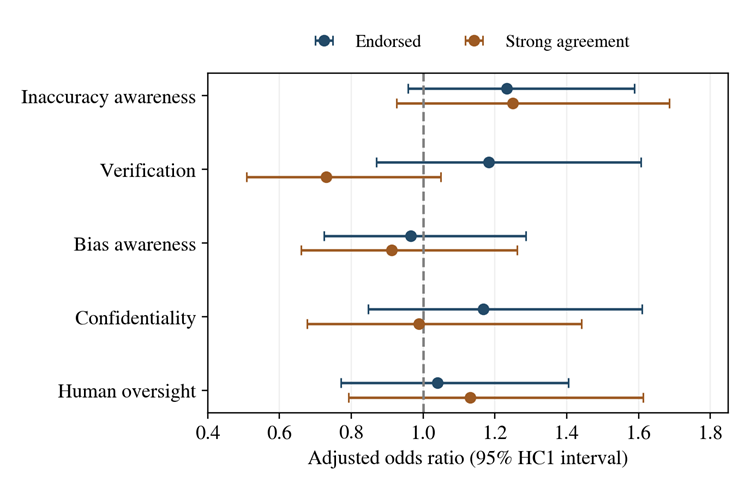
Figure 2. Adjusted focal odds ratios at two response thresholds
Contextual estimates appear in Table 8. Frequency has odds ratios of 1.19 (.96-1.46) for endorsement and 1.20 (.93-1.55) for strong agreement. Both intervals include one. Age, experience and training estimates are also uncertain at both thresholds. Contextual estimates receive no confirmatory interpretation or additional hypothesis labels.
Table 8. Contextual coefficients in the primary models
| Contextual variable | Endorsed OR (95% CI) | Strong OR (95% CI) |
| Age 27+ | 1.29 (0.75-2.21) | 0.65 (0.33-1.25) |
| AI frequency category | 1.19 (0.96-1.46) | 1.20 (0.93-1.55) |
| AI experience category | 1.04 (0.85-1.28) | 0.91 (0.72-1.16) |
| Any AI training | 1.22 (0.78-1.90) | 0.73 (0.44-1.22) |
N = 385. Age compares 27+ with younger respondents; training compares any with none. Frequency and experience are per coded category. These pointwise HC1 intervals are descriptive and are not included in the focal hypothesis family.
The point estimates for frequency remain positive but do not establish frequency as a clear predictor. The final models answer narrower questions about two response thresholds, and neither supplies a population-level adoption effect. Independent logistic estimation differs by less than .00001 in the primary coefficients, supporting numerical reproducibility of the estimates.
4.8 Sensitivity and results summary
Table 9 compares the focal estimates when governance indicators are added and when never-use records are excluded. Extended-model estimates remain imprecise. The consistent-use subset retains 355 respondents, with 235 endorsement and 75 strong-agreement events. Its focal intervals all include one, as in the primary models.
Table 9. Governance adjustment and consistent-use sensitivity
| Specification | Facet | Endorsed OR (95% CI) | Strong OR (95% CI) |
| Governance added | Inaccuracy | 1.21 (0.94-1.57) | 1.21 (0.89-1.63) |
| Verification | 1.17 (0.85-1.59) | 0.70 (0.48-1.01) | |
| Bias awareness | 0.94 (0.70-1.27) | 0.89 (0.64-1.24) | |
| Confidentiality | 1.18 (0.85-1.62) | 1.00 (0.68-1.48) | |
| Human oversight | 1.03 (0.76-1.39) | 1.10 (0.76-1.59) | |
| Consistent use | Inaccuracy | 1.25 (0.96-1.63) | 1.24 (0.90-1.70) |
| Verification | 1.19 (0.87-1.64) | 0.72 (0.49-1.06) | |
| Bias awareness | 0.94 (0.70-1.27) | 1.02 (0.72-1.45) | |
| Confidentiality | 1.08 (0.78-1.52) | 0.96 (0.65-1.43) | |
| Human oversight | 1.03 (0.75-1.40) | 1.11 (0.77-1.62) |
Governance-added models: N = 385, including ADG1-ADG4 alongside the primary covariates. Consistent-use models: n = 355, with 235 endorsement and 75 strong-agreement events. Intervals are pointwise HC1; sensitivity checks do not create a new confirmatory test family.
The student-only checks contain 136 respondents, with 94 endorsement and 32 strong-agreement events. They are substantially less precise: for example, verification endorsement is 1.66 (.90-3.06), while strong agreement is .65 (.33-1.28). These are exploratory composition checks, not evidence of a subgroup difference. Overall, the stable descriptive finding is the greater endorsement of safeguards; the adjusted evidence linking literacy facets with the attribution in ADG5 remains uncertain across the reported specifications.
5. Discussion
The study identifies broad support for responsible data practices alongside more uneven reported awareness and evaluation. It also finds that five literacy-related facets do not show clear adjusted associations with the belief that literacy increases intention to use trustworthy agricultural services. These results are compatible: a widely accepted principle need not account for differences in an intention-related response. The discussion considers what the pattern means for capability, acceptance and governance while maintaining the distinction between stated beliefs and observed behaviour.
5.1 Safeguards and capability are different empirical objects
The paired governance differences are the clearest substantive result. Within the same sample, transparency-related confidence and intended protection are endorsed more frequently than data awareness or risk evaluation. This suggests that a favourable governance orientation should not be used as a proxy for a person’s understanding of data relationships. A service evaluation that asks only whether protection matters could overlook whether users recognise what data are collected or understand a practical risk.
The result should nevertheless be interpreted at the level of the questionnaire. ADG2 is conditional and ADG4 concerns intended conduct, while ADG1 and ADG3 ask about understanding and capability. Their differing endorsement may partly reflect the greater ease of approving a desirable principle. It is therefore more accurate to identify an endorsement difference than to call it a measured skills deficit. Literacy frameworks support following the survey with tasks that assess evaluation directly.[24]
Agricultural governance further depends on service arrangements, not only users’ skills. Carbonell’s analysis highlights why control over data deserves independent scrutiny. A highly literate individual may still encounter an opaque or restrictive arrangement. The survey consequently supports a dual evaluation agenda: investigate what users can understand and evaluate, and examine whether providers offer intelligible and accountable data practices. It cannot determine which side is responsible for a particular service failure.[25]
5.2 Why the outcome changes the acceptance claim
The outcome’s wording is central to the study’s contribution. ADG5 does not independently measure literacy and intention; it asks whether the former increases the latter. A positive response may reflect belief in the importance of literacy, a preference for trustworthy services or a favourable view of learning. Without separate measures, the study cannot identify those components or estimate a literacy effect on intention.
This qualifies the interpretation of technology-acceptance theory. UTAUT2 is useful for situating intention within a broader context, but the present analysis does not reproduce its constructs or temporal design. In particular, general AI frequency is not agricultural adoption, and a statement attributing intention to literacy is not a behavioural record. The findings therefore inform how an acceptance study should specify its measures, rather than confirming or refuting the full theory.[26]
The same qualification applies to a causal reading of the hypotheses. An association between AIL1 and ADG5 would indicate that respondents who report inaccuracy awareness also express a stronger attribution to literacy. It would not show that training increases adoption. The absence of clear adjusted support likewise does not show that training fails. A more direct test would measure capability before an intervention and intention independently afterwards, with subsequent use where feasible.[27]
5.3 Uneven literacy related responses
Confidentiality has 88.8% endorsement, while inaccuracy awareness has 56.4%. This matters because responsible AI engagement involves both information supplied to a tool and information received from it. Restricting disclosure can be sensible even when a user is uncertain about evaluating an output. Conversely, recognising possible inaccuracies does not guarantee careful data handling. The survey pattern argues for separating these topics when designing education and evaluation.
Conceptual literacy scholarship supports attention to several capacities, but it does not make every heterogeneous item set a validated multidimensional scale. The low alpha and small correlations here justify avoiding an unsupported average, not declaring that five well-established dimensions have been discovered. Content-specific reporting is a defensible intermediate step. More extensive instrument development would require multiple items per proposed domain, cognitive testing and external validation.[28]
Training should therefore not be assessed solely by whether participants endorse a confidentiality statement after instruction. Tasks could examine whether they recognise a plausible error, decide when to check a source or identify unnecessary disclosure. Those examples are proposed evaluation approaches, not activities tested in this study. Their value is that they connect the general idea of literacy to observable decisions while keeping agricultural domain knowledge distinct.
5.4 Threshold differences and the frequency finding
The diagnostic rejection of proportional odds materially changes the analysis. A single ordinal coefficient imposes a common relationship across response thresholds, whereas the verification point estimate is positive for endorsement and negative for strong agreement. Neither estimate is precise enough to establish its direction. Their contrast nonetheless shows why an apparently simple ordering of agreement can require a more flexible interpretation.
Ordinal modelling remains useful when its assumptions are appropriate. Here, separate thresholds offer transparent summaries without requiring a fully unconstrained multinomial model for sparse categories. This choice reduces the information retained from the full ordinal outcome, so the full counts remain essential. The final results should be read as two related summaries of the same responses, with their joint multiplicity explicitly addressed.[29]
The frequency estimates also warrant restraint. They are positive in both final models, but their intervals include one; adding governance items weakens the point estimates further. General exposure might matter through familiarity or selection, but this study cannot identify that mechanism. It would be inappropriate to recommend more frequent use as an evidence-based way to increase adoption on the basis of an unsupported common-slope interpretation. Statistical interpretation should follow the final specification and uncertainty rather than retain the most favourable estimate.[30]
5.5 Legal governance without a compliance inference
Bangladesh’s 2026 legislation makes the governance setting concrete, while the questionnaire remains a record of attitudes and self-reports. ADG4 does not test whether a participant understands a lawful basis, recognises a valid consent request or follows an applicable statutory duty. Nor does it measure provider compliance. The article therefore separates a legal reference point from an empirical claim about implementation. Commencement provisions also caution against treating every statutory requirement as operative at the same time.[31]
A governance-sensitive service should make responsibilities understandable and corrections feasible. Accountability research helps frame that institutional question. A declaration that a user should be careful cannot substitute for a provider’s capacity to explain processing and respond to problems. Likewise, publishing information does not ensure that users can act on it. The survey motivates evaluation of these arrangements without establishing their effectiveness.[32]
Responsible-innovation scholarship in smart farming offers a related lesson: social and ethical questions belong within development and evaluation, with attention to the setting and affected actors. Eastwood and colleagues’ New Zealand research provides a useful precedent for examining how such concerns are incorporated, but its findings cannot be transferred as evidence about Bangladesh. The present contribution is to identify specific response differences that local participatory and task-based research could investigate.[33]
5.6 Integrated interpretation and limits
Taken together, the results support a distinction between endorsing governance, reporting capability and attributing intention to literacy. None should stand in for the others. The paired contrasts and joint configurations make that distinction visible, while the adjusted estimates show limited evidence for a simple direct association among the selected items. The resulting account is more specific than a claim that respondents are generally ready for agricultural AI.
Several limitations remain consequential. The mixed adult sample is not verified as farmers, the selection process is insufficiently documented for population inference and all focal responses are collected together. Common response tendencies may influence several answers. A low variance inflation factor cannot rule out common-method bias, and no single post hoc test would establish its absence. The outcome is one attributed-relationship statement, while literacy is measured through self-report rather than task performance.[34]
These limits do not invalidate the descriptive patterns, but they determine their scope. Uncertain adjusted coefficients should remain uncertain rather than be rewritten as evidence of no relationship. The strongest next step is a study in a clearly specified agricultural-user population with independent capability, intention and use measures. The present analysis supplies concrete contrasts and measurement decisions for that work, without claiming an evaluated literacy intervention or a validated adoption model.[35]
6. Theoretical and Practical Implications
The findings have implications for how adoption research defines its outcomes and how agricultural information services evaluate users’ capabilities and governance needs. These implications are reasoned proposals informed by the observed patterns and literature. They are not estimated effects of an intervention. The central practical requirement is to assess understandable safeguards and usable skills separately, then examine whether either translates into intended and actual service use.
6.1 Theoretical implications
The first implication concerns the definition of intention-related outcomes. A statement that literacy increases intention measures a perceived relationship and may be influenced by beliefs about learning, usefulness and trustworthiness. Treating it as a direct intention scale risks a circular account in which the predictor is embedded in the criterion. Future acceptance models should measure the focal capability and the intended behaviour independently, then test their association. This would make a proposed extension of acceptance theory empirically distinguishable from agreement with its premise.[36]
Second, AI literacy should be specified through the capabilities actually required by the task. The five present statements provide useful content distinctions but insufficient evidence for a validated composite or a confirmed five-dimensional structure. A stronger theory test would define domains, use multiple indicators where needed and include performance evidence. This approach preserves conceptual breadth while avoiding a structural model whose apparent precision depends on a poorly established score.[37]
Third, governance should enter an adoption account as more than a general positive attitude. Transparency-related confidence, awareness of collection, evaluation and intended protection may have different relationships with use. Their separation permits a future model to ask whether an understandable service changes capability, whether capability changes intention and whether institutional safeguards affect those pathways. The present survey motivates those questions; it does not identify mediation or moderation.[38]
6.2 Practical implications for services and training
Service providers should evaluate whether their data explanations enable a user to answer concrete questions: what information is requested, for what purpose and where clarification can be obtained. A favourable transparency response is insufficient if the actual explanation is difficult to understand. These proposed tests follow from the difference between endorsing openness and reporting awareness. Disclosure should be assessed for usability, with meaningful opportunities to ask questions and correct misunderstandings.[39]
Training should cover both output evaluation and information disclosure. The comparatively low endorsement of inaccuracy awareness makes error recognition a relevant topic for further investigation. Exercises could ask participants to compare a plausible answer with a reliable agricultural source, identify missing local context and decide whether sensitive information is necessary for a task. Success should be scored against a documented standard rather than inferred from greater confidence or stronger agreement after instruction.
Human assistance should have a defined function and a feasible route of access. It may help interpret an uncertain recommendation, explain a data request or refer a dispute to an appropriate institution. Merely adding a human-oversight label does not establish that help is available, timely or competent. Providers should examine how the process works in realistic service conditions, including situations where users cannot independently verify an answer.[40]
6.3 Policy and societal implications
Public institutions and procurement teams can distinguish three evaluation questions: whether a service meets applicable legal requirements, whether intended users understand its information and whether it improves a specified outcome. These questions require different evidence. Current statutes establish a legal context, while a questionnaire about intended conduct cannot demonstrate compliance. Service-specific legal assessment must account for relevant scope and commencement provisions.[41]
The Sustainable Development Goals concerning small-scale producers, sustainable production and accountable institutions provide a wider rationale for inclusive digital services. The present responses are not indicators of achievement against those targets. A useful policy contribution would connect transparent services and practical skills to observed access and outcomes in an agricultural population, while examining who remains excluded. That approach would ground claims about development benefits in evidence beyond general endorsement of technology.[42]
7. Conclusion Limitations and Future Research
This article examines the perceived contribution of AI literacy to digital agricultural service use using 385 adult survey records from Bangladesh. Its main substantive finding is that safeguard-related statements attract broader endorsement than data awareness and reported risk evaluation. Transparency-related confidence and intended protection exceed the capability-related statements by 19.0-23.4 percentage points in paired comparisons. The joint results further show that 96 respondents endorse both safeguards without endorsing evaluation capability. These are differences in reported responses, not diagnoses of individual competence.
The article also clarifies the outcome being analysed. ADG5 asks whether literacy increases intention to use trustworthy services, so it measures endorsement of a perceived relationship. It does not independently measure an increase in intention, a training effect or observed adoption. Keeping that distinction visible permits a substantive analysis of respondents’ beliefs while avoiding an effect claim embedded in the wording of the question itself.
The modelling findings provide limited support for direct associations between the literacy facets and this proposition. A proportional-odds diagnostic rejects a common-slope restriction, leading to separate endorsement and strong-agreement models. All five focal intervals span an odds ratio of one at both thresholds, and no hypothesis receives clear support after correction across ten coefficients. General AI frequency remains positively estimated but uncertain in both final models. The analysis therefore does not support a strong frequency conclusion from the diagnostic common-slope specification.
The contribution is a more precise account of the relationship between literacy, governance and acceptance. Broad support for confidentiality and protection can coexist with less consistent reported understanding. A perceived literacy benefit can coexist with uncertain item-level associations. These observations show why capability, institutional safeguards and intention should be specified and measured independently. They also identify a practical evaluation agenda focused on error recognition, understandable data practices and accessible assistance. For agricultural services, this means testing whether an answer is locally relevant and whether a data request is understood, alongside measuring willingness to engage. Favourable ratings should be accompanied by evidence that information and governance arrangements help users make well-founded decisions.
The study’s limitations set the boundaries of that contribution. The sample includes legal education and professional groups but does not verify an agricultural-user population. Recruitment dates, invitation numbers and a probability frame are not documented in the supplied database. The measures are simultaneous self-reports, the outcome is a single attributed-relationship statement and the literacy block does not support a validated reflective composite. Conditional intervals address sampling and model uncertainty under assumptions, not unknown selection processes or measurement error.
Future research should recruit a clearly defined agricultural-user population and document recruitment and fieldwork procedures. It should develop independent measures of capability, trust, intention and observed use, with cognitive testing before field deployment. A task-based evaluation could compare ordinary data notices with explanations designed for comprehension, while a training study could assess error detection and disclosure decisions before and after instruction. Follow-up use records would then test whether reported intentions translate into behaviour. Such designs would establish whether literacy and governance interventions produce the outcomes that the present respondents are being asked to anticipate.
Declarations
Ethical approval and oversight
Formal ethical approval was not obtained because the authors’ institutional setting did not provide an accessible formal review mechanism applicable to this non-interventional adult questionnaire study. The researchers remained responsible for ethical conduct. Participant-protection and analytical safeguards are detailed in Section 3.8; no official exemption or retrospective approval is claimed.
Informed consent
Participants were informed of the study purpose, voluntary participation, anonymity and the opportunity to discontinue before questionnaire completion. All analysed records contain affirmative consent and adult-eligibility responses.
Data availability
De-identified numerical data and analytical specifications may be requested from the corresponding author, subject to confidentiality and applicable institutional requirements. The contextual-comment field was excluded from analysis.
Author contributions
Mahia Sarkar Turna: Lead student researcher; conceptualisation; organisation and curation of survey data; manuscript preparation. The project was conducted under the supervision of Prof. Dr Kazi Abdul Mannan.
Kazi Abdul Mannan: Conceptual and methodological guidance; supervision; interpretation of statistical findings; critical review and editing of the manuscript.
Generative AI disclosure
Generative AI assisted drafting, language editing, organisation and analytical-code development. Estimates were computed programmatically from the numerical survey responses. The authors remain responsible for the analysis, interpretation and reporting.
Bibliography
Ajzen I, ‘The Theory of Planned Behavior’ (1991) 50 Organizational Behavior and Human Decision Processes 179
Altman DG and Bland JM, ‘Absence of Evidence Is Not Evidence of Absence’ (1995) 311 BMJ 485
Ananny M and Crawford K, ‘Seeing without Knowing: Limitations of the Transparency Ideal and Its Application to Algorithmic Accountability’ (2018) 20 New Media & Society 973
Boateng GO and others, ‘Best Practices for Developing and Validating Scales for Health, Social, and Behavioral Research: A Primer’ (2018) 6 Frontiers in Public Health 149
Bovens M, ‘Analysing and Assessing Accountability: A Conceptual Framework’ (2007) 13 European Law Journal 447
Brant R, ‘Assessing Proportionality in the Proportional Odds Model for Ordinal Logistic Regression’ (1990) 46 Biometrics 1171
Cameron AC and Miller DL, ‘A Practitioner’s Guide to Cluster-Robust Inference’ (2015) 50 Journal of Human Resources 317
Carbonell IM, ‘The Ethics of Big Data in Big Agriculture’ (2016) 5(1) Internet Policy Review, DOI: 10.14763/2016.1.405
Cochran WG, Sampling Techniques (3rd edn, John Wiley & Sons 1977)
Cronbach LJ, ‘Coefficient Alpha and the Internal Structure of Tests’ (1951) 16 Psychometrika 297
Eastwood C and others, ‘Managing Socio-Ethical Challenges in the Development of Smart Farming: From a Fragmented to a Comprehensive Approach for Responsible Research and Innovation’ (2019) 32 Journal of Agricultural and Environmental Ethics 741
Efron B and Tibshirani RJ, An Introduction to the Bootstrap (Chapman & Hall 1993)
Green B, ‘The Flaws of Policies Requiring Human Oversight of Government Algorithms’ (2022) 45 Computer Law & Security Review 105681
Holm S, ‘A Simple Sequentially Rejective Multiple Test Procedure’ (1979) 6 Scandinavian Journal of Statistics 65
Information and Communication Technology Division, ‘Laws’ <https://ictd.gov.bd/pages/laws> accessed 26 October 2026
Klerkx L, Jakku E and Labarthe P, ‘A Review of Social Science on Digital Agriculture, Smart Farming and Agriculture 4.0: New Contributions and a Future Research Agenda’ (2019) 90-91 NJAS: Wageningen Journal of Life Sciences 100315
Kroll JA and others, ‘Accountable Algorithms’ (2017) 165 University of Pennsylvania Law Review 633
Lee JD and See KA, ‘Trust in Automation: Designing for Appropriate Reliance’ (2004) 46 Human Factors 50
Long D and Magerko B, ‘What Is AI Literacy? Competencies and Design Considerations’ in Proceedings of the 2020 CHI Conference on Human Factors in Computing Systems (ACM 2020)
Mayer RC, Davis JH and Schoorman FD, ‘An Integrative Model of Organizational Trust’ (1995) 20 Academy of Management Review 709
McCullagh P, ‘Regression Models for Ordinal Data’ (1980) 42 Journal of the Royal Statistical Society Series B 109
McNemar Q, ‘Note on the Sampling Error of the Difference between Correlated Proportions or Percentages’ (1947) 12 Psychometrika 153
Ng DTK and others, ‘Conceptualizing AI Literacy: An Exploratory Review’ (2021) 2 Computers and Education: Artificial Intelligence 100041
Podsakoff PM and others, ‘Common Method Biases in Behavioral Research: A Critical Review of the Literature and Recommended Remedies’ (2003) 88 Journal of Applied Psychology 879
Rousseau DM and others, ‘Not So Different After All: A Cross-Discipline View of Trust’ (1998) 23 Academy of Management Review 393
Sijtsma K, ‘On the Use, the Misuse, and the Very Limited Usefulness of Cronbach’s Alpha’ (2009) 74 Psychometrika 107
Stefanski LA and Boos DD, ‘The Calculus of M-Estimation’ (2002) 56 American Statistician 29
United Nations General Assembly, Transforming Our World: The 2030 Agenda for Sustainable Development (25 September 2015) UN Doc A/RES/70/1, targets 2.3, 2.4 and 16.6
Venkatesh V and others, ‘User Acceptance of Information Technology: Toward a Unified View’ (2003) 27 MIS Quarterly 425
Venkatesh V, Thong JYL and Xu X, ‘Consumer Acceptance and Use of Information Technology: Extending the Unified Theory of Acceptance and Use of Technology’ (2012) 36 MIS Quarterly 157
Wang B, Rau PLP and Yuan T, ‘Measuring User Competence in Using Artificial Intelligence: Validity and Reliability of Artificial Intelligence Literacy Scale’ (2023) 42 Behaviour & Information Technology 1324
Wasserstein RL and Lazar NA, ‘The ASA Statement on p-Values: Context, Process, and Purpose’ (2016) 70 American Statistician 129
Wilson EB, ‘Probable Inference, the Law of Succession, and Statistical Inference’ (1927) 22 Journal of the American Statistical Association 209
World Bank, ‘A Global Farming Initiative Is Redefining Jobs and Harvests in Rural Bangladesh’ (6 July 2026) <https://www.worldbank.org/en/news/feature/2026/07/06/a-global-farming-initiative-is-redefining-jobs-and-harvests-in-rural-bangladesh> accessed 26 October 2026
Appendix A Exact analytical statements
Table A1 reproduces the ten analytical statements to make the distinction between literacy-related self-report, governance expectations and the attributed intention outcome transparent. The questionnaire wording is reported as supplied; no claim is made that the block directly reproduces a published validated instrument.
Table A1. Exact analytical item wording
| Code | Statement |
| AIL1 | I understand that generative AI can produce plausible but inaccurate information. |
| AIL2 | I verify important AI-generated information before relying on it. |
| AIL3 | I understand that AI outputs may reflect bias or incomplete data. |
| AIL4 | I avoid sharing confidential or sensitive information with AI tools unless appropriate safeguards are in place. |
| AIL5 | I believe meaningful human oversight is necessary when AI affects important legal or rights-related decisions. |
| ADG1 | I understand that digital agricultural services may collect farm or personal data. |
| ADG2 | I would use AI agricultural services more confidently if data-use practices were transparent. |
| ADG3 | I can evaluate basic benefits and risks of AI-enabled agricultural services. |
| ADG4 | I would follow appropriate data-protection and consent practices when using agricultural AI. |
| ADG5 | AI literacy increases my intention to use trustworthy digital agricultural services. |
Source: Group 16 Codebook. One strongly disagree; two disagree; three neutral; four agree; five strongly agree. No reverse coding is used.
ADG1-ADG4 enter only the extended sensitivity models. AIL1-AIL5 enter all reported adjusted models separately. The endorsement and strong-agreement outcomes are derived from ADG5 without changing its wording or interpreting it as observed adoption.
Table of legislation
National Data Management Act 2026 (Bangladesh Act No 80 of 2026)
Personal Data Protection Act 2026 (Bangladesh Act No 63 of 2026)
[1] Laurens Klerkx, Emma Jakku and Pierre Labarthe, ‘A Review of Social Science on Digital Agriculture, Smart Farming and Agriculture 4.0: New Contributions and a Future Research Agenda’ (2019) 90–91 NJAS: Wageningen Journal of Life Sciences 100315.
[2] World Bank, ‘A Global Farming Initiative Is Redefining Jobs and Harvests in Rural Bangladesh’ (6 July 2026) <https://www.worldbank.org/en/news/feature/2026/07/06/a-global-farming-initiative-is-redefining-jobs-and-harvests-in-rural-bangladesh> accessed 26 October 2026.
[3] Information and Communication Technology Division, ‘Laws’ <https://ictd.gov.bd/pages/laws> accessed 26 October 2026.
[4] Viswanath Venkatesh, James YL Thong and Xin Xu, ‘Consumer Acceptance and Use of Information Technology: Extending the Unified Theory of Acceptance and Use of Technology’ (2012) 36 MIS Quarterly 157; Duri Long and Brian Magerko, ‘What Is AI Literacy? Competencies and Design Considerations’ in Proceedings of the 2020 CHI Conference on Human Factors in Computing Systems (ACM 2020).
[5] Klerkx, Jakku and Labarthe (n 1).
[6] Long and Magerko (n 4); Davy Tsz Kit Ng and others, ‘Conceptualizing AI Literacy: An Exploratory Review’ (2021) 2 Computers and Education: Artificial Intelligence 100041.
[7] Bingcheng Wang, Pei-Luen Patrick Rau and Tianyi Yuan, ‘Measuring User Competence in Using Artificial Intelligence: Validity and Reliability of Artificial Intelligence Literacy Scale’ (2023) 42 Behaviour & Information Technology 1324.
[8] Viswanath Venkatesh and others, ‘User Acceptance of Information Technology: Toward a Unified View’ (2003) 27 MIS Quarterly 425; Venkatesh, Thong and Xu (n 4).
[9] Icek Ajzen, ‘The Theory of Planned Behavior’ (1991) 50 Organizational Behavior and Human Decision Processes 179.
[10] Roger C Mayer, James H Davis and F David Schoorman, ‘An Integrative Model of Organizational Trust’ (1995) 20 Academy of Management Review 709; Denise M Rousseau and others, ‘Not So Different After All: A Cross-Discipline View of Trust’ (1998) 23 Academy of Management Review 393.
[11] Isabelle M Carbonell, ‘The Ethics of Big Data in Big Agriculture’ (2016) 5(1) Internet Policy Review, DOI: 10.14763/2016.1.405.
[12] Mark Bovens, ‘Analysing and Assessing Accountability: A Conceptual Framework’ (2007) 13 European Law Journal 447; Joshua A Kroll and others, ‘Accountable Algorithms’ (2017) 165 University of Pennsylvania Law Review 633.
[13] Personal Data Protection Act 2026 (Bangladesh Act No 63 of 2026), s 1; National Data Management Act 2026 (Bangladesh Act No 80 of 2026), s 1.
[14] Long and Magerko (n 4).
[15] John D Lee and Katrina A See, ‘Trust in Automation: Designing for Appropriate Reliance’ (2004) 46 Human Factors 50.
[16] Ng and others (n 6).
[17] William G Cochran, Sampling Techniques (3rd edn, John Wiley & Sons 1977).
[18] Lee J Cronbach, ‘Coefficient Alpha and the Internal Structure of Tests’ (1951) 16 Psychometrika 297; Klaas Sijtsma, ‘On the Use, the Misuse, and the Very Limited Usefulness of Cronbach’s Alpha’ (2009) 74 Psychometrika 107.
[19] Godfred O Boateng and others, ‘Best Practices for Developing and Validating Scales for Health, Social, and Behavioral Research: A Primer’ (2018) 6 Frontiers in Public Health 149.
[20] Edwin B Wilson, ‘Probable Inference, the Law of Succession, and Statistical Inference’ (1927) 22 Journal of the American Statistical Association 209; Quinn McNemar, ‘Note on the Sampling Error of the Difference between Correlated Proportions or Percentages’ (1947) 12 Psychometrika 153; Sture Holm, ‘A Simple Sequentially Rejective Multiple Test Procedure’ (1979) 6 Scandinavian Journal of Statistics 65; Bradley Efron and Robert J Tibshirani, An Introduction to the Bootstrap (Chapman & Hall 1993).
[21] Peter McCullagh, ‘Regression Models for Ordinal Data’ (1980) 42 Journal of the Royal Statistical Society Series B 109; Rollin Brant, ‘Assessing Proportionality in the Proportional Odds Model for Ordinal Logistic Regression’ (1990) 46 Biometrics 1171.
[22] Leonard A Stefanski and Dennis D Boos, ‘The Calculus of M-Estimation’ (2002) 56 American Statistician 29; Holm (n 20); A Colin Cameron and Douglas L Miller, ‘A Practitioner’s Guide to Cluster-Robust Inference’ (2015) 50 Journal of Human Resources 317.
[23] Ronald L Wasserstein and Nicole A Lazar, ‘The ASA Statement on p-Values: Context, Process, and Purpose’ (2016) 70 American Statistician 129; Douglas G Altman and J Martin Bland, ‘Absence of Evidence Is Not Evidence of Absence’ (1995) 311 BMJ 485.
[24] Long and Magerko (n 4); Wang, Rau and Yuan (n 7).
[25] Carbonell (n 11).
[26] Venkatesh, Thong and Xu (n 4).
[27] Ajzen (n 9).
[28] Ng and others (n 6); Boateng and others (n 19).
[29] McCullagh (n 21); Brant (n 21); Holm (n 20).
[30] Wasserstein and Lazar (n 23).
[31] Personal Data Protection Act 2026 (n 13); National Data Management Act 2026 (n 13).
[32] Bovens (n 12); Mike Ananny and Kate Crawford, ‘Seeing without Knowing: Limitations of the Transparency Ideal and Its Application to Algorithmic Accountability’ (2018) 20 New Media & Society 973.
[33] Callum Eastwood and others, ‘Managing Socio-Ethical Challenges in the Development of Smart Farming: From a Fragmented to a Comprehensive Approach for Responsible Research and Innovation’ (2019) 32 Journal of Agricultural and Environmental Ethics 741.
[34] Cochran (n 17); Philip M Podsakoff and others, ‘Common Method Biases in Behavioral Research: A Critical Review of the Literature and Recommended Remedies’ (2003) 88 Journal of Applied Psychology 879.
[35] Altman and Bland (n 23).
[36] Ajzen (n 9); Venkatesh and others (n 8).
[37] Long and Magerko (n 4); Boateng and others (n 19).
[38] Kroll and others (n 12).
[39] Ananny and Crawford (n 32).
[40] Ben Green, ‘The Flaws of Policies Requiring Human Oversight of Government Algorithms’ (2022) 45 Computer Law & Security Review 105681.
[41] Personal Data Protection Act 2026 (n 13); National Data Management Act 2026 (n 13).
[42] United Nations General Assembly, Transforming Our World: The 2030 Agenda for Sustainable Development (25 September 2015) UN Doc A/RES/70/1, targets 2.3, 2.4 and 16.6.