Journal Home
OPEN ACCESS
Trust in AI Chatbots and Perceived Consumer Protection in Digital Commerce: Evidence from Bangladesh
| Israt Jahan Jui ORCID: https://orcid.org/0009-0004-8769-0354 Tasnim Akter Zafrin ORCID: https://orcid.org/0009-0003-2514-1774 Santa Ahamed ORCID: https://orcid.org/0009-0004-8470-3893 Department of Law Shanto-Mariam University of Creative Technology Uttara, Dhaka, Bangladesh |
| Prof. Dr Kazi Abdul Mannan Department of Business Administration Faculty of Business Shanto-Mariam University of Creative Technology Dhaka, Bangladesh Email: drkaziabdulmannan@gmail.com ORCID: https://orcid.org/0000-0002-7123-132X Corresponding author: Israt Jahan Jui: isratjahanjuillb@gmail.com |
Asian microecon. rev. 2026, 6(4); https://doi.org/10.64907/xkmf.v6i4.amr.1
Submission received:20 September 2026 / Revised: 25 October 2026 / Accepted: 28 October 2026 / Published: 30 October 2026
Download PDF (1 MB)
Abstract
Artificial-intelligence chatbots are becoming an increasingly important interface between consumers and digital-commerce firms, yet the legal significance of trust in these systems depends on whether trust coexists with effective consumer-protection expectations. This study examines that relationship in Bangladesh using 385 usable observations from the Group 7 Q7 survey. The questionnaire was designed around AI literacy, AI-driven consumer-rights awareness, AI-chatbot trust and consumer-protection expectations, and awareness of algorithmic manipulation. Rather than imposing a conventional latent-variable model on the data, the analysis first audits measurement quality and then uses robust ordinary least squares regression and item-level diagnostics. The results show moderate-to-high mean scores across all substantive domains: AI literacy (M = 4.05), consumer-rights awareness (M = 3.91), chatbot trust/consumer protection (M = 3.97), and algorithmic-manipulation awareness (M = 3.90). However, internal consistency is weak across the supplied five-item blocks (α = 0.16–0.20), and a 20-item factorability audit is only marginal (KMO = 0.60). The indices are therefore interpreted as descriptive measures rather than validated latent scales. At the predictive level, AI literacy and algorithmic-manipulation awareness are significant positive predictors of the composite chatbot-trust/consumer-protection score, whereas consumer-rights awareness is not statistically significant at the 5% level. The disclosure-conditioned trust item shows limited evidence of association with the protection/safeguard index (B = 0.004, p = 0.858). Algorithmic-manipulation awareness has the largest positive coefficient in the protection-index model (B = 0.192, p < .001). The pattern motivates an exploratory distinction between disclosure-conditioned trust and safeguard endorsement, while low internal consistency limits broader construct-level conclusions. The study informs discussion of transparency, human escalation, business accountability and complaint mechanisms as conditions of justified reliance in AI-mediated commerce.
Keywords: AI chatbots; consumer protection; digital commerce; trust; algorithmic manipulation; Bangladesh; e-commerce law
1. Introduction
Artificial intelligence increasingly mediates product enquiries, delivery information, returns and complaints in digital commerce. Conversational interfaces can influence purchasing decisions by communicating information on behalf of businesses. Trust research shows that consumers’ willingness to rely on such systems depends on the task, the interaction and the perceived qualities of the technology.[1] Evidence on chatbot adoption also connects trust with interactivity and perceived humanness.[2] These findings motivate examination of whether confidence in an interface corresponds with expectations of consumer protection.
Bangladesh’s Consumers’ Right Protection Act 2009 establishes a general framework for consumer rights, while the Digital Commerce Operation Guidelines 2021 address operational responsibilities in digital commerce.[3] Conversational AI adds questions about the source and authority of transactional information: consumers may encounter responses generated by a model, retrieved from business records or supplied by a human agent. Applying consumer-protection principles to these interactions requires attention to disclosure, accuracy and responsibility for representations.
For a legal and policy perspective, the central question is therefore not simply whether consumers trust AI. The more consequential question is whether trust is anchored in safeguards that preserve consumer autonomy and accountability. The supplied Q7 questionnaire operationalises this issue through statements concerning AI disclosure, accuracy of price and return information, access to human representatives, business responsibility for misleading chatbot information, and complaint mechanisms. These are unusually important because they map technological trust onto recognisable consumer-protection principles.
Trust research has examined technology acceptance, perceived risk and reliance, including the attributes of AI interfaces.[4] The present study focuses on a narrower question: whether disclosure-conditioned chatbot trust is associated with endorsement of safeguards concerning accuracy, human assistance, business responsibility and complaints. Bangladesh provides a relevant legal context for examining these expectations alongside an established consumer-protection framework.[5] The contribution is contextual and exploratory rather than a claim that trust and institutional assurance have previously been unconnected in the literature.
This creates a particularly important research problem for emerging digital markets: a consumer may express high confidence in a chatbot while lacking sufficient awareness of algorithmic influence, or may support strong safeguards without trusting the automated agent. These are analytically different states with different regulatory implications. A high aggregate score can conceal this divergence. Accordingly, the present study examines not only the level of chatbot trust and consumer-protection perceptions but also whether trust is empirically connected to protection-oriented responses.
The study connects three analytical concerns: the distinction between interface trust and safeguard expectations, the measurement consequences of combining these concepts in one index, and the interpretation of this relationship within Bangladesh’s digital-commerce framework. This focus brings the institutional conditions of reliance into dialogue with established technology-trust research.[6]
The general objective is to examine how AI literacy, consumer-rights awareness and awareness of algorithmic manipulation relate to trust in AI chatbots and perceived consumer protection in digital commerce in Bangladesh.
- RQ1: What are the levels of AI literacy, consumer-rights awareness, chatbot trust/consumer-protection perceptions and algorithmic-manipulation awareness among respondents?
- RQ2: Do AI literacy, consumer-rights awareness and algorithmic-manipulation awareness predict the supplied chatbot-trust/consumer-protection score?
- RQ3: Is the Q7 disclosure-conditioned trust item associated with endorsement of the protection-oriented items concerning accuracy, human support, business accountability and complaint mechanisms?
- RQ4: What do the measurement properties and item-level response patterns imply for the design of trustworthy AI-enabled digital commerce in Bangladesh?
The paper makes four contributions. First, it applies a trust–protection lens that distinguishes disclosure-conditioned confidence from endorsement of safeguards. Second, it examines internal consistency and factorability before selecting an observed-index analysis. Third, it identifies algorithmic-manipulation awareness as the largest estimated positive association among the predictors in the reported models, without assuming that the coefficients differ significantly from one another. Fourth, it develops legal and policy implications concerning disclosure, human escalation, business accountability and accessible complaints. These implications are normative recommendations informed by the survey, rather than tested effects of specific interventions.
The remainder of the paper reviews the conceptual and theoretical foundations, develops hypotheses, explains the research design and data-quality procedures, presents the empirical findings, discusses their implications for trust and consumer protection, and concludes with limitations and directions for future research.
2. Literature Review and Theoretical Foundation
This section connects consumer decision research with technology-trust theory to distinguish confidence in a chatbot from endorsement of protective arrangements.[7] It defines the four questionnaire domains, develops the proposed associations and explains why the disclosure-conditioned trust item is examined separately from the broader CTP index.
2.1 Conceptual Background
AI chatbots are conversational systems that use natural-language interfaces to support enquiries and transactions. In digital commerce, they can assist with product information, order status and customer service.[8] Fluent interaction can encourage reliance, while the reliability and authority of the underlying information remain separate concerns.[9] Consumers therefore need ways to identify the system’s role and verify information relevant to a purchase.
Trust involves willingness to accept vulnerability on the basis of favourable expectations, while institution-based assurance concerns the conditions that support reliance.[10] Consumer protection additionally involves information quality, accountability and access to remedies.[11] The Q7 instrument links these domains through statements on AI disclosure, transactional accuracy, human assistance, business responsibility and complaints. Importantly, these statements measure respondents’ expectations; they do not establish that the corresponding safeguards are effective in practice.
Bangladesh’s general consumer legislation and digital-commerce guidelines provide the legal context for these expectations.[12] Chatbot communications can raise questions about inaccurate descriptions, omitted conditions and the attribution of representations. The analysis uses these legal instruments as an interpretive framework; it does not determine liability in any individual case.
2.2 Theoretical Foundation
Consumer decision research explains how information, task demands and decision strategies shape choice.[13] AI interfaces can alter the information presented to consumers and the effort required to compare alternatives. Awareness of algorithmic manipulation may therefore encourage scrutiny of personalised prompts and recommendations.[14] AI literacy provides a complementary basis for recognising capabilities, limitations and the need for critical evaluation.[15]
Trust theory explains willingness to rely on another party or a technology under uncertainty.[16] In automation research, appropriate reliance depends on calibrating confidence to system capabilities and context.[17] The present framework applies this reasoning to expectations concerning disclosure, accuracy, human escalation and accountability. It treats these safeguards as possible conditions of justified trust, while leaving their causal ordering to future research.
The integrated model proposes that AI literacy, consumer-rights awareness and algorithmic-manipulation awareness shape consumers’ orientation toward AI-mediated commerce, while chatbot trust represents willingness to rely on the conversational interface and protection-oriented items represent expectations that safeguard the consumer when automated interaction fails. The critical theoretical proposition is that trust and protection need not move together. A mature consumer-protection regime may produce cautious, conditional trust rather than maximum trust.
2.3 Construct-specific Literature
AI literacy concerns the competencies needed to understand, use and critically evaluate AI.[18] In consumer contexts, such competencies may help users recognise limitations and verify consequential information. The Q7 AIL block includes statements on verification, bias, confidentiality and human oversight. Its scores are interpreted as self-reported orientations rather than demonstrated AI competence.
Consumer-rights awareness concerns respondents’ recognition of commercial influence, personalisation and the importance of transparent information. Consumer decision research and the OECD’s analysis of dark commercial patterns provide reasons to expect informed users to scrutinise the conditions under which choices are presented.[19] The CRA items capture awareness-related responses, without directly testing legal knowledge or successful exercise of rights.
The CTP block combines disclosure-conditioned trust with expectations about accuracy, human support, accountability and complaint mechanisms. Chatbot studies associate trust with interaction characteristics and consumer experience,[20] while e-commerce trust research distinguishes beliefs about a provider from institutional assurances.[21] The present analysis therefore reports the block as a descriptive index and separately examines its items, rather than presuming a homogeneous latent construct.
Algorithmic-manipulation awareness concerns recognition that digital systems can influence choices through personalised pressure and interface design. The OECD documents consumer risks associated with dark commercial patterns, while algorithm-ethics research identifies concerns about opacity, unfairness and responsibility.[22] These perspectives motivate examining whether AMR responses are associated with safeguard expectations; the survey does not directly observe manipulative practices.
2.4 Hypotheses Development
H1—AI literacy and chatbot trust/protection. AI literacy may support critical evaluation of automated information,[23] and calibrated reliance requires attention to system capabilities.[24] Because the integrated outcome includes safeguard expectations, higher literacy is expected to be positively associated with that observed index. H1: AI literacy is positively associated with the integrated chatbot-trust/consumer-protection score.
H2—Consumer-rights awareness and chatbot trust/protection. Awareness of the commercial decision environment may increase attention to transparency and accountability.[25] Institution-based trust research also recognises the relevance of structural assurances.[26] H2: Consumer-rights awareness is positively associated with the integrated chatbot-trust/consumer-protection score.
H3—Algorithmic-manipulation awareness and chatbot trust/protection. Recognising persuasive or manipulative design may encourage expectations of protective arrangements.[27] It may also encourage caution about automated interfaces. Since the integrated outcome includes several safeguard items, the directional hypothesis concerns the combined observed score. H3: Algorithmic-manipulation awareness is positively associated with the integrated chatbot-trust/consumer-protection score.
H4—Disclosure-conditioned trust and protection expectations. E-commerce research links trust and institutional assurance, but these remain distinguishable concepts.[28] The study tests a positive association without presuming that safeguard endorsement follows automatically from confidence in an interface. H4: Disclosure-conditioned chatbot trust is positively associated with the protection-oriented Q7 index.
2.5 Conceptual Framework
The conceptual framework therefore contains three antecedent domains-AI literacy, consumer-rights awareness and algorithmic-manipulation awareness-leading to an integrated chatbot-trust/consumer-protection evaluation. A second diagnostic pathway separates chatbot trust from the protection-oriented items to test whether trust itself predicts protection expectations.
3. Methodology
The study uses a quantitative cross-sectional design to examine associations among self-reported AI-related orientations and consumer-protection expectations. The research plan specifies a common five-point agreement questionnaire for Group 7. Measurement assessment preceded regression: limited internal consistency supported an exploratory observed-index analysis rather than interpretation of the blocks as validated reflective latent scales.[29]
3.1 Study Population and Research Context
The Q7 questionnaire is designed for adults with awareness or experience relevant to AI and digital commerce in Bangladesh. The database contains 385 respondent records. The respondent profile is heterogeneous: 232 are law students, 68 law graduates, 51 advocates/legal professionals and 34 other relevant respondents. The unit of analysis is the individual respondent. The database does not provide a verified sampling frame or fieldwork log; therefore, this paper does not claim that the 385 observations constitute a probability sample of all Bangladeshi digital-commerce consumers.
3.2 Sampling Design and Sample Size
The research plan specifies a target of 385 completed responses using Cochran’s large-population proportion formula at 95% confidence, 5% nominal precision and p = .50.[30] The database contains 385 records. Recruitment probabilities, the contact denominator and the response rate are not documented in the available study records. Consequently, the formula explains the planned sample size; it does not establish a design-based 5% margin of error or national representativeness for the achieved sample.
3.3 Questionnaire Development and Measurement
The questionnaire uses a five-point agreement scale from 1 (strongly disagree) to 5 (strongly agree). Q7 contains a common AI-literacy block (AIL1-AIL5), an AI recommendations and consumer-rights awareness block (CRA1-CRA5), an AI-chatbot trust and consumer-protection block (CTP1-CTP5), and an algorithmic-manipulation and redress block (AMR1-AMR5). The questionnaire also includes demographic variables, AI experience/frequency, training, AI-tool exposure and an optional comment.
Table 1 summarises the item blocks, their analytical roles and internal consistency. All blocks contain five items; their average scores are used as observed indices rather than validated latent scales.
Table 1. Measurement domains, descriptive scores and internal consistency
| Construct | Items | Observed M (SD) | Cronbach α | Analytical role |
| AI literacy (AIL) | 5 | 4.05 (0.37) | 0.20 | Predictor |
| Consumer-rights awareness (CRA) | 5 | 3.91 (0.37) | 0.19 | Predictor |
| Chatbot trust/consumer protection (CTP) | 5 | 3.97 (0.37) | 0.16 | Integrated diagnostic outcome |
| Algorithmic-manipulation awareness (AMR) | 5 | 3.90 (0.39) | 0.20 | Predictor |
The mean scores lie toward agreement, whereas alpha values range from 0.16 to 0.20. High endorsement and limited internal consistency describe different properties of these responses; the latter constrains construct-level interpretation.[31]
A crucial measurement decision is that the CTP block is not treated as a validated unidimensional scale. Its first item concerns trust conditional on AI disclosure, whereas later items concern accuracy, human support, business accountability and complaint mechanisms. Their conceptual heterogeneity is reinforced by the low internal consistency coefficient. Accordingly, CTP is retained as an integrated descriptive index only, while CTP1 is treated as a trust indicator and CTP2-CTP5 are examined as a protection-oriented diagnostic index.
3.4 Pilot Study and Instrument Refinement
A pilot of 30–50 respondents was proposed in the research plan. Separate pilot records and an item-revision history are not available, so the present study reports measurement diagnostics from the 385-record analytical sample without claiming pilot validation.
3.5 Data Collection Procedure
The Excel file is the analytical source. It contains respondent sequence identifiers, screening variables, demographics, substantive Likert responses and quality-control fields. Fifteen cells are missing in the database, but the substantive Likert blocks are complete; the missing values occur in the optional/contextual field rather than the four substantive five-item blocks. No duplicate respondent IDs were detected. All substantive items fall within their intended 1-5 response range.
3.6 Ethical Considerations
The questionnaire specifies voluntary participation, anonymity, no requirement to provide names and the option to stop before completion. The protocol advises against unnecessary identifying information and confidential case details. Analysis used the existing database and reports aggregate patterns without attempting to identify individuals. Formal ethical approval was not obtained: the authors report that an accessible institutional review mechanism applicable to this non-interventional adult questionnaire study was unavailable at the time. This institutional circumstance is not presented as an independent ethics waiver. The researchers retained responsibility for consent, confidentiality and proportionate handling of the data.
3.7 Data Analysis Strategy
Analysis proceeded in four stages. First, records were screened for duplicate identifiers, missingness and out-of-range values. Second, descriptive statistics were calculated for the four blocks and individual CTP items. Third, internal consistency and factorability were examined using Cronbach’s alpha, the Kaiser–Meyer–Olkin statistic and Bartlett’s test of sphericity.[32] Fourth, ordinary least squares models estimated observed-score associations, with HC3 heteroskedasticity-consistent standard errors for coefficient inference.[33] HC3 addresses heteroskedasticity in model-based inference; it does not correct measurement error or undocumented selection processes.
Two regression specifications were central. Model 1 predicted the integrated CTP score from AIL, CRA and AMR. Model 2 predicted the protection-oriented index (CTP2-CTP5) from CTP1, AIL, CRA and AMR. A supplementary model predicted CTP1 from AIL, CRA and AMR. This structure permits the study to test the distinctive trust-protection relationship without mechanically correlating an item with a composite that contains that same item.
3.8 Analytical Limitations Built into the Measurement Design
Limited internal consistency restricts interpretation of the block averages as measures of homogeneous latent traits.[34] Item content also combines personal evaluations and normative expectations. Regression results are therefore interpreted as exploratory associations among observed indices. Neither a significant coefficient nor a favourable mean establishes construct validity, causal influence or successful consumer protection.
4. Results
The results proceed from respondent characteristics and AI exposure to descriptive scores, measurement diagnostics and regression associations. Tables 2–8 report the empirical findings, while Table 1 summarises the measurement domains and Table 9 documents database checks. Coefficients describe associations within the analytical sample; statistical inference does not establish causality or population representativeness.
4.1 Respondent Profile
Table 2 describes the age, gender, professional status and location of the analytical sample. These characteristics define the context in which the reported associations should be interpreted.
Table 2. Demographic and professional characteristics of respondents (N = 385)
| Variable | Category | n | % |
| Age | 18-20 | 60 | 15.6 |
| Age | 21-23 | 162 | 42.1 |
| Age | 24-26 | 83 | 21.6 |
| Age | 27-30 | 41 | 10.6 |
| Age | 31+ | 39 | 10.1 |
| Gender | Male | 188 | 48.8 |
| Gender | Female | 188 | 48.8 |
| Gender | Prefer not to say | 5 | 1.3 |
| Gender | Other | 4 | 1.0 |
| Status | Law student | 232 | 60.3 |
| Status | Law graduate | 68 | 17.7 |
| Status | Advocate/legal professional | 51 | 13.2 |
| Status | Other | 34 | 8.8 |
| Location | Dhaka | 160 | 41.6 |
| Location | Other city corporation | 82 | 21.3 |
| Location | District town | 70 | 18.2 |
| Location | Upazila-rural area | 64 | 16.6 |
| Location | Other | 9 | 2.3 |
The sample is predominantly law-oriented and concentrated in younger age groups. Geographic variation provides contextual breadth, but the profile does not establish representativeness of all consumers in Bangladesh. Percentages may differ slightly from 100 because of rounding.
The sample is relatively young and professionally connected to law. The largest age group is 21-23 years (42.1%), while 60.3% are law students. Gender is almost evenly divided between male and female respondents. Dhaka accounts for 41.6% of the sample, but substantial numbers come from other city corporations, district towns and upazila/rural areas. This distribution supports contextual analysis across levels of digital exposure, but it should not be treated as nationally representative.
4.2 AI Exposure and Experience
Table 3 describes AI experience, frequency of use and training. Weekly or daily use is reported by 70.6% of respondents, whereas 57.7% report no formal training. These categories distinguish routine exposure from organised preparation.
Table 3. AI experience, frequency of use and training (N = 385)
| Indicator | Category | n | % |
| AI experience | Less than 6 months | 66 | 17.1 |
| AI experience | 6-12 months | 112 | 29.1 |
| AI experience | 1-2 years | 132 | 34.3 |
| AI experience | More than 2 years | 66 | 17.1 |
| AI experience | Never | 9 | 2.3 |
| AI frequency | Never | 12 | 3.1 |
| AI frequency | Less than monthly | 30 | 7.8 |
| AI frequency | Monthly | 71 | 18.4 |
| AI frequency | Weekly | 166 | 43.1 |
| AI frequency | Daily/almost daily | 106 | 27.5 |
| Training | No | 222 | 57.7 |
| Training | Short orientation | 117 | 30.4 |
| Training | Course/certified | 46 | 12.0 |
Frequent AI use coexists with limited formal training. These are self-reported exposure categories and should not be read as objective evidence of competence; AI literacy involves critical evaluation in addition to use.[35]
4.3 Descriptive Statistics
Table 4 presents the distribution of the four observed indices. Mean scores exceed the neutral midpoint of 3.0, with AI literacy highest at 4.045. Standard deviations range from 0.368 to 0.386, indicating concentration within the upper part of the response scale.
Table 4. Descriptive statistics for the observed indices
| Construct | Mean | SD | Min | Max |
| AI literacy | 4.045 | 0.373 | 3.0 | 5.0 |
| Consumer-rights awareness | 3.906 | 0.374 | 3.0 | 4.8 |
| Chatbot trust/protection | 3.968 | 0.368 | 2.8 | 5.0 |
| Algorithmic-manipulation awareness | 3.902 | 0.386 | 2.8 | 5.0 |
The indices have similar means and limited dispersion. Their upper-range concentration may reduce the variation available for explaining differences between respondents. Mean differences across domains do not establish differences in validated latent capabilities.
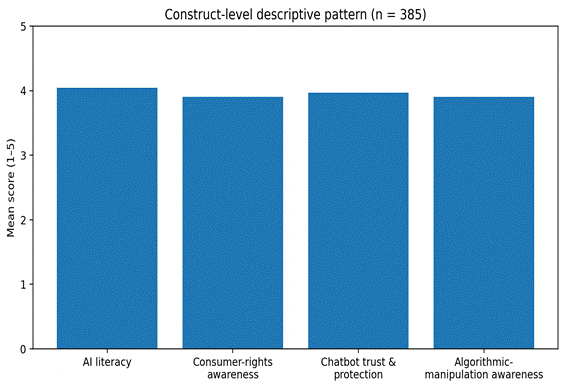
Figure 1. Mean scores for the four observed questionnaire indices (N = 385). Scores range from 1 to 5; the figure describes index averages rather than validated latent constructs.
4.4 Measurement Model Audit
Internal consistency is limited across all five-item blocks: α = 0.20 for AIL, 0.19 for CRA, 0.16 for CTP and 0.20 for AMR (Table 1). The CTP2–CTP5 index has α = 0.11. These estimates constrain interpretation of the indices as homogeneous reflective scales.[36] The indices are retained to describe the questionnaire domains, with item-level findings used to clarify their content.
For the 20 substantive items, KMO = 0.60 and Bartlett’s test gives χ² ≈ 296.8, df = 190, p < .001. Bartlett’s test indicates that the correlation matrix differs from an identity matrix; it does not establish the proposed four-domain structure. The overall KMO and alpha results warrant caution about latent-scale interpretation and support the descriptive and exploratory emphasis adopted here.[37]
4.4.1 Item-level Trust–Protection Patterns
Table 5 reports each CTP item separately so that disclosure-conditioned trust can be distinguished from specific safeguard expectations. Item wording is summarised in the final column.
Table 5. Mean scores for disclosure-conditioned trust and safeguard items
| CTP item | Mean | Interpretive domain |
| CTP1 | 3.774 | Trust increases when the chatbot identifies itself as AI |
| CTP2 | 3.795 | Accuracy of prices, terms and returns |
| CTP3 | 3.818 | Access to a human representative |
| CTP4 | 4.226 | Business responsibility for misleading information |
| CTP5 | 4.226 | Complaint mechanisms as a trust condition |
Business accountability and complaint mechanisms receive equal and comparatively high means of 4.226. Accuracy and human assistance are also endorsed, but these responses do not demonstrate that the safeguards are present or effective in actual transactions.
Table 5 separates the disclosure-conditioned trust item from the accuracy, human-support, accountability and complaint items. The mean of CTP4 and CTP5 is approximately 4.23, compared with approximately 3.80 for CTP1–CTP3. This paired contrast is statistically significant, t(384) = 12.18, p < .001. The contrast compares two groups of item content; it is not a direct test of trust against every protection item.
4.5 Correlations and Regression Associations
Table 6 presents unadjusted correlations before the multivariable models. The protection index excludes CTP1, avoiding a correlation between the trust item and an outcome containing the same item.
Table 6. Bivariate correlations with the integrated CTP and protection indices
| Predictor | CTP r | Protection-index r |
| AI literacy | 0.226 | 0.172 |
| Consumer-rights awareness | 0.168 | 0.144 |
| Algorithmic-manipulation awareness | 0.301 | 0.228 |
| Chatbot trust (CTP1) | – | 0.081 |
AMR has the largest reported correlation with each index (r = .301 and .228), while CTP1 has a small correlation with the protection index (r = .081). These coefficients do not establish causal direction; adjusted associations are reported in Tables 7 and 8.
4.5.1 Model 1: Integrated chatbot trust/protection
Table 7 reports Model 1, which relates the integrated CTP score to AIL, CRA and AMR. The reported model summary is F(3, 381) = 19.11, p < .001, R² = 0.127 and adjusted R² = 0.120. The unstandardised coefficients are positive for AIL (B = 0.157, HC3 p = .003) and AMR (B = 0.241, p < .001). CRA has B = 0.088, p = .090. At the nominal 5% threshold, H1 and H3 receive support in this observed-index specification; H2 does not.
Table 7. Model 1 associations with the integrated chatbot trust/protection index
| Path | B | HC3 p | 95% CI | Decision |
| AIL → CTP | 0.157 | 0.003 | [0.053, 0.261] | Supported |
| CRA → CTP | 0.088 | 0.090 | [-0.014, 0.189] | Not supported |
| AMR → CTP | 0.241 | < .001 | [0.157, 0.325] | Supported |
AIL and AMR have positive coefficients with confidence intervals excluding zero; the CRA interval includes zero. B denotes an unstandardised coefficient, with HC3-based coefficient inference. The estimates apply to the observed indices and do not validate the underlying measurement blocks.
4.5.2 Model 2: Trust-protection pathway
Table 8 reports Model 2, with the CTP2–CTP5 index as the outcome and CTP1, AIL, CRA and AMR as predictors. The reported model summary is F(4, 380) = 7.91, p < .001, with R² = 0.076. CTP1 has B = 0.004, HC3 p = .858. AIL (B = 0.124, p = .035) and AMR (B = 0.192, p < .001) have positive coefficients; CRA does not meet the nominal 5% threshold. This specification does not support H4.
Table 8. Model 2 associations with the protection-oriented index
| Predictor | B | HC3 p | Interpretation |
| Chatbot trust (CTP1) | 0.004 | 0.858 | Limited evidence of an adjusted association |
| AI literacy | 0.124 | 0.035 | Positive association |
| Consumer-rights awareness | 0.090 | 0.117 | Not significant |
| Algorithmic-manipulation awareness | 0.192 | < .001 | Largest positive point estimate |
The CTP1 estimate is close to zero in this adjusted specification. The result does not establish equivalence or absence of a relationship in the wider population. AIL and AMR show positive associations, but the model explains a modest share of observed-score variation.
4.6 Supplementary Trust Model
To examine whether the antecedents are related specifically to chatbot trust, CTP1 was regressed on AIL, CRA and AMR. The model explains R² = 0.074. AI literacy is significant (B = 0.285, p = 0.013) and algorithmic-manipulation awareness is also significant (B = 0.431, p < .001), whereas consumer-rights awareness is not (B = 0.077, p = 0.511). These estimates suggest that AMR responses may accompany disclosure-conditioned trust as well as safeguard endorsement; the cross-sectional design does not establish the direction of either association.
Across the reported specifications, AIL and AMR are positively associated with the observed outcome indices. CRA has positive point estimates but greater statistical uncertainty. The adjusted CTP1 coefficient provides limited evidence of a relationship with the protection index. Taken together, these patterns support treating disclosure-conditioned trust and safeguard endorsement as analytically distinct, while recognising the measurement constraints.
5. Discussion
The study examined whether disclosure-conditioned chatbot trust corresponds with consumer-protection expectations. The adjusted relationship is imprecisely estimated around a value close to zero, while accountability and complaint items receive higher average endorsement than the other CTP items. AIL and AMR show positive associations with the observed protection index. These findings concern stated expectations, and do not measure the effectiveness of safeguards or establish that trust and protection are unrelated in other settings.
5.1 AI Literacy as a Protective Capability
The positive AIL coefficients are consistent with the proposition that critical evaluation of AI may accompany attention to protective conditions.[38] Calibrated-reliance research provides a complementary interpretation: understanding a system’s limitations may matter alongside confidence in its performance.[39] Because literacy is self-reported and measured concurrently with the outcomes, the present findings do not establish that literacy causes stronger protection expectations.
In these data, higher AIL scores accompany greater endorsement of the combined CTP and protection indices. A plausible interpretation is that respondents attentive to AI limitations also value accurate information and human assistance. Consumer education could therefore include verification and awareness of system limitations.[40] Whether such education changes purchasing or complaint behaviour remains an intervention question.
5.2 Algorithmic-Manipulation Awareness and Safeguard Expectations
AMR has the largest positive unstandardised coefficient among the antecedent indices in the reported models. This pattern is compatible with greater attention to safeguards among respondents who recognise algorithmic influence. It does not establish that AMR has a statistically larger effect than the other predictors. Research on dark commercial patterns provides a basis for examining how the organisation of online choices can affect consumer autonomy.[41]
The policy interpretation extends beyond the truthfulness of individual chatbot answers. Personalisation, interface structure and friction in challenging a recommendation can also shape consumer choice.[42] The survey’s association between AMR and safeguard endorsement is consistent with this broader concern, although no manipulative interface or actual consumer harm was observed.
5.3 Why Consumer-rights Awareness Is Statistically Weaker
CRA has a favourable descriptive mean but its adjusted coefficients do not meet the 5% threshold. This result does not demonstrate that rights awareness is irrelevant. Restricted score variation, measurement heterogeneity and shared variance with other indices may contribute to the uncertainty. Consumer decision and institution-based trust perspectives also allow awareness of rights to differ from confidence that a particular service will provide recourse.[43]
This distinction is important for policy. Legal awareness campaigns often focus on informing citizens that rights exist. In AI-enabled commerce, the next step is operational knowledge: where to verify an AI-generated statement, how to reach a human representative, how to preserve evidence of a misleading interaction, and where to lodge a complaint. Rights awareness therefore needs an implementation layer.
5.4 The Trust-Protection Gap
The adjusted CTP1 estimate suggests limited evidence of an association between disclosure-conditioned trust and the protection index in this sample. Higher means for accountability and complaints indicate differing endorsement of item content. However, CTP1 is a conditional statement about AI disclosure, not a comprehensive measure of trust. The observed pattern is therefore described as an exploratory trust–protection distinction rather than proof of a general psychological separation.
This interpretation complements research linking chatbot trust with interaction characteristics and task context.[44] It also fits calibrated-reliance theory, in which confidence should correspond to system capabilities and the conditions of use.[45] The policy objective proposed here is justified reliance supported by verification and recourse; this is a normative interpretation rather than an outcome directly tested by the survey.
5.5 Additional and Unexpected Findings
The measurement audit is consequential for interpretation. Low alpha values mean that within-block responses provide limited evidence of internal consistency.[46] They do not by themselves identify whether the cause is item breadth, wording, response patterns or measurement error. In particular, responsibility for misleading information and trust conditional on disclosure are conceptually different statements. Analyses of the block averages cannot resolve those differences.
Future instrument development should distinguish competence, integrity, disclosure, accountability and access to redress. The current indices organise policy-relevant responses, but their low internal consistency and mixed item content limit claims about underlying latent traits. The observed associations remain exploratory.
5.6 Integrated Interpretation
The combined theoretical interpretation treats AI literacy as an evaluative orientation, AMR as awareness of commercial influence, and safeguard expectations as a distinct dimension of AI-mediated commerce. Institution-based trust and appropriate-reliance research support examining these dimensions together.[47] Their causal ordering, and the practical contribution of individual safeguards, require designs that separate expectations from actual behaviour.
For Bangladesh, the findings motivate clearer links between chatbot interaction and existing consumer-protection processes.[48] As a comparative reference, Article 50 of the EU AI Act addresses transparency for certain AI systems, including interaction with natural persons.[49] The comparison informs policy discussion; it does not make EU obligations equivalent to Bangladeshi law.
6. Theoretical and Practical Implications
This section develops implications for theory, service design and policy from the observed distinction between disclosure-conditioned trust and safeguard expectations. Recommendations draw on the survey and relevant trust and consumer-protection literature.[50] They are proposed governance priorities whose effects require evaluation, particularly given the sample and measurement limitations.
6.1 Theoretical Implications
The findings motivate a conditional interpretation of technology trust. Established frameworks distinguish willingness to rely from the beliefs and structural assurances supporting that willingness.[51] Here, disclosure-conditioned trust and expectations of accuracy, accountability and recourse should be modelled separately. The study offers an exploratory application of this distinction, rather than a causal extension established by the present data.
The trust–protection distinction identifies a question for future theory testing: whether safeguards precede, moderate or follow reliance on AI interfaces. The non-significant CTP1 coefficient cannot determine this ordering. Its contribution is to show why the instrument’s disclosure-conditioned item should not be used as a substitute for a broader consumer-protection measure.
The Bangladesh context encourages integration of behavioural constructs with the legal arrangements surrounding commercial representations and complaints.[52] Such models could examine whether awareness of enforceable responsibilities changes reliance on chatbots, while distinguishing formal legal provisions from consumers’ knowledge and experience of those provisions.
6.2 Practical and Managerial Implications
- AI disclosure should be explicit and persistent. Consumers should not have to infer whether they are interacting with an automated system. Disclosure should be paired with a clear explanation of the system’s role and limits.
- Chatbots should distinguish information from legally consequential commitments. Prices, return conditions, delivery terms and complaint outcomes should be drawn from authoritative business records rather than generated freely.
- Access to human review should be a clear service-governance commitment. The CTP3 mean of 3.818 indicates endorsement of human assistance, although it does not establish the legal status or effectiveness of such a route.
- Businesses should establish responsibility for reviewing and correcting misleading chatbot communications. This recommendation concerns organisational accountability; the survey does not determine liability in individual transactions.
- Complaint mechanisms should be visible inside the chatbot interface. A consumer should be able to preserve the interaction, identify the responsible business, and initiate a complaint without navigating an unrelated channel.
- Algorithmic-manipulation awareness should be incorporated into consumer education. Consumers should learn how personalisation, ranking, targeted persuasion and recommendation systems can shape choice.
- AI governance teams should assess both information quality and interface practices that may constrain informed choice. Algorithm-ethics and consumer-policy research provide reasons to examine these concerns together.[53]
6.3 Policy and Societal Implications
Policy development could clarify how the Consumers’ Right Protection Act 2009 and Digital Commerce Operation Guidelines 2021 apply to AI-mediated representations and complaint handling.[54] Potential guidance could address disclosure, records of consequential statements, attribution, human review and preservation of conversational evidence. These are proposed implementation priorities, not claims that the survey establishes additional statutory requirements.
Consumer agencies and platforms should jointly develop standardised AI-commerce notices and complaint pathways. Such measures would not require banning chatbots; instead, they would make the conditions of trustworthy automation legible to consumers.
7. Conclusion, Limitations and Future Research
Using 385 records from the Group 7 Q7 database, this study examined associations between AI-related orientations, disclosure-conditioned chatbot trust and consumer-protection expectations. AIL and AMR have positive coefficients in the integrated CTP model and the protection-index model. CRA estimates are positive but do not meet the nominal 5% threshold. The adjusted CTP1 coefficient is close to zero, with substantial uncertainty. Accountability and complaint-mechanism statements receive the highest average endorsement within the CTP block.
The findings motivate attention to the conditions supporting reliance on chatbot communications: accurate information, AI disclosure, human assistance, business accountability and accessible complaints. They concern perceived and expected safeguards rather than observed protection. Limited internal consistency also means that the index regressions should be read as exploratory associations, not validated latent-variable relationships.
The contribution is an observed-item account of the distinction between disclosure-conditioned trust and safeguard endorsement in a law-oriented Bangladesh sample. AMR is associated with protection-oriented responses, providing a basis for further study of how awareness of commercial influence relates to reliance and recourse. The practical implications are proposals for governance and future evaluation.
- The study is cross-sectional, so the observed relationships should not be interpreted causally.
- The sample is the supplied 385-record dataset; the file does not document a verified probability sampling frame or response rate, limiting claims of national representativeness.
- All substantive measures are self-reported and collected through the same questionnaire. Social desirability, item context and common-method effects may influence observed relationships.[55]
- The five-item blocks show weak internal consistency, limiting latent-construct interpretation and preventing a strong claim that the questionnaire has validated reflective scales.
- The study does not contain objective behavioural measures of chatbot use, purchase behaviour, complaint filing or actual consumer harm.
- The analysis cannot establish how respondents would behave when confronted with a real misleading chatbot interaction.
Future research should develop a dedicated multi-dimensional measurement instrument separating chatbot competence, transparency, integrity, human recourse, accountability and complaint accessibility. A longitudinal design could test whether repeated chatbot use increases justified trust or produces over-reliance. Experimental studies could manipulate AI disclosure, accuracy warnings, human escalation and complaint visibility to establish causal effects. Multi-group analysis could compare law students, ordinary consumers, legal professionals and experienced e-commerce users. Cross-country research could examine whether regulatory environments change the trust-protection relationship. Finally, researchers should combine survey data with behavioural evidence such as chatbot transcripts, complaint records and controlled purchase scenarios. These approaches would move beyond perception toward evidence of whether AI-mediated commerce actually improves or undermines consumer autonomy and legal protection.
Declarations
Ethics Approval
Formal ethical approval was not obtained. At the time of the study, the authors report that their institutional setting did not provide an accessible formal review mechanism applicable to this non-interventional adult questionnaire research. This circumstance is not represented as a formal exemption or independent ethics clearance. Participant-protection provisions included informed consent, voluntary participation, the option to discontinue, an anonymous questionnaire and aggregate reporting, as described in Section 3.6. Responsibility for ethical conduct remained with the researchers.
Informed Consent
The questionnaire includes a consent screen stating that participation is voluntary, that no name is required, that responses will be analysed in aggregate, and that participants may stop at any time.
Data Availability
The analysed Group 7 database is held by the research team. Access is subject to participant-consent conditions, confidentiality and applicable institutional requirements. Aggregate findings and analytical definitions are reported in this article and its appendices.
Conflict of Interest
No competing interests are reported in the study documentation.
Funding
No external funding is identified in the available study documentation.
Author Contributions
Israt Jahan Jui: Conceptualisation; preparation of study materials; data organisation and curation; writing-original draft. The project was conducted under the supervision of Prof. Dr Kazi Abdul Mannan.
Kazi Abdul Mannan: Supervision; conceptual and methodological guidance; interpretation of findings; writing-review and editing.
AI/Generative AI Disclosure
Generative AI assisted manuscript drafting, language editing and analytical support. The authors retain responsibility for the accuracy of the data analysis, references, legal interpretation and conclusions.
Legislation and Regulatory Materials
Consumers’ Right Protection Act 2009 (Act No 26 of 2009) (Bangladesh)
Ministry of Commerce, Government of Bangladesh, Digital Commerce Operation Guidelines 2021 (4 July 2021)
Regulation (EU) 2024/1689 of the European Parliament and of the Council laying down harmonised rules on artificial intelligence (Artificial Intelligence Act) [2024] OJ L 2024/1689, art 50
Bibliography
Bettman JR, Luce MF and Payne JW, ‘Constructive Consumer Choice Processes’ (1998) 25 Journal of Consumer Research 187
Castelo N, Bos MW and Lehmann DR, ‘Task-Dependent Algorithm Aversion’ (2019) 56 Journal of Marketing Research 809
Cochran WG, Sampling Techniques (3rd edn, John Wiley & Sons 1977)
Cronbach LJ, ‘Coefficient Alpha and the Internal Structure of Tests’ (1951) 16 Psychometrika 297
Ding Y and Najaf M, ‘Interactivity, Humanness, and Trust: A Psychological Approach to AI Chatbot Adoption in E-Commerce’ (2024) 12 BMC Psychology 595
Glikson E and Woolley AW, ‘Human Trust in Artificial Intelligence: Review of Empirical Research’ (2020) 14 Academy of Management Annals 627
Kaiser HF, ‘An Index of Factorial Simplicity’ (1974) 39 Psychometrika 31
Lee JD and See KA, ‘Trust in Automation: Designing for Appropriate Reliance’ (2004) 46 Human Factors 50
Long D and Magerko B, ‘What Is AI Literacy? Competencies and Design Considerations’ in Proceedings of the 2020 CHI Conference on Human Factors in Computing Systems (ACM 2020)
MacKinnon JG and White H, ‘Some Heteroskedasticity-Consistent Covariance Matrix Estimators with Improved Finite Sample Properties’ (1985) 29 Journal of Econometrics 305
Mayer RC, Davis JH and Schoorman FD, ‘An Integrative Model of Organizational Trust’ (1995) 20 Academy of Management Review 709
McKnight DH, Choudhury V and Kacmar C, ‘Developing and Validating Trust Measures for e-Commerce: An Integrative Typology’ (2002) 13 Information Systems Research 334
Mittelstadt BD and others, ‘The Ethics of Algorithms: Mapping the Debate’ (2016) 3 Big Data & Society, DOI: 10.1177/2053951716679679
OECD, Dark Commercial Patterns (OECD Digital Economy Papers No 336, OECD Publishing 2022)
Pavlou PA, ‘Consumer Acceptance of Electronic Commerce: Integrating Trust and Risk with the Technology Acceptance Model’ (2003) 7 International Journal of Electronic Commerce 101
Podsakoff PM and others, ‘Common Method Biases in Behavioral Research: A Critical Review of the Literature and Recommended Remedies’ (2003) 88 Journal of Applied Psychology 879
Wang C and others, ‘Whether to Trust Chatbots: Applying the Event-Related Approach to Understand Consumers’ Emotional Experiences in Interactions with Chatbots in E-Commerce’ (2023) 73 Journal of Retailing and Consumer Services 103325
Appendix A. Analytical Coding Used in This Manuscript
AIL = mean(AIL1-AIL5); CRA = mean(CRA1-CRA5); CTP = mean(CTP1-CTP5); AMR = mean(AMR1-AMR5). For the trust-protection diagnostic, CTP1 is treated as the trust indicator and Protection Index = mean(CTP2-CTP5). No reverse-coded items were present. The analysis uses HC3 robust standard errors for regression coefficients.
Appendix B. Data Integrity Audit
Table 9 records the checks documented for the analytical database. Identifier uniqueness, substantive-item completeness and permitted response ranges are reported separately.
Table 9. Database completeness and range checks
| Audit check | Result |
| Rows | 385 |
| Unique respondent IDs | 385; no duplicates |
| Substantive Likert missingness | 0 |
| Other missing cells | 15, confined to optional/contextual data |
| Likert range violations | None detected |
| Analytical sample | 385 |
All 385 records remain in the reported analysis. These checks establish completeness and coding consistency for the fields examined; unique identifiers alone do not establish unique participants, probability recruitment or measurement validity.
[1] Ella Glikson and Anita Williams Woolley, ‘Human Trust in Artificial Intelligence: Review of Empirical Research’ (2020) 14 Academy of Management Annals 627; Cuicui Wang and others, ‘Whether to Trust Chatbots: Applying the Event-Related Approach to Understand Consumers’ Emotional Experiences in Interactions with Chatbots in E-Commerce’ (2023) 73 Journal of Retailing and Consumer Services 103325; Noah Castelo, Maarten W Bos and Donald R Lehmann, ‘Task-Dependent Algorithm Aversion’ (2019) 56 Journal of Marketing Research 809.
[2] Yi Ding and Muzammil Najaf, ‘Interactivity, Humanness, and Trust: A Psychological Approach to AI Chatbot Adoption in E-Commerce’ (2024) 12 BMC Psychology 595.
[3] Consumers’ Right Protection Act 2009 (Act No 26 of 2009) (Bangladesh); Ministry of Commerce, Government of Bangladesh, Digital Commerce Operation Guidelines 2021 (4 July 2021).
[4] Roger C Mayer, James H Davis and F David Schoorman, ‘An Integrative Model of Organizational Trust’ (1995) 20 Academy of Management Review 709; D Harrison McKnight, Vivek Choudhury and Charles Kacmar, ‘Developing and Validating Trust Measures for e-Commerce: An Integrative Typology’ (2002) 13 Information Systems Research 334; John D Lee and Katrina A See, ‘Trust in Automation: Designing for Appropriate Reliance’ (2004) 46 Human Factors 50.
[5] Consumers’ Right Protection Act 2009 (Bangladesh); Digital Commerce Operation Guidelines 2021 (Bangladesh).
[6] McKnight, Choudhury and Kacmar (n 4); Lee and See (n 4).
[7] Mayer, Davis and Schoorman (n 4); Lee and See (n 4); James R Bettman, Mary Frances Luce and John W Payne, ‘Constructive Consumer Choice Processes’ (1998) 25 Journal of Consumer Research 187.
[8] Wang and others (n 1); Ding and Najaf (n 2).
[9] Glikson and Woolley (n 1); Lee and See (n 4).
[10] Mayer, Davis and Schoorman (n 4); McKnight, Choudhury and Kacmar (n 4).
[11] Consumers’ Right Protection Act 2009 (Bangladesh); Digital Commerce Operation Guidelines 2021 (Bangladesh).
[12] Consumers’ Right Protection Act 2009 (Bangladesh); Digital Commerce Operation Guidelines 2021 (Bangladesh).
[13] Bettman, Luce and Payne (n 7).
[14] OECD, Dark Commercial Patterns (OECD Digital Economy Papers No 336, OECD Publishing 2022).
[15] Duri Long and Brian Magerko, ‘What Is AI Literacy? Competencies and Design Considerations’ in Proceedings of the 2020 CHI Conference on Human Factors in Computing Systems (ACM 2020).
[16] Mayer, Davis and Schoorman (n 4); McKnight, Choudhury and Kacmar (n 4).
[17] Lee and See (n 4).
[18] Long and Magerko (n 15).
[19] Bettman, Luce and Payne (n 7); OECD (n 14).
[20] Wang and others (n 1); Ding and Najaf (n 2).
[21] McKnight, Choudhury and Kacmar (n 4); Paul A Pavlou, ‘Consumer Acceptance of Electronic Commerce: Integrating Trust and Risk with the Technology Acceptance Model’ (2003) 7 International Journal of Electronic Commerce 101.
[22] OECD (n 14); Brent Daniel Mittelstadt and others, ‘The Ethics of Algorithms: Mapping the Debate’ (2016) 3 Big Data & Society, DOI: 10.1177/2053951716679679.
[23] Long and Magerko (n 15).
[24] Lee and See (n 4).
[25] Bettman, Luce and Payne (n 7); OECD (n 14).
[26] McKnight, Choudhury and Kacmar (n 4).
[27] OECD (n 14); Mittelstadt and others (n 22).
[28] McKnight, Choudhury and Kacmar (n 4); Pavlou (n 21).
[29] Lee J Cronbach, ‘Coefficient Alpha and the Internal Structure of Tests’ (1951) 16 Psychometrika 297.
[30] William G Cochran, Sampling Techniques (3rd edn, John Wiley & Sons 1977).
[31] Cronbach (n 29).
[32] Cronbach (n 29); Henry F Kaiser, ‘An Index of Factorial Simplicity’ (1974) 39 Psychometrika 31.
[33] James G MacKinnon and Halbert White, ‘Some Heteroskedasticity-Consistent Covariance Matrix Estimators with Improved Finite Sample Properties’ (1985) 29 Journal of Econometrics 305.
[34] Cronbach (n 29).
[35] Long and Magerko (n 15).
[36] Cronbach (n 29).
[37] Cronbach (n 29); Kaiser (n 32).
[38] Long and Magerko (n 15).
[39] Lee and See (n 4).
[40] Long and Magerko (n 15).
[41] OECD (n 14).
[42] OECD (n 14); Mittelstadt and others (n 22).
[43] McKnight, Choudhury and Kacmar (n 4); Bettman, Luce and Payne (n 7).
[44] Wang and others (n 1); Castelo, Bos and Lehmann (n 1); Ding and Najaf (n 2).
[45] Lee and See (n 4).
[46] Cronbach (n 29).
[47] McKnight, Choudhury and Kacmar (n 4); Lee and See (n 4).
[48] Consumers’ Right Protection Act 2009 (Bangladesh); Digital Commerce Operation Guidelines 2021 (Bangladesh).
[49] Regulation (EU) 2024/1689 of the European Parliament and of the Council laying down harmonised rules on artificial intelligence (Artificial Intelligence Act) [2024] OJ L 2024/1689, art 50.
[50] Consumers’ Right Protection Act 2009 (Bangladesh); Digital Commerce Operation Guidelines 2021 (Bangladesh); McKnight, Choudhury and Kacmar (n 4); Lee and See (n 4).
[51] Mayer, Davis and Schoorman (n 4); McKnight, Choudhury and Kacmar (n 4).
[52] Consumers’ Right Protection Act 2009 (Bangladesh); Digital Commerce Operation Guidelines 2021 (Bangladesh).
[53] OECD (n 14); Mittelstadt and others (n 22).
[54] Consumers’ Right Protection Act 2009 (Bangladesh); Digital Commerce Operation Guidelines 2021 (Bangladesh).
[55] Philip M Podsakoff and others, ‘Common Method Biases in Behavioral Research: A Critical Review of the Literature and Recommended Remedies’ (2003) 88 Journal of Applied Psychology 879.