Journal Home
OPEN ACCESS
AI Awareness and Conditional Legal Career Confidence in Bangladesh
| Md. Rohmot Ali Tonoy ORCID: https://orcid.org/0009-0005-9187-2756 Shopnil Islam ORCID: https://orcid.org/0009-0009-2127-512X Md. Hanif Iqbal Hawlader ORCID: https://orcid.org/0009-0002-1366-5637 Department of Law Shanto-Mariam University of Creative Technology Dhaka, Bangladesh |
| Prof. Dr Kazi Abdul Mannan Department of Business Administration Faculty of Business Shanto-Mariam University of Creative Technology Dhaka, Bangladesh Email: drkaziabdulmannan@gmail.com ORCID: https://orcid.org/0000-0002-7123-132X Corresponding author: Md. Rohmot Ali Tonoy: zacktonoy08@gmail.com |
Int. Res. J. Bus. Soc. Sci. 2026, 12(4); https://doi.org/10.64907/xkmf.v12i4.irjbss.01
Submission received: 10 September 2026 / Revised: 28 September 2026 / Accepted: 30 September 2026 / Published: 02 October 2026
Download (PDF)
Abstract
Awareness of artificial intelligence (AI) in legal work does not necessarily imply that respondents regard AI literacy as an employment requirement or attribute career confidence to their ability to use it responsibly. This cross-sectional study separates these judgements using 385 adult responses to a common questionnaire in Bangladesh. We report item distributions, joint endorsement and within-person contrasts, then estimate exploratory adjusted associations with conditional career confidence and intention to develop AI skills. Self-reported understanding of legal AI capabilities and limitations was endorsed by 277 respondents (71.9%), while 154 (40.0%) endorsed the growing importance of AI literacy for legal employment. The paired difference was 31.9 percentage points (95% CI 25.5 to 38.4; Holm-adjusted p < 0.001). Confidence attributed to responsible AI use was endorsed by 171 respondents (44.4%), and 71 (18.4%) endorsed both that statement and employment relevance. In adjusted models, the coefficient for legal AI awareness in relation to conditional confidence was 0.071 (95% CI −0.081 to 0.222); none of the four focal coefficients met the multiplicity-adjusted threshold. The findings distinguish familiarity with the capabilities and risks of AI from the career value respondents assign to that familiarity. They support assessing legal AI competence and career expectations separately in curriculum evaluation. The questionnaire does not measure demonstrated skills, overall employability, labour-market demand or employment outcomes.
Keywords: legal education; artificial intelligence literacy; career confidence; learning intention; Bangladesh.
1. Introduction
Generative artificial intelligence can help a learner identify possible search terms, organise a research plan or compare ways of framing a legal issue. A plausible answer can also contain a false citation or misstate the scope of a genuine authority. Professional competence therefore requires knowing when an output can assist a task and when its claims must be checked independently. Evaluations of legal research tools have documented reliability problems even in products designed to support legal work. These findings justify teaching verification, but they do not show that familiarity with a tool improves hiring outcomes.[1]
A legal career involves expectations that are not reducible to familiarity with technology. A student may understand what a model can do and still be uncertain whether firms, chambers or public organisations value that competence. A graduate may anticipate that AI will matter in a particular workplace without believing that their own skills are sufficient. A practitioner may regard responsible use as part of professional judgement while placing greater weight on legal research, communication or experience when assessing employment prospects. These distinctions are important when interpreting a survey that contains capability, employment relevance, confidence and learning statements in the same item block.
1.1 Research problem and questions
The original question is whether awareness of legal AI relates to confidence about future legal employment in Bangladesh. The instrument does not measure general employability or record employers’ evaluations. It asks whether the respondent’s ability to use AI responsibly increases their confidence about future legal employment. Agreement is evidence about the attribution expressed in that statement, rather than a direct rating of confidence or probability of obtaining a job. This narrower interpretation gives the data a useful role while avoiding an inference that a cross-sectional survey cannot support.
We ask how frequently respondents endorse each of the five legal AI and career statements; how employment relevance compares within respondents with awareness, conditional confidence and learning intention; and how awareness and perceived relevance covary with the two career responses after adjustment. The descriptive comparison is central because respondents can recognise a tool’s capabilities without endorsing its growing importance for employment. The regression addresses a different question about variation in ratings.
1.2 Contribution and scope
The study analyses the Group 1 questionnaire in Bangladesh. The shared instrument also supports separate analyses of AI-assisted legal research and case reasoning. The present article focuses on judgements about legal work and careers; the papers are not independent samples. Our contribution is to distinguish respondents’ reports about what they understand from beliefs about what employers value, and to distinguish both from confidence and intention to learn. The resulting evidence informs the design of evaluations of legal education, rather than a prediction of hiring or a ranking of career determinants.
2. Literature Review and Theoretical Foundation
This section connects legal AI literacy with social cognitive career theory. The former concerns what people can understand and do with AI; the latter distinguishes beliefs about one’s capabilities, expected consequences and goals. The questionnaire captures related judgements in a limited form. Keeping those judgements separate prevents conclusions about professional competence or employment from being drawn from broad agreement items.
2.1 Legal AI literacy and verification
AI literacy includes competencies needed to understand, evaluate and use AI. In legal work, those competencies have a specific content: a user must recognise when an output rests on an uncertain premise, check citations against authoritative sources and distinguish what a decision says from what a model infers. The relevance of verification is not confined to fabricated authorities. A citation may exist yet fail to support the proposition for which it is invoked, or the source may concern a different jurisdiction, legal issue or procedural stage. This is why evaluation should consider the reasoning process as well as the final answer.[2]
The two focal awareness statements ask respondents whether they understand capabilities and limitations and can explain major risks. These are reports about perceived ability and understanding. An assessment of performance would instead ask participants to identify inaccuracies, support conclusions with sources or decide how to handle sensitive information in a specified situation. Such an assessment could reveal differences even among respondents who report similar awareness. The present data therefore do not justify interpreting the awareness mean as a competence score.
2.2 Social cognitive career theory
Social cognitive career theory distinguishes self-efficacy, outcome expectations and goals. People may believe they can perform a task while remaining uncertain about its consequences in a particular work environment. They can also expect a skill to be rewarded without being confident that they have mastered it. Supports and barriers can influence how beliefs translate into action. In legal education, opportunities to practise, receive feedback and observe professional workflows could shape a student’s understanding of how AI competence relates to a particular role. The questionnaire does not measure the complete theory; it provides a way to distinguish several judgements that should not be combined.[3]
The employment-relevance item asks whether AI literacy is becoming important for legal employment. It is closer to a broad expectation about the field than to a measure of personal efficacy. The conditional-confidence item instead asks whether the respondent’s own ability to use AI responsibly increases confidence. It combines a personal attribution and an expected career consequence. The learning item expresses an intention, rather than a commitment documented by registration, practice time or completion. These distinctions suggest why endorsement of one item does not guarantee endorsement of another.
2.3 Career confidence and perceived employability
Self-perceived employability can include judgements about one’s qualifications, institutional reputation and external labour-market conditions. A rating about confidence attributed to one capability is narrower. For instance, a person might be confident about employment for reasons unrelated to AI and disagree that AI ability increases it. Another might see AI as helpful while remaining pessimistic about their broader prospects. The questionnaire cannot separate those positions because it has no independent baseline confidence item. A higher score on AILE4 is therefore interpreted as stronger agreement with the attribution, not higher employability overall.[4]
Learning intention likewise can reflect several motives. Some may intend to learn because they anticipate career benefits, others because they want to avoid errors or meet professional responsibilities. An intention may remain unfulfilled if training, time or suitable tools are unavailable. Research using a career framework should identify what learning is planned, what opportunity is available and what actions follow. This study reports intention as a separate outcome to avoid treating it as observed development.
2.4 Conceptual framework and exploratory expectations
Figure 1 shows the two explanatory measures and the two distinct outcomes. Greater awareness might coincide with stronger confidence if respondents regard responsible use as a skill they can demonstrate. It could also coincide with greater caution if respondents recognise the limits of current tools. Belief in employment relevance could track intentions to learn, but career expectations may reflect opportunities and constraints not measured here. These are competing interpretations of possible associations, not preregistered causal hypotheses.
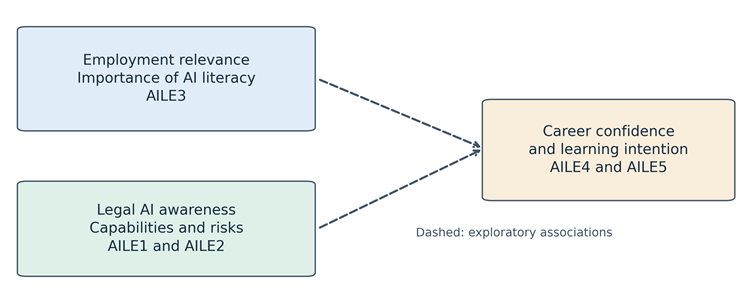
Figure 1. Analytical framework for AI awareness and career judgements
The model distinguishes the legal AI awareness summary from general AI orientation. The former concerns perceived capabilities and risks in legal work; the latter includes general recognition of inaccuracy and bias and reported verification. They are not validated latent measures. The analytical aim is to see whether either focal explanatory measure distinguishes the two career ratings once the recorded respondent characteristics are taken into account.
3. Methodology
This section sets out the source, screening rules and analytical choices. The analysis preserves item wording and within-person dependence. Its reporting follows the logic of cross-sectional observational research by separating observed denominators and model precision from claims about a target population.[5]
3.1 Sample and data source
The Group 1 workbook contains a Data sheet, README and codebook for a common questionnaire. The unit of analysis is an individual response. All 385 records indicated consent, adult eligibility and general AI awareness. The available documentation does not establish the invitation denominator, exact collection dates, mode of distribution or a verified probability sampling frame. Consequently, we report the achieved analytical sample rather than a response rate or national margin of error. The recorded status field defines the law-student sensitivity subset.
3.2 Screening and data provenance
We checked the uniqueness of the sequence, completeness of numerical and profile fields, and allowed values for all 20 agreement items. All ratings were within the 1–5 range. No duplicate response and profile patterns were detected after excluding the sequence and contextual text. No case was removed. “None” remained a valid AI tool category. The study team confirmed that the numerical records were empirical and that the synthetic descriptors for the sequence and contextual fields were labelling errors. The contextual-text field was excluded without quotation or coding.
3.3 Measures
Table 1 states the roles assigned to the items. AILE1 and AILE2 are averaged with equal weights as an observed legal AI awareness summary. AILE3 is employment relevance. AILE4 and AILE5 are separate outcomes, respectively conditional confidence and learning intention. AIL1–3 form an observed general AI orientation mean. Status, location and formal AI training are categorical adjustment variables.
Table 1. Analytical roles of career and adjustment items
| Role | Code | Interpretation |
| Legal AI awareness | AILE1–2 | Mean of perceived capabilities, limitations and ability to explain risks |
| Employment relevance | AILE3 | Belief that AI literacy is becoming important for legal employment |
| Conditional confidence | AILE4 | Confidence attributed to responsible AI use |
| Learning intention | AILE5 | Intention to develop career-related AI skills |
| Adjustment | AIL1–3 and profile | General AI orientation, status, location and training |
Outcomes do not enter the predictors.
Appendix A gives the exact statements. All retain their original directions and anchors. We report coefficient alpha and rank correlations for descriptive diagnostic purposes. Neither alpha nor an average of different items demonstrates a valid latent construct. The analysis does not combine awareness and career outcomes in a common score and does not estimate structural paths, mediation or a measurement model.[6]
3.4 Endorsement and paired comparisons
We report all response categories and define endorsement as agreement or strong agreement. Wilson intervals accompany the marginal proportions. The cross-tabulation compares AILE3 and AILE4 and uses the full sample as the denominator for cell percentages. Non-endorsement includes neutral answers and is not treated as opposition.[7]
We compare each other AILE item with AILE3, the employment-relevance benchmark. The difference is the net discordant count divided by 385. Exact McNemar tests condition on discordant responses. Pointwise percentile intervals use 10,000 resamples of whole respondents, preserving the original pairing (seed 20261103). Holm adjustment applies across the four paired tests. These are comparisons of statements as worded, not estimates of a latent difference between awareness and confidence.[8]
3.5 Exploratory models
Separate linear models use AILE4 and AILE5 as original 1–5 ratings. Both include the legal AI awareness mean, employment relevance, the general orientation mean, and categorical status, location and training. We report unstandardised coefficients and HC3 standard errors; intervals are pointwise. Holm adjustment covers the four focal coefficients across the two main models. Adjusting for measured background does not establish temporal order or identify a causal effect.[9]
Sensitivity analyses model confidence endorsement with logistic regression and robust sandwich intervals, and repeat the original rating model among law students. Each sensitivity model has a separate two-coefficient Holm family. The binary outcome treats agreement and strong agreement alike, and therefore changes the question. The student subset overlaps the full sample and is not an independent validation or a test of group differences.[10]
3.6 Ethics and data protection
The source manuscript reports voluntary anonymous participation and informed consent. All analysed records carry affirmative consent and adult eligibility. Contextual text was excluded and results were reported in aggregate.
4. Results
Results proceed from the sample and item distributions to joint endorsement, paired differences and exploratory adjusted models. All main analyses use 385 records.
4.1 Respondent profile
Table 2 describes age, current status, location and training. The largest age group was 21–23 (136, 35.3%). The workbook recorded 237 law students, 69 law graduates, 46 advocates or legal professionals and 33 other relevant respondents. Dhaka accounted for 168 records; 230 reported no formal AI training.
Table 2. Sample profile
| Characteristic | Category | n (%) |
| Age | 21-23 | 136 (35.3%) |
| Age | 24-26 | 94 (24.4%) |
| Age | 18-20 | 70 (18.2%) |
| Age | 31+ | 46 (11.9%) |
| Age | 27-30 | 39 (10.1%) |
| Status | Law student | 237 (61.6%) |
| Status | Law graduate | 69 (17.9%) |
| Status | Advocate or legal professional | 46 (11.9%) |
| Status | Other relevant respondent | 33 (8.6%) |
| Location | Dhaka | 168 (43.6%) |
| Location | District town | 86 (22.3%) |
| Location | Other city corporation | 77 (20.0%) |
| Location | Upazila-rural area | 48 (12.5%) |
| Location | Other | 6 (1.6%) |
| AI training | No | 230 (59.7%) |
| AI training | Yes, short orientation | 105 (27.3%) |
| AI training | Yes, course or certified training | 50 (13.0%) |
Denominator = 385 for all percentages.
The status mix includes respondents at different stages, so the full sample is not a cohort of new graduates or jobseekers. Weekly or daily or almost daily generative AI use was reported by 275 respondents (71.4%). This indicates general use, not the frequency of professional legal tasks performed with AI.
4.2 Item distributions
Table 3 shows that 277 respondents (71.9%) endorsed understanding legal AI capabilities and limitations, while 272 (70.6%) endorsed ability to explain major risks. Employment relevance was endorsed by 154 (40.0%). Another 181 selected neutrality and 50 disagreed or strongly disagreed. Confidence attributed to responsible use was endorsed by 171 (44.4%), and learning intention by 166 (43.1%).
Table 3. Distributions of AI awareness and career ratings
| Item | 1 | 2 | 3 | 4 | 5 | Agree n (%) | 95% CI (%) |
| AILE1 | 1 | 11 | 96 | 188 | 89 | 277 (71.9%) | 67.3 to 76.2 |
| AILE2 | 0 | 12 | 101 | 182 | 90 | 272 (70.6%) | 65.9 to 75.0 |
| AILE3 | 5 | 45 | 181 | 139 | 15 | 154 (40.0%) | 35.2 to 45.0 |
| AILE4 | 2 | 47 | 165 | 138 | 33 | 171 (44.4%) | 39.5 to 49.4 |
| AILE5 | 4 | 47 | 168 | 139 | 27 | 166 (43.1%) | 38.3 to 48.1 |
Agree combines 4 and 5. Intervals are Wilson intervals.
The first two statements had higher endorsement than any of the three career-related statements. On the career items, between 165 and 181 respondents chose neutrality. This is a substantive feature of the distributions: lack of agreement should not be described uniformly as rejection. Coefficient alpha across AILE1–5 was 0.240 and the pairwise Spearman correlations ranged from 0.023 to 0.079. The weak covariation and different item content support separate reporting.
4.3 Joint endorsement and paired contrasts
Table 4 reports the overlap of employment relevance and conditional confidence. Seventy-one respondents (18.4%) endorsed both; 83 endorsed relevance without endorsing confidence; 100 endorsed confidence without endorsing relevance; and 131 endorsed neither.
Table 4. Joint endorsement of employment relevance and career confidence
| Employment relevance | Confidence not endorsed | Confidence endorsed | Total |
| Not endorsed | 131 (34.0%) | 100 (26.0%) | 231 (60.0%) |
| Endorsed | 83 (21.6%) | 71 (18.4%) | 154 (40.0%) |
| Total | 214 (55.6%) | 171 (44.4%) | 385 (100.0%) |
Cell percentages use the full sample. Non-endorsement includes neutral responses.
Among relevance endorsers, 46.1% endorsed conditional confidence, compared with 43.3% of other respondents. Neither item identifies the other reliably. The paired comparison in Table 5 shows that understanding of capabilities exceeded employment relevance by 31.9 points (95% CI 25.5 to 38.4), and ability to explain risks exceeded it by 30.6 points (95% CI 23.9 to 37.4).
Table 5. Paired contrasts with employment relevance
| Contrast | Other only | Relevance only | Gap (pp) | 95% CI (pp) | Holm p |
| AILE1 − AILE3 | 167 | 44 | 31.9 | 25.5 to 38.4 | <0.001 |
| AILE2 − AILE3 | 163 | 45 | 30.6 | 23.9 to 37.4 | <0.001 |
| AILE4 − AILE3 | 100 | 83 | 4.4 | -2.3 to 11.2 | 0.474 |
| AILE5 − AILE3 | 97 | 85 | 3.1 | -3.9 to 10.1 | 0.474 |
Exact McNemar tests. Pointwise percentile intervals use 10,000 respondent resamples.
Both awareness comparisons retained Holm-adjusted p values below 0.001. The confidence and learning differences from employment relevance were 4.4 and 3.1 points, respectively; both intervals included zero and both adjusted p values were 0.474. These results support a distinction between the relative breadth of awareness and career endorsements. They do not establish that the three career judgements have equivalent endorsement.
4.4 Adjusted associations
Table 6 shows that the awareness coefficient for conditional confidence was 0.071 (95% CI −0.081 to 0.222; adjusted p = 0.725). The employment-relevance coefficient was 0.012 (95% CI −0.098 to 0.121). For learning intention, the corresponding awareness and relevance estimates were 0.135 (95% CI −0.015 to 0.285) and 0.076 (95% CI −0.034 to 0.185). None met the multiplicity-adjusted threshold.
Table 6. Adjusted associations with career confidence and learning intention
| Model (n) | Term | Estimate | 95% CI | Holm p | R² |
| Career confidence (385) | Relevance | 0.012 | -0.098 to 0.121 | 0.836 | 0.047 |
| Career confidence (385) | Awareness | 0.071 | -0.081 to 0.222 | 0.725 | 0.047 |
| Learning intention (385) | Relevance | 0.076 | -0.034 to 0.185 | 0.529 | 0.068 |
| Learning intention (385) | Awareness | 0.135 | -0.015 to 0.285 | 0.311 | 0.068 |
| Confidence endorsement (385) | Relevance | 1.001 | 0.762 to 1.316 | 0.992 | 0.028 |
| Confidence endorsement (385) | Awareness | 1.235 | 0.855 to 1.783 | 0.522 | 0.028 |
| Law students confidence (237) | Relevance | -0.020 | -0.155 to 0.115 | 1.000 | 0.046 |
| Law students confidence (237) | Awareness | 0.044 | -0.161 to 0.250 | 1.000 | 0.046 |
Linear rows report unstandardised coefficients, HC3 intervals and ordinary R². Binary confidence rows report odds ratios, sandwich intervals and McFadden pseudo-R². Holm families: four main coefficients together, two coefficients separately for each sensitivity model.
The full models explained 4.7% and 6.8% of observed variance in confidence and intention. In the confidence endorsement model, the odds ratios were 1.235 for awareness and 1.001 for employment relevance, with intervals spanning one. In law students the corresponding linear estimates were 0.044 and −0.020, with intervals spanning zero. The sensitivity results do not supply clearer evidence of a relationship. The interval widths do not establish absence of meaningful associations in other settings.
5. Discussion
The central result is the gap between reported awareness and endorsement of AI literacy’s growing employment relevance. Both awareness statements were endorsed by around seven in ten respondents, compared with four in ten for employment relevance. The adjusted analysis does not support the original draft’s claim that greater AI literacy improves employability. What the survey shows is that the judgements are distinct and that the measured awareness summary did not reliably distinguish the conditional confidence and learning ratings.
5.1 Awareness is not a career expectation
The within-person contrast helps locate the difference. For capabilities and limitations, 167 respondents endorsed the awareness statement without endorsing employment relevance, while 44 showed the reverse pattern. This suggests that agreement about understanding AI is common even among people who do not affirm a proposition about its place in the labour market. The difference can reflect the information each statement requires. A person can answer about what they understand from using a tool. Judging whether employers value that competence may require knowledge of organisations or roles the person has not encountered. The substantial neutral category is consistent with uncertainty, although the survey does not establish why any respondent chose it.
The career framework explains why one should not infer outcome expectations from perceived capability. An individual can expect a capability to be useful only in some roles or can value it as a professional safeguard without expecting a recruitment advantage. Employers may also require legal analysis and writing, professional responsibility, client communication and other skills. The survey asks neither employers nor applicants in a defined hiring process. Its results describe the positions of respondents, rather than establish the skill requirements of a labour market.[11]
5.2 Confidence and learning as separate outcomes
The confidence item is conditional on the respondent’s reported ability to use AI responsibly. Its association with awareness was small and imprecise. The model cannot determine whether a measure of demonstrated proficiency would be more closely associated with confidence. The learning intention coefficient for awareness was positive but did not meet the adjusted threshold. A person might intend to learn because of professional obligations even when they see little hiring benefit, or might value the skill but lack time or access. The item does not record the reason, whether training was available or whether learning took place.
The weak covariation across the five items also argues against reporting a single score as employability. The result does not prove that the questionnaire items represent distinct latent factors; there are too few indicators of each content domain for that claim. It does show why a composite would give similar numeric values to people with meaningfully different profiles. An overall measure could hide a combination of confidence in explaining risks and uncertainty about professional demand. The distinction is particularly relevant when deciding whether a curriculum should teach a capability, provide information about career pathways or do both.[12]
5.3 What the results can inform
Legal training can make the work that responsible use requires visible. For example, an exercise can give learners a draft memorandum with plausible citations and ask them to verify each one, explain any mismatch and revise the argument. Students can be evaluated on how they handle uncertainty and confidential information. Such an exercise addresses a competency directly. If it is accompanied by a discussion of how different employers use AI, the course can also make career expectations more concrete. Neither activity should be presented as a proven route to employment based on this survey.[13]
6. Theoretical and Practical Implications
The findings support separate measures of legal AI competence, expected career value and participation in professional learning. These measures are useful for different decisions. A performance task can identify where learners need practice. A career survey can identify where they lack information about roles. Attendance or completion records can show whether a learning opportunity was used.
6.1 Theory and measurement
A direct application of social cognitive career theory would use task-specific measures of efficacy, specified outcome expectations and a defined learning goal. It would also measure the institutional supports and barriers relevant to the goal. The current instrument contains statements related to these domains but does not test the full theory. A future study could ask whether a respondent can verify an authority, whether they expect that skill to matter in a named role and whether they plan to complete a specified activity. Distinct outcomes would make it possible to interpret changes without assuming that confidence is evidence of competence.[14]
6.2 Curriculum and professional development
A legal education programme could teach and assess AI use through a workflow: identify the issue, decide whether a tool is suitable, check authoritative sources and document the reasoning that remains the learner’s responsibility. Assessment should reward the quality of verification and explanation. A demonstration that compares an apparently persuasive output with the cited material can reveal whether a learner recognises unsupported claims. A confidentiality scenario can test when material should not be shared. These tasks provide evidence about performance that self-report cannot supply.[15]
Career guidance can address a different gap by describing the tasks and safeguards relevant to different roles. Practitioners can explain where tools are used, which decisions require independent review and what a student could show in a portfolio. Evaluations should track whether students understand the relevance of a task, perform it competently and act on learning plans. A rise in agreement that AI is important should not be the sole measure of curriculum success.
7. Conclusion Limitations and Future Research
In this sample of 385 AI-aware adults, self-reported understanding of legal AI capabilities and risks was more widespread than endorsement of its growing importance for employment. Fewer than half attributed greater career confidence to responsible AI use or expressed an intention to develop career-related skills. No focal adjusted association met the multiplicity-adjusted threshold. The study supports separating perceived awareness from expected career value and measuring each on its own terms.
Respondents were predominantly drawn from legal study and practice, and the recruitment frame and fieldwork details were not verified in the supplied materials. The findings do not estimate attitudes across Bangladesh’s legal labour market. The single career items do not measure overall employability, recruitment outcomes or actual learning. The observed awareness mean is self-report, and the cross-sectional design cannot determine whether awareness precedes the career judgements. The law-student subset shares records with the full sample, and companion Group 1 studies share the questionnaire.
A follow-up could assess legal AI performance with a marked verification task and measure self-efficacy separately. It could compare career expectations for specific roles, recruit employers to document the competencies they seek and record learning activity after the survey. A curriculum evaluation could measure competence before and after a defined course and distinguish changes in skill from changes in confidence. Employment outcomes, where ethically and practically observable, would require follow-up beyond the course. These designs would address the employability question more directly than the present ratings.
Declarations
Ethical approval and oversight
No study-specific formal ethics approval or exemption was documented in the available materials. Section 3.6 details the adult consent indicators, exclusion of contextual text and aggregate reporting.
Informed consent
The source manuscript reports informed consent and voluntary anonymous participation. All 385 analysed records affirm consent and adult eligibility.
Data availability
Requests for de-identified numerical data and analytical specifications may be directed to the corresponding author, subject to confidentiality and applicable institutional requirements.
Funding and competing interests
No external funding or competing interest was disclosed in the available study materials.
Author contributions
Rohmot Ali Tonoy led the student research, developed the research question, organised the study materials and prepared the initial manuscript. Prof. Dr Kazi Abdul Mannan supervised the research, provided conceptual and methodological guidance, contributed to interpretation and critically revised the manuscript. Kazi Abdul Mannan is the corresponding author.
Generative AI disclosure
Generative AI assisted literature retrieval, drafting, editing and preparation of analytical code. Numerical estimates were computed programmatically from the supplied workbook. The authors are responsible for verifying and approving the analysis, interpretation and reporting.
Bibliography
Efron B and Tibshirani RJ, An Introduction to the Bootstrap (Chapman & Hall 1993)
Holm S, ‘A Simple Sequentially Rejective Multiple Test Procedure’ (1979) 6 Scandinavian Journal of Statistics 65
Hosmer DW Jr, Lemeshow S and Sturdivant RX, Applied Logistic Regression (3rd edn, John Wiley & Sons 2013)
Lent RW, Brown SD and Hackett G, ‘Toward a Unifying Social Cognitive Theory of Career and Academic Interest, Choice, and Performance’ (1994) 45 Journal of Vocational Behavior 79
Long D and Magerko B, ‘What Is AI Literacy? Competencies and Design Considerations’ (Proceedings of the 2020 CHI Conference on Human Factors in Computing Systems, ACM 2020) doi:10.1145/3313831.3376727
Magesh V and others, ‘Hallucination-Free? Assessing the Reliability of Leading AI Legal Research Tools’ (2025) 22 Journal of Empirical Legal Studies 216
McNemar Q, ‘Note on the Sampling Error of the Difference between Correlated Proportions or Percentages’ (1947) 12 Psychometrika 153
Rothwell A, Herbert I and Rothwell F, ‘Self-Perceived Employability: Construction and Initial Validation of a Scale for University Students’ (2008) 73 Journal of Vocational Behavior 1
Sijtsma K, ‘On the Use, the Misuse, and the Very Limited Usefulness of Cronbach’s Alpha’ (2009) 74 Psychometrika 107
von Elm E and others, ‘The Strengthening the Reporting of Observational Studies in Epidemiology (STROBE) Statement: Guidelines for Reporting Observational Studies’ (2007) 4 PLOS Medicine e296
Wasserstein RL and Lazar NA, ‘The ASA Statement on p-Values: Context, Process, and Purpose’ (2016) 70 American Statistician 129
White H, ‘A Heteroskedasticity-Consistent Covariance Matrix Estimator and a Direct Test for Heteroskedasticity’ (1980) 48 Econometrica 817
Wilson EB, ‘Probable Inference, the Law of Succession, and Statistical Inference’ (1927) 22 Journal of the American Statistical Association 209
Appendix A Questionnaire wording
Table A1 reproduces the focal and adjustment items so that the scope of each result can be checked against the instrument.
Table A1. Exact wording of the analysed questionnaire statements
| Code | Questionnaire statement |
| AIL1 | I understand that generative AI can produce plausible but inaccurate information. |
| AIL2 | I verify important AI-generated information before relying on it. |
| AIL3 | I understand that AI outputs may reflect bias or incomplete data. |
| AILE1 | I understand the basic capabilities and limitations of generative AI in legal work. |
| AILE2 | I can explain major risks of AI use in legal practice, including hallucination, bias and confidentiality. |
| AILE3 | AI literacy is becoming an important competency for legal employment. |
| AILE4 | My ability to use AI responsibly increases my confidence about future legal employment. |
| AILE5 | I intend to continue developing AI-related professional skills for my legal career. |
Source: Group 1 Codebook. Response anchors run from 1 strongly disagree to 5 strongly agree.
AILE4 and AILE5 are separate outcomes. The legal AI awareness summary includes AILE1 and AILE2 only.
[1] Varun Magesh and others, ‘Hallucination-Free? Assessing the Reliability of Leading AI Legal Research Tools’ (2025) 22 Journal of Empirical Legal Studies 216; Duri Long and Brian Magerko, ‘What Is AI Literacy? Competencies and Design Considerations’ (Proceedings of the 2020 CHI Conference on Human Factors in Computing Systems, ACM 2020) doi:10.1145/3313831.3376727.
[2] Long and Magerko (n 1); Magesh and others (n 1).
[3] Robert W Lent, Steven D Brown and Gail Hackett, ‘Toward a Unifying Social Cognitive Theory of Career and Academic Interest, Choice, and Performance’ (1994) 45 Journal of Vocational Behavior 79.
[4] Andrew Rothwell, Ian Herbert and Frances Rothwell, ‘Self-Perceived Employability: Construction and Initial Validation of a Scale for University Students’ (2008) 73 Journal of Vocational Behavior 1.
[5] Erik von Elm and others, ‘The Strengthening the Reporting of Observational Studies in Epidemiology (STROBE) Statement: Guidelines for Reporting Observational Studies’ (2007) 4 PLOS Medicine e296.
[6] Klaas Sijtsma, ‘On the Use, the Misuse, and the Very Limited Usefulness of Cronbach’s Alpha’ (2009) 74 Psychometrika 107.
[7] Edwin B Wilson, ‘Probable Inference, the Law of Succession, and Statistical Inference’ (1927) 22 Journal of the American Statistical Association 209.
[8] Quinn McNemar, ‘Note on the Sampling Error of the Difference between Correlated Proportions or Percentages’ (1947) 12 Psychometrika 153; Bradley Efron and Robert J Tibshirani, An Introduction to the Bootstrap (Chapman & Hall 1993); Sture Holm, ‘A Simple Sequentially Rejective Multiple Test Procedure’ (1979) 6 Scandinavian Journal of Statistics 65.
[9] Halbert White, ‘A Heteroskedasticity-Consistent Covariance Matrix Estimator and a Direct Test for Heteroskedasticity’ (1980) 48 Econometrica 817; Holm (n 8).
[10] David W Hosmer Jr, Stanley Lemeshow and Rodney X Sturdivant, Applied Logistic Regression (3rd edn, John Wiley & Sons 2013); Ronald L Wasserstein and Nicole A Lazar, ‘The ASA Statement on p-Values: Context, Process, and Purpose’ (2016) 70 American Statistician 129.
[11] Lent, Brown and Hackett (n 3); Rothwell, Herbert and Rothwell (n 4).
[12] Sijtsma (n 6).
[13] Long and Magerko (n 1); Magesh and others (n 1).
[14] Lent, Brown and Hackett (n 3).
[15] Long and Magerko (n 1); Magesh and others (n 1).