Journal Home
OPEN ACCESS
Expected Confidence Benefits and Verification of AI Migration Information in Bangladesh
| Kaifa Yeshmin ORCID: https://orcid.org/0009-0008-9084-582X Fahmida Faria Iva ORCID: https://orcid.org/0009-0009-3679-9495 Most. Irin Jahan Emo ORCID: https://orcid.org/0009-0007-2030-2873 Department of Law Shanto-Mariam University of Creative Technology Dhaka, Bangladesh |
| Prof. Dr Kazi Abdul Mannan Department of Business Administration Shanto-Mariam University of Creative Technology Uttara, Dhaka, Bangladesh Email: drkaziabdulmannan@gmail.com ORCID: https://orcid.org/0000-0002-7123-132X |
Corresponding author: Kaifa Yeshmin, Email: kaifayeshminkuasha@gmail.com |
Migration diaspora and remittance review. 2026, 6(4); https://doi.org/10.64907/xkmf.v6i4.mdrr.1
Submission received: 20 September 2026 / Revised: 25 October 2026 / Accepted: 28 October 2026 / Published: 30 October 2026
Download PDF (437 KB)
Abstract
Artificial intelligence can make migration information easier to access, yet perceived confidence benefits must be distinguished from accurate advice, informed decisions and effective rights protection. This study examines that distinction using 385 adult questionnaire records from Bangladesh. It analyses five migration-information statements separately rather than treating a heterogeneous item block as a validated confidence scale. The analysis combines complete response distributions, four paired endorsement contrasts, joint response configurations and an adjusted proportional-odds model of agreement that accurate AI information could improve migration-related decision confidence. Verification against official or authoritative sources received 87.5% endorsement, compared with 64.2% for the conditional confidence proposition. Their paired difference was 23.4 percentage points, with a whole-record bootstrap 95% interval of 17.9-28.8 points. Verification exceeded endorsement of comparison benefits, the distinction between general information and legal advice, and supplementary use; all four exact paired comparisons remained below p = .001 after Holm correction. Adjusted associations with the conditional confidence outcome were imprecise: comparison benefits, migration-specific verification, the legal-advice boundary and rights-information search all had intervals spanning an odds ratio of one. The results identify a stronger stated verification norm than endorsement of several practical conditions for reliance. They do not establish actual checking, improved decision quality or a causal effect of AI services. The article develops an information-governance account in which confidence is evaluated alongside source traceability, professional referral and usable verification routes. Its contribution is a measurement-specific account of anticipated benefit and verification, with implications for migration-information design and the evaluation of AI-supported legal information.
Keywords: artificial intelligence; migration information; expected confidence; verification; legal information; Bangladesh; SDG 10.7
1. Introduction
Migration information can shape consequential choices about recruitment, documentation, employment and avenues for assistance. People considering work abroad may need to compare several kinds of information at once: eligibility requirements, contractual terms, costs, institutional responsibilities and the conditions under which professional advice becomes necessary. An accessible explanation can help organise these questions, but accessibility alone does not establish that the explanation is correct or applicable. For AI-mediated information, the central governance problem is therefore how a useful presentation connects to an authoritative source and to an accountable route for resolving uncertainty. This problem is relevant to the Sustainable Development Goals concerning orderly migration, labour rights and access to justice, without implying that a favourable questionnaire response demonstrates progress against those targets.[1]
AI tools introduce a particular tension into this setting. They can produce fluent summaries and plausible comparisons while leaving the user uncertain about the authority, currency or jurisdictional relevance of the material. Research documenting legal hallucinations shows why a coherent answer cannot be treated as a sufficient indicator of legal reliability. Those findings concern the systems and tasks actually examined, rather than every migration-information service, but they establish a strong reason to distinguish presentation quality from verified accuracy. A migration-information interface should consequently be assessed through its evidence pathway as well as its apparent helpfulness.[2]
Confidence is also an ambiguous evaluation target. A respondent may believe that accurate information would make decisions easier without having used a particular system or completed a migration decision. A service may raise subjective confidence while leaving the underlying answer unchanged. Alternatively, a careful explanation of uncertainty may reduce immediate confidence while improving a person’s recognition of when further advice is necessary. Treating every increase in confidence as an improvement would collapse these possibilities. The present study therefore focuses on the precise proposition contained in its questionnaire: accurate AI information could improve confidence in migration-related decisions. This is an anticipated, conditional benefit, not a measure of demonstrated decision competence.
The distinction matters empirically. Survey research can offer valuable evidence about expectations and stated intentions, but its contribution depends on the correspondence between item wording and the claims drawn from it. A statement about verifying advice measures a stated intention, while a statement about using a tool to locate rights information measures reported capability. Neither directly establishes that respondents checked a source, identified an error or obtained a remedy. Likewise, agreement that AI should distinguish general information from professional legal advice is an expectation about service design. These responses can be related analytically without being interchangeable indicators of one underlying attitude.
Existing technology-acceptance and trust research offers useful starting points, but the present problem requires a more specific account of reliance. Perceived usefulness can help explain willingness to accept a technology, while appropriate reliance requires attention to the relationship between a system’s capabilities and the task being undertaken. A system might be useful for organising questions but unsuitable for determining a disputed legal entitlement. The same person may reasonably welcome assistance and insist on external verification. The analysis therefore treats benefit expectations and verification as potentially complementary responses, rather than assuming that checking expresses rejection of AI.[3]
This article examines the Group 11 survey database, containing 385 adult records and five migration-information statements. Its distinctive focus is the distance between endorsement of verification and endorsement of expected confidence, legal-advice boundaries and supplementary reliance. It also asks whether the confidence proposition aligns with comparison benefits, migration-specific verification, professional boundaries and perceived ability to locate migrant-worker-rights information when selected contextual characteristics are held constant. The sample includes law students, graduates, legal professionals and other relevant respondents. The data do not identify a verified cohort of prospective migrants, so the article makes no claim to represent that population.
The first research question concerns the distribution of the five migration-information responses: which propositions receive the greatest endorsement, and how much neutrality or disagreement remains? The second asks whether migration-specific verification is endorsed more often than each of the other four propositions within the same respondents. The third concerns joint responses: how frequently do verification and the confidence proposition coincide, and how often does one appear without the other? The fourth examines adjusted associations with the ordinal confidence response. These questions separate description, paired comparison and exploratory modelling rather than treating them as competing searches for a statistically significant result.
The study makes three contributions. It first provides a measurement-specific account of anticipated confidence benefits, avoiding an inference from conditional wording to achieved decision confidence. It then quantifies a verification-benefit difference using paired records, which preserves information lost by comparing unrelated percentages. Finally, it translates the findings into a governance framework that connects verification, information boundaries and referral. The framework is a reasoned interpretation of the survey and relevant scholarship, not an evaluation of a deployed service. Its practical value lies in specifying what future service evaluations should observe before claiming that AI information improves migration decisions.
The article proceeds from this bounded contribution. Section 2 develops its theoretical foundation and exploratory propositions. Section 3 explains the database, measurement decisions, modelling and ethical safeguards. Section 4 reports distributions, paired differences, joint patterns and adjusted estimates. Section 5 interprets these findings in relation to information adoption, calibrated reliance and legal accountability. Section 6 develops theoretical and practical implications, and Section 7 identifies the conclusions and the evidence needed for a stronger evaluation. The central argument is that confidence should be examined together with the conditions under which an answer can be checked and its limitations recognised.
2. Literature Review and Theoretical Foundation
The literature is organised around a specific analytical problem: why people might anticipate confidence benefits from AI information while also requiring independent verification and professional boundaries. Information adoption explains the perceived value of advice; calibrated reliance explains why value does not justify unqualified dependence; and accountability scholarship explains why a route to challenge or referral matters. These perspectives are used to interpret item-level response patterns. They are not combined into an unmeasured latent model, and the present survey cannot test all their mechanisms.
2.1 Information usefulness and conditional confidence
Technology-acceptance research gives perceived usefulness a central role in understanding acceptance. For migration information, usefulness may include organising alternatives, explaining terminology or reducing the effort needed to locate a relevant question. Such functions can precede, and remain distinct from, the legal correctness of a final recommendation. The questionnaire’s comparison item captures one expected benefit: AI-based information could help prospective migrants compare legal migration options. It does not ask whether a respondent successfully compared options or whether a particular recommendation complied with the relevant rules.[4]
Information-adoption research helps clarify this distinction. Sussman and Siegal connect informational influence to the adoption of advice through perceived usefulness. Their organisational research offers a conceptual reason to consider the content and credibility of information together. Applying that insight to migration information is a theoretical extension; their study does not itself validate migration-specific measures or establish how prospective migrants respond to AI. The present analysis therefore examines whether endorsement of a comparison benefit is associated with the conditional confidence proposition, rather than claiming to estimate the full information-adoption process.[5]
The accuracy condition in MID3 is analytically important. Asking whether accurate AI information could improve confidence may elicit approval of an ideal service rather than an assessment of existing tools. Accuracy is built into the hypothetical premise. A respondent can agree even while doubting that available systems reliably satisfy that premise. Consequently, the outcome is best understood as an expected confidence benefit conditional on accuracy. This narrower interpretation avoids attributing a level of current trust, satisfaction or performance that the questionnaire never records.
A further distinction separates confidence from decision quality. Subjective assurance may support action, but its value depends on whether the person has understood relevant alternatives and limitations. The questionnaire contains no benchmark task, expert-scored answer or subsequent decision record. It therefore cannot demonstrate calibration between confidence and correctness. A useful empirical account should keep three outcomes apart: favourable expectations, competent information evaluation and materially better decisions. This study measures the first and uses the other two as requirements for future evaluation.
2.2 Verification and appropriate reliance
Lee and See’s account of appropriate reliance directs attention to the fit between trust, system capability and the context of use. This is particularly relevant where errors are difficult for users to detect. Independent checking may support appropriate reliance rather than simply signal distrust. A user who verifies an answer before using it may be making a more discriminating decision about the tool’s role. The survey’s migration-specific verification item is therefore treated as a separate proposition with substantive importance, not as an item to be reverse-coded into a scale of unqualified acceptance.[6]
Hoff and Bashir’s systematic review distinguishes dispositional, situational and learned influences on automation trust. This supports a contextual view of reliance: responses can vary with users’ experience and the task rather than expressing a stable attitude towards all AI. Glikson and Woolley’s review likewise synthesises empirical research on human trust in AI, while highlighting the diversity of systems and settings. Neither review establishes that this survey measures actual trust in a migration-information service. Their relevance is conceptual, helping explain why general AI experience is an adjustment variable rather than a substitute for domain-specific measurement.[7]
Verification itself has several possible meanings. It may involve opening an official source, comparing dates, checking the applicable jurisdiction or contacting a competent adviser. The questionnaire does not distinguish these actions, their frequency or their success. MID2 records that respondents would verify migration advice against official or authoritative sources. A high endorsement rate supports a stated norm of checking, but it cannot establish that checking is feasible, routinely performed or effective. This distinction prevents an optimistic interpretation of a response that is normatively attractive and relatively easy to endorse.
AI literacy offers a complementary perspective. Long and Magerko conceptualise competencies needed to understand, use and critically evaluate AI. In the present dataset, however, a broad literacy label cannot replace the specific evidence supplied by individual questions. AIL2 concerns self-reported checking of important AI-generated information. It can help adjust for general verification orientation, but it is not a performance test of literacy. Separating AIL2 from migration-specific MID2 also permits the analysis to distinguish general checking claims from a domain-specific intention.[8]
2.3 Legal information, professional advice and supplementary use
AI information can assist a user before professional advice becomes necessary. It may help identify a document, organise a question or locate a responsible institution. Yet a general explanation may omit factual details that change a person’s legal position. The boundary between information and advice is therefore relevant to service design. MID4 asks whether AI services should clearly distinguish general information from professional legal advice. This is a normative expectation about communication; it does not show that respondents can identify the boundary in practice or that a service currently maintains it.
Research on legal hallucinations reinforces the need for such boundaries, but the implications should be stated carefully. Evidence of errors in evaluated legal tasks warrants concern about unsupported legal assertions. It does not prove the error rate of an unspecified migration chatbot. The defensible design implication is to require verifiable references, scope statements and escalation for consequential or disputed questions, then test whether these features improve users’ understanding. A generic disclaimer alone cannot demonstrate that a user recognises when the answer is insufficient.[9]
Supplementary use is related but distinct. MID5 asks whether respondents would use AI migration information as a supplementary rather than sole decision source. Someone can endorse legal-advice boundaries yet fail to consult another source; someone else can use several sources without understanding their relative authority. This is why the two items should not be collapsed into a single indicator of safe reliance. Their endorsement levels describe separate expectations that a responsible information service would need to accommodate.
Accountability scholarship adds an institutional dimension. Bovens treats accountability in terms of a relationship in which conduct can be explained and assessed. Kroll and colleagues examine how algorithmic systems can be made accountable through technical and institutional arrangements. For migration information, these perspectives motivate a practical question: who can explain, correct or take responsibility for an answer when a user identifies a problem? The present questionnaire does not measure such arrangements, but its legal-boundary item can be situated within this wider governance problem.[10]
Transparency is helpful only when it supplies information that people can use. Ananny and Crawford identify limits to treating visibility as equivalent to understanding or accountability. A list of sources may offer little protection if the sources are unavailable, irrelevant or too difficult to interpret. The interpretive framework therefore distinguishes disclosure from usable verification. This is a normative distinction informed by scholarship; the present survey measures neither the usability of a source trail nor a respondent’s success in following it.[11]
2.4 Rights-information access and the migration context
The rights-information item asks whether respondents can use AI tools to locate information about migrant-worker rights. Locating material may be an initial capability, but locating is not equivalent to understanding a legal entitlement, establishing its applicability or securing a remedy. MWR1 is consequently used as a reported information-search capability. It is not labelled legal empowerment or effective rights protection. This narrow interpretation also avoids claiming that the sample has direct experience of cross-border employment disputes.
The ILO’s fair-recruitment principles provide a relevant normative reference for understandable information and responsible recruitment practice. They are non-binding guidance and should not be represented as self-executing domestic law. Their role here is to orient the discussion towards accessible information and the responsibilities of actors involved in recruitment. The survey does not evaluate compliance with these principles or establish whether an individual recruitment arrangement meets a legal standard.[12]
The SDG connection is similarly bounded. Targets 8.8, 10.7 and 16.3 connect labour rights, migration governance and justice, but aggregate agreement with an AI statement is not an indicator of their achievement. The study contributes to the informational conditions that may matter for these goals. It does not estimate changes in recruitment costs, access to remedies, safe migration or institutional performance. Keeping this distinction explicit prevents a general development framework from becoming a claim that exceeds the evidence.[13]
2.5 Exploratory propositions and analytical framework
Four exploratory propositions guide the adjusted analysis. H1 anticipates a positive association between expected comparison benefits and the conditional confidence response. H2 anticipates a positive association between migration-specific verification and that response, recognising that verification may coexist with anticipated usefulness. H3 anticipates a positive association between support for the information-advice boundary and conditional confidence. H4 anticipates a positive association between perceived rights-information search capability and conditional confidence. These are theoretically motivated associations, specified for this reanalysis rather than registered hypotheses from the original fieldwork.
The model also includes general verification orientation, any formal AI training, frequency of AI use and age group. These variables offer limited contextual adjustment; they do not remove all confounding or establish temporal order. Figure 1 summarises the response-level framework. The arrows identify the associations examined, not a causal pathway. The framework permits an important outcome: descriptive support for verification may be strong even when its adjusted association with the confidence proposition is uncertain.
Figure 1. Exploratory response-level framework. H1-H4 concern associations, not causal effects. The outcome is conditional on accurate information.
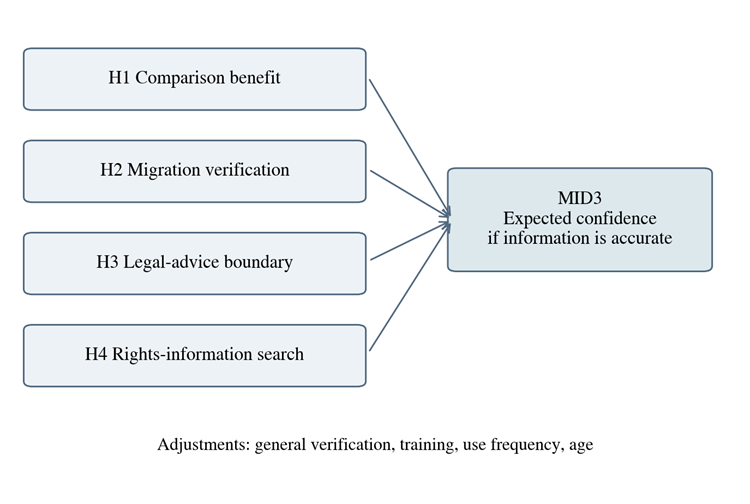
Figure 1. Exploratory response-level framework.
The framework’s contribution is its separation of outcomes and safeguards. Confidence expectation is an individual response; verification intention concerns a proposed action; the legal-advice boundary concerns service design; and search capability concerns perceived competence. Their relationships are empirical questions. The analysis therefore evaluates their distributions and associations while retaining their different meanings, rather than assuming that a single favourable attitude explains all four.
3. Methodology
The study uses a cross-sectional, questionnaire-based design and a reproducible reanalysis of the complete Group 11 numerical database. The methods distinguish what is recorded from what can be inferred: the database supports item-level distributions and conditional associations, while it does not establish representative sampling, observed verification or causal effects. The following subsections specify the analytical population, measurement choices, quality checks, uncertainty calculations and ethical safeguards.
3.1 Data source and analytical population
The workbook contains a Data sheet with 385 records and 35 fields, a Codebook sheet and a README sheet. The numerical responses are treated as collected survey records on the research team’s confirmation. The sequential respondent identifier is an organisational field, and the contextual-text field is excluded entirely. No inference is drawn from its contents. All analysed records contain affirmative consent, adult-eligibility and AI-awareness responses. The complete numerical sample is retained as N = 385.
The analytical population comprises the respondents represented in this workbook. Current status includes law students, law graduates, advocates or legal professionals and other relevant respondents. There is no field confirming prospective-migrant status, migrant-household membership or an intention to migrate. The study therefore describes adults responding to migration-information propositions in Bangladesh. It does not relabel them as verified prospective migrants or claim nationally representative estimates.
The available materials do not document a probability sampling frame, an invitation denominator or recruitment dates sufficient to calculate a response rate. None is reconstructed from the final sample size. The analysis does not assign survey weights or calculate a population margin of sampling error. Its intervals and tests are conditional on the recorded sample and an independence assumption; unknown selection and recruitment clustering remain limitations. This distinguishes model-based uncertainty from the wider uncertainty about who entered the database.[14]
3.2 Measures and content validity
The five migration-information items use a five-category scale from strongly disagree to strongly agree. MID3 is the outcome and is described throughout as a conditional expected confidence benefit. Its accuracy premise is retained in the interpretation. MID1, MID2 and MID4 are focal predictors, and MWR1 adds reported ability to locate migrant-worker-rights information. MID5 is analysed descriptively and in paired contrasts because its supplementary-use content is substantively important but distinct from the four focal propositions. Table 1 summarises these roles; Appendix A provides the exact wording.
Table 1. Item content and analytical roles
| Code | Abbreviated content | Analytical role |
| MID1 | Expected comparison benefit | Focal predictor H1 |
| MID2 | Intention to verify migration advice | Focal predictor H2 |
| MID3 | Expected confidence if information is accurate | Ordinal outcome |
| MID4 | General information versus legal advice | Focal predictor H3 |
| MID5 | Supplementary rather than sole use | Descriptive contrast |
| MWR1 | Ability to locate rights information | Focal predictor H4 |
| AIL2 | General checking of important AI information | Contextual adjustment |
Source: Group 11 Codebook. These are separate propositions, not a validated composite scale. Exact wording appears in Appendix A.
These roles are based on item content, not on which variables produce the smallest p-values. All five MID distributions are reported, including neutrality and disagreement. The distinction between the outcome and its predictors remains imperfect because all are self-reports collected together. Shared wording, acquiescence and a favourable orientation towards useful information could influence several answers. No item is interpreted as an externally validated measure of behaviour or competence.
3.3 Why composite scores were not used
Internal consistency was inspected for the four five-item blocks. Cronbach’s alpha was .234 for AIL, .345 for MID, .134 for MRP and .234 for MWR. These values do not support presenting the blocks as established reflective scales in this sample. Alpha is not, by itself, a test of unidimensionality or content validity, and a low value does not make a substantively distinct item meaningless. The appropriate response here is to retain content-specific statements and avoid a composite regression that implies a measurement model not established by the data.[15]
The analysis also avoids relabelling the blocks as validated formative indices merely to retain their averages. Formative index construction requires a defensible specification of how components define a construct and how the index will be validated. That work is not supplied by a thematic grouping of questions. Accordingly, the article reports item-level results and treats the theoretical framework as an interpretation of their relationships.[16]
3.4 Data audit and coding
The 20 agreement items contain no missing or out-of-range values. Respondent identifiers are unique, no two records have identical 20-item response vectors, and no record uses one response category across all 20 items. These checks assess basic consistency, not authenticity or freedom from response bias. The optional AI-tool field has 17 missing entries and is not used in the models. The article does not describe the entire workbook as free of missing data.
There are 12 records reporting no AI experience but some use frequency and nine reporting some experience but a never-use frequency. One additional respondent reports never in both fields. The full sample remains the primary analysis because these fields concern contextual experience rather than consent or the focal responses. A sensitivity analysis excludes anyone reporting never in either field, leaving 363 records. A separate law-student subset contains 138 records and is used only to assess the stability and precision of focal estimates.
Agreement predictors are entered as scores from one to five, centred at three. Training is coded one for either a short orientation or a course/certified training, and zero for none. Frequency is coded zero for never through four for daily or almost daily, centred at two. Age is coded one for 27-30 or 31+ and zero for younger recorded groups. These parsimonious coding decisions imply equal score increments for ordinal predictors and are not claims that psychological distances between categories are identical.
3.5 Distributions, paired contrasts and joint responses
Descriptive results include the five-category counts, means, sample standard deviations and endorsement rates. Endorsement means agree or strongly agree. Means are compact summaries of coded responses, while the full counts preserve the ordinal distribution. Pointwise 95% Wilson intervals accompany endorsement rates and should be read as conditional sampling summaries rather than population guarantees.[17]
Four paired comparisons contrast MID2 endorsement with MID1, MID3, MID4 and MID5 endorsement. The exact conditional version of McNemar’s test uses the two discordant cells for each pair. Holm correction is applied across these four tests. Differences in endorsement percentages receive percentile intervals from 10,000 whole-record bootstrap resamples, using seed 20261026. Resampling records preserves the pairing. These intervals are pointwise, while the adjusted p-values address the family of four comparisons.[18]
A two-by-two table additionally cross-classifies MID2 and MID3 endorsement. This makes the overlap visible and prevents a difference in marginal percentages from being interpreted as a group of respondents uniformly rejecting confidence benefits. Neutrality and disagreement are combined only for this clearly labelled binary summary. Non-endorsement is not treated as opposition.
3.6 Adjusted ordinal model
The primary model is a cumulative proportional-odds logistic regression of MID3. No respondent selects category one, so the observed outcome has four categories, two through five, with three estimated thresholds. The model estimates logit P(Y ≥ k) as a threshold-specific intercept plus the eight predictor terms. Positive coefficients indicate greater odds of a higher response. The four focal terms are MID1, MID2, MID4 and MWR1; the four adjustments are AIL2, training, frequency and age. All terms are retained together, without stepwise selection.[19]
Maximum likelihood estimates use an analytic score and a numerical observed-information matrix. HC1 sandwich covariance supplies pointwise intervals, with the finite-sample factor based on all eight slopes and three threshold parameters. A second optimiser checks the fitted solution. The four focal p-values receive Holm correction as a separate family from the paired comparisons. The model is exploratory and explanatory at the response level; no predictive deployment or individual classification claim is made.[20]
3.7 Diagnostics and sensitivity analysis
The proportional-odds restriction is examined through a Brant-style comparison of slopes from cumulative binary models at the three observed cutpoints. The calculation stacks respondent-level influence contributions to account for correlated estimates across cutpoints. It tests 16 slope-equality restrictions. A non-rejection is treated as compatible with the restriction, not proof of its truth. Binary models at endorsement and strong agreement are also reported as descriptive sensitivity checks, using HC1 intervals.[21]
The ordinal model is repeated in the consistent-use and law-student subsets. These analyses examine dependence on contextual coding and sample composition; they are not independent replications. No new confirmatory test family is created from them. Interpretation prioritises effect sizes, interval widths and consistency across specifications. A result that does not cross a conventional threshold is not described as evidence that an association is absent.[22]
3.8 Ethical safeguards and oversight
The study’s ethical account rests on participant protection and transparent reporting rather than an implication that administrative approval was obtained. As stated in the Declarations, no accessible formal review mechanism applicable to this adult, non-interventional questionnaire was available in the authors’ institutional setting. This contextual explanation does not constitute an official exemption, establish that review is universally unnecessary or transfer ethical responsibility away from the researchers. No approval number, retrospective authorisation or formal waiver is claimed.
Participants received information on the study’s purpose, voluntary participation, anonymity and the option to discontinue before questionnaire completion. The retained records all contain affirmative consent and adult-eligibility responses. Discontinuation refers to the opportunity before completion; the article does not promise that an anonymous response could later be individually identified and withdrawn. The analysis uses aggregate numerical responses, excludes the contextual-text field and does not publish respondent-level material. Sequential identifiers are not treated as personal identities.
The analytical safeguards also protect participants from misrepresentation. Responses are not used to label individuals as legally competent, vulnerable, irresponsible or ready to migrate. Small profile categories are reported only as broad aggregates, with no intersecting case narratives. Data access remains subject to confidentiality and applicable institutional requirements, as specified in the Declarations. These measures support the ethical conduct described by the research team while preserving an accurate account of the absence of formal approval.
4. Results
The results distinguish broad endorsement from associations between respondents’ answers. Verification is the most strongly supported migration-information proposition, but its prominence does not establish actual checking or a causal pathway to confidence. The section first describes the sample and response distributions, then reports paired contrasts, the confidence-verification cross-classification and adjusted estimates. All primary results use N = 385.
4.1 Sample composition
Table 2 reports all recorded demographic and experience categories. The sample is relatively young and contains a substantial group of respondents with legal education or professional status. Nevertheless, the largest current-status category is other relevant respondent. This composition supports analysis of the recorded responses while limiting interpretation as a migrant-specific or population-representative survey.
Table 2. Complete respondent profile
| Characteristic | Recorded categories and counts |
| Age | 21-23: 154; 24-26: 75; 18-20: 62; 27-30: 48; 31+: 46 |
| Gender | Male: 210; Female: 162; Other: 7; Prefer not to say: 6 |
| Current status | Other relevant respondent: 152; Law student: 138; Law graduate: 55; Advocate or legal professional: 40 |
| Education | Undergraduate: 223; Graduate: 81; Postgraduate: 45; Professional: 36 |
| Location | Dhaka: 156; District town: 92; Other city corporation: 69; Upazila-rural area: 59; Other: 9 |
| AI experience | 1-2 years: 140; 6-12 months: 91; Less than 6 months: 79; More than 2 years: 62; Never: 13 |
| AI frequency | Weekly: 163; Daily or almost daily: 111; Monthly: 69; Less than monthly: 32; Never: 10 |
| AI training | No: 222; Yes, short orientation: 110; Yes, course or certified training: 53 |
N = 385. Categories sum to 385 within each field. No field verifies prospective-migrant status. Counts are unweighted.
The 21-23 age group accounts for 154 records, or 40.0%, and 291 respondents are under 27. Law students account for 35.8%, law graduates for 14.3% and advocates or legal professionals for 10.4%. Dhaka contributes 40.5% of records. Formal AI training is reported by 163 respondents, or 42.3%, while weekly or daily use is reported by 274, or 71.2%. Education and current status remain separate variables: the 36 professional education responses are not the same count as the 40 legal professionals.
4.2 Distribution of migration-information expectations
Table 3 provides complete response counts rather than endorsement percentages alone. Verification receives 337 endorsements, or 87.5%, including 155 strong agreements. The conditional confidence statement receives 247 endorsements, or 64.2%, including 78 strong agreements. The distinction between those responses is central: the most accepted proposition concerns checking information, while confidence gains remain conditional on accuracy.
Table 3. Migration-information response distributions
| Item | Mean (SD) | Counts 1 / 2 / 3 / 4 / 5 | Endorsed n (%) | 95% CI % |
| MID1 | 3.85 (0.80) | 2 / 16 / 95 / 196 / 76 | 272 (70.6%) | 65.9-75.0 |
| MID2 | 4.27 (0.69) | 0 / 3 / 45 / 182 / 155 | 337 (87.5%) | 83.9-90.5 |
| MID3 | 3.79 (0.83) | 0 / 22 / 116 / 169 / 78 | 247 (64.2%) | 59.2-68.8 |
| MID4 | 3.84 (0.77) | 0 / 13 / 111 / 185 / 76 | 261 (67.8%) | 63.0-72.3 |
| MID5 | 3.84 (0.79) | 0 / 15 / 110 / 182 / 78 | 260 (67.5%) | 62.7-72.0 |
N = 385. Categories: one strongly disagree; two disagree; three neutral; four agree; five strongly agree. Endorsement = four or five. CI = pointwise Wilson confidence interval.
MID1 comparison benefits receives 70.6% endorsement, MID4 the legal-advice boundary 67.8% and MID5 supplementary use 67.5%. The outcome’s mean is 3.79 with a standard deviation of .83, compared with 4.27 and .69 for verification. These means summarise the coded scale; they are not interval measures of confidence intensity. The comparatively high mean for verification is supported by the full distribution, including only three disagreement responses and 45 neutral responses.
Neutrality is substantial for several other items: 95 respondents are neutral about comparison benefits, 116 about confidence benefits, 111 about the legal-advice boundary and 110 about supplementary use. Consequently, the complement of endorsement should not be described as widespread rejection. For MID3, 22 respondents disagree and none strongly disagree. Most non-endorsement therefore reflects neutrality. This pattern is compatible with uncertainty about hypothetical services, but the survey does not ask why a neutral response was selected.
The two additional model items also show favourable responses. Rights-information search capability receives 256 endorsements, or 66.5%, with mean 3.83 and standard deviation .78. General verification receives 329 endorsements, or 85.5%, with mean 4.24 and standard deviation .71. Their similar or different marginal rates do not establish whether the same respondents hold these views; the adjusted model addresses association while retaining the distinction between reported capability and stated checking.
4.3 Paired verification contrasts
Table 4 compares verification endorsement with each of the other migration-information propositions within the same records. The difference ranges from 16.9 percentage points for comparison benefits to 23.4 points for conditional confidence. Each interval lies above zero, and every exact paired test remains below .001 after correction across the four comparisons.
Table 4. Paired differences in verification endorsement
| Contrast | Verification only / other only | Difference pp | 95% CI pp | Holm p |
| MID2 – MID1 | 87 / 22 | 16.9 | 11.9-21.8 | < .001 |
| MID2 – MID3 | 115 / 25 | 23.4 | 17.9-28.8 | < .001 |
| MID2 – MID4 | 103 / 27 | 19.7 | 14.3-25.2 | < .001 |
| MID2 – MID5 | 105 / 28 | 20.0 | 14.5-25.5 | < .001 |
N = 385. pp = percentage points. Whole-record bootstrap intervals use 10,000 resamples and are pointwise. Exact McNemar tests use discordant pairs; Holm correction covers four tests.
For the confidence contrast, 115 respondents endorse verification without endorsing MID3, whereas 25 endorse MID3 without endorsing verification. The difference in these discordant counts explains the 90-record marginal gap. This paired evidence is stronger than a visual comparison of separate percentages because it recognises that each person answers both questions. It still describes differential endorsement rather than an effect of verification on confidence.
The comparison-benefit contrast has 87 verification-only and 22 comparison-only responses. Corresponding counts are 103 and 27 for the legal-advice boundary, and 105 and 28 for supplementary use. The persistence of these differences across four distinct propositions suggests that the verification statement has a particularly broad appeal in this questionnaire. It does not establish that one item is intrinsically more important or that wording has no influence on endorsement.
4.4 Joint confidence and verification responses
The joint distribution in Table 5 shows how the two focal responses coexist. Both propositions are endorsed by 222 respondents, or 57.7% of the sample. Thus, verification and anticipated confidence benefits frequently appear together. The larger verification-only group identifies a separate response configuration that is obscured by treating all positive AI attitudes as equivalent.
Table 5. Verification and conditional confidence cross-classification
| MID2 verification | MID3 endorsed | MID3 not endorsed | Total |
| Endorsed | 222 | 115 | 337 |
| Not endorsed | 25 | 23 | 48 |
| Total | 247 | 138 | 385 |
N = 385. Endorsement = agree or strongly agree. Not endorsed includes neutrality and disagreement. Cells are counts, not measured checking or confidence calibration.
Among the 247 respondents endorsing the confidence proposition, 222 also endorse verification: 89.9%. Among the 337 verification endorsers, 222 endorse the confidence proposition: 65.9%. These conditional percentages answer different questions and use different denominators. The 25 confidence-only responses constitute 6.5% of the full sample, but they cannot be labelled overconfidence because neither accuracy judgement nor actual confidence calibration is observed. The 23 respondents endorsing neither proposition are likewise not classified as resistant or uninformed.
4.5 Adjusted associations with expected confidence
Table 6 reports the primary ordinal model, including all contextual adjustments. The estimated odds ratios for comparison benefits, migration-specific verification and the legal-advice boundary are above one, while the rights-information search estimate is below one. All four pointwise intervals span one, and the Holm-adjusted p-value is .394 for each focal term. These results do not provide clear adjusted support for H1-H4 in the present sample.
Table 6. Adjusted ordinal model of conditional expected confidence
| Predictor | OR (95% CI) | Raw p | Holm p |
| MID1 comparison benefit | 1.18 (0.96-1.45) | 0.118 | 0.394 |
| MID2 migration verification | 1.25 (0.94-1.65) | 0.118 | 0.394 |
| MID4 legal-advice boundary | 1.23 (0.96-1.57) | 0.099 | 0.394 |
| MWR1 rights-information search | 0.81 (0.62-1.06) | 0.117 | 0.394 |
| AIL2 general verification | 1.20 (0.91-1.57) | 0.196 | — |
| Any AI training | 0.85 (0.58-1.25) | 0.405 | — |
| AI frequency category | 1.13 (0.93-1.38) | 0.220 | — |
| Age 27+ | 1.08 (0.70-1.66) | 0.742 | — |
N = 385; outcome MID3 observed categories two to five. OR = odds ratio for a higher response. Agreement terms are per score point; training compares any with none, age 27+ with younger groups, frequency per category. HC1 intervals are pointwise. Holm correction covers the four focal terms; adjustments are descriptive.
Comparison benefits has an odds ratio of 1.18 with a 95% interval of .96-1.45. Migration-specific verification is 1.25 (.94-1.65), and the legal-advice boundary is 1.23 (.96-1.57). Rights-information search is .81 (.62-1.06). These intervals accommodate more than one substantive interpretation. In particular, the rights-search estimate should not be presented as evidence that access to rights information undermines confidence. Its direction is uncertain and the analysis does not establish an intervening mechanism.
Figure 2. Primary adjusted ordinal estimates for the four focal propositions. N = 385; pointwise 95% HC1 intervals.
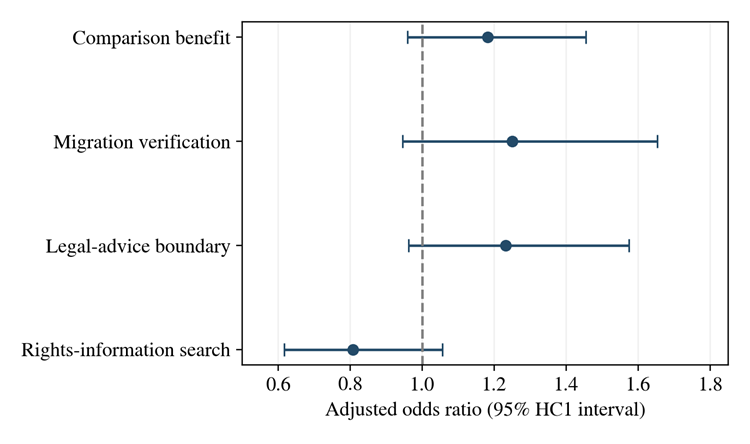
Figure 2. Primary adjusted ordinal estimates for the four focal propositions
The model log likelihood is -457.552, compared with -465.803 for the intercept-only model, giving McFadden’s pseudo-R² of .0177. This statistic is not a percentage of variance explained in the ordinary least-squares sense. It indicates a limited improvement in relative likelihood for these predictors. The model’s modest fit and imprecise coefficients support a restrained account of response alignment rather than a strong explanatory theory of migration decisions.
The proportional-odds diagnostic yields a Wald statistic of 19.072 on 16 degrees of freedom, p = .265. The data therefore do not give clear evidence against the common-slope restriction in this diagnostic. The independent optimiser agrees with the primary coefficients to less than .000001, and the maximum absolute score component is below .000001. These checks support numerical stability; they do not resolve measurement limitations, selection bias or the possibility of omitted contextual variables.
4.6 Sensitivity and interpretation of uncertainty
Table 7 reports focal estimates from the endorsement and strong-agreement binary models and the two ordinal subset analyses. The purpose is to expose sensitivity, not select the most favourable specification. The ordinal estimates in the consistent-use subset remain close to those in the full sample. The student estimates are less precise and all four intervals span one.
Table 7. Sensitivity of focal associations
| Predictor | Endorsed OR (CI) | Strong OR (CI) | Consistent use OR (CI) | Students OR (CI) |
| Comparison | 1.17 (0.90-1.53) | 1.23 (0.90-1.67) | 1.21 (0.98-1.50) | 1.35 (0.93-1.94) |
| Verification | 1.24 (0.91-1.70) | 1.22 (0.83-1.80) | 1.25 (0.94-1.66) | 1.10 (0.69-1.74) |
| Legal boundary | 1.07 (0.81-1.42) | 1.53 (1.09-2.16) | 1.18 (0.91-1.53) | 1.27 (0.76-2.12) |
| Rights search | 0.77 (0.58-1.01) | 0.79 (0.55-1.14) | 0.81 (0.61-1.06) | 0.94 (0.58-1.55) |
Binary models: N = 385; endorsement events 247, strong-agreement events 78. Subsets use ordinal models: n = 363 and 138. All models retain eight predictors. Intervals are pointwise 95% HC1; these checks are descriptive and do not constitute independent confirmation.
The legal-advice boundary has a strong-agreement odds ratio of 1.53, with a pointwise interval of 1.09-2.16, whereas its endorsement estimate is 1.07 (.81-1.42). The strong-agreement result is a descriptive sensitivity finding, not a separately established hypothesis. Its unadjusted p-value is .015; applying Holm correction across the eight focal binary coefficients would give .120 for that coefficient. The primary ordinal test family remains non-significant. The difference warrants targeted future investigation rather than a conclusion that legal boundaries have a proven confidence effect.
Removing never-use records yields focal ordinal odds ratios of 1.21, 1.25, 1.18 and .81, in the order used in Table 6. All intervals include one. The student-only estimates are 1.35, 1.10, 1.27 and .94 and are wider still. These checks show that the main pattern is not driven solely by the 22 records excluded from the consistent-use analysis. They do not demonstrate equivalence between students and other respondents, because no adequately powered interaction analysis is undertaken.
5. Discussion
The central finding is a separation between the breadth of a verification norm and the strength of evidence about confidence. Respondents endorse checking migration advice more frequently than expected confidence benefits, legal-advice boundaries or supplementary use. Yet the adjusted associations with conditional confidence are uncertain. This combination supports a discussion of how expectations are organised, while withholding claims that verification increases confidence or that AI improves migration decisions.
5.1 A strong verification norm with a bounded meaning
The 87.5% verification endorsement suggests that independent checking is widely accepted at the level of stated intention. The paired contrasts show that its prominence is not merely an artefact of comparing different respondent groups. Nevertheless, verification may be easier to endorse in principle than to perform under practical constraints. Source availability, language, time and the ability to identify the relevant institution could all affect implementation, but none is measured here. These possibilities are hypotheses for future research, not explanations established by the current results.
Appropriate-reliance scholarship provides a useful interpretation: asking for verification need not imply refusal to use a tool. It may describe the conditions under which assistance becomes acceptable. The 222 respondents endorsing both verification and confidence are consistent with that possibility. The study does not identify actual calibrated reliance, because no task compares confidence with correctness. It instead identifies a response pattern that would be missed if all checking were interpreted as distrust.[23]
The distinction also qualifies claims about AI literacy. High self-reported verification does not show that a respondent can identify a fabricated authority, distinguish an official page from an imitation or recognise an outdated rule. Long and Magerko’s competency approach motivates performance-based assessment in future work. Here, AIL2 is useful as a contextual self-report, while its high endorsement cannot certify a literate sample. This is especially important when interpreting a confidence proposition whose wording already assumes accurate information.[24]
5.2 Conditional confidence and information adoption
The confidence item describes a potential benefit under an accuracy condition. Its 64.2% endorsement is therefore evidence about an expectation, not a measured improvement. Some respondents may regard the premise as plausible; others may remain neutral because they doubt its practical availability. The questionnaire does not distinguish these interpretations. The article’s contribution is to retain that ambiguity explicitly rather than convert the statement into an outcome such as successful migration planning.
Information-adoption theory suggests why expected comparison benefits might align with confidence: organising alternatives can make advice appear useful. However, the adjusted comparison estimate is imprecise. The results do not validate a mediation process or show that usefulness causes confidence. They leave open whether specific features of information quality, source credibility or task complexity would provide a better explanation in a study designed to measure them.[25]
This interpretation also limits the use of broad technology-acceptance models. A favourable statement about AI’s potential is different from accepting a particular service, and acceptance is different from safe use. The current study contains no named platform, usability assessment or behavioural adoption record. Its findings therefore extend the discussion of expected usefulness at the proposition level, while leaving actual adoption as an empirical question.[26]
5.3 Legal boundaries and supplementary reliance
The difference between verification endorsement and support for legal-advice boundaries is practically important because these safeguards address different problems. Verification concerns checking an answer; professional boundaries concern recognising whether a general answer is sufficient for the user’s situation. A service can provide links while still making an over-specific recommendation. Conversely, a disclaimer can announce a limitation without giving the user an effective next step. The survey indicates uneven endorsement of these propositions, not the effectiveness of any particular safeguard.
Legal hallucination research supports the need to test source accuracy and task suitability directly. It does not justify assuming that every AI explanation is wrong, nor does the absence of an observed error in this survey establish reliability. The relevant implication is procedural: high-stakes information needs a way to establish where an assertion came from and when a human assessment is required. These features should be evaluated through observed tasks and expert review, rather than inferred from approval of a questionnaire statement.[27]
The exploratory strong-agreement association for MID4 offers a possible direction for that work. It might reflect a subgroup that welcomes clear boundaries alongside conditional benefits. It might also reflect response style or chance among several sensitivity estimates. The primary model does not establish the association, and multiplicity weakens a confirmatory interpretation of the isolated binary finding. Reporting this result alongside its limits is preferable to converting it into a claim that disclaimers increase confidence.[28]
5.4 Search capability, rights and accountability
Reported ability to locate migrant-worker-rights information is not positively associated with the confidence outcome in the fitted model. The point estimate is below one, but its interval includes both modestly lower and slightly higher odds. There is no basis for concluding that rights knowledge reduces confidence, particularly because the item measures neither knowledge nor successful rights enforcement. A plausible future question is whether searching exposes complexity that changes confidence, but that mechanism requires direct measurement.
Accountability provides a stronger practical lens than interpreting every uncertain coefficient as a failed intervention. A person may locate information yet still need someone to explain applicability, correct an error or accept responsibility for the next step. Bovens’ relational account and algorithmic-accountability scholarship direct attention to these institutional arrangements. The survey does not observe them; its results help identify why a future migration-information service should be assessed beyond user satisfaction alone.[29]
The legal information-advice distinction is therefore part of a broader chain. A source must be traceable, the scope must be understandable, and a disputed or consequential issue must have a route to an appropriate person or institution. Visibility alone is insufficient if it does not enable meaningful checking. This proposition follows from the governance literature and the measurement limits of the present study, rather than from a statistically identified effect of any interface feature.[30]
5.5 Strengths, limitations and contribution
The analysis strengthens inference by using all 385 numerical records, retaining full distributions and making paired comparisons within respondents. Item-level modelling avoids presenting low-consistency blocks as validated scales. The disclosure of uncertain estimates, sensitivity results and the outcome’s conditional wording also reduces the risk that an attractive narrative outruns the evidence. These are reporting strengths; they do not compensate for an undocumented sampling frame or create behavioural measures that were not collected.
Several limitations constrain generalisation. The sample is relatively young, includes a substantial legal-education component and is not identified as a prospective-migrant cohort. Selection processes and recruitment clustering are not sufficiently documented for design-based population inference. All focal variables are simultaneous self-reports, so common response tendencies and reverse interpretation remain possible. The five-category predictor coding imposes a parsimonious trend, and the diagnostic’s non-rejection does not establish that every ordinal assumption is correct.[31]
The findings are also instrument-specific. Broadly attractive wording may produce favourable responses without distinguishing realistic service choices. There are no observed errors, response times, source-opening records or measures of actual referral. The study cannot assess whether participants would verify a persuasive false answer, whether a disclaimer changes action or whether an AI tool improves a legal outcome. Future research should connect expectations to these observable tasks before using confidence as evidence of service success.
The resulting contribution is deliberately focused. It identifies a reproducible difference between verification and other expectations, demonstrates the limited adjusted evidence for confidence associations and articulates how those two findings can coexist. Absence of clear adjusted support is not evidence that the underlying relationships are zero. Instead, the estimates define the uncertainty that a stronger design must address through improved measures and a more clearly specified population.[32]
6. Theoretical and Practical Implications
The implications follow from separating expected benefits from the conditions for responsible reliance. They are proposed applications of the analysis, not effects demonstrated by an intervention. The theoretical contribution concerns how confidence, checking and institutional safeguards should be conceptualised together. The practical contribution concerns what information services and future evaluations should make observable before claiming safer or better migration decisions.
6.1 Theoretical implications
First, the study suggests that verification deserves an independent place in models of AI information use. A model focused solely on acceptance can overlook the possibility that users welcome assistance precisely because they expect to check it. The coexistence of verification and conditional confidence supports treating the two as distinct responses. Appropriate-reliance theory provides the rationale, while the current data offer a descriptive configuration rather than a test of a full trust mechanism.[33]
Second, anticipated confidence should be distinguished from calibrated confidence. The former concerns what respondents expect from accurate information; the latter requires evidence linking subjective certainty to correct judgement. A future model should specify which outcome it predicts and avoid treating a favourable expectation as a validated proxy for competence. This clarification matters especially for legal information, where a confident but unsupported answer can be less useful than an appropriately qualified explanation.[34]
Third, legal boundaries and referral introduce an institutional component into individual-level accounts of usefulness. A service may be valuable because it helps users recognise the need for assistance, even if it does not resolve their question. The theoretical challenge is to model that contribution without forcing it into a single scale of trust or approval. Accountability scholarship supplies a way to connect an answer to explanation, correction and responsibility; the present survey identifies propositions that a future instrument could measure more directly.[35]
6.2 Practical implications for service design
A migration-information service should make verification actionable. For consequential factual claims, the interface should identify the originating authority, relevant jurisdiction and date, and offer a usable route to the underlying source. This is a proposed design standard, not an observed characteristic of services in the dataset. Its evaluation should ask whether users can actually find and interpret the source, rather than merely whether a citation appears on screen. Transparency should serve understanding and correction.[36]
The service should also state its scope at the point where a user may mistake a general explanation for an individual determination. A useful boundary statement would connect the limitation to a next step: what information remains uncertain and which type of competent assistance is needed. Referral should be feasible in the user’s circumstances. Human oversight cannot be assumed effective simply because a human option is mentioned; its availability and capacity must be tested.[37]
Rights-information support should be assessed through realistic tasks. Examples include locating the responsible authority, identifying an inconsistent source or recognising that a question depends on an individual contract. Such tasks can be designed without asking participants to disclose sensitive migration histories. Evaluation should compare answer correctness, source checking and recognition of uncertainty, while recording confidence separately. This would show whether a service improves understanding rather than merely producing a reassuring interaction.
6.3 Policy and research implications
For migration governance, the survey supports attention to the informational conditions surrounding recruitment and rights, while offering no estimate of institutional compliance. The ILO’s non-binding fair-recruitment guidance and the SDG framework provide normative reference points. Local implementation still requires assessment of applicable law, responsible institutions and users’ access needs. The present evidence should therefore inform questions for service design and evaluation, rather than be used as proof that an AI system advances a development target.[38]
Future research should recruit a clearly defined migration-relevant population and document the invitation process and fieldwork dates. A task-based experiment could compare an unsupported answer with a source-linked answer and a source-linked answer offering referral, while measuring verification and correctness independently. Longitudinal follow-up could assess whether stated checking predicts actual behaviour. These designs would test mechanisms that the current cross-sectional questionnaire can only motivate, and they would allow the distinction between confidence, competence and rights-related outcomes to be evaluated directly.
7. Conclusion
This study examines how adults in the Group 11 survey respond to AI migration-information propositions, with a particular focus on the expected confidence benefit of accurate information. Its principal finding is that verification receives broader endorsement than confidence benefits, comparison benefits, legal-advice boundaries or supplementary use. The paired difference between verification and conditional confidence is 23.4 percentage points. This difference remains clear when the same respondents’ answers are compared and multiplicity is addressed.
The joint distribution adds an important qualification. Verification and conditional confidence are often endorsed together, so the result should not be described as a simple division between supporters and opponents of AI. Among confidence endorsers, 89.9% also endorse verification. The larger verification-only group indicates that a norm of checking can exist without a similarly broad expectation of confidence gains. The questionnaire does not reveal whether these patterns reflect experience, uncertainty, wording or other influences.
Adjusted modelling provides limited evidence for explaining the confidence response through the selected propositions. All four primary focal intervals span an odds ratio of one, and no proposition receives clear adjusted support after Holm correction. The proportional-odds diagnostic is compatible with the fitted common-slope model, and numerical checks support stable estimation. These technical findings do not turn an exploratory cross-sectional analysis into a causal evaluation. They instead make the uncertainty in the substantive relationships more explicit.
The article’s theoretical contribution is to place expected benefits, verification and legal boundaries in the same account without collapsing their meanings. Accurate information may be expected to improve confidence, but confidence is not a substitute for correctness or effective rights protection. Verification may support reliance, but an intention to check is not evidence of successful checking. A legal-advice boundary may be desirable, but its practical value depends on whether a user understands the limitation and can obtain appropriate assistance.
These distinctions suggest a clear evaluation agenda. Migration-information services should be examined through source accuracy, usable verification, recognition of scope and feasible referral. Future studies should observe these features in realistic tasks with a clearly specified migration-relevant sample, keeping confidence and decision correctness as separate outcomes. Recruitment documentation and stronger behavioural measures would enable more credible generalisation and tests of mechanisms than the present workbook permits.
The current findings support a focused conclusion: the recorded respondents express a particularly strong verification norm, while the relationship between that norm and anticipated confidence remains uncertain. Responsible use of the evidence requires preserving both parts of this result. It offers a basis for designing and testing accountable information support, while leaving claims about safer migration, better decisions and improved access to justice to studies that directly measure those outcomes.
Declarations
Ethical approval and oversight
Formal ethical approval was not obtained because, at the time of the study, the authors’ institutional setting did not provide an accessible formal review mechanism applicable to this non-interventional adult questionnaire research. The study nevertheless followed participant-protection safeguards, including informed consent, voluntary participation, the opportunity to discontinue, an anonymous questionnaire and aggregate reporting. The methodological safeguards are detailed in Section 3.8. The absence of an accessible review mechanism describes the institutional context; responsibility for ethical conduct remained with the researchers.
Informed consent
Informed consent was obtained from adult participants before questionnaire completion. The questionnaire explained the study purpose, voluntary participation, anonymity and the option to discontinue. All analysed records contain affirmative consent and adult-eligibility responses.
Data availability
The numerical data supporting the reported analyses are held by the research team. Requests for de-identified data and analytical specifications may be directed to the corresponding author. Any sharing is subject to participant confidentiality and applicable institutional requirements. The contextual-text field was excluded from the analysis.
Author contributions
Kaifa Yeshmin: Lead student researcher; conceptualisation; preparation of study materials; organisation and curation of survey data; manuscript development. The project was conducted under the supervision of Prof. Dr Kazi Abdul Mannan.
Kazi Abdul Mannan: Conceptual and methodological guidance; supervision; interpretation of statistical findings; critical review and editing of the manuscript.
Generative AI disclosure
Generative AI assisted manuscript drafting, language editing, organisation and the development of analytical code. Statistical estimates were computed programmatically from the numerical survey data. Responsibility for the study’s analysis, interpretation and reporting.
Bibliography
Altman DG and Bland JM, ‘Absence of Evidence Is Not Evidence of Absence’ (1995) 311 BMJ 485
Ananny M and Crawford K, ‘Seeing without Knowing: Limitations of the Transparency Ideal and Its Application to Algorithmic Accountability’ (2018) 20 New Media & Society 973
Bovens M, ‘Analysing and Assessing Accountability: A Conceptual Framework’ (2007) 13 European Law Journal 447
Brant R, ‘Assessing Proportionality in the Proportional Odds Model for Ordinal Logistic Regression’ (1990) 46 Biometrics 1171
Cameron AC and Miller DL, ‘A Practitioner’s Guide to Cluster-Robust Inference’ (2015) 50 Journal of Human Resources 317
Cobbe J, Lee MSA and Singh J, ‘Reviewable Automated Decision-Making: A Framework for Accountable Algorithmic Systems’ in Proceedings of the 2021 ACM Conference on Fairness, Accountability, and Transparency (ACM 2021) 598
Cochran WG, Sampling Techniques (3rd edn, John Wiley & Sons 1977)
Cronbach LJ, ‘Coefficient Alpha and the Internal Structure of Tests’ (1951) 16 Psychometrika 297
Dahl M and others, ‘Large Legal Fictions: Profiling Legal Hallucinations in Large Language Models’ (2024) 16 Journal of Legal Analysis 64
Davis FD, ‘Perceived Usefulness, Perceived Ease of Use, and User Acceptance of Information Technology’ (1989) 13 MIS Quarterly 319
Diamantopoulos A and Winklhofer HM, ‘Index Construction with Formative Indicators: An Alternative to Scale Development’ (2001) 38 Journal of Marketing Research 269
Efron B and Tibshirani RJ, An Introduction to the Bootstrap (Chapman & Hall 1993)
Glikson E and Woolley AW, ‘Human Trust in Artificial Intelligence: Review of Empirical Research’ (2020) 14 Academy of Management Annals 627
Green B, ‘The Flaws of Policies Requiring Human Oversight of Government Algorithms’ (2022) 45 Computer Law & Security Review 105681
Hoff KA and Bashir M, ‘Trust in Automation: Integrating Empirical Evidence on Factors That Influence Trust’ (2015) 57 Human Factors 407
Holm S, ‘A Simple Sequentially Rejective Multiple Test Procedure’ (1979) 6 Scandinavian Journal of Statistics 65
International Labour Organization, General Principles and Operational Guidelines for Fair Recruitment and Definition of Recruitment Fees and Related Costs (ILO 2019)
Kroll JA and others, ‘Accountable Algorithms’ (2017) 165 University of Pennsylvania Law Review 633
Lee JD and See KA, ‘Trust in Automation: Designing for Appropriate Reliance’ (2004) 46 Human Factors 50
Long D and Magerko B, ‘What Is AI Literacy? Competencies and Design Considerations’ in Proceedings of the 2020 CHI Conference on Human Factors in Computing Systems (ACM 2020)
McCullagh P, ‘Regression Models for Ordinal Data’ (1980) 42 Journal of the Royal Statistical Society Series B 109
McNemar Q, ‘Note on the Sampling Error of the Difference between Correlated Proportions or Percentages’ (1947) 12 Psychometrika 153
Sijtsma K, ‘On the Use, the Misuse, and the Very Limited Usefulness of Cronbach’s Alpha’ (2009) 74 Psychometrika 107
Stefanski LA and Boos DD, ‘The Calculus of M-Estimation’ (2002) 56 American Statistician 29
Sussman SW and Siegal WS, ‘Informational Influence in Organizations: An Integrated Approach to Knowledge Adoption’ (2003) 14 Information Systems Research 47
United Nations General Assembly, Transforming Our World: The 2030 Agenda for Sustainable Development (25 September 2015) UN Doc A/RES/70/1, targets 8.8, 10.7 and 16.3
Wasserstein RL and Lazar NA, ‘The ASA Statement on p-Values: Context, Process, and Purpose’ (2016) 70 American Statistician 129
Wilson EB, ‘Probable Inference, the Law of Succession, and Statistical Inference’ (1927) 22 Journal of the American Statistical Association 209
rests with the authors.
Appendix A. Exact analytical statements
The following statements reproduce the Codebook wording. They support interpretation of the outcome and predictors and make clear the distinction between anticipated benefit, stated intention, design expectation and reported capability.
Table A1. Exact analytical item wording
| Code | Statement |
| MID1 | AI-based migration information could help prospective migrants compare legal migration options. |
| MID2 | I would verify AI migration advice against official or authoritative sources. |
| MID3 | Accurate AI information could improve confidence in migration-related decisions. |
| MID4 | AI services should clearly distinguish general information from professional legal advice. |
| MID5 | I would use AI migration information as a supplementary rather than sole decision source. |
| MWR1 | I can use AI tools to locate information about migrant-worker rights. |
| AIL2 | I verify important AI-generated information before relying on it. |
Source: Group 11 Codebook. One strongly disagree; two disagree; three neutral; four agree; five strongly agree.
The five response categories are coded one to five in the order shown in the table note. No reverse coding is used. MID5 is included in distributions and paired comparisons but not in the adjusted ordinal model.
[1] United Nations General Assembly, Transforming Our World: The 2030 Agenda for Sustainable Development (25 September 2015) UN Doc A/RES/70/1, targets 8.8, 10.7 and 16.3.
[2] Matthew Dahl and others, ‘Large Legal Fictions: Profiling Legal Hallucinations in Large Language Models’ (2024) 16 Journal of Legal Analysis 64.
[3] Fred D Davis, ‘Perceived Usefulness, Perceived Ease of Use, and User Acceptance of Information Technology’ (1989) 13 MIS Quarterly 319; John D Lee and Katrina A See, ‘Trust in Automation: Designing for Appropriate Reliance’ (2004) 46 Human Factors 50.
[4] Davis (n 3).
[5] Stephanie Watts Sussman and Wendy Schneier Siegal, ‘Informational Influence in Organizations: An Integrated Approach to Knowledge Adoption’ (2003) 14 Information Systems Research 47.
[6] Lee and See (n 3).
[7] Kevin Anthony Hoff and Masooda Bashir, ‘Trust in Automation: Integrating Empirical Evidence on Factors That Influence Trust’ (2015) 57 Human Factors 407; Ella Glikson and Anita Williams Woolley, ‘Human Trust in Artificial Intelligence: Review of Empirical Research’ (2020) 14 Academy of Management Annals 627.
[8] Duri Long and Brian Magerko, ‘What Is AI Literacy? Competencies and Design Considerations’ in Proceedings of the 2020 CHI Conference on Human Factors in Computing Systems (ACM 2020).
[9] Dahl and others (n 2).
[10] Mark Bovens, ‘Analysing and Assessing Accountability: A Conceptual Framework’ (2007) 13 European Law Journal 447; Joshua A Kroll and others, ‘Accountable Algorithms’ (2017) 165 University of Pennsylvania Law Review 633.
[11] Mike Ananny and Kate Crawford, ‘Seeing without Knowing: Limitations of the Transparency Ideal and Its Application to Algorithmic Accountability’ (2018) 20 New Media & Society 973.
[12] International Labour Organization, General Principles and Operational Guidelines for Fair Recruitment and Definition of Recruitment Fees and Related Costs (ILO 2019).
[13] UNGA, 2030 Agenda (n 1).
[14] William G Cochran, Sampling Techniques (3rd edn, John Wiley & Sons 1977); A Colin Cameron and Douglas L Miller, ‘A Practitioner’s Guide to Cluster-Robust Inference’ (2015) 50 Journal of Human Resources 317.
[15] Lee J Cronbach, ‘Coefficient Alpha and the Internal Structure of Tests’ (1951) 16 Psychometrika 297; Klaas Sijtsma, ‘On the Use, the Misuse, and the Very Limited Usefulness of Cronbach’s Alpha’ (2009) 74 Psychometrika 107.
[16] Adamantios Diamantopoulos and Heidi M Winklhofer, ‘Index Construction with Formative Indicators: An Alternative to Scale Development’ (2001) 38 Journal of Marketing Research 269.
[17] Edwin B Wilson, ‘Probable Inference, the Law of Succession, and Statistical Inference’ (1927) 22 Journal of the American Statistical Association 209.
[18] Quinn McNemar, ‘Note on the Sampling Error of the Difference between Correlated Proportions or Percentages’ (1947) 12 Psychometrika 153; Sture Holm, ‘A Simple Sequentially Rejective Multiple Test Procedure’ (1979) 6 Scandinavian Journal of Statistics 65; Bradley Efron and Robert J Tibshirani, An Introduction to the Bootstrap (Chapman & Hall 1993).
[19] Peter McCullagh, ‘Regression Models for Ordinal Data’ (1980) 42 Journal of the Royal Statistical Society Series B 109.
[20] Leonard A Stefanski and Dennis D Boos, ‘The Calculus of M-Estimation’ (2002) 56 American Statistician 29; Holm (n 18).
[21] Rollin Brant, ‘Assessing Proportionality in the Proportional Odds Model for Ordinal Logistic Regression’ (1990) 46 Biometrics 1171.
[22] Ronald L Wasserstein and Nicole A Lazar, ‘The ASA Statement on p-Values: Context, Process, and Purpose’ (2016) 70 American Statistician 129; Douglas G Altman and J Martin Bland, ‘Absence of Evidence Is Not Evidence of Absence’ (1995) 311 BMJ 485.
[23] Lee and See (n 3).
[24] Long and Magerko (n 8).
[25] Sussman and Siegal (n 5).
[26] Davis (n 3).
[27] Dahl and others (n 2).
[28] Holm (n 18); Wasserstein and Lazar (n 22).
[29] Bovens (n 10); Kroll and others (n 10).
[30] Ananny and Crawford (n 11); Jennifer Cobbe, Michelle Seng Ah Lee and Jatinder Singh, ‘Reviewable Automated Decision-Making: A Framework for Accountable Algorithmic Systems’ in Proceedings of the 2021 ACM Conference on Fairness, Accountability, and Transparency (ACM 2021) 598.
[31] Cochran (n 14); Brant (n 21).
[32] Altman and Bland (n 22).
[33] Lee and See (n 3).
[34] Dahl and others (n 2).
[35] Bovens (n 10); Cobbe, Lee and Singh (n 30).
[36] Ananny and Crawford (n 11).
[37] Ben Green, ‘The Flaws of Policies Requiring Human Oversight of Government Algorithms’ (2022) 45 Computer Law & Security Review 105681.
[38] ILO, Fair Recruitment (n 12); UNGA, 2030 Agenda (n 1).