Journal Home
OPEN ACCESS
Conditional Willingness and Regulatory Assurance Expectations for AI Enabled Financial Services in Bangladesh
| Md Wahidul Bari ORCID: https://orcid.org/0009-0006-7652-841X Mst. Asura Jaman Osru ORCID: https://orcid.org/0009-0005-7220-3469 Poushia Hossen Megha ORCID: https://orcid.org/0009-0000-2535-7194 Department of Law Shanto-Mariam University of Creative Technology Dhaka, Bangladesh |
| Prof. Dr Kazi Abdul Mannan Department of Business Administration Faculty of Business Shanto-Mariam University of Creative Technology Dhaka, Bangladesh Email: drkaziabdulmannan@gmail.com ORCID: https://orcid.org/0000-0002-7123-132X Corresponding author: Md Wahidul Bari: mdwahidulbarisourav@gmail.com |
Asian microecon. rev. 2026, 6(4); https://doi.org/10.64907/xkmf.v6i4.amr.2
Submission received:20 September 2026 / Revised: 25 October 2026 / Accepted: 28 October 2026 / Published: 30 October 2026
Download PDF (1 MB)
Abstract
Artificial intelligence in financial services raises questions about whether willingness to engage reflects confidence in technology, expectations of consumer protection or confidence attributed to institutional safeguards. These positions are frequently discussed together despite their different meanings. This study examines their distribution and association in a Bangladesh sample with substantial legal education and professional representation. A cross-sectional questionnaire database containing 385 consenting, AI-aware adults was analysed at item level. Five protection-related statements were assessed using endorsement distributions, paired contrasts, joint response patterns and exploratory adjusted regression. Low internal consistency discouraged combining the statements into a reflective trust scale. Clear-protection conditional willingness was endorsed by 87.8%, compared with 67.5% for oversight-related trust, 83.6% for disclosure, 83.6% for redress and 84.2% for accountability-related confidence. The oversight statement was endorsed 20.3 percentage points less often than conditional willingness (bootstrap 95% interval −26.0 to −14.8; Holm-adjusted p < 0.001). Only 53.0% endorsed conditional willingness, oversight-related trust and accountability-related confidence together. None of the four focal adjusted associations with willingness met the Holm-corrected threshold; ordinal and law-student-restricted analyses likewise retained none. The findings distinguish broad approval of protective conditions from a supported individual-level model of willingness. Institution-based trust and procedural justice provide interpretive lenses, while the measures do not establish current provider trust, actual financial-service use or regulatory effectiveness. Practical implications concern testing understandable disclosures and accessible review arrangements against operational evidence rather than treating favourable survey responses as evidence of implementation.
Keywords: institutional assurance; conditional willingness; financial consumer protection; algorithmic accountability; redress; Bangladesh
1 Introduction
AI can support financial screening, customer interaction and monitoring, yet the conditions under which people should rely on those applications require separate examination. The Financial Stability Board identifies operational opportunities alongside vulnerabilities involving model governance, data quality, cyber risk and concentrated dependencies. These concerns make consumer protection relevant to the design of a service rather than an issue addressed only after adoption. This study examines expectations surrounding protection without assuming that respondents have used a particular application or experienced a specific failure.[1]
Trust needs a clearly identified object. Confidence in a bank, confidence in a model, belief that a regulator will intervene and willingness to try a protected service are related judgements with different implications. Recent FinTech scholarship calls for greater precision about the focus and measurement of trust across heterogeneous services. Joining these judgements into one score may obscure which assurances respondents actually endorse. The present article therefore begins with five protection-related statements and asks what each can establish.[2]
Bangladesh provides a relevant institutional setting. Bangladesh Bank’s customer-service guidance addresses disclosure and customer charters, while the 2022 MFS Regulations address education, oversight and complaints. Its current Customer Interest Protection Centre information describes escalation from a provider to the central bank. These official sources establish relevant arrangements; they do not demonstrate that every AI application falls within identical rules or that safeguards work equally well in practice. Survey perceptions cannot substitute for separate legal and operational assessment.[3]
The principal problem arises when conditional statements are interpreted as reports of current confidence. Agreement that oversight increases trust is an attribution about an assurance mechanism. It does not show that oversight is adequate, that the respondent knows its scope or that a named provider is trusted. Agreement that someone is more willing to use a service when protections are clear is similarly a conditional comparison expressed in one sentence. It is neither an observed change following a protection intervention nor unconditional demand.
The instrument also asks whether services should explain fees, risks and limitations, and whether users should have effective complaint and dispute-resolution mechanisms. These expectations may coexist with caution about an actual product. They concern what a service ought to provide rather than whether the respondent currently relies on it. Research distinguishing institutional assurances, trusting beliefs and trusting intentions provides a conceptual reason to keep those positions separate. A sample can endorse each frequently while showing little association between individuals’ answers.[4]
This article addresses that problem by retaining the qualifiers in each statement and distinguishing marginal endorsement from individual-level covariance. It asks whether apparent consensus about protections also supports a model associating specific assurance statements with conditional willingness. A favourable descriptive response should not be used to imply that protections have already earned confidence or increased financial-service adoption.
Technology acceptance research links intentions to beliefs about a technology and its setting. Online-trust research shows that evaluations of technology and trust in a provider can jointly inform intentions. FinTech research has examined benefits and risks as reasons for willingness or hesitation. These perspectives motivate attention to safeguards, but they do not make every protection-related item equivalent to a validated adoption or trust scale.[5]
A second distinction concerns receiving information and being able to act on it. A financial advisory system may disclose information without making its operation comprehensible. Organisational justice research also distinguishes informational quality from procedural fairness. Both explanation and redress may therefore matter without one replacing the other. A single favourable statement about either cannot establish its implementation or capture every element of the corresponding construct.[6]
The empirical contribution is consequently specific: the study examines whether conditional willingness, attributed confidence benefits and normative expectations align within the same respondents. Paired and joint distributions precede the exploratory model. The article makes no claim that Bangladesh research is absent or that no prior study considers regulation and trust. Its contribution is a transparent assessment of alignment in this legally oriented sample, with conclusions matched to what the questions measure.
The objective is to examine protection-related expectations and their association with conditional willingness to use AI-enabled financial services. Three questions guide the analysis. First, how frequently are the five statements endorsed, and which differ from conditional willingness within respondents? Second, how often do willingness, oversight-related trust and accountability-related confidence coexist? Third, are oversight, explanation, redress and accountability statements associated with willingness after adjustment, and do the associations persist under ordinal coding and restriction to law students? Generic AI-verification and human-oversight statements offer supporting context rather than additional latent predictors.
The distinctive contribution is an item-sensitive account of institutional assurance: marginal agreement is distinguished from joint alignment and from an adjusted explanatory relationship. This can reveal a substantial endorsement contrast even when the regression model does not support directional expectations. Such a result specifies what the instrument records and what stronger evidence would be needed. Recommendations are therefore proposed design and evaluation priorities rather than proven interventions.
The sample includes law students, graduates, advocates or other legal professionals and other relevant adults. It is not a representative survey of Bangladesh’s financial consumers. Legal education may be relevant to accountability expectations, but neither verified legal competence nor financial-product experience was measured. The article proceeds from theoretical distinctions to methodology, results, discussion, implications and conclusions. Its focus remains protection-related statements rather than the shared database’s separate credit-fairness and fraud/privacy topics.
2. Literature Review and Theoretical Foundation
A person may value disclosure, expect a fair procedure, believe supervision matters and reserve judgement about an actual service. This section connects those positions to institution-based trust and procedural justice. Technology acceptance and privacy calculus are retained as boundary perspectives where the questionnaire cannot support a complete test. The framework explains why the statements are examined separately rather than assuming they express one underlying attitude.
2.1 Concepts and boundaries
AI-enabled financial services include applications that support decisions or service delivery through computational inference, such as advisory support, credit assessment, customer interaction and monitoring. Their risks depend on function, implementation, data and consequences of error. The questionnaire names the category broadly, without demonstrating a common system, naming a provider or recording a particular transaction. Responses concern the category as understood by each participant.
Trust entails vulnerability to another party’s actions, whereas a judgement of trustworthiness concerns qualities attributed to that party. Mayer, Davis and Schoorman distinguish trust from its antecedents and from risk-taking behaviour. Here, agreement that accountability improves confidence records an attributed basis for confidence. Without a direct assessment of vulnerability, provider conduct or a financial decision, it cannot be treated as comprehensive trust measurement.[7]
The willingness item expresses greater willingness under a protective condition. No baseline willingness was recorded and no alternative protection condition was assigned. It cannot quantify a treatment effect. The distinction between intention and behaviour is particularly relevant when the question concerns a hypothetical condition rather than a completed transaction. Nor does agreement establish that the condition is sufficient to overcome every other concern a respondent may have.[8]
Regulatory protection likewise has legal and perceptual dimensions. An oversight arrangement’s existence, knowledge of its jurisdiction, confidence in its performance and access to a remedy are different questions. The instrument tests none objectively. Official materials establish the legal context; survey answers describe positions towards general protection propositions. This separation permits a legally relevant discussion without claiming that participants evaluated statutory compliance.
2.2 Institution based trust
Institution-based trust provides the primary interpretive lens. McKnight, Choudhury and Kacmar distinguish confidence arising from institutional conditions from beliefs about an actor and from intentions to rely. Their framework supplies a reason to examine relationships among assurances and willingness, rather than assuming equivalence. Mentioning a regulator does not by itself make a study-specific sentence a validated institutional-trust measure.
Oversight and accountability could make reliance appear less exposed to unchecked discretion. A regulator may be understood as a source of supervision, while an accountable provider may be expected to explain conduct and face review. A person can value these mechanisms while doubting an implementation. Another may favour clear consumer protections without strongly endorsing an abstract statement about oversight. The questionnaire can identify such patterns, but cannot determine their causes.
Trust in automation introduces a further qualification: greater trust is not always the appropriate goal. Reliance should correspond to a system’s capabilities and limitations. Persuasive communication could increase confidence without improving reliability. Appropriate reliance is thus a more defensible practical aim than maximising agreement with a trust statement. The present survey records expectations relevant to this aim, but does not test whether reliance is calibrated.[9]
2.3 Procedural justice and accountability
Procedural justice concerns how decisions are reached and reviewed, including opportunities to be heard; informational justice concerns the adequacy and sincerity of explanations. These distinctions help interpret explanation and complaint access as separate expectations. A fee notice may clarify cost without offering a remedy. A complaint route may offer review without explaining the original output. Neither statement captures the entire corresponding justice construct.[10]
Accountability requires more than a favourable label. Bovens conceptualises an actor-forum relationship involving explanation, questioning, judgement and possible consequences. TRF5 asks whether strong accountability increases confidence, without specifying actor, forum or consequence. Its breadth makes it a useful attitudinal proposition but an incomplete institutional measure. Agreement cannot confirm that a financial provider has an effective accountability arrangement.[11]
Algorithmic auditing research moves from general commitments towards documented responsibilities across development and deployment. Raji and colleagues’ end-to-end framework supports the relevance of records, review responsibilities and organisational processes. It is not a consumer-trust instrument. That distinction allows operational accountability to inform the implications without presenting favourable responses as proof that an audit or corrective process exists.[12]
2.4 The limits of acceptance and privacy models
UTAUT2 extends technology acceptance through consumer-oriented determinants of intention and use. This questionnaire does not measure its full predictors, including performance expectancy, effort expectancy, hedonic motivation and habit. It therefore cannot test UTAUT2 as a structural model. The limited connection is that intentions involve situated evaluations: protection clarity is one condition respondents associate with willingness. The framework should retain that condition rather than add unobserved paths.
Privacy calculus addresses evaluations of benefits and privacy-related costs. The shared Group 8 instrument contains a separate fraud-and-privacy block, but that block primarily supports another article. This analysis does not estimate a privacy trade-off, mediation mechanism or continued-use model. A common questionnaire does not automatically support every recommended theory. Privacy calculus helps delimit the broader setting rather than describing an empirically established mechanism here.[13]
Generic AI use also cannot establish familiarity with financial AI. AI literacy includes understanding capabilities, limitations and appropriate interaction. Self-reports of verification and endorsement of human oversight provide limited context; they are neither an objective financial-literacy test nor a demonstrated ability to contest an automated decision. Treating them as such would overstate the measurement.[14]
2.5 Evidence concerning specific assurances
Oversight can represent standards beyond a provider’s own claims. The Bangladesh MFS framework addresses education, supervision and complaints separately, which is useful conceptually: expectations about supervisory protection and access to a remedy need not coincide. No question asks whether participants know these provisions, so endorsement does not establish legal awareness.
Explanation is similarly specific. Zhu and colleagues’ qualitative financial-advisory study documents problems of transparency and comprehensibility. It motivates examining understandable communication rather than assuming that more disclosure improves decisions. TRF3 is different: it asks whether services should explain fees, risks and limitations, without presenting an explanation to evaluate. It measures a disclosure expectation, not observed comprehension.
Redress creates an opportunity to seek correction if a process goes wrong. Someone may value it even without expecting to use it. Its endorsement can therefore differ from satisfaction with a service. Complaint systems supply an institutional context for operationalising that expectation, but a questionnaire answer cannot establish whether an individual complaint would be resolved promptly or fairly. Distinguishing existence, accessibility and outcome remains essential.
Accountability-related confidence, finally, records an expected benefit rather than current provider conduct. Research synthesising trust in automation recognises individual, situational and experiential influences. These layers caution against interpreting one broad accountability statement as a sufficient determinant of willingness. Its relationship with willingness is an empirical question, not a definitional certainty.[15]
2.6 Exploratory expectations
The analysis is exploratory: preregistration and a dated analysis plan predating inspection of this supplied database were unavailable. The following expectations organise the associations without being presented as confirmatory hypotheses. Each concerns the relation between a one-point increase in a focal statement and endorsement of conditional willingness, holding the other focal statements and two profile variables constant.
E1 anticipates a positive association for oversight-related trust. Institutional assurances could make a protected service more acceptable, but the relation may be weak when oversight is interpreted differently or when nearly everyone endorses the conditional outcome. A favourable judgement of oversight’s potential value is not a judgement of its actual effectiveness. The expected sign is therefore a proposition to examine rather than a measurement identity.
E2 anticipates a positive association for the expectation of explanation. Fees, risks and limitations are information a user might need to assess vulnerability. Nevertheless, supporting a right to information can be independent of willingness to use a service. A person who would avoid the service may still strongly endorse that right. The predicted association must therefore survive empirical examination rather than follow automatically from the normative value of disclosure.
E3 anticipates a positive association for effective complaint and dispute-resolution access. A procedural opportunity to contest an outcome could make reliance more acceptable. It can also be an entitlement supported regardless of willingness. The instrument does not specify delay, cost, reviewer independence or outcomes. A broad redress expectation may therefore relate differently to willingness than a demonstrated review process would.
E4 anticipates a positive association for accountability-related confidence. A person who attributes value to accountable conduct may also express willingness under clear protections. Yet the two sentences do not name identical safeguards or establish a causal sequence. Their shared favourable framing may encourage agreement, while their different meanings can limit covariance. Reporting either pattern is necessary to judge this exploratory expectation.
2.7 Proposed framework
Figure 1 shows the four estimated associations with conditional willingness. Any formal AI training and law-student status account for limited observed variation in this legally oriented sample; neither is interpreted as an intervention. The framework excludes unmeasured mediation and moderation, distinguishes the focal statements by their content and preserves the outcome’s condition. It assesses alignment among responses rather than a comprehensive theory of financial trust. Separate descriptive analysis examines both paired endorsement differences and the joint pattern of willingness, oversight-related trust and accountability-related confidence.
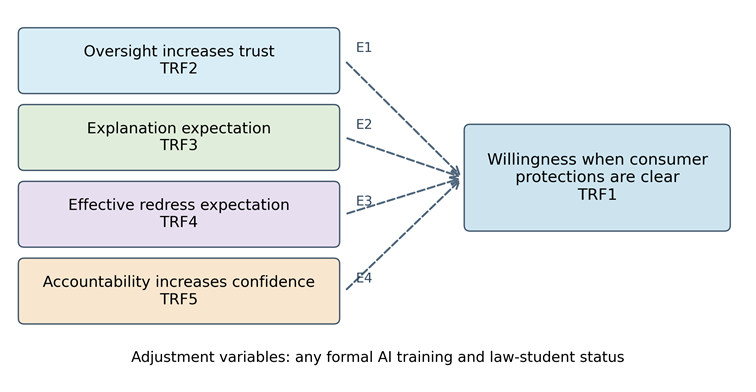
Figure 1. Exploratory framework for assurance statements and conditional willingness
Dashed arrows denote estimated associations, not causal effects. E1-E4 are exploratory expectations, not preregistered hypotheses. TRF1 is conditional willingness; oversight and accountability statements attribute benefits, whereas explanation and redress statements express expectations. Current trust and actual use are not measured.
3. Methodology
The design follows the questionnaire’s scope and the observable properties of the real-data workbook. Item-level descriptions are central, while regression assesses exploratory alignment. This section distinguishes documented information from facts unavailable in a numerical file and explains why a latent-variable model was not imposed on heterogeneous statements.
3.1 Design and participants
The study uses a cross-sectional adult questionnaire concerning AI, FinTech and financial regulation in Bangladesh. The individual is the unit of analysis. All 385 records affirm consent, adult eligibility and AI awareness. The achieved sample includes 228 law students, 77 law graduates, 54 advocates or legal professionals and 26 other relevant respondents. It is a mixed sample with substantial legal representation rather than a verified population of AI-finance customers. Reporting separates participant characteristics, measurement and analytical limitations.[16]
3.2 Sampling and achieved sample
All 385 supplied records were retained. Recruitment probabilities, a sampling frame, invitation totals and a response denominator were not documented. Results are therefore interpreted as non-probability achieved-sample evidence, without national weights or a population response rate. A database containing 385 rows does not establish random sampling. No target of 400, power-based recruitment calculation or exclusion count before database assembly is inferred from the writing template.
The binary model contains four focal statements and two adjustment variables, with 338 endorsements and 47 other outcome responses. This imbalance constrains precision and model complexity. The student-only sensitivity model has just 19 non-endorsements and five predictors after removal of the constant status indicator. No post hoc claim of adequate power is made; its interval estimates are considered alongside the full-sample model.
3.3 Questionnaire and measures
The shared questionnaire contains screening, profile and AI-exposure information, five AI-literacy statements and three topic-specific blocks. This article focuses on TRF1-TRF5. The same Group 8 questionnaire supports companion topics on credit-scoring fairness and fraud/privacy. The present sample is not an independent replication of those projects; its contribution concerns the separate assurance statements and their conditional-willingness outcome. Table 1 maps their roles; Appendix A provides exact wording for the focal and five supporting AI statements. All use agreement categories from 1 strongly disagree to 5 strongly agree. No focal item is reverse-coded. Verified item-level adaptation sources were unavailable, so theoretical literature informs interpretation without being misrepresented as the source of a validated scale.
Table 1. Measured statements and analytical roles
| Code | Statement focus | Interpretation and role |
| TRF1 | Willingness when protections are clear | Conditional willingness; outcome |
| TRF2 | Oversight increases trust | Attributed trust benefit; focal predictor |
| TRF3 | Explain fees, risks and limitations | Disclosure expectation; focal predictor |
| TRF4 | Effective complaints and dispute resolution | Redress expectation; focal predictor |
| TRF5 | Accountability increases confidence | Attributed confidence benefit; focal predictor |
Source: Group 8 Codebook; exact wording in Appendix A. Items are study-specific statements, not verified adaptations of validated scales. They do not establish actual regulatory quality, service use or current provider trust.
TRF1 responses 4-5 define binary endorsement. Responses 1-3 form a comparison category including neutrality, which is not called unwillingness. TRF2-TRF5 retain their original numerical ordering as focal predictors, with a one-point linear contribution to log odds assumed. Any AI training combines short orientation and course/certified training, referenced to no training. Student status is compared with all other statuses. These adjustments do not identify effects of training or legal education.
3.4 Collection and development
The research team confirmed online and in-person questionnaire collection. Exact fieldwork dates, platform, recruitment locations and mode-specific counts were not supplied; none is inferred from the semester or file date. Mode effects and invitation-to-completion rates cannot be evaluated. A completed pilot, translation validation or cognitive-pretesting exercise was not documented. No pilot sample, expert validation procedure or pilot reliability estimate is claimed.
3.5 Screening and data handling
Literal categories were preserved, including F1 “None”; blank cells were checked separately. All 385 records were complete and analysed agreement values were within 1-5. No duplicate profile/numerical response was found after excluding the sequence identifier and contextual text. Thirteen records had constant TRF responses, but none was constant across all 20 agreement items. They were retained because consistency within one block alone is not a defensible exclusion rule. Timestamps and validated attention checks were unavailable.
The research team identified the records as real and clarified that two Codebook uses of “synthetic” were clerical labels. The analysis follows that clarification without independently authenticating collection provenance. The contextual comment field was excluded from all interpretation. Sequence identifiers distinguished rows only. No responses were generated, imputed or altered to improve reliability or significance.
3.6 Measurement and analytical strategy
Raw Cronbach alpha was a diagnostic rather than proof of dimensionality. The focal block mixes an outcome, attributed benefits and normative expectations; alpha was 0.250. The AI block alpha was 0.322. Neither justified a homogeneous reflective score. The analysis consequently uses observed items, without invented latent loadings, composite reliability, AVE or HTMT. Low alpha limits scoring claims; it does not justify deleting inconvenient items.[17]
Endorsements use pointwise Wilson 95% intervals. Four paired contrasts subtract TRF1 endorsement from each other TRF item, with exact McNemar tests and 10,000 respondent bootstrap resamples for percentile intervals. Six Spearman correlations use 3,000 bootstrap resamples. Separate Holm corrections cover the four contrasts and six correlations. Joint endorsement patterns are descriptive, without latent-class claims.[18]
A binomial generalised linear model with logit link estimates adjusted odds ratios using HC0 sandwich covariance. Variance inflation factors assess collinearity. A cumulative-logit sensitivity model retains TRF1’s four observed categories, assuming common slopes and using observed-information intervals. A law-student-only binary model removes the status covariate. Each model has a separate four-coefficient Holm family. These overlapping analyses are not independent replications. They estimate associations rather than causal effects or out-of-sample prediction.[19]
3.7 Uncertainty
Intervals are pointwise; adjusted p values address the stated testing families. Neither accounts for unknown recruitment bias or measurement error. An interval crossing the null does not establish equivalence. Raw p values below 0.05 are not retained as supported findings after correction. No exploratory subgroup interaction search or mediation analysis is added. Outcome concentration and exploratory model specification are considered throughout.[20]
3.8 Ethics and participant protection
Every analysed record contains affirmative consent and adult eligibility. The supplied questionnaire describes voluntary participation, no requirement to provide a name and aggregate reporting. The study concerns attitudes, without account access, transactions or automated decisions affecting participants. Excluding free text and reporting aggregates limits exposure of potentially identifying information. De-identified data sharing remains subject to confidentiality safeguards. These protections address consent, data minimisation and reporting; they do not substitute for institutional review.
4. Results
The results distinguish the profile of the achieved sample, the frequency of endorsement and the association among responses. Paired comparisons preserve respondent matching. Regression results are then reported with multiplicity correction and sensitivity estimates. No descriptive majority is interpreted as evidence of actual service adoption or regulatory performance.
4.1 Respondent profile and data quality
Law students accounted for 228 of 385 respondents (59.2%). The remaining categories were law graduates (20.0%), advocates or legal professionals (14.0%) and other relevant respondents (6.8%). Table 2 sets out status and training, the two profile dimensions used in adjustment. The most frequent age category was 21-23 years (162; 42.1%), followed by 24-26 (83; 21.6%), 18-20 (61; 15.8%), 27-30 (40; 10.4%) and 31 or above (39; 10.1%).
Table 2. Respondent status and AI training
| Measure | Category | Count (%) |
| Status | Law student | 228 (59.2%) |
| Law graduate | 77 (20.0%) | |
| Advocate or legal professional | 54 (14.0%) | |
| Other relevant respondent | 26 (6.8%) | |
| Training | No | 199 (51.7%) |
| Yes, short orientation | 138 (35.8%) | |
| Yes, course or certified training | 48 (12.5%) |
N = 385; law-student subset n = 228. Neither status nor generic AI exposure verifies use of an AI-enabled financial product. Percentages describe the achieved sample.
There were 194 men (50.4%), 177 women (46.0%), ten respondents preferring not to say and four selecting other. Dhaka accounted for 149 records (38.7%), district towns for 80, other city corporations for 76, upazila/rural areas for 64 and other locations for 16. Weekly or daily/almost-daily generic AI use was reported by 264 (68.6%). No formal AI training was reported by 199 (51.7%). Twelve selected the valid tool category “None”; this is not missing data. Fourteen reported never having used AI on the experience question, whereas 13 selected never for frequency. These distinct measures are not interchangeable and neither verifies financial-AI experience.
4.2 Protection related distributions
Table 3 reports the complete category counts alongside endorsement. TRF1 conditional willingness was endorsed by 338 respondents (87.8%; Wilson interval 84.1-90.7%). The remaining 47 comprised 44 neutral responses and three disagreements, with no strong disagreement. TRF2 oversight-related trust was endorsed by 260 (67.5%; 62.7-72.0%). Its 125 other responses included 110 neutral answers, 14 disagreements and one strong disagreement. The difference in endorsement is thus largely a difference in the proportion choosing neutrality rather than evidence of widespread rejection of oversight.
Table 3. Protection-related statement distributions
| Item | Counts 1 / 2 / 3 / 4 / 5 | Mean | SD | Endorsed n (%) | 95% CI (%) |
| TRF1 | 0 / 3 / 44 / 189 / 149 | 4.26 | 0.68 | 338 (87.8%) | 84.1 to 90.7 |
| TRF2 | 1 / 14 / 110 / 191 / 69 | 3.81 | 0.77 | 260 (67.5%) | 62.7 to 72.0 |
| TRF3 | 1 / 2 / 60 / 170 / 152 | 4.22 | 0.74 | 322 (83.6%) | 79.6 to 87.0 |
| TRF4 | 0 / 5 / 58 / 184 / 138 | 4.18 | 0.73 | 322 (83.6%) | 79.6 to 87.0 |
| TRF5 | 0 / 3 / 58 / 186 / 138 | 4.19 | 0.71 | 324 (84.2%) | 80.2 to 87.5 |
N = 385. Categories 1-5 run from strongly disagree to strongly agree. Endorsed = 4 or 5. Wilson intervals are pointwise and do not correct recruitment bias. Means and standard deviations are descriptive.
Explanation and redress each had 322 endorsements (83.6%; 79.6-87.0%), while accountability-related confidence had 324 (84.2%; 80.2-87.5%). Equal endorsement totals for explanation and redress did not identify the same people: 269 endorsed both, 53 endorsed explanation alone, 53 redress alone and ten neither. Thus 106 respondents (27.5%) differed on those two statements despite identical marginal percentages. The means ranged from 3.81 for oversight to 4.26 for conditional willingness; these summaries describe numerical responses rather than distances on a validated latent scale.
The supporting AI statements also varied. Understanding that AI can produce plausible inaccuracies was endorsed by 215 (55.8%); claimed verification by 313 (81.3%); awareness of bias or incomplete data by 338 (87.8%); confidentiality safeguards by 327 (84.9%); and meaningful human oversight by 306 (79.5%). These are item-specific reports or preferences, not a single verified competence measure.
4.3 Paired contrasts and joint alignment
Table 4 compares each other TRF statement with TRF1 within respondents. Oversight-related trust was endorsed 20.3 percentage points less often, with a bootstrap interval from −26.0 to −14.8 and Holm-adjusted p < 0.001. There were 28 oversight-only endorsements and 106 willingness-only endorsements. This asymmetry supports an endorsement contrast between the statements, while preserving their different wording.
Table 4. Paired endorsement contrasts with conditional willingness
| Contrast | Other item only / TRF1 only | Difference pp | 95% CI pp | Holm p |
| TRF2 − TRF1 | 28 / 106 | -20.3 | -26.0 to -14.8 | <0.001 |
| TRF3 − TRF1 | 40 / 56 | -4.2 | -9.1 to 0.8 | 0.316 |
| TRF4 − TRF1 | 35 / 51 | -4.2 | -8.8 to 0.5 | 0.316 |
| TRF5 − TRF1 | 37 / 51 | -3.6 | -8.6 to 1.3 | 0.316 |
N = 385; pp = percentage points. Exact McNemar tests corrected across four contrasts. Pointwise percentile intervals use 10,000 respondent bootstrap resamples. Comparisons concern differently worded statements, not changes caused by an intervention.
The other three contrasts were smaller: explanation and redress each differed by −4.2 percentage points, and accountability by −3.6. None was retained after Holm correction (each adjusted p = 0.316). Their intervals include zero, but this is not a demonstration of equivalence. Accountability and willingness, for example, still had 88 discordant records: 37 accountability-only and 51 willingness-only endorsements.
Table 5 examines the three conditional or attributed-benefit statements jointly. It separates willingness under clear protection from trust attributed to oversight and confidence attributed to accountability. This descriptive analysis asks whether those positions coincide within a respondent rather than assuming alignment from their high individual percentages.
Table 5. Joint endorsement of conditional willingness and attributed confidence benefits
| Willingness TRF1 | Oversight trust TRF2 | Accountability confidence TRF5 | Count (%) |
| Yes | Yes | Yes | 204 (53.0%) |
| Yes | Yes | No | 28 (7.3%) |
| Yes | No | Yes | 83 (21.6%) |
| Yes | No | No | 23 (6.0%) |
| No | Yes | Yes | 22 (5.7%) |
| No | Yes | No | 6 (1.6%) |
| No | No | Yes | 15 (3.9%) |
| No | No | No | 4 (1.0%) |
N = 385. Yes = agreement/strong agreement; No includes neutral responses and must not be read as distrust or unwillingness. These patterns are descriptive and are not latent classes.
All three were endorsed by 204 respondents (53.0%). A further 83 (21.6%) endorsed willingness and accountability-related confidence without endorsing oversight-related trust. Twenty-eight endorsed willingness and oversight but not accountability, and 23 endorsed willingness alone. Of the 47 who did not endorse willingness, 22 endorsed both oversight and accountability, 15 accountability alone, six oversight alone and four neither. These are response configurations, not psychological types or demonstrated distrust groups.
4.4 Reliability and ordinal associations
The TRF alpha of 0.250 and AI-item alpha of 0.322 did not support a common reflective score. The other shared topic blocks were also heterogeneous (credit-scoring fairness alpha 0.193; fraud/privacy alpha 0.224), but their substantive responses were outside this article’s focal model. No latent measurement or mediation analysis was undertaken. Table 6 reports the six selected ordinal associations with TRF1.
Table 6. Ordinal associations with conditional willingness
| Pair | Spearman ρ | 95% CI | Raw p | Holm p |
| TRF2 / TRF1 | 0.010 | -0.089 to 0.109 | 0.851 | 1.000 |
| TRF3 / TRF1 | 0.101 | 0.003 to 0.198 | 0.047 | 0.278 |
| TRF4 / TRF1 | 0.097 | -0.002 to 0.201 | 0.056 | 0.278 |
| TRF5 / TRF1 | -0.030 | -0.131 to 0.072 | 0.555 | 1.000 |
| AIL2 / TRF1 | 0.102 | 0.002 to 0.201 | 0.046 | 0.278 |
| AIL5 / TRF1 | 0.020 | -0.078 to 0.119 | 0.692 | 1.000 |
N = 385. Pointwise intervals use 3,000 respondent bootstrap resamples. Holm correction covers six correlations. AIL2 reports verification practice; AIL5 endorses human oversight. Neither measures observed financial decisions.
All correlations were small, ranging from −0.030 for accountability to 0.102 for verification. Explanation and verification had raw p values below 0.05, but neither survived the six-test Holm correction (both adjusted p = 0.278). Oversight’s correlation was 0.010 (adjusted p = 1.000). The results show that frequent endorsement need not correspond to strong individual-level covariance; they do not establish that the underlying mechanisms are irrelevant.
4.5 Adjusted model and sensitivity
The binary model converged, with variance inflation factors between 1.004 and 1.032. Table 7 reports all six coefficients, separating the corrected focal family from the two adjustment variables. No focal relationship was retained: adjusted p values were 0.812 for oversight, 0.812 for explanation, 0.237 for redress and 0.485 for accountability. E1-E4 therefore received no retained support in the primary model.
Table 7. Adjusted binary model of conditional willingness
| Predictor | aOR | 95% CI | Raw p | Holm p |
| Oversight TRF2 | 1.18 | 0.80 to 1.75 | 0.406 | 0.812 |
| Explanation TRF3 | 0.95 | 0.63 to 1.43 | 0.798 | 0.812 |
| Redress TRF4 | 1.50 | 0.98 to 2.29 | 0.059 | 0.237 |
| Accountability TRF5 | 1.38 | 0.88 to 2.16 | 0.162 | 0.485 |
| Any formal AI training | 1.32 | 0.70 to 2.50 | 0.397 | — |
| Law-student status | 2.39 | 1.29 to 4.44 | 0.006 | — |
N = 385; TRF1 endorsements = 338; other responses = 47. HC0 robust pointwise intervals; item estimates per one-point increase. Holm family covers four focal item coefficients. Training/status references: no training and non-student. Control p values are unadjusted; aOR = adjusted odds ratio, not a probability ratio.
Redress had an adjusted odds ratio of 1.50 (95% interval 0.98-2.29), while accountability had 1.38 (0.88-2.16). The intervals leave considerable uncertainty. Student status was associated with higher endorsement odds (2.39; 1.29-4.44; unadjusted control p = 0.006), while training was imprecise (1.32; 0.70-2.50). The status estimate is descriptive adjustment evidence, not a tested effect of legal education, and its p value belongs to no confirmatory intervention analysis.
Table 8 assesses outcome coding and sample composition. The ordinal model retains disagreement, neutrality, agreement and strong agreement, whereas the student model retains the original binary definition within the 228 students. These checks address different analytical choices and share observations with the primary analysis.
Table 8. Ordinal and student-restricted sensitivity models
| Predictor | Ordinal aOR (95% CI) | Ordinal Holm p | Student aOR (95% CI) | Student Holm p |
| Oversight TRF2 | 0.96 (0.75 to 1.24) | 1.000 | 1.00 (0.58 to 1.71) | 0.998 |
| Explanation TRF3 | 1.24 (0.96 to 1.62) | 0.310 | 1.32 (0.76 to 2.29) | 0.888 |
| Redress TRF4 | 1.32 (1.01 to 1.73) | 0.173 | 2.03 (1.03 to 3.97) | 0.158 |
| Accountability TRF5 | 0.93 (0.71 to 1.23) | 1.000 | 1.39 (0.75 to 2.57) | 0.888 |
Ordinal N = 385; TRF1 observed category counts = 3 disagree, 44 neutral, 189 agree, 149 strongly agree; no strongly-disagree response. Common slopes assumed; observed-information intervals. Student binary n = 228, endorsements = 209, other = 19; HC0 intervals. Separate four-coefficient Holm families; overlapping analyses, not independent replications.
No focal coefficient was retained in either sensitivity model. Redress had a raw ordinal p = 0.043 (adjusted 0.173) and a raw student-model p = 0.039 (adjusted 0.158). These nominal results cannot be reported as robust confirmation of E3. The student model contains 209 endorsements and 19 other responses, making precision especially limited. Overall, endorsement was high, alignment varied and the corrected explanatory associations remained unresolved.
5. Discussion
The central result is a distinction between support for protective conditions and evidence that particular assurance statements explain individual willingness. Clear-protection willingness was widely endorsed, while oversight-related trust was less frequently endorsed and weakly correlated with willingness. This section interprets that combination through institutional trust and procedural justice, keeping actual financial behaviour and regulatory performance outside the survey’s inferential reach.
5.1 Conditional willingness and the object of trust
The 87.8% endorsement of TRF1 indicates that a large share of this sample favours willingness under clear protections. It does not indicate that 87.8% currently trusts AI finance or intends to adopt an available product. The conditional clause is substantive: willingness is expressed relative to a protective circumstance, without measuring a baseline or presenting an actual protection arrangement. Reading it as an adoption rate would remove the very institutional condition respondents were asked to consider.
Institution-based trust helps distinguish a potentially acceptable setting from trust in a named actor. This is consistent with the broader need to identify what is being trusted in FinTech. The present evidence is strongest at the level of assurance-related propositions. It cannot allocate confidence among a bank, software vendor, regulator or human reviewer, because those objects were not separately evaluated. Future measurement should identify the object before estimating paths among beliefs and intentions.[21]
5.2 The oversight contrast
The 20.3-point paired difference is the clearest contrast. Most respondents who did not endorse oversight-related trust were neutral, so it should not be described as widespread distrust of the regulator. It could reflect uncertainty about what oversight entails, differences in wording or limited exposure to its operation. Those explanations remain possibilities; no knowledge test, institutional-performance assessment or interview evidence identifies the cause.
Nor is the contrast internally inconsistent. A person can favour clear protections while being uncertain whether oversight increases trust. The service condition and the institutional mechanism are not the same proposition. The 106 willingness-only versus 28 oversight-only endorsements show how their distributions differ within the same respondents, but do not reveal what would happen if supervision were strengthened. This is a measurement distinction with practical relevance, not an estimated regulatory effect.
For the Bangladesh setting, oversight and complaint arrangements are documented in official sources. Their existence prevents a discussion that assumes no consumer-protection framework. At the same time, an attitudinal contrast cannot assess enforcement or accessibility. A defensible next step would pair knowledge and experience questions with a precisely defined supervisory or redress arrangement. It would test whether respondents understand its scope before interpreting confidence attributed to it.[22]
5.3 Similar totals conceal different preferences
Explanation and redress each attracted 83.6% endorsement, yet one quarter of respondents differed across the two. This result illustrates why marginal consensus is insufficient to claim that a common safeguard package has uniform support. Informational and procedural expectations can differ within people even when their population totals match. They should therefore remain distinguishable in service design and measurement.
The justice literature supplies a conceptual explanation for the distinction. An account of fees or limitations addresses an informational need; the ability to dispute a decision addresses procedural voice and correction. The study has not established a complete justice model, but its response pattern is compatible with treating those needs separately. Combining them would lose information about respondents who endorse one without the other.[23]
For providers, the implication is to evaluate both comprehensibility and usability of review. A disclosure should be tested by whether users can identify relevant charges, uncertainty and limits. A complaint process should be evaluated by whether a user can initiate and pursue review. These are proposed operational tests. Their merit derives from the measured expectations and conceptual distinctions, rather than proof that either intervention increases uptake.
5.4 Accountability and joint confidence
Accountability-related confidence had broad endorsement, but only 53.0% endorsed it together with willingness and oversight-related trust. The additional 83 respondents endorsing willingness and accountability without oversight illustrate a particularly common configuration. It would be premature to name this a stable consumer segment or infer a preference for private over public governance: the survey neither defines competing arrangements nor measures repeated choices.
Bovens’ actor-forum account clarifies what the broad accountability wording leaves unspecified. A useful follow-up would identify who explains an AI-assisted outcome, who can question the explanation and what consequences follow. Internal auditing research likewise provides a basis for asking about documentation and responsibility across deployment. Neither perspective implies that respondents endorsing TRF5 have encountered those practices.[24]
5.5 Unsupported associations and analytical sensitivity
None of the four focal associations was retained after correction, and sensitivity analyses did not change that conclusion. High endorsement combined with limited dispersion can make it difficult to distinguish respondents. The statements also mix normative preferences and attributed benefits, with low internal consistency. These features limit what the model can explain; they do not demonstrate that oversight, disclosure or redress has no value.
Redress provides a useful caution. Its ordinal and student-restricted raw p values were below 0.05, but their adjusted values were 0.173 and 0.158. Selecting those nominal estimates while ignoring the testing families would overstate the result. The overlapping analyses and small student non-endorsement group also preclude treating them as independent replications. Statistical guidance supports interpreting estimates, uncertainty and the analytical context together rather than treating a threshold as a conclusion about mechanism.[25]
The negative rank association for accountability and positive binary-model estimate are likewise compatible with outcome coding emphasising different parts of a concentrated distribution. Neither is precise evidence of a directional mechanism. The appropriate conclusion is that this database does not support a stable explanatory relationship under the analyses used. A theory-informed expectation remains open to better measurement and stronger design.
5.6 Sample composition and alternative explanations
The law-student status coefficient should not be read as evidence that legal study causes willingness. Students differed from other participants in an observational sample and may differ in unrecorded financial experience, recruitment exposure or interpretation. The questionnaire records generic AI experience rather than product-specific familiarity. Adding more unsupported controls would not reconstruct those missing histories.
Self-report also places predictors and outcome in the same questionnaire context. Shared favourable wording or response styles could influence answers, yet the study cannot quantify that influence. Low alpha is not evidence that common-method bias has been eliminated. Research on common-method effects instead supports using design and measurement improvements in future work, including separated measurement and behavioural corroboration where feasible.[26]
5.7 Integrated interpretation
The findings support an item-level account: protective conditions are broadly welcomed, but the statements do not form a defensible unitary trust scale or a supported model of individual willingness. This boundary refines the use of institutional trust and justice in this setting. It also keeps the practical objective aligned with warranted reliance. Financial services should demonstrate the quality of protections through understandable information, effective review and accountable operation; greater confidence alone is not evidence of safer decisions.[27]
6. Theoretical and Practical Implications
The contribution lies in separating what people endorse from what an explanatory model establishes. The implications below distinguish conceptual refinement, proposed provider evaluations and regulatory research. They do not rank legal duties by regression significance or suggest that a safeguard loses importance when an association is imprecise.
6.1 Theoretical implications
First, the analysis distinguishes institutional-assurance propositions from current trust and from behaviour. Conditional willingness, oversight-related trust and accountability-related confidence need not be interchangeable outcomes. Their partial joint alignment gives an empirical reason to specify the object and conditions of trust before aggregating responses. This is a measurement contribution to an institutional perspective rather than validation of a full institutional-trust theory.
Second, the identical disclosure and redress totals, combined with 27.5% individual discordance, illustrate the importance of separating informational and procedural expectations. A future model could test whether explanation improves understanding and whether accessible review changes vulnerability assessments. Those mechanisms should be measured directly rather than inferred from general statements. The current study identifies the distinction and leaves its causal significance unresolved.
Third, the unretained associations identify a boundary of this instrument and sample, not a theoretical claim that protections are irrelevant. The framework lacks direct measures of provider trust, perceived enforcement, financial experience and actual behaviour. Adding latent paths would not repair those omissions. More discriminating instruments and a clearly identified financial decision are needed before technology acceptance, privacy calculus and institutional assurance can be integrated in a defensible structural model.[28]
6.2 Implications for financial service providers
Providers can use the findings to formulate evaluations of safeguards. The high endorsement of explanations motivates testing whether users can understand fees, material risks and limitations in a specific service. A useful task would ask users to identify a cost, recognise uncertainty and decide when to seek assistance after seeing a notice. Completion and error rates would provide stronger implementation evidence than agreement that explanations should be provided. Financial-advisory research on comprehensibility supports this focus on usability rather than disclosure volume.[29]
The high redress expectation motivates a separate test of complaint access. Providers could examine whether users can find the relevant channel, describe an AI-related problem, obtain a reference and understand the next review step. Operational indicators might include abandonment, resolution time and recurrence. These indicators were not measured here and are proposed for evaluation, not asserted provider deficiencies.
Accountability should similarly be specified through responsibilities and records. A service could document who owns a model-assisted decision, who reviews a contested output and what evidence supports a correction. The survey does not demonstrate that such practices increase willingness. They are concrete ways to turn a broad accountability proposition into arrangements that users and reviewers can assess.
Providers should also avoid using the 87.8% result in adoption forecasts. It concerns conditional willingness in a legally oriented sample, without product-specific eligibility, cost or experience. A service evaluation should include actual users and non-users, alternative offers and consequential tasks. Appropriate reliance would be assessed alongside confidence, including whether users reject outputs when limits are material.
6.3 Regulatory and societal implications
Bangladesh Bank’s guidance already connects customer information with service commitments, and its MFS framework separately addresses oversight and complaint handling. This study supports examining how such arrangements are understood in AI-mediated contexts without claiming a newly discovered legal obligation. The oversight contrast motivates research on awareness of institutional scope, while the complaint and explanation endorsements motivate testing accessibility and comprehension.[30]
Regulatory evaluation should combine perception surveys with process and outcome evidence. Increased trust can coexist with misunderstanding; a confident user may still lack an effective remedy. Authorities and researchers could therefore examine awareness, service accessibility and complaint outcomes separately. The FSB’s emphasis on monitoring and governance provides a broader rationale for stronger evidence about implementation, while the present sample supplies only an attitudinal starting point.[31]
7. Conclusion Limitations and Future Research
This study examined protection-related expectations for AI-enabled financial services in a database of 385 adults in Bangladesh, including 228 law students. The analysis distinguished willingness under clear protections from confidence attributed to oversight and accountability, and from expectations of explanation and redress. All five statements attracted majority endorsement. The oversight statement, however, was endorsed 20.3 percentage points less often than conditional willingness, and only 53.0% endorsed willingness, oversight-related trust and accountability-related confidence together.
These descriptive patterns did not translate into retained adjusted relationships. None of the four focal coefficients met the Holm-corrected threshold in the primary model, and ordinal and student-restricted analyses retained none. The principal conclusion is therefore a distinction between broadly favourable positions towards protections and evidence that particular statements explain individual willingness. No inference follows about actual adoption, legal compliance or regulatory effectiveness.
The article’s contribution is to preserve meaning across measurement and interpretation. Conditional clauses, normative language and attributed benefits remain visible throughout the analysis. Paired contrasts and joint patterns reveal differences that would disappear in one average score, while multiplicity correction prevents nominal sensitivity findings from being described as confirmation. The resulting framework offers a focused basis for developing more discriminating assurance measures in legally oriented research on financial AI.
This approach also avoids a purely promotional interpretation of trust. The relevant future outcome is reliance matched to capability and protection, rather than a higher trust percentage in isolation. Evidence of implementation must come from service information, review processes and outcomes that the questionnaire did not observe.
The achieved sample has substantial legal and student representation, with undocumented recruitment probabilities. Generic AI awareness does not verify financial-AI use. Exact dates, recruitment channels and mode-specific counts were unavailable. Single-item measures mix conditional and normative content, and internal consistency is low. Cross-sectional self-report cannot identify direction, temporal change or causal effects. The binary outcome is concentrated, and student sensitivity has only 19 non-endorsements. Ordinal common slopes were assumed rather than independently verified. The authors’ real-data clarification resolves the intended interpretation of clerical metadata, but does not provide independent provenance verification.
These limitations are material to generalisation and mechanism claims. Complete numerical records remove the need for imputation; they do not remove selection bias, response-style effects or uncertainty about how respondents interpreted AI finance.
Future work should begin with documented recruitment, dates and product-specific eligibility. Cognitive interviews could establish whether users distinguish clear protections, effective oversight and accountability in the intended way. A measurement study could then compare direct provider-trust questions with conditional willingness and demonstrated knowledge of remedies, retaining informational and procedural dimensions separately.
A factorial experiment could vary explanation quality and review access while holding the financial decision constant. Outcomes should include comprehension, review-seeking and reliance on accurate and inaccurate outputs, rather than intention alone. Longitudinal work could examine how actual complaint experiences change confidence. Such designs would test the mechanisms left unresolved here and allow evidence about consumer protection to progress from favourable expectations to observable institutional performance.
Declarations
Ethical approval and oversight
No study-specific formal ethical approval or exemption was reported in the study materials, and none is claimed. Participant-protection measures and analytical safeguards are described in Section 3.8.
Informed consent
All analysed records affirm consent and adult eligibility. The questionnaire describes voluntary participation, no requirement to provide a name and aggregate reporting.
Data availability
Numerical data and analytical specifications are held by the research team. Requests for de-identified material may be directed to the corresponding author, subject to confidentiality and applicable requirements. Contextual text was excluded from analysis.
Funding and competing interests
No external funding source or competing interest was disclosed in the study materials supplied for manuscript preparation.
Author contributions
Md Wahidul Bari: lead student researcher; conceptualisation; preparation of study materials; data organisation and curation; manuscript development. The project was conducted under the supervision of Prof. Dr Kazi Abdul Mannan.
Kazi Abdul Mannan: conceptual and methodological guidance; supervision; interpretation of statistical findings; critical review and editing of the manuscript; corresponding authorship.
Generative AI disclosure
Generative AI assisted literature retrieval, manuscript drafting, language editing, organisation and analytical-code development. Statistical estimates were computed programmatically from the numerical survey data. Responsibility for analysis, interpretation and reporting rests with the authors.
Bibliography
Ajzen I, ‘The Theory of Planned Behavior’ (1991) 50 Organizational Behavior and Human Decision Processes 179
Altman DG and Bland JM, ‘Absence of Evidence Is Not Evidence of Absence’ (1995) 311 BMJ 485
Bangladesh Bank, ‘Customer Interest Protection Centre (CIPC)’ <https://www.bb.org.bd/en/index.php/services/cipc_procedure> accessed 2 November 2026
Bangladesh Bank, Guidelines for Customer Services and Complaint Management (June 2014) paras 2.09 and 2.09.01 <https://www.bb.org.bd/aboutus/regulationguideline/ficsd/cipc_eng.pdf> accessed 2 November 2026
Bovens M, ‘Analysing and Assessing Accountability: A Conceptual Framework’ (2007) 13 European Law Journal 447
Colquitt JA, ‘On the Dimensionality of Organizational Justice: A Construct Validation of a Measure’ (2001) 86 Journal of Applied Psychology 386
Devlin JF and others, ‘Trust and FinTech: A Review and Research Agenda’ (2025) 35 Electronic Markets 62, doi:10.1007/s12525-025-00803-w
Dinev T and Hart P, ‘An Extended Privacy Calculus Model for E-Commerce Transactions’ (2006) 17 Information Systems Research 61
Efron B and Tibshirani RJ, An Introduction to the Bootstrap (Chapman & Hall 1993)
Financial Stability Board, Artificial Intelligence and Machine Learning in Financial Services (1 November 2017) <https://www.fsb.org/2017/11/artificial-intelligence-and-machine-learning-in-financial-service/> accessed 2 November 2026
Financial Stability Board, The Financial Stability Implications of Artificial Intelligence (14 November 2024) <https://www.fsb.org/2024/11/the-financial-stability-implications-of-artificial-intelligence/> accessed 2 November 2026
Gefen D, Karahanna E and Straub DW, ‘Trust and TAM in Online Shopping: An Integrated Model’ (2003) 27 MIS Quarterly 51
Greenland S and others, ‘Statistical Tests, P Values, Confidence Intervals, and Power: A Guide to Misinterpretations’ (2016) 31 European Journal of Epidemiology 337
Hoff KA and Bashir M, ‘Trust in Automation: Integrating Empirical Evidence on Factors That Influence Trust’ (2015) 57 Human Factors 407
Holm S, ‘A Simple Sequentially Rejective Multiple Test Procedure’ (1979) 6 Scandinavian Journal of Statistics 65
Hosmer DW Jr, Lemeshow S and Sturdivant RX, Applied Logistic Regression (3rd edn, John Wiley & Sons 2013)
Lee JD and See KA, ‘Trust in Automation: Designing for Appropriate Reliance’ (2004) 46 Human Factors 50
Lind EA and Tyler TR, The Social Psychology of Procedural Justice (Plenum Press 1988)
Long D and Magerko B, ‘What Is AI Literacy? Competencies and Design Considerations’ in Proceedings of the 2020 CHI Conference on Human Factors in Computing Systems (ACM 2020) 1
Mayer RC, Davis JH and Schoorman FD, ‘An Integrative Model of Organizational Trust’ (1995) 20 Academy of Management Review 709
McCullagh P, ‘Regression Models for Ordinal Data’ (1980) 42 Journal of the Royal Statistical Society Series B 109
McKnight DH, Choudhury V and Kacmar C, ‘Developing and Validating Trust Measures for e-Commerce: An Integrative Typology’ (2002) 13 Information Systems Research 334
McNemar Q, ‘Note on the Sampling Error of the Difference between Correlated Proportions or Percentages’ (1947) 12 Psychometrika 153
Podsakoff PM and others, ‘Common Method Biases in Behavioral Research: A Critical Review of the Literature and Recommended Remedies’ (2003) 88 Journal of Applied Psychology 879
Raji ID and others, ‘Closing the AI Accountability Gap: Defining an End-to-End Framework for Internal Algorithmic Auditing’ in Proceedings of the 2020 Conference on Fairness, Accountability, and Transparency (ACM 2020) 33
Ryu H-S, ‘What Makes Users Willing or Hesitant to Use Fintech? The Moderating Effect of User Type’ (2018) 118 Industrial Management & Data Systems 541
Sijtsma K, ‘On the Use, the Misuse, and the Very Limited Usefulness of Cronbach’s Alpha’ (2009) 74 Psychometrika 107
Venkatesh V, Thong JYL and Xu X, ‘Consumer Acceptance and Use of Information Technology: Extending the Unified Theory of Acceptance and Use of Technology’ (2012) 36 MIS Quarterly 157
von Elm E and others, ‘The Strengthening the Reporting of Observational Studies in Epidemiology (STROBE) Statement: Guidelines for Reporting Observational Studies’ (2007) 4 PLOS Medicine e296
Wasserstein RL and Lazar NA, ‘The ASA Statement on p-Values: Context, Process, and Purpose’ (2016) 70 American Statistician 129
White H, ‘A Heteroskedasticity-Consistent Covariance Matrix Estimator and a Direct Test for Heteroskedasticity’ (1980) 48 Econometrica 817
Wilson EB, ‘Probable Inference, the Law of Succession, and Statistical Inference’ (1927) 22 Journal of the American Statistical Association 209
Zhu H, Sallnäs Pysander E-L and Söderberg I-L, ‘Not Transparent and Incomprehensible: A Qualitative User Study of an AI-Empowered Financial Advisory System’ (2023) 7 Data and Information Management 100041
Appendix A Questionnaire wording
Table A1 reproduces every statement used in the focal and supporting analyses. Their analytical roles follow the wording rather than a claim of validated scale equivalence.
Table A1. Exact wording of analysed statements
| Code | Questionnaire statement |
| TRF1 | I am more willing to use AI-enabled financial services when consumer protections are clear. |
| TRF2 | Regulatory oversight increases my trust in AI-enabled financial services. |
| TRF3 | AI financial services should clearly explain important fees, risks and limitations. |
| TRF4 | Users should have access to effective complaint and dispute-resolution mechanisms. |
| TRF5 | Strong accountability increases my confidence in AI-enabled financial services. |
| AIL1 | I understand that generative AI can produce plausible but inaccurate information. |
| AIL2 | I verify important AI-generated information before relying on it. |
| AIL3 | I understand that AI outputs may reflect bias or incomplete data. |
| AIL4 | I avoid sharing confidential or sensitive information with AI tools unless appropriate safeguards are in place. |
| AIL5 | I believe meaningful human oversight is necessary when AI affects important legal or rights-related decisions. |
Source: supplied Group 8 Codebook. Responses range from 1 strongly disagree to 5 strongly agree. No substantive item is reverse-coded.
TRF1 is the outcome. TRF2-TRF5 are focal predictors. AIL2 and AIL5 support selected correlations; the AI items also provide descriptive context. These statements do not constitute an objective knowledge test, observed service-use measure or audit of regulatory effectiveness.
Table of Legislation
Bangladesh Mobile Financial Services (MFS) Regulations 2022, paras 15-17
[1] Financial Stability Board, Artificial Intelligence and Machine Learning in Financial Services (1 November 2017) <https://www.fsb.org/2017/11/artificial-intelligence-and-machine-learning-in-financial-service/> accessed 2 November 2026; Financial Stability Board, The Financial Stability Implications of Artificial Intelligence (14 November 2024) <https://www.fsb.org/2024/11/the-financial-stability-implications-of-artificial-intelligence/> accessed 2 November 2026.
[2] James F Devlin and others, ‘Trust and FinTech: A Review and Research Agenda’ (2025) 35 Electronic Markets 62, doi:10.1007/s12525-025-00803-w.
[3] Bangladesh Bank, Guidelines for Customer Services and Complaint Management (June 2014) paras 2.09 and 2.09.01 <https://www.bb.org.bd/aboutus/regulationguideline/ficsd/cipc_eng.pdf> accessed 2 November 2026; Bangladesh Mobile Financial Services (MFS) Regulations 2022, paras 15–17; Bangladesh Bank, ‘Customer Interest Protection Centre (CIPC)’ <https://www.bb.org.bd/en/index.php/services/cipc_procedure> accessed 2 November 2026.
[4] D Harrison McKnight, Vivek Choudhury and Charles Kacmar, ‘Developing and Validating Trust Measures for e-Commerce: An Integrative Typology’ (2002) 13 Information Systems Research 334.
[5] David Gefen, Elena Karahanna and Detmar W Straub, ‘Trust and TAM in Online Shopping: An Integrated Model’ (2003) 27 MIS Quarterly 51; Viswanath Venkatesh, James YL Thong and Xin Xu, ‘Consumer Acceptance and Use of Information Technology: Extending the Unified Theory of Acceptance and Use of Technology’ (2012) 36 MIS Quarterly 157; Hyun-Sun Ryu, ‘What Makes Users Willing or Hesitant to Use Fintech? The Moderating Effect of User Type’ (2018) 118 Industrial Management & Data Systems 541.
[6] Hui Zhu, Eva-Lotta Sallnäs Pysander and Inga-Lill Söderberg, ‘Not Transparent and Incomprehensible: A Qualitative User Study of an AI-Empowered Financial Advisory System’ (2023) 7 Data and Information Management 100041; Jason A Colquitt, ‘On the Dimensionality of Organizational Justice: A Construct Validation of a Measure’ (2001) 86 Journal of Applied Psychology 386.
[7] Roger C Mayer, James H Davis and F David Schoorman, ‘An Integrative Model of Organizational Trust’ (1995) 20 Academy of Management Review 709.
[8] Icek Ajzen, ‘The Theory of Planned Behavior’ (1991) 50 Organizational Behavior and Human Decision Processes 179.
[9] John D Lee and Katrina A See, ‘Trust in Automation: Designing for Appropriate Reliance’ (2004) 46 Human Factors 50.
[10] E Allan Lind and Tom R Tyler, The Social Psychology of Procedural Justice (Plenum Press 1988); Colquitt (n 6).
[11] Mark Bovens, ‘Analysing and Assessing Accountability: A Conceptual Framework’ (2007) 13 European Law Journal 447.
[12] Inioluwa Deborah Raji and others, ‘Closing the AI Accountability Gap: Defining an End-to-End Framework for Internal Algorithmic Auditing’ in Proceedings of the 2020 Conference on Fairness, Accountability, and Transparency (ACM 2020) 33.
[13] Tamara Dinev and Paul Hart, ‘An Extended Privacy Calculus Model for E-Commerce Transactions’ (2006) 17 Information Systems Research 61.
[14] Duri Long and Brian Magerko, ‘What Is AI Literacy? Competencies and Design Considerations’ in Proceedings of the 2020 CHI Conference on Human Factors in Computing Systems (ACM 2020) 1.
[15] Kevin Anthony Hoff and Masooda Bashir, ‘Trust in Automation: Integrating Empirical Evidence on Factors That Influence Trust’ (2015) 57 Human Factors 407.
[16] Erik von Elm and others, ‘The Strengthening the Reporting of Observational Studies in Epidemiology (STROBE) Statement: Guidelines for Reporting Observational Studies’ (2007) 4 PLOS Medicine e296.
[17] Klaas Sijtsma, ‘On the Use, the Misuse, and the Very Limited Usefulness of Cronbach’s Alpha’ (2009) 74 Psychometrika 107.
[18] Edwin B Wilson, ‘Probable Inference, the Law of Succession, and Statistical Inference’ (1927) 22 Journal of the American Statistical Association 209; Quinn McNemar, ‘Note on the Sampling Error of the Difference between Correlated Proportions or Percentages’ (1947) 12 Psychometrika 153; Bradley Efron and Robert J Tibshirani, An Introduction to the Bootstrap (Chapman & Hall 1993); Sture Holm, ‘A Simple Sequentially Rejective Multiple Test Procedure’ (1979) 6 Scandinavian Journal of Statistics 65.
[19] David W Hosmer Jr, Stanley Lemeshow and Rodney X Sturdivant, Applied Logistic Regression (3rd edn, John Wiley & Sons 2013); Halbert White, ‘A Heteroskedasticity-Consistent Covariance Matrix Estimator and a Direct Test for Heteroskedasticity’ (1980) 48 Econometrica 817; Peter McCullagh, ‘Regression Models for Ordinal Data’ (1980) 42 Journal of the Royal Statistical Society Series B 109.
[20] Ronald L Wasserstein and Nicole A Lazar, ‘The ASA Statement on p-Values: Context, Process, and Purpose’ (2016) 70 American Statistician 129; Sander Greenland and others, ‘Statistical Tests, P Values, Confidence Intervals, and Power: A Guide to Misinterpretations’ (2016) 31 European Journal of Epidemiology 337.
[21] McKnight, Choudhury and Kacmar (n 4); Devlin and others (n 2).
[22] Bangladesh Mobile Financial Services (MFS) Regulations 2022; Bangladesh Bank, CIPC (n 3).
[23] Colquitt (n 6); Lind and Tyler (n 10).
[24] Bovens (n 11); Raji and others (n 12).
[25] Wasserstein and Lazar (n 20); Douglas G Altman and J Martin Bland, ‘Absence of Evidence Is Not Evidence of Absence’ (1995) 311 BMJ 485.
[26] Philip M Podsakoff and others, ‘Common Method Biases in Behavioral Research: A Critical Review of the Literature and Recommended Remedies’ (2003) 88 Journal of Applied Psychology 879.
[27] Lee and See (n 9); Hoff and Bashir (n 15).
[28] Venkatesh, Thong and Xu (n 5); Dinev and Hart (n 13).
[29] Zhu, Sallnäs Pysander and Söderberg (n 6).
[30] Bangladesh Bank, Customer Services Guidelines (n 3); Bangladesh Mobile Financial Services (MFS) Regulations 2022.
[31] FSB, Financial Stability Implications (n 1).