Home
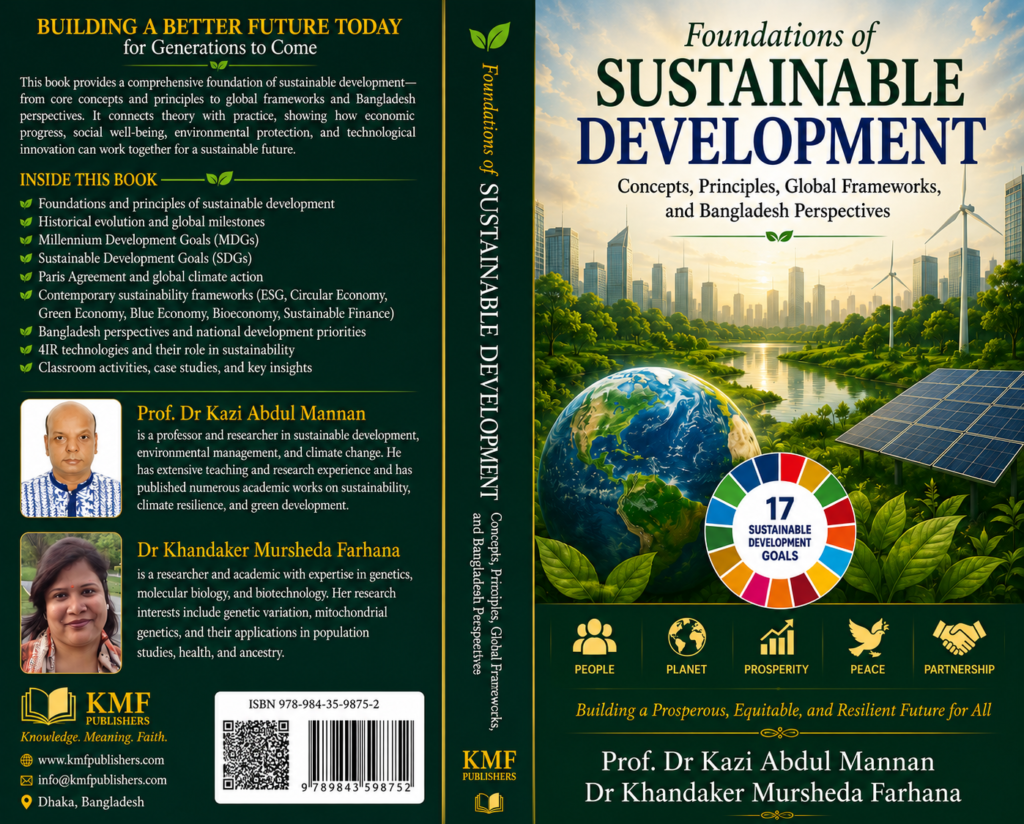
Foundations of Sustainable Development
Concepts, Principles, Global Frameworks, and Bangladesh Perspectives
By Kazi Abdul Mannan; Khandaker Mursheda Farhana
A comprehensive university-level textbook exploring the concepts and principles of sustainable development, SDGs, climate change, global sustainability frameworks, the Fourth Industrial Revolution, and Bangladesh perspectives.
Designed for students, teachers, researchers, policymakers, and development professionals, the book connects global sustainability thinking with practical applications and Bangladesh’s development realities.
Subject: Sustainable Development; Sustainable Development Goals (SDGs); Environmental Sustainability; Climate Change; Global Sustainability Frameworks; Fourth Industrial Revolution (4IR); Bangladesh Development Perspectives.
| Download (PDF 18MB) (Free) 30 Downloads |
Book Descriptions
| Edition | 1st Edition |
| First Published | 2026 |
| eBook Published | August 30, 2026 |
| Pub. Location | Bangladesh |
| Publisher | KMF Publishers (ISIN: 000000050389326X) |
| ISBN | 978-984-35-9875-2 |
| QR Code |  |
| Bar Code |  |
| DOI: | https://doi.org/10.64907/xkmf.book.b4.30.08.26 |
Citation: Mannan, K.A., & Farhana, K.M. (2026). Foundations of Sustainable Development
Concepts, Principles, Global Frameworks, and Bangladesh Perspectives. KMF Publishers. Open Access (CC BY 4.0). DOI: https://doi.org/10.64907/xkmf.book.b4.30.08.26
PREFACE
Sustainable development has become one of the defining ideas of the twenty-first century. The world today faces a complex combination of economic, social, environmental, and technological challenges. Climate change, environmental degradation, biodiversity loss, resource scarcity, poverty, inequality, rapid urbanization, demographic pressures, and technological transformation are reshaping the conditions under which societies pursue development. These challenges demonstrate that development can no longer be understood merely as an increase in national income, industrial output, or economic growth. Genuine development must improve human well-being, promote social inclusion, protect natural systems, strengthen institutions, and preserve opportunities for future generations.
Foundations of Sustainable Development: Concepts, Principles, Global Frameworks, and Bangladesh Perspectives has been developed to provide students with a systematic and accessible understanding of this evolving field. The book begins with the fundamental question of what development actually means and gradually moves from traditional economic interpretations toward the broader concepts of human, social, environmental, and sustainable development. In doing so, it emphasizes that economic prosperity is important, but lasting development requires a balance among economic advancement, social well-being, environmental responsibility, institutional effectiveness, and technological progress.
A major purpose of this book is to connect the theoretical foundations of sustainable development with its historical evolution and contemporary applications. The discussion therefore traces the intellectual and institutional development of sustainability through major international milestones, including the Stockholm Conference, the Brundtland Commission and Our Common Future, the Rio Earth Summit, Agenda 21, the Millennium Development Goals, Rio+20, the 2030 Agenda and Sustainable Development Goals, and the Paris Agreement. These developments demonstrate how sustainability evolved from a predominantly environmental concern into a comprehensive global framework for human development.
Particular attention is given to the Sustainable Development Goals (SDGs) and their interconnected economic, social, environmental, and institutional dimensions. Rather than treating the goals as isolated objectives, the book encourages students to understand their interdependence. Poverty, education, health, gender equality, clean energy, sustainable industry, responsible consumption, climate action, biodiversity, institutions, and international partnerships are parts of a larger development system in which progress in one area can influence outcomes in many others.
The book also considers emerging approaches to sustainability that increasingly influence governments, businesses, universities, and international organizations. Concepts such as the green economy, circular economy, sustainable consumption and production, climate resilience, responsible resource management, innovation, and sustainable technological transformation help translate the broad principles of sustainable development into practical strategies.
Bangladesh occupies an important place throughout the discussion. Sustainable development has particular significance for a country that must simultaneously pursue economic transformation, poverty reduction, employment creation, industrialization, urban development, environmental protection, and climate resilience. Bangladesh’s experiences and challenges therefore provide students with an opportunity to connect global theories and frameworks with realities that they can observe within their own society.
The book has been designed primarily as a university-level textbook. For this reason, the chapters do not rely exclusively on descriptive discussion. Concepts are accompanied, where appropriate, by comparative explanations, Bangladesh perspectives, classroom activities, reflection questions, mini case studies, key terms, and chapter insights. These elements are intended to encourage students to move beyond memorization toward analysis, discussion, application, and critical thinking.
Another important feature of the book is its connection between sustainable development and technological transformation. Contemporary development is increasingly influenced by artificial intelligence, the Internet of Things, big data, digital platforms, automation, renewable-energy technologies, and other innovations associated with the Fourth Industrial Revolution. These technologies offer significant opportunities for improving productivity, environmental monitoring, healthcare, education, agriculture, energy management, and public services. At the same time, technological progress raises important questions concerning inclusion, employment, environmental impacts, privacy, governance, and equitable access. Sustainable development therefore requires not merely technological advancement, but responsible and human-centred technological transformation.
Although prepared with undergraduate students in mind, the book may also be useful to teachers, researchers, policymakers, development practitioners, business students, professionals, and general readers seeking an introductory but comprehensive understanding of sustainable development.
The central message of this book is straightforward: development and sustainability should not be treated as competing objectives. The challenge before humanity is not to choose between economic progress and environmental protection, or between technological innovation and human well-being. Rather, it is to design development pathways in which prosperity, social justice, environmental responsibility, institutional strength, and innovation reinforce one another.
It is hoped that this book will help students understand sustainable development not simply as a set of theories or international goals, but as a framework for thinking critically about the future. Ultimately, sustainability concerns the choices made today and the kind of economic, social, environmental, and technological world those choices will leave for generations to come.
Prof. Dr Kazi Abdul Mannan
Dr Khandaker Mursheda Farhana
Authors
August, 2026
CONTENTS
| Content / Heading | Page |
| Foundations of Sustainable Development | i |
| Concepts, Principles, Global Frameworks, and Bangladesh Perspectives | i |
| PART I | |
| CHARACTERISTICS OF SUSTAINABLE DEVELOPMENT | |
| CHAPTER 1 | |
| Introduction to Sustainable Development | |
| Chapter Overview | 1 |
| Learning Outcomes | 2 |
| 1. Introduction | 3 |
| 1.1 What is Development? | 4 |
| 1.1.1 Meaning of Development | 4 |
| 1.1.2 Dimensions of Development | 5 |
| 1.2 Growth vs. Development | 7 |
| 1.1.1 Key Differences between Growth and Development | 9 |
| 1.1.2 Illustrative Example | 10 |
| 1.1.3 Growth without Development | 10 |
| 1.1.4 Development without Rapid Growth | 11 |
| 1.1.5 The Relationship between Growth and Development | 11 |
| 1.3 Bangladesh Perspective | 11 |
| 1.4 Classroom Activity | 12 |
| 1.5 Chapter Insight | 12 |
| CHAPTER 2 | |
| Human Development | |
| 2.1 What is Human Development? | 14 |
| 2.2 Historical Evolution of Human Development | 14 |
| 2.2.1 The Capability Approach | 15 |
| 2.2.1 Dimensions of Human Development | 16 |
| 2.3 Classroom Reflection | 18 |
| 2.4 Chapter Insight | 19 |
| CHAPTER 3 | |
| Economic Development | |
| 3.1 What is Economic Development? | 20 |
| 3.2 Objectives of Economic Development | 21 |
| 3.2 Characteristics of Economic Development | 22 |
| 3.3 Indicators of Economic Development | 22 |
| 3.4 Economic Development and Sustainable Development | 23 |
| 3.5 Economic Development in the Era of the Fourth Industrial Revolution | 23 |
| 3.6 Economic Development in Bangladesh | 24 |
| 3.7 Classroom Activity | 25 |
| 3.7.1 Think-Pair-Share | 25 |
| 7.7.2 Mini Case Study | 25 |
| 3.8 Chapter Summary | 25 |
| CHAPTER 4 | |
| Social Development and Environmental Development | |
| 4.1 What is Social Development? | 27 |
| 4.2 Objectives of Social Development | 28 |
| 4.3 Indicators of Social Development | 29 |
| 4.4 Importance of Social Development | 29 |
| 4.5 What is Environmental Development? | 30 |
| 4.6 Objectives of Environmental Development | 30 |
| 4.7 Major Environmental Challenges | 30 |
| 4.8 Ecosystem Services | 31 |
| 4.9 The Relationship between Social Development and Environmental Development | 32 |
| 4.10 Bangladesh Perspective | 32 |
| 4.11 Classroom Activity | 33 |
| 4.11.1 Group Exercise | 33 |
| 4.11.2 Mini Case Study | 33 |
| 4.12 Chapter Summary | 34 |
| CHAPTER 5 | |
| Sustainable Development | |
| 5.1 What is Sustainable Development? | 35 |
| 5.2 Learning Outcomes | 36 |
| 5.3 Origin of the Concept | 37 |
| 5.4 Key Insight | 38 |
| 5.5 Definitions of Sustainable Development | 38 |
| 5.1.1 Brundtland Commission Definition (1987) | 39 |
| 5.1.2 United Nations Perspective | 40 |
| 5.1.3 World Bank Perspective | 41 |
| 5.1.4 IUCN Perspective | 41 |
| 5.1.5 Comparative Analysis of Major Definitions | 42 |
| 5.6 Classroom Activity | 43 |
| 5.6.1 Think-Pair-Compare | 43 |
| 5.6.2 Mini Case Study | 43 |
| 5.7 Chapter Summary | 44 |
| CHAPTER 6 | |
| The Importance of Sustainable Development in the Twenty-First Century | |
| 6.1 Why Sustainability Matters: The Importance of Sustainable Development in the Twenty-First Century | 45 |
| 6.1.1 Population Growth and Rising Demand for Resources | 46 |
| 6.1.2 Climate Change | 46 |
| 6.1.3 Environmental Degradation | 47 |
| 6.1.4 Biodiversity Loss | 47 |
| 6.1.5 Poverty and Social Inequality | 48 |
| 6.1.6 Food Security | 48 |
| 6.1.7 Energy Security | 48 |
| 6.1.8 Rapid Urbanization | 49 |
| 6.1.9 The Fourth Industrial Revolution | 49 |
| 6.1.10 Responsibility to Future Generations | 50 |
| 6.2 Sustainable Development in Bangladesh | 50 |
| 6.3 Classroom Activity | 51 |
| 6.3.1 Scenario Analysis | 51 |
| 6.3.2 Mini Case Study | 51 |
| 6.4 Chapter Summary | 51 |
| CHAPTER 7 | |
| Characteristics of Sustainable Development | |
| 7.1 Introduction | 53 |
| 7.2 Long-term Thinking | 54 |
| 7.2.1 What is Long-term Thinking? | 54 |
| 7.2.2 Why Long-term Thinking Matters | 54 |
| 7.2.3 Long-term Thinking in Economic Planning | 55 |
| 7.2.4 Long-term Thinking in Business | 55 |
| 7.2.5 Long-term Thinking in Environmental Management | 56 |
| 7.2.6 Long-term Thinking in Education | 56 |
| 7.2.7 Long-term Thinking and the Fourth Industrial Revolution | 56 |
| 7.3 Bangladesh Perspective | 57 |
| 7.3 Classroom Activity | 58 |
| 7.3.1 Future Scenario Analysis | 58 |
| 7.3.2 Mini Case Study | 58 |
| 7.4 Chapter Insight | 59 |
| CHAPTER 8 | |
| Equity | |
| 8.1 Introduction | 60 |
| 8.2 What is Equity? | 61 |
| 8.2.1 Equity versus Equality | 61 |
| 8.2.2 Intragenerational Equity | 62 |
| 8.2.3 Intergenerational Equity | 62 |
| 8.2.3 Equity in Sustainable Development | 63 |
| 8.2.4 Equity and the Sustainable Development Goals | 64 |
| 8.3 Bangladesh Perspective | 65 |
| 8.4 Classroom Activity | 65 |
| 8.4.1 Equity or Equality? | 65 |
| 8.4.2 Mini Case Study | 65 |
| 8.5 Chapter Insight | 66 |
| CHAPTER 9 | |
| Environmental Protection | |
| 9.1 Introduction | 67 |
| 9.2 What is Environmental Protection? | 67 |
| 9.3 Why Environmental Protection Matters | 68 |
| 9.4 Major Objectives of Environmental Protection | 68 |
| 9.4.1 Conservation of Natural Resources | 68 |
| 9.4.1 Prevention of Pollution | 69 |
| 9.4.2 Biodiversity Conservation | 69 |
| 9.4.3 Climate Change Mitigation | 69 |
| 9.4.4 Ecosystem Restoration | 70 |
| 9.4.5 Ecosystem Services | 70 |
| 9.5 Environmental Protection and Sustainable Development | 71 |
| 9.6 Environmental Protection in Bangladesh | 72 |
| 9.7 Environmental Protection and the Fourth Industrial Revolution | 72 |
| 9.8 Classroom Activity | 73 |
| 9.8.1 Environmental Decision-Making Exercise | 73 |
| 9.8.2 Mini Case Study | 74 |
| 9.9 Chapter Insight | 74 |
| CHAPTER 10 | |
| Resource Efficiency | |
| 10.1 Introduction | 76 |
| 10.2 What is Resource Efficiency? | 77 |
| 10.3 Why Resource Efficiency Matters | 77 |
| 10.4 Principles of Resource Efficiency | 78 |
| 10.5 Resource Efficiency in Different Sectors | 79 |
| 10.6 Resource Efficiency and the Fourth Industrial Revolution | 80 |
| 10.7 Resource Efficiency and Sustainable Development Goals | 81 |
| 10.8 Resource Efficiency in Bangladesh | 82 |
| 10.9 Classroom Activity | 83 |
| 10.9.1 Resource Audit | 83 |
| 10.9.2 Mini Case Study | 83 |
| 10.10 Chapter Insight | 83 |
| CHAPTER 11 | |
| Economic Prosperity | |
| 11.1 Introduction | 85 |
| 11.2 What is Economic Prosperity? | 86 |
| 11.2.1 Economic Prosperity versus Economic Growth | 86 |
| 11.2.2 Pillars of Sustainable Economic Prosperity | 87 |
| 11.3 Economic Prosperity and the Fourth Industrial Revolution | 89 |
| 11.4 Economic Prosperity in Bangladesh | 90 |
| 11.5 Economic Prosperity and Sustainable Development Goals | 90 |
| 11.6 Classroom Activity | 91 |
| 11.6.1 Designing a Sustainable Business | 91 |
| 11.6.2 Mini Case Study | 91 |
| 11.7 Chapter Insight | 92 |
| CHAPTER 12 | |
| Social Inclusion | |
| 12.1 Introduction | 93 |
| 12.2 What is Social Inclusion? | 94 |
| 12.3 Objectives of Social Inclusion | 94 |
| 12.3 Dimensions of Social Inclusion | 95 |
| 12.4 Social Inclusion and Sustainable Development Goals | 96 |
| 12.5 Social Inclusion and the Fourth Industrial Revolution | 97 |
| 12.6 Social Inclusion in Bangladesh | 98 |
| 12.7 Benefits of Social Inclusion | 98 |
| 12.8 Classroom Activity | 99 |
| 12.8.1 Inclusive Development Workshop | 99 |
| 12.8.2 Mini Case Study | 99 |
| 12.9 Chapter Insight | 99 |
| PART II: PRINCIPLES OF SUSTAINABLE DEVELOPMENT | |
| CHAPTER 13 | |
| Intergenerational Equity | |
| 13.1 Introduction | 102 |
| 13.2 What is Intergenerational Equity? | 102 |
| 13.3 Why Intergenerational Equity Matters | 102 |
| 13.4 Areas Where Intergenerational Equity Applies | 103 |
| 13.5 Intergenerational Equity and the Fourth Industrial Revolution | 104 |
| 13.6 Intergenerational Equity and Sustainable Development Goals | 104 |
| 13.7 Bangladesh Perspective | 105 |
| 13.8 Classroom Activity | 105 |
| 13.8.1 Future Generations Workshop | 105 |
| 13.8.2 Mini Case Study | 106 |
| 13.9 Chapter Insight | 106 |
| CHAPTER 14 | |
| Intragenerational Equity | |
| 14.1 Introduction | 107 |
| 14.2 What is Intragenerational Equity? | 107 |
| 14.3 Why Intragenerational Equity Matters | 108 |
| 14.4 Dimensions of Intragenerational Equity | 108 |
| 14.5 Intragenerational Equity and Sustainable Development Goals | 110 |
| 14.6 Intragenerational Equity and the Fourth Industrial Revolution | 111 |
| 14.7 Bangladesh Perspective | 111 |
| 14.8 Classroom Activity | 112 |
| 14.8.1 Equity Mapping Exercise | 112 |
| 14.8.2 Mini Case Study | 112 |
| 14.9 Chapter Insight | 113 |
| CHAPTER 15 | |
| Conservation of Biodiversity | |
| 15.1 Introduction | 114 |
| 15.2 What is Biodiversity? | 115 |
| 15.3 Levels of Biodiversity | 115 |
| 15.4 Why Biodiversity is Important | 116 |
| 15.5 Major Threats to Biodiversity | 117 |
| 15.6 Biodiversity Conservation Strategies | 117 |
| 15.7 Biodiversity and Sustainable Development Goals | 118 |
| 15.8 Biodiversity Conservation and the Fourth Industrial Revolution | 119 |
| 15.9 Biodiversity Conservation in Bangladesh | 120 |
| 15.10 Classroom Activity | 120 |
| 15.10.1 Ecosystem Assessment | 120 |
| 15.10.2 Mini Case Study | 121 |
| 15.11 Chapter Insight | 121 |
| CHAPTER 16 | |
| Precautionary Principle | |
| 16. 1 Introduction | 123 |
| 16.2 What is the Precautionary Principle? | 123 |
| 16.3 Why the Precautionary Principle Matters | 124 |
| 16.4 Core Elements of the Precautionary Principle | 124 |
| 16.5 Applications of the Precautionary Principle | 125 |
| 16.6 Precautionary Principle and the Fourth Industrial Revolution | 127 |
| 16.7 Advantages of the Precautionary Principle | 127 |
| 16.8 Criticisms and Limitations | 128 |
| 16.9 Precautionary Principle in Bangladesh | 128 |
| 16.10 Precautionary Principle and Sustainable Development Goals | 129 |
| 16.11 Classroom Activity | 129 |
| 16.11.1 Risk Assessment Workshop | 129 |
| 16.11.2 Mini Case Study | 130 |
| 16.12 Chapter Insight | 130 |
| CHAPTER 17 | |
| Polluter Pays Principle | |
| 17.1 Introduction | 132 |
| 17.2 What is the Polluter Pays Principle? | 133 |
| 17.3 Historical Development | 133 |
| 17.4 Why the Polluter Pays Principle Matters | 134 |
| 17.5 Objectives of the Polluter Pays Principle | 134 |
| 17.6 Applications of the Polluter Pays Principle | 135 |
| 17.7 Polluter Pays Principle and the Fourth Industrial Revolution | 136 |
| 17.8 Polluter Pays Principle and Sustainable Development Goals | 137 |
| 17.9 Polluter Pays Principle in Bangladesh | 137 |
| 17.10 Classroom Activity | 138 |
| 17.10.1 Environmental Cost Analysis | 138 |
| 17.10.2 Mini Case Study | 138 |
| 17.10.11 Chapter Insight | 138 |
| CHAPTER 18 | |
| Public Participation | |
| 18.1 Introduction | 140 |
| 18.2 What is Public Participation? | 141 |
| 18.3 Why Public Participation Matters | 141 |
| 18.4 Levels of Public Participation | 142 |
| 18.5 Stakeholders in Sustainable Development | 143 |
| 18.6 Public Participation and Environmental Governance | 143 |
| 18.7 Public Participation and the Fourth Industrial Revolution | 144 |
| 18.8 Public Participation and Sustainable Development Goals | 144 |
| 18.9 Public Participation in Bangladesh | 145 |
| 18.10 Classroom Activity | 145 |
| 18.10.1 Community Participation Simulation | 145 |
| 18.10.2 Mini Case Study | 146 |
| 18.11 Chapter Insight | 146 |
| Part II: Summary | |
| PART III: WHY SUSTAINABLE DEVELOPMENT IS IMPORTANT | |
| CHAPTER 19 | |
| Population Growth | |
| 19.1 Introduction | 150 |
| 19.2 Global Population Trends | 150 |
| 19.3 Challenges Associated with Population Growth | 150 |
| 19.4 Population Growth and Sustainable Development | 151 |
| 19.5 Population Growth and the Fourth Industrial Revolution | 152 |
| 19.6 Bangladesh Perspective | 152 |
| 19.7 Classroom Activity | 153 |
| 19.7.1 Population Challenge Workshop | 153 |
| 19.7.2 Mini Case Study | 153 |
| 19.8 Chapter Insight | 154 |
| CHAPTER 20 | |
| Climate Change | |
| 20.1 Introduction | 155 |
| 20.2 What is Climate Change? | 156 |
| 20.3 Causes of Climate Change | 156 |
| 20.4 Major Impacts of Climate Change | 157 |
| 20.5 Climate Change and Sustainable Development | 159 |
| 20.6 Climate Mitigation and Climate Adaptation | 159 |
| 20.7 Climate Change and the Fourth Industrial Revolution | 160 |
| 20.7 Climate Change in Bangladesh | 160 |
| 20.8 Climate Change and Sustainable Development Goals | 161 |
| 20.9 Classroom Activity | 162 |
| 20.9.1 Climate Risk Assessment | 162 |
| 20.9.2 Mini Case Study | 162 |
| 20.10 Chapter Insight | 162 |
| CHAPTER 21 | |
| Poverty | |
| 21.1 Introduction | 164 |
| 21.2 What is Poverty? | 165 |
| 21.3 Types of Poverty | 165 |
| 21.4 Causes of Poverty | 166 |
| 21.5 Consequences of Poverty | 167 |
| 21.6 Poverty and Sustainable Development | 168 |
| 21.7 Poverty and the Fourth Industrial Revolution | 168 |
| 21.8 Poverty in Bangladesh | 169 |
| 21.9 Poverty and Sustainable Development Goals | 169 |
| 21.10 Classroom Activity | 170 |
| 21.10.1 Poverty Reduction Strategy Workshop | 170 |
| 21.10.2 Mini Case Study | 170 |
| 21.11 Chapter Insight | 171 |
| CHAPTER 22 | |
| Food Security | |
| 22.1 Introduction | 172 |
| 22.2 What is Food Security? | 173 |
| 22.3 Four Pillars of Food Security | 173 |
| 22.4 Why Food Security Matters | 174 |
| 22.5 Major Challenges to Food Security | 175 |
| 22.6 Food Security and the Fourth Industrial Revolution | 176 |
| 22.7 Food Security in Bangladesh | 177 |
| 22.8 Food Security and Sustainable Development Goals | 178 |
| 22.9 Classroom Activity | 178 |
| 22.9.1 Sustainable Farming Design Challenge | 178 |
| 22.9.2 Mini Case Study | 179 |
| 22.10 Chapter Insight | 179 |
| CHAPTER 23 | |
| Energy Security | |
| 23.1 Introduction | 181 |
| 23.2 What is Energy Security? | 182 |
| 23.3 Dimensions of Energy Security | 182 |
| 23.4 Why Energy Security Matters | 183 |
| 23.5 Major Challenges to Energy Security | 184 |
| 23.6 Energy Security and the Fourth Industrial Revolution | 185 |
| 23.7 Energy Security in Bangladesh | 186 |
| 23.8 Energy Security and Sustainable Development Goals | 186 |
| 23.9 Classroom Activity | 187 |
| 23.9.1 Designing a Sustainable Energy System | 187 |
| 23.9.2 Mini Case Study | 187 |
| 23.10 Chapter Insight | 188 |
| CHAPTER 24 | |
| Water Scarcity | |
| 24.1 Introduction | 189 |
| 24.1 What is Water Scarcity? | 190 |
| 24.2 Types of Water Scarcity | 190 |
| 24.3. Why Water Scarcity Matters | 190 |
| 24.4 Major Causes of Water Scarcity | 192 |
| 24.5 Water Scarcity and Sustainable Development | 193 |
| 24.6 Integrated Water Resources Management (IWRM) | 193 |
| 24.7 Water Scarcity and the Fourth Industrial Revolution | 194 |
| 24.8 Water Scarcity in Bangladesh | 195 |
| 24.9 Water Scarcity and Sustainable Development Goals | 195 |
| 24.10 Classroom Activity | 196 |
| 24.10.1 Water Conservation Planning Exercise | 196 |
| 24.10.2 Mini Case Study | 196 |
| 24.11 Chapter Insight | 197 |
| CHAPTER 25 | |
| Biodiversity Loss | |
| 25.1 Introduction | 198 |
| 25.2 What is Biodiversity Loss? | 199 |
| 25.3 Major Causes of Biodiversity Loss | 199 |
| 25.4 Why Biodiversity Loss Matters | 200 |
| 25.5 Consequences of Biodiversity Loss | 201 |
| 25.6 Biodiversity Loss and Sustainable Development | 202 |
| 25.7 Biodiversity Loss and the Fourth Industrial Revolution | 202 |
| 25.8 Biodiversity Loss in Bangladesh | 203 |
| 25.9 Biodiversity Loss and Sustainable Development Goals | 204 |
| 25.10 Classroom Activity | 204 |
| 25.10.1 Biodiversity Conservation Strategy | 204 |
| 25.10.2 Mini Case Study | 205 |
| 25.11 Chapter Insight | 205 |
| PART III: Chapter Summary | |
| PART IV: SUSTAINABLE DEVELOPMENT IN DAILY LIFE | |
| CHAPTER 26 | |
| Sustainable Development at Home | |
| 26.1 Introduction | 208 |
| 16.1.1 Energy Conservation | 203 |
| 16.1.2 Water Conservation | 203 |
| 16.1.3 Waste Management | 203 |
| 26.2 Responsible Consumption | 209 |
| 26.3 Sustainable Food Choices | 209 |
| 26.4 Digital Sustainability | 209 |
| 26.5 Sustainable Home and the Fourth Industrial Revolution | 210 |
| 26.6 Benefits of Sustainable Living at Home | 210 |
| 26.7 Bangladesh Perspective | 210 |
| 26.8 Classroom Activity | 211 |
| 26.8.1 Household Sustainability Audit | 211 |
| 26.8.2 Mini Case Study | 211 |
| 26.9 Chapter Insight | 212 |
| CHAPTER 27 | |
| Sustainable Development at University | |
| 27.1 Introduction | 213 |
| 27.2 Why Universities are Important for Sustainable Development | 214 |
| 27.3 Pillars of a Sustainable University | 214 |
| 27.3.1 Sustainable Teaching | 214 |
| 27.3.2 Sustainable Research | 215 |
| 27.3.3 Sustainable Campus Operations | 215 |
| 27.3.4 Water Management | 215 |
| 27.3.5 Waste Management | 216 |
| 27.3.6 Sustainable Transportation | 216 |
| 27.3.7 Community Engagement | 216 |
| 27.3.8 Good Governance | 216 |
| 27.4 Sustainable Universities and the Fourth Industrial Revolution | 217 |
| 27.5 Universities and the Sustainable Development Goals | 218 |
| 27.6 Sustainable Universities in Bangladesh | 218 |
| 27.7 Classroom Activity | 219 |
| 27.7.1 Designing a Sustainable University | 219 |
| 27.7.2 Mini Case Study | 219 |
| 27.8 Chapter Insight | 219 |
| CHAPTER 28 | |
| Sustainable Development in Industry | |
| 28.1 Introduction | 221 |
| 28.2 What is Sustainable Industrial Development? | 222 |
| 28.3 Characteristics of Sustainable Industry | 222 |
| 28.3.1 Resource Efficiency | 222 |
| 28.3.2 Cleaner Production | 222 |
| 28.3.3 Waste Minimization | 223 |
| 28.3.4 Energy Efficiency | 223 |
| 28.3.5 Occupational Health and Safety | 223 |
| 28.3.6 Circular Economy in Industry | 223 |
| 28.4 Environmental Management Systems | 224 |
| 28.5 Corporate Social Responsibility (CSR) | 224 |
| 28.6 Sustainable Industry and the Fourth Industrial Revolution | 225 |
| 28.7 Sustainable Industry in Bangladesh | 226 |
| 28.8 Sustainable Industry and Sustainable Development Goals | 227 |
| 28.9 Classroom Activity | 227 |
| 28.9.1 Designing a Green Factory | 227 |
| 28.9.2 Mini Case Study | 228 |
| 28.10 Chapter Insight | 228 |
| CHAPTER 29 | |
| Sustainable Development in Agriculture | |
| 29.1 Introduction | 230 |
| 29.2 What is Sustainable Agriculture? | 231 |
| 29.3 Objectives of Sustainable Agriculture | 231 |
| 29.4 Principles of Sustainable Agriculture | 231 |
| 29.4.1 Soil Conservation | 231 |
| 29.4.2 Efficient Water Management | 232 |
| 29.4.3 Biodiversity Conservation | 232 |
| 29.4.4 Integrated Pest Management (IPM) | 232 |
| 29.4.5 Climate Resilience | 232 |
| 29.4.6 Climate-Smart Agriculture | 233 |
| 29.5 Sustainable Agriculture and the Fourth Industrial Revolution | 233 |
| 29.5.1 Artificial Intelligence | 233 |
| 29.5.2 Internet of Things (IoT) | 234 |
| 29.5.3 Precision Agriculture | 234 |
| 29.5.4 Agricultural Drones | 234 |
| 29.5.5 Agricultural Robotics | 234 |
| 29.5.6 Big Data Analytics | 235 |
| 29.6 Sustainable Agriculture in Bangladesh | 235 |
| 29.7 Sustainable Agriculture and Sustainable Development Goals | 236 |
| 29.8 Classroom Activity | 236 |
| 29.8.1 Designing a Climate-Smart Farm | 236 |
| 29.8.2 Mini Case Study | 237 |
| 29.9 Chapter Insight | 237 |
| CHAPTER 30 | |
| Sustainable Development in Healthcare | |
| 30.1 Introduction | 239 |
| 30.2 What is Sustainable Healthcare? | 240 |
| 30.3 Objectives of Sustainable Healthcare | 240 |
| 30.4 Key Principles of Sustainable Healthcare | 240 |
| 30.4.1 Universal Health Coverage | 240 |
| 30.4.2 Preventive Healthcare | 241 |
| 30.4.3 Health Equity | 241 |
| 30.4.4 Environmental Sustainability | 241 |
| 30.4.5 Evidence-Based Practice | 241 |
| 30.4.6 Green Hospitals | 241 |
| 30.5 Sustainable Healthcare and the Fourth Industrial Revolution | 242 |
| 30.5.1 Artificial Intelligence | 242 |
| 30.5.2 Telemedicine | 242 |
| 30.5.3 Internet of Things (IoT) | 243 |
| 30.5.4 Robotics | 243 |
| 30.5.5 Big Data Analytics | 243 |
| 30.5.6 Electronic Health Records (EHR) | 243 |
| 30.6 Sustainable Healthcare in Bangladesh | 244 |
| 30.7 Sustainable Healthcare and Sustainable Development Goals | 244 |
| 30.8 Classroom Activity | 245 |
| 30.8.1 Designing a Sustainable Hospital | 245 |
| 30.8.2 Mini Case Study | 245 |
| 30.9 Chapter Insight | 246 |
| CHAPTER 31 | |
| Sustainable Development in Business | |
| 31.1 Introduction | 247 |
| 31.2 What is Sustainable Business? | 248 |
| 31.3 Characteristics of Sustainable Business | 248 |
| 31.3.1 Ethical Leadership | 248 |
| 31.3.2 Responsible Resource Management | 248 |
| 31.3.3 Customer Responsibility | 249 |
| 31.3.4 Employee Well-being | 249 |
| 31.3.5 Environmental Responsibility | 249 |
| 31.3.6 Triple Bottom Line (People, Planet, Profit) | 249 |
| 31.3.7 Environmental, Social and Governance (ESG) | 250 |
| 31.3.9 Governance (G) | 250 |
| 31.3.10 Circular Economy in Business | 251 |
| 31.3.11 Responsible Supply Chain Management | 251 |
| 31.4 Sustainable Business and the Fourth Industrial Revolution | 251 |
| 31.4.1 Artificial Intelligence | 251 |
| 31.4.2 Internet of Things (IoT) | 252 |
| 31.4.3 Blockchain | 252 |
| 31.4.4 Cloud Computing | 252 |
| 31.4.5 Big Data Analytics | 252 |
| 31.5 Sustainable Business in Bangladesh | 253 |
| 31.6 Sustainable Business and Sustainable Development Goals | 253 |
| 31.7. Classroom Activity | 254 |
| 31.7.1 Designing a Sustainable Business Model | 254 |
| 31.7.2 Mini Case Study | 254 |
| 31.8 Chapter Insight | 255 |
| CHAPTER 32 | |
| Sustainable Development in Government | |
| 32.1 Introduction | 256 |
| 32.2 What is Sustainable Government? | 257 |
| 32.3 Core Responsibilities of Government in Sustainable Development | 257 |
| 32.3.1 Policy Formulation | 257 |
| 32.3.2 Legislation and Regulation | 257 |
| 32.3.3 Public Investment | 258 |
| 32.3.4 Environmental Protection | 258 |
| 32.3.5 Social Protection | 258 |
| 32.3.6 Good Governance | 259 |
| 32.4 Smart Government and the Fourth Industrial Revolution | 259 |
| 32.4.1 Artificial Intelligence | 259 |
| 32.4.2 Big Data Analytics | 260 |
| 32.4.3 Internet of Things (IoT) | 260 |
| 32.4.4 Blockchain | 260 |
| 32.4.5 Cloud Computing | 260 |
| 32.4.6 Smart Cities | 261 |
| 32.5 Sustainable Government in Bangladesh | 261 |
| 32.5.1 Vision 2041 | 261 |
| 32.5.2 Smart Bangladesh | 261 |
| 32.5.3 Bangladesh Delta Plan 2100 | 261 |
| 32.5.4 Digital Public Services | 262 |
| 32.6 Government and Sustainable Development Goals | 262 |
| 32.7 Classroom Activity | 263 |
| 32.7.1 Designing a Sustainable Government Strategy | 263 |
| 32.7.2 Mini Case Study | 263 |
| 32.8 Chapter Insight | 263 |
| Part IV Chapter Summary | |
| PART V: SUSTAINABLE DEVELOPMENT IN BANGLADESH | |
| CHAPTER 33 | |
| Current Situation of Sustainable Development in Bangladesh | |
| 33.1 Introduction | 268 |
| 33.2 Economic Progress | 268 |
| 33.3 Human Development | 269 |
| 33.4 Digital Transformation | 269 |
| 33.5 Environmental Conditions | 269 |
| 33.6 Climate Vulnerability | 270 |
| 33.7 Social Development | 270 |
| 33.8 Progress toward the Sustainable Development Goals | 271 |
| 33.9 Strengths of Bangladesh’s Sustainable Development Journey | 271 |
| 33.10 Remaining Challenges | 271 |
| 33.11 Bangladesh and the Fourth Industrial Revolution | 272 |
| 33.12 Classroom Activity | 272 |
| 33.12.1 Bangladesh Sustainability Assessment | 272 |
| 33.12.2 Mini Case Study | 273 |
| 33.13 Chapter Insight | 273 |
| CHAPTER 34 | |
| Major Challenges to Sustainable Development in Bangladesh | |
| 34.1 Introduction | 275 |
| 34.2 Population Growth and Urbanization | 276 |
| 34.3 Climate Change | 276 |
| 34.4 Environmental Pollution | 277 |
| 34.4.1 Air Pollution | 277 |
| 34.4.2 Water Pollution | 277 |
| 34.4.3 Solid Waste | 277 |
| 34.4.4 Energy Security | 277 |
| 34.4.5 Water Resource Management | 278 |
| 34.4.6 Food Security and Agriculture | 278 |
| 34.4.7 Biodiversity Conservation | 278 |
| 34.4.8 Employment and Skills Development | 279 |
| 34.4.9 Digital Divide | 279 |
| 34.4.10 Governance and Institutional Capacity | 279 |
| 34.5 Role of the Fourth Industrial Revolution in Addressing These Challenges 280 | |
| 34.5.1 Artificial Intelligence | 280 |
| 34.5.2 Internet of Things (IoT) | 280 |
| 34.5.3 Big Data Analytics | 280 |
| 34.5.4 Blockchain | 280 |
| 34.5.5 Robotics and Automation | 281 |
| 34.6 National Strategies for Overcoming These Challenges | 281 |
| 34.7 Classroom Activity | 281 |
| 34.7.1 Sustainability Challenge Mapping | 281 |
| 34.7.2 Mini Case Study | 282 |
| 34.8 Chapter Insight | 282 |
| CHAPTER 35 | |
| National Initiatives for Sustainable Development | |
| 35.1 Introduction | 284 |
| 35.1.1 Vision 2041 | 284 |
| 35.1.2 Smart Bangladesh | 285 |
| 35.1.3 Bangladesh Delta Plan 2100 | 287 |
| 35.1.4 Perspective Plan of Bangladesh | 288 |
| 35.1.5 Sustainable Development Goals (SDGs) Implementation Framework | 288 |
| 35.1.6 Other Supporting National Initiatives | 289 |
| 35.2 Relationship among National Initiatives | 289 |
| 35.3 National Initiatives and the Fourth Industrial Revolution | 289 |
| 35.3.1 Artificial Intelligence | 290 |
| 35.3.2 Internet of Things (IoT) | 290 |
| 35.3.3 Big Data Analytics | 290 |
| 35.3.4 Blockchain | 290 |
| 35.3.5 Cloud Computing | 290 |
| 35.4 Classroom Activity | 291 |
| 35.4.1 National Strategy Analysis | 291 |
| 35.4.2 Mini Case Study | 291 |
| 35.5 Chapter Insight | 292 |
| CHAPTER 36 | |
| Future Opportunities and Strategic Priorities for Sustainable Development in Bangladesh | |
| 36.1 Introduction | 293 |
| 36.2 Green Economic Growth | 294 |
| 36.3 Renewable Energy Transition | 294 |
| 36.4 Human Capital Development | 294 |
| 36.5 Digital Transformation | 295 |
| 36.6 Innovation and Research | 295 |
| 36.7 Sustainable Industrialization | 295 |
| 36.8 Climate Resilience | 296 |
| 36.9 Blue Economy | 296 |
| 36.10 Circular Economy | 296 |
| 36.11 Smart Agriculture | 297 |
| 36.12. Smart Healthcare | 297 |
| 36.13 Good Governance and Institutional Strengthening | 297 |
| 36.14 The Fourth Industrial Revolution as a National Opportunity | 298 |
| 36.14.1 Artificial Intelligence | 298 |
| 36.14.2 Internet of Things (IoT) | 298 |
| 36.14.3 Robotics | 298 |
| 36.14.4 Big Data Analytics | 298 |
| 36.14.5 Blockchain | 299 |
| 36.15 Strategic Priorities for the Next Two Decades | 299 |
| 36.16 Classroom Activity | 300 |
| 36.16.1 Bangladesh 2041 Sustainability Vision | 300 |
| 36.16.2 Mini Case Study | 300 |
| 36.17 Chapter Insight | 300 |
| Part V: Comprehensive Summary | |
| PART VI: EVOLUTION OF SUSTAINABLE DEVELOPMENT AND GLOBAL SUSTAINABILITY FRAMEWORKS | |
| CHAPTER 37 | |
| Evolution of Sustainable Development and Global Sustainability Frameworks | |
| 37.1 Introduction | 304 |
| 37.2 Historical Evolution of Sustainable Development | 305 |
| 37.2.1 Phase 1: Human Civilization and Resource Dependence (Before the Industrial Revolution) | 305 |
| 37.2.2 Characteristics of the Pre-Industrial Period | 306 |
| 37.3 Human-Nature Relationship | 306 |
| 37.4 Limitations of the Pre-Industrial Economy | 307 |
| 37.5 Why This Period Matters | 307 |
| 37.6 Relationship with Sustainable Development | 307 |
| 37.8 Bangladesh Perspective | 308 |
| 37.9 Classroom Activity | 308 |
| 37.9.1 Historical Reflection Exercise | 308 |
| 37.9.2 Mini Case Study | 308 |
| 37.10 Chapter Insight | 309 |
| CHAPTER 38 | |
| The Industrial Revolution and the Rise of Environmental Concerns | |
| 38.1 Introduction | 310 |
| 38.2 What Was the Industrial Revolution? | 311 |
| 38.3 Major Characteristics of the Industrial Revolution | 311 |
| 38.4 Environmental Consequences of Industrialization | 312 |
| 38.5 Social Consequences of Industrialization | 314 |
| 38.6 Emergence of Environmental Awareness | 314 |
| 38.7 Industrial Revolution and Sustainable Development | 315 |
| 38.8 Industrial Revolution and the Fourth Industrial Revolution | 315 |
| 38.9 Bangladesh Perspective | 316 |
| 38.10 Classroom Activity | 316 |
| 38.10.1 Comparing Two Industrial Revolutions | 316 |
| 38.10.2 Mini Case Study | 317 |
| 38.11 Chapter Insight | 317 |
| CHAPTER 39 | |
| Early Environmental Movements and the Emergence of Global Environmental Awareness | |
| 39.1 Introduction | 319 |
| 39.2 Origins of the Environmental Movement | 320 |
| 39.3 Early Conservation Movement | 320 |
| 39.4 Scientific Contributions to Environmental Awareness | 320 |
| 39.5 Growth of Environmental Organizations | 321 |
| 39.6 Landmark Publications | 321 |
| 39.7 Expansion of Public Environmental Awareness | 321 |
| 39.8 Environmental Legislation | 322 |
| 39.9 International Cooperation | 322 |
| 39.10 From Environmental Protection to Sustainable Development | 323 |
| 39.11 Environmental Awareness and the Fourth Industrial Revolution | 323 |
| 39.11.1 Artificial Intelligence | 323 |
| 39.11.2 Internet of Things (IoT) | 323 |
| 39.11.3 Satellite Remote Sensing | 324 |
| 39.11.4 Big Data Analytics | 324 |
| 39.11.5 Bangladesh Perspective | 324 |
| 39.12 Classroom Activity | 325 |
| 39.12.1 Timeline of Environmental Awareness | 325 |
| 39.12.2 Mini Case Study | 325 |
| 39.13 Chapter Insight | 325 |
| CHAPTER 40 | |
| Major Global Environmental Conferences | |
| 40.1 United Nations Conference on the Human Environment (Stockholm Conference, 1972) | 327 |
| 40.1.1 Historical Background | 328 |
| 40.1.2 Why Was the Stockholm Conference Organized? | 328 |
| 40.1.3 Growing Environmental Awareness | 328 |
| 40.1.4 Main Objectives of the Conference | 329 |
| 40.1.5 Participation | 329 |
| 40.1.6 Major Outcomes of the Stockholm Conference | 330 |
| 40.1.7 Environment and Development Became Connected | 331 |
| 40.1.8 Strengthening Environmental Institutions | 331 |
| 40.1.9 Foundation for Future Conferences | 332 |
| 40.1.10 Limitations of the Stockholm Conference | 332 |
| 40.1.11 Stockholm Conference and Sustainable Development | 332 |
| 40.1.12 Stockholm Conference and the Fourth Industrial Revolution | 333 |
| 40.1.13 Bangladesh Perspective | 333 |
| 40.2 Classroom Activity | 334 |
| 40.2.1 Stockholm Conference Policy Analysis | 334 |
| 40.2.2 Mini Case Study | 334 |
| 40.3 Chapter Insight | 335 |
| CHAPTER 41 | |
| Brundtland Commission (1987): Our Common Future | |
| 41.1 Introduction | 336 |
| 41.2 Historical Background | 337 |
| 41.3 Establishment of the World Commission on Environment and Development (WCED) | 337 |
| 41.4 Publication of Our Common Future | 338 |
| 41.5 The Famous Definition of Sustainable Development | 338 |
| 41.6 Future Generations | 339 |
| 41.7 Two Central Concepts of the Brundtland Report | 339 |
| 41.8 Major Contributions of the Brundtland Report | 340 |
| 41.9 Influence on Later International Agreements | 341 |
| 41.10 Brundtland Report and the Fourth Industrial Revolution | 341 |
| 41.10.1 Artificial Intelligence | 341 |
| 41,10.2 Internet of Things (IoT) | 333 |
| 41.10.3 Big Data Analytics | 342 |
| 41.10.3 Renewable Energy Technologies | 342 |
| 41.11 Bangladesh Perspective | 342 |
| 41.12 Classroom Activity | 342 |
| 41.12.1 Interpreting the Brundtland Definition | 342 |
| 41.12.2 Mini Case Study | 343 |
| 41.13 Chapter Insight | 343 |
| CHAPTER 42 | |
| United Nations Conference on Environment and Development (Rio Earth Summit, 1992) | |
| 42.1 Introduction | 345 |
| 42.2 Historical Background | 346 |
| 42.3 Objectives of the Rio Earth Summit | 346 |
| 42.4 Participation | 346 |
| 42.5 Major Outcomes of the Rio Earth Summit | 347 |
| 42.5.1 Rio Declaration on Environment and Development | 347 |
| 42.5.2 Agenda 21 | 348 |
| 42.5.3 United Nations Framework Convention on Climate Change (UNFCCC) | 348 |
| 42.5.4 Convention on Biological Diversity (CBD) | 348 |
| 42.5.5 Forest Principles | 349 |
| 42.6 Significance of the Rio Earth Summit | 349 |
| 42.7 Rio Earth Summit and the Fourth Industrial Revolution | 350 |
| 42.7.1 Artificial Intelligence | 350 |
| 42.7.2 Internet of Things (IoT) | 350 |
| 42.7.3 Satellite Technology | 350 |
| 42.7.4 Big Data Analytics | 350 |
| 42.8 Bangladesh Perspective | 351 |
| 42.9 Classroom Activity | 351 |
| 42.9.1 Designing a Local Agenda 21 | 351 |
| 42.9.2 Mini Case Study | 351 |
| 42.10 Chapter Insight | 352 |
| CHAPTER 43 | |
| World Summit on Sustainable Development (Johannesburg Summit, 2002) | |
| 43.1 Introduction | 353 |
| 43.2 Historical Background | 354 |
| 43.3 From Rio 1992 to Johannesburg 2002 | 354 |
| 43.4 Main Objectives of the Johannesburg Summit | 354 |
| 43.5 Major Outcomes of the Johannesburg Summit | 355 |
| 43.5.1 Johannesburg Declaration on Sustainable Development | 355 |
| 43.5.2 Major Themes of the Johannesburg Declaration | 355 |
| 43.5.3 Johannesburg Plan of Implementation | 356 |
| 43.6 Rio 1992 and Johannesburg 2002: A Comparison | 359 |
| 43.7 Johannesburg Summit and the Sustainable Development Goals | 360 |
| 43.8 Johannesburg Summit and the Fourth Industrial Revolution | 360 |
| 43.9 Bangladesh Perspective | 361 |
| 43.10 Classroom Activity | 362 |
| 43.10.1 From Commitment to Implementation | 362 |
| 43.10.2 Mini Case Study | 362 |
| 43.11 Chapter Insight | 363 |
| CHAPTER 44 | |
| 44.1 Introduction | |
| 44.2 Historical Background | 364 |
| 44.3 Why is it Called Rio+20? | 365 |
| 44.4 Main Objectives of Rio+20 | 365 |
| 44.5 Major Outcome: The Future We Want | 366 |
| 44.6 The Green Economy | 366 |
| 44.6.1 What is a Green Economy? | 366 |
| 44.6.2 Examples of Green Economy Activities | 366 |
| 44.6.3 Green Jobs | 367 |
| 44.6.4 Green Economy and Poverty Reduction | 367 |
| 44.7 Institutional Framework for Sustainable Development | 368 |
| 44.7.1 Strengthening UNEP | 368 |
| 44.7.2 The Most Important Legacy: Beginning the SDG Process | 368 |
| 44.8 Sustainable Consumption and Production | 369 |
| 44.9 Sustainable Cities | 369 |
| 44.10 Food, Water and Energy Nexus | 370 |
| 44.11 Rio+20 and Business | 370 |
| 44.12 Rio+20 and Universities | 370 |
| 44.13 Rio+20 and the Fourth Industrial Revolution | 371 |
| 44.14 Renewable and Smart Energy Technologies | 371 |
| 44.15 Bangladesh Perspective | 372 |
| 44.16 From Stockholm to Rio+20: Historical Evolution | 372 |
| 44.17 Classroom Activity | 373 |
| 44.17.1 Designing a Green Economy Strategy for Bangladesh | 373 |
| 44.17.2 Mini Case Study | 373 |
| 44.18 Chapter Insight | 374 |
| CHAPTER 45 | |
| Millennium Development Goals (MDGs): 2000-2015 | |
| 45.1 Introduction | 375 |
| 45.2 Historical Background of the MDGs | 376 |
| 45.3 The Millennium Declaration | 376 |
| 45.4 The Eight Millennium Development Goals | 377 |
| 45.4.1 MDG 1: Eradicate Extreme Poverty and Hunger | 377 |
| 45.4.2 MDG 2: Achieve Universal Primary Education | 377 |
| 45.4.3 MDG 3: Promote Gender Equality and Empower Women | 378 |
| 45.4.4 MDG 4: Reduce Child Mortality | 378 |
| 45.4.5 MDG 5: Improve Maternal Health | 378 |
| 45.4.6 MDG 6: Combat HIV/AIDS, Malaria and Other Diseases | 379 |
| 45.4.7 MDG 7: Ensure Environmental Sustainability | 379 |
| 45.4.8 MDG 8: Develop a Global Partnership for Development | 379 |
| 45.4.9 The Eight MDGs at a Glance | 380 |
| 45.5 Major Achievements of the MDGs | 380 |
| 45.6 Why Were the MDGs Important? | 381 |
| 45.7 Bangladesh and the Millennium Development Goals | 382 |
| 45.8 Limitations of the MDGs | 382 |
| 45.9 From MDGs to SDGs | 384 |
| 45.10 MDGs versus SDGs | 385 |
| 45.11 MDGs and the Fourth Industrial Revolution | 385 |
| 45.12 Classroom Activity | 386 |
| 45.12.1 MDG Performance Review | 386 |
| 45.12.2 Mini Case Study | 387 |
| 45.13 Chapter Insight | 387 |
| CHAPTER 46 | |
| Sustainable Development Goals (SDGs): 2015-2030 | |
| 46.1 Introduction | 389 |
| 46.2 The 2030 Agenda for Sustainable Development | 390 |
| 46.3 Vision of the 2030 Agenda | 390 |
| 46.4 The 17 Sustainable Development Goals | 391 |
| 46.4.1 SDG 1: No Poverty | 391 |
| 46.4.2 SDG 2: Zero Hunger | 392 |
| 46.4.3 SDG 3: Good Health and Well-being | 392 |
| 46.4.4 SDG 4: Quality Education | 393 |
| 46.4.5 SDG 5: Gender Equality | 393 |
| 46.4.6 SDG 6: Clean Water and Sanitation | 394 |
| 46.4.7 SDG 7: Affordable and Clean Energy | 394 |
| 46.4.8 SDG 8: Decent Work and Economic Growth | 395 |
| 46.4.9 SDG 9: Industry, Innovation and Infrastructure | 395 |
| 46.4.10 SDG 10: Reduced Inequalities | 395 |
| 46.4.11 SDG 11: Sustainable Cities and Communities | 396 |
| 46.4.12 SDG 12: Responsible Consumption and Production | 396 |
| 46.4.13 SDG 13: Climate Action | 397 |
| 46.4.14 SDG 14: Life Below Water | 397 |
| 46.4.15 SDG 15: Life on Land | 398 |
| 46.4.16 SDG 16: Peace, Justice and Strong Institutions | 398 |
| 46.4.17 SDG 17: Partnerships for the Goals | 398 |
| 46.5 The 169 Targets | 399 |
| 46.6 The Five Ps of Sustainable Development | 399 |
| 46.7 Leave No One Behind | 400 |
| 46.8 The SDGs Are Integrated and Indivisible | 401 |
| 46.9 SDGs and Bangladesh | 402 |
| 46.10 SDGs and the Fourth Industrial Revolution | 403 |
| 46.11 Classroom Activity | 404 |
| 46.11.1 SDG Mapping Exercise | 404 |
| 46.11.2 Mini Case Study | 404 |
| 46.11.3 Chapter Insight | 405 |
| CHAPTER 47 | |
| Paris Agreement (2015): Global Climate Action and Sustainable Development | |
| 47.1 Introduction | 406 |
| 47.2 Historical Background | 407 |
| 47.3 Main Objective of the Paris Agreement | 407 |
| 47.4 Nationally Determined Contributions (NDCs) | 408 |
| 47.4.1 What are NDCs? | 408 |
| 47.5 The Five-Year Ambition Cycle | 408 |
| 47.6 Mitigation | 409 |
| 47.6.1 What is Climate Mitigation? | 409 |
| 47.7 Adaptation | 409 |
| 47.7.1 What is Climate Adaptation? | 409 |
| 47.7.2 Mitigation versus Adaptation | 410 |
| 47.8 Climate Resilience | 410 |
| 47.8.1 Climate Finance | 410 |
| 47.9 Technology Transfer | 411 |
| 47.10 Capacity Building | 411 |
| 47.11 Transparency Framework | 411 |
| 47.12 Global Stocktake | 412 |
| 47.13 Net Zero | 412 |
| 47.13.1 What is Net Zero? | 412 |
| 47.14 Loss and Damage | 412 |
| 47.15 Paris Agreement and Sustainable Development | 413 |
| 47.16 Paris Agreement and the Fourth Industrial Revolution | 413 |
| 47.17 Bangladesh and the Paris Agreement | 414 |
| 47.18 Bangladesh: Adaptation versus Mitigation Priorities | 415 |
| 47.19 Classroom Activity | 415 |
| 47.19.1 Designing a National Climate Action Plan | 415 |
| 47.19.2 Mini Case Study | 416 |
| 47.20 Paris Agreement at a Glance | 416 |
| 47.21 Chapter Insight | 417 |
| BIBLIOGRAPHY | 418 |