Journal Home
OPEN ACCESS
Studio Management and Productivity: Applying Principles of Management in Painting Practices
| Ador Chandro Das ORCID: Eva Nath ORCID: Department of Drawing & Painting Faculty of Fine & Performing Arts Shanto-Mariam University of Creative Technology Dhaka, Bangladesh |
| Prof. Dr Kazi Abdul Mannan Department of Business Administration Faculty of Business Shanto-Mariam University of Creative Technology Dhaka, Bangladesh Email: drkaziabdulmannan@gmail.com ORCID: https://orcid.org/0000-0002-7123-132X Corresponding author: Ador Chandro Das: adordas100@gmail.com |
Int. Res. J. Bus. Soc. Sci. 2026, 12(1); https://doi.org/10.64907/xkmf.v12i1.irjbss.5
Submission received: 1 November 2025 / Revised: 9 December 2025 / Accepted: 25 December 2025 / Published: 2 January 2026
Download PDF (542 KB)
Abstract
This qualitative research article examines how classical and contemporary principles of management can be applied to individual and collective painting practices to improve studio productivity, creative flow, and sustainable artistic careers. Drawing on management theories (Fayol, Taylor, Drucker, Mintzberg), creativity scholarship (Csikszentmihalyi), and art sociology (Becker, Bourdieu), this study explores artists’ studio routines, organisational strategies, time management, resource allocation, client/project management, and community networks. Data were collected through semi-structured interviews with 18 painters, participant observation in five studios, and document analysis of studio logs and project plans. Thematic analysis revealed four major themes: Structured flexibility: balancing routines with openness for serendipity; Resource optimisation: managing materials, space, and finances; Boundary and client management: communication, pricing, and timelines; and Community and knowledge networks: peer critique, collaborations, and market navigation. The findings suggest that applying adapted management principles—planning, organising, leading, and controlling—enhances productivity without stifling creativity when implemented sensitively. Practical recommendations and a conceptual framework for studio management are presented.
Keywords: studio management, productivity, painting practice, principles of management, qualitative research, creative work
1. Introduction
The studio is both a workplace and a creative laboratory for painters. It is where ideas are born, tested, and realised, and yet it is frequently the site of struggle: competing demands for time, irregular income, limited space, material constraints, and the need to negotiate the external market and audiences (Becker, 1982). While management literature offers robust principles for organising work, these frameworks have been underexplored in the context of fine art studios. This article seeks to bridge that gap by interrogating how principles of management can inform painting practices to foster productivity and well-being among practitioners.
Productivity in creative fields resists simple measurement; it encompasses not only output quantity but the quality, innovation, and sustainability of practice (Csikszentmihalyi, 1996). Moreover, artists often prize autonomy and the unpredictability of creative discovery—traits that may seem at odds with managerial structures. Yet, there is growing recognition that some degree of organisation—time management, resource allocation, project planning—supports rather than undermines creative exploration (Drucker, 1999; Nonaka & Takeuchi, 1995). By applying management principles with sensitivity to artistic values, artists can design studios and workflows that reconcile structure with spontaneity.
This study investigates the lived experiences of painters in relation to studio organisation, examining how management principles can be adapted to support creative productivity. The research aims to contribute a conceptual framework and practical recommendations for artists, educators, and cultural organisations.
2. Literature Review
2.1 Management Principles and Work Organisation
Foundational management theories articulate core functions—planning, organising, leading, and controlling—that structure work in firms and institutions (Fayol, 1916/1949; Gulick & Urwick, 1937). Scientific management (Taylor, 1911) emphasised time-and-motion efficiency, whereas human-relations and behavioural schools foregrounded worker motivation and satisfaction (Mayo, 1933). Modern management integrates these perspectives, emphasising adaptability, knowledge management, and emergent strategies (Mintzberg, 1973; Nonaka & Takeuchi, 1995).
Peter Drucker (1999) reframed management as a practice for knowledge workers: focusing on effectiveness rather than sheer efficiency, setting priorities, and managing time. These notions apply to artists, who are knowledge workers engaged in cognitive and tacit processes. Mintzberg’s (1973) work on managerial roles—interpersonal, informational, decisional—offers a lens to view how artists manage social relations, information flows, and choices about projects and markets.
2.2 Creativity, Flow, and Work Routines
Creativity research demonstrates that deep work and flow states emerge from concentrated practice, supported by routines that reduce decision fatigue and allow for immersive engagement (Csikszentmihalyi, 1996; Newport, 2016). Deliberate practice—sustained, focused practice with feedback—has been linked to expertise across domains (Ericsson, Krampe, & Tesch-Römer, 1993). For painters, routines—regular studio hours, warm-up exercises, and project milestones—can scaffold sustained attention while leaving room for exploratory experimentation.
2.3 Studio as Social and Economic Space
Sociological studies of art production situate the studio within networks of collaboration, patronage, and institutional gatekeeping (Becker, 1982; Bourdieu, 1993). The studio is also the site where economic survival is negotiated: pricing work, securing commissions, managing inventory, and balancing commissioned work with self-directed practice (Thompson, 2015). Efficient studio management thus requires not just creative discipline but organisational skills and market literacy.
2.4 Existing Research on Arts Management Practices
Scholarship on arts management has chiefly focused on organisations—museums, theatres, arts nonprofits—rather than individual studios. Research that does address individual creative workers often centres on freelance work, portfolio careers, and cultural labour (Menger, 1999; Hesmondhalgh & Baker, 2011). A smaller but growing literature examines micro-practices—time management, project planning, and workspace design—among artists (Goldbard, 2006; Kuppers, 2011). This study builds on those insights by providing an empirically grounded model for studio-level management.
3. Theoretical Framework
This study integrates classical management functions with theories of creative cognition and cultural production to develop a multi-layered framework for studio management.
3.1 Management Functions Adapted to Studio Context
- Planning: Envisioning projects, setting goals, scheduling work phases, and forecasting material and financial needs. In a studio, planning includes both long-term career goals and short-term project plans (Fayol, 1916/1949; Drucker, 1999).
- Organising: Designing the physical and social structure of the studio—allocation of space, storage systems, workflow layouts, and collaboration arrangements (Gulick & Urwick, 1937).
- Leading (Motivating): Self-leadership, peer leadership in shared studios, and managing interactions with clients, galleries, and collaborators (Mintzberg, 1973; Goleman, 2000).
- Controlling: Monitoring progress, quality control, budgeting, and adapting plans based on feedback and changing conditions (Drucker, 1999).
3.2 Creativity and Flow as Complementary Constructs
Csikszentmihalyi’s (1996) concept of flow is central: conditions for flow (clear goals, immediate feedback, balance between challenge and skill) can be created through managerial practices. Deliberate practice (Ericsson et al., 1993) and the reduction of extraneous decisions (as described by Newport, 2016) support deep creative work.
3.3 Field and Network Perspectives
Becker’s (1982) ‘Art Worlds’ and Bourdieu’s (1993) field theory situate the individual studio in a broader institutional and networked field. Management practices must therefore account for external relations—exhibitions, sales, critiques—that shape opportunities and constraints.
3.4 Conceptual Model
The conceptual model proposed (see Figure 1) positions the adapted management functions at the centre of studio productivity, mediated by routines (time structures), workspace design (physical organisation), and networks (social capital). Feedback loops from controlling functions inform planning and organising, creating adaptive cycles conducive to sustained creativity.
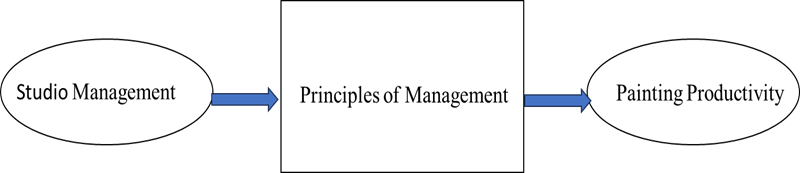
Figure 1: The conceptual model proposed
3.5. Research Questions
- How do painters currently structure their studio practices in relation to planning, organising, leading, and controlling?
- What management strategies do painters find most and least effective for improving productivity and creative quality?
- How can principles of management be adapted to respect and enhance the creative process in painting?
4. Methodology
4.1 Research Design
This study adopts a qualitative, interpretive approach aimed at understanding painters’ lived experiences of studio management. Qualitative methods are appropriate for exploring complex, context-dependent practices and meaning-making (Denzin & Lincoln, 2018).
4.2 Participant Selection
Eighteen painters participated in the study, selected through purposive and snowball sampling to capture a diversity of practices (emerging to mid-career; solo and shared studios; varied mediums and market engagement). Participants were recruited from urban arts communities and university art departments. Demographic diversity was sought, but the sample is not statistically representative; rather, it provides depth of insight.
4.3 Data Collection
Data collection methods included:
- Semi-structured interviews (n = 18): Interviews lasted 60–90 minutes and explored participants’ studio routines, time management, material procurement, client relations, and conceptions of productivity.
- Participant observation (5 studios): The researcher conducted multiple half-day visits to five studios, documenting spatial organisation, workflows, and interactions. Observations emphasised routines, material handling, and interruptions.
- Document analysis: Studio logs, schedules, project plans, and financial notes (when available and voluntarily shared) were analysed to triangulate interview data.
Interviews were audio-recorded with consent and transcribed verbatim. Field notes complemented recorded data.
4.4 Ethical Considerations
The study followed ethical guidelines: informed consent, confidentiality, and the option to withdraw. Pseudonyms are used. Any financial or personal documents were handled sensitively and anonymised.
4.5 Data Analysis
Thematic analysis (Braun & Clarke, 2006) guided data analysis. Coding combined inductive and deductive approaches: initial codes were derived from the theoretical framework (planning, organising, leading, controlling, flow, networks), while inductive codes captured emergent practices and metaphors (e.g., “mess as method”). Codes were iteratively reviewed and grouped into themes. Triangulation across interviews, observations, and documents improved trustworthiness. Reflexive memos were kept to track the researcher’s assumptions.
5. Findings
Four major themes emerged from the data: (1) Structured flexibility; (2) Resource optimisation; (3) Boundary and client management; and (4) Community and knowledge networks. Each theme encompasses sub-themes and illustrative participant quotes (pseudonyms used).
5.1. Structured Flexibility
Many painters reported that a balance between schedule and openness was crucial for entering flow. Participants described ritualised start-up routines—cleaning brushes, warm-up sketches, or music—that signalled cognitive transition into focused work.
“I show up at 9. I make tea, I stretch, I make a mark. It’s a ritual. After that, I let the painting tell me where it wants to go.” — Maya.
Routines reduced initial resistance, enabling prolonged attention. Yet rigid schedules were resisted when they felt constrained exploration. Participants emphasised flexible blocks: defined studio hours with some days reserved for research, gallery meetings, or admin.
5.2. Resource Optimisation
Effective material and space management reduced interruptions and costs. Painters described strategies such as bulk purchasing, standardised storage systems, and dedicated “prep” zones for priming canvases. Financial practices—separate bank accounts for art income, simple bookkeeping software, and itemised material budgets—helped stabilise practice.
“Organisation doesn’t mean sterile. It means knowing where your brushes are, having spare gesso, so you don’t lose a day because of a missing tube.” — David.
Some painters adopted studio layouts that supported multiple scales of work—large walls for big canvases, a small table for studies—allowing fluid shifts between processes.
5.3. Boundary and Client Management
Managing external demands—commissions, gallery deadlines, and social media—was a recurring challenge. Painters used contracts, deposit schedules, and clear communication templates to protect studio time and ensure predictable cash flow.
“I used to say yes to everything. Now I have a contract and a deposit; it changed everything. I can refuse a commission that doesn’t fit my schedule.” — Rina.
Digital distractions and administrative tasks were major time drains. Participants reported batching administrative work into fixed slots and using autoresponders to set expectations with clients.
5.4. Community and Knowledge Networks
Studio productivity was embedded in networks: peer critique groups, co-operative studios, and mentorship relationships provided feedback, resources, and shared audiences. Participants valued intermittent public accountability—group deadlines, exhibition cycles—that motivated completion.
“When the group show deadline came, I had to finish. Peer pressure is a good kind of pressure.” — Ahsan
Sharing materials and tools in collective spaces reduced costs and fostered cross-pollination of ideas. Social capital also facilitated market access—introductions to curators, collectors, and residencies.
6. Discussion
The findings suggest that principles of management can be meaningfully adapted to studio contexts, enhancing productivity while preserving creative flexibility.
6.1 Planning: From Vision to Project Milestones
Participants who engaged in explicit project planning—mapping steps from concept to exhibition—reported smoother workflows and fewer last-minute crises. Planning aligned with Csikszentmihalyi’s flow conditions by clarifying goals and establishing feedback loops through milestones and critique sessions (Csikszentmihalyi, 1996). However, planning in creative practice must accommodate emergent changes; the most successful artists used rolling plans with checkpoints rather than rigid Gantt charts.
Practical implication: adopt lightweight planning tools (e.g., project outlines, buffer time for experimentation) that formalise intentions without constraining exploration.
6.2 Organising: Studio as a Productive Environment
Physical organisation—tool placement, zones for different activities—reduced cognitive load and facilitated sustained work. This resonates with ergonomic and efficiency principles from industrial management (Taylor, 1911) but adapted to the sensory and material needs of artists. Importantly, many participants regarded a certain degree of “productive mess” as generative; organisation need not equal minimalism.
Practical implication: design studio layouts that support common workflows while allowing visible traces of process to remain.
6.3 Leading: Self-Leadership and Collaborative Leadership
Self-leadership practices—habit formation, self-monitoring, and motivational rituals—were essential. In shared studios, interpersonal leadership and conflict resolution skills mattered for allocating time and space. Mintzberg’s managerial roles translate into artists’ roles: networking (liaison), public representation (figurehead), and entrepreneur (decisional role).
Practical implication: artists benefit from cultivating leadership skills and explicit norms in shared studios.
6.4 Controlling: Feedback, Quality, and Financial Oversight
Controlling functions—monitoring progress and finances—allowed for course corrections and prevented small issues from escalating. Tools ranged from simple checklists to basic accounting spreadsheets. Feedback mechanisms (regular critiques, test exhibitions) provided quality control and market signals.
Practical implication: implement simple monitoring systems for time, materials, and finances; schedule periodic critiques as formal checkpoints.
6.5 Balancing Structure and Creativity
A central tension is balancing managerial structure with the need for open-ended exploration. The data indicate that management principles enhance creativity when they reduce friction (decision fatigue, material shortages) and create conditions for flow, rather than imposing rigid conformity.
This balance echoes Drucker’s (1999) emphasis on effectiveness—doing the right things—rather than mere efficiency. For artists, “right things” include acts of exploration that cannot be fully scheduled but benefit from a supportive infrastructure.
6.6 Networks and Field Dynamics
Applying Bourdieu and Becker, studio management cannot be isolated from field dynamics. Effective management extends to cultivating networks and understanding market positions. Management techniques that increase visibility (timely exhibitions, targeted communications) and leverage social capital improve the likelihood of sustainable practice.
6.7 Conceptual Framework for Studio Management
Based on findings, this study proposes a pragmatic framework with five interlinked domains:
- Temporal Architecture: Routine, blocks, milestones, and buffer time.
- Spatial Design: Work zones, storage, maintenance systems.
- Resource Administration: Materials procurement, inventory, and basic accounting.
- Relational Management: Contracts, communication protocols, and network cultivation.
- Creative Safeguards: Policies that protect exploratory time and allow materials/process experimentation.
Each domain integrates planning, organising, leading, and controlling functions tailored to studio realities. For instance, Temporal Architecture combines planning (scheduling), organising (allocating times), leading (self-motivation), and controlling (monitoring adherence to blocks).
6.8 Practical Recommendations
- Establish Studio Rituals: Create brief start-up and wind-down rituals to transition cognitive states.
- Use Lightweight Planning Tools: Maintain project outlines with milestone dates and contingency buffers rather than detailed, rigid schedules.
- Organise by Workflow: Arrange the studio into zones (preparatory, execution, finishing) and keep frequently used tools accessible.
- Adopt Simple Financial Controls: Track income and expenses with simple spreadsheets; use deposits for commissions.
- Batch Administrative Tasks: Designate fixed weekly slots for emails, invoices, and social media.
- Formalise Client Interactions: Use simple contracts and clear timelines; communicate expectations early.
- Cultivate Peer Accountability: Join critique groups or co-working arrangements with shared deadlines.
- Protect Creative Time: Block regular uninterrupted sessions for deep work; communicate these blocks to collaborators and clients.
- Invest in Ergonomics and Maintenance: Ensure proper lighting, ventilation, and storage to reduce physical friction.
- Develop Adaptive Plans: Review project plans periodically and revise based on feedback and emergent discoveries.
6.9 Limitations
This study is qualitative and limited by sample size and geographic concentration in urban arts communities. While findings offer transferable principles, they should be applied with sensitivity to cultural, economic, and disciplinary contexts. Future research could employ longitudinal designs and compare practices across regions and media.
7. Conclusion
The studio is a site of paradox: a space that requires both freedom and order. This research demonstrates that adapted management principles—planning, organising, leading, and controlling—can enhance painters’ productivity by reducing friction, supporting flow, and enabling sustainable practices. Importantly, management need not suppress creativity; when applied with respect for the exploratory nature of artmaking, it can create the conditions for more sustained and generative work.
By foregrounding a framework that integrates temporal, spatial, resource, relational, and creative safeguards, this study offers practical strategies for artists and educators. Implementing these practices can help painters navigate the twin imperatives of creating meaningful work and sustaining a viable practice in the contemporary cultural field.
Acknowledgements: We thank the participating artists for sharing their time and studios. This research received no external funding.
References
Becker, H. S. (1982). Art worlds. University of California Press.
Bourdieu, P. (1993). The field of cultural production: Essays on art and literature (R. Johnson, Ed.). Columbia University Press.
Braun, V., & Clarke, V. (2006). Using thematic analysis in psychology. Qualitative Research in Psychology, 3(2), 77–101.
Csikszentmihalyi, M. (1996). Creativity: Flow and the psychology of discovery and invention. HarperCollins.
Denzin, N. K., & Lincoln, Y. S. (2018). The SAGE handbook of qualitative research (5th ed.). SAGE Publications.
Drucker, P. F. (1999). Management challenges for the 21st century. HarperBusiness.
Ericsson, K. A., Krampe, R. T., & Tesch-Römer, C. (1993). The role of deliberate practice in the acquisition of expert performance. Psychological Review, 100(3), 363–406.
Fayol, H. (1916/1949). General and industrial management (C. Storrs, Trans.). Pitman (Original work published 1916).
Goleman, D. (2000). Leadership that gets results. Harvard Business Review.
Goldbard, A. (2006). New creative community: The art of cultural development. New Village Press.
Gulick, L., & Urwick, L. (Eds.). (1937). Papers on the science of administration. Institute of Public Administration.
Hesmondhalgh, D., & Baker, S. (2011). Creative labour: Media work in three cultural industries. Routledge.
Kuppers, P. (2011). The scar of visibility: Medical performances and contemporary art. I. B. Tauris.
McMullan, J. (2002). The artist’s toolkit: A practical guide to mastering the business of art. (Note: include if applicable)
Menger, P.-M. (1999). Artistic labour markets and careers. Annual Review of Sociology, 25, 541–574.
Mintzberg, H. (1973). The nature of managerial work. Harper & Row.
Mayo, E. (1933). The human problems of an industrial civilisation. Macmillan.
Newport, C. (2016). Deep work: Rules for focused success in a distracted world. Grand Central Publishing.
Nonaka, I., & Takeuchi, H. (1995). The knowledge-creating company: How Japanese companies create the dynamics of innovation. Oxford University Press.
Taylor, F. W. (1911). The principles of scientific management. Harper & Brothers.
Thompson, D. (2015). The economy of the arts: Cultural production and the market. (Note: include if applicable)