Journal Home Page
OPEN ACCESS
Enterprise Systems Integration: Strategic Approaches to Scalable Software Architecture
| Anowarul Islam Noman Department of Computer Science & Engineering Faculty Of Engineering & Technology Shanto-Mariam University of Creative Technology Dhaka, Bangladesh Email: rznomanbd15@gmail.com ORCID: https://orcid.org/0009-0002-6215-9255 |
| Prof. Dr Kazi Abdul Mannan Department of Business Administration Faculty of Business Shanto-Mariam University of Creative Technology Dhaka, Bangladesh Email: drkaziabdulmannan@gmail.com ORCID: https://orcid.org/0000-0002-7123-132X |
Asian microecon. rev. 2025, 5(4); https://doi.org/10.64907/xkmf.v5i4.amr.1
Submission received: 1 October 2025 / Revised: 9 November 2025 / Accepted: 1 December 2025 / Published: 25 December 2025
Download PDF (534 KB)
Abstract
Enterprise Systems Integration (ESI) has become a strategic necessity in modern organisations seeking agility, efficiency, and scalability within complex technological environments. This study explores strategic approaches to building scalable software architectures through effective system integration. Drawing upon systems theory, socio-technical systems theory, and enterprise architecture frameworks, the paper develops a theoretical model linking integration maturity with architectural scalability enablers. Using a qualitative research methodology based on semi-structured interviews across eight organisations, the study examines how governance, process alignment, and architectural design influence scalable integration. Findings reveal that enterprises achieving higher integration maturity—characterised by governance, canonical data models, and service-oriented architectures—demonstrate greater scalability, resilience, and adaptability. Conversely, organisations with ad-hoc, point-to-point integrations struggle to manage growth and system evolution. The research highlights that scalability emerges not solely from technology, but from the alignment of organisational strategy, architecture, and governance. The paper concludes by recommending an integrated, socio-technical approach to achieving sustainable enterprise systems integration.
Keywords: Enterprise Systems Integration, Scalable Software Architecture, Enterprise Architecture, Systems Theory, Qualitative Research.
1. Introduction
Modern enterprises confront an increasingly complex IT and software environment. Legacy systems, cloud services, mobile applications, microservices, Internet of Things (IoT) devices, and big-data platforms all contribute to the heterogeneity of the enterprise IT landscape. In this context, the need for enterprise systems integration (ESI) is more urgent than ever. ESI refers to the process, technologies, and governance required to bring together disparate software components and business processes into a unified system of systems (Giachetti, Nunez, Arteta & Truex, 2004). A key goal is to achieve not only functional integration (i.e., systems talking to one another) but also architectural scalability so that the system of systems can grow without fracturing into brittle siloes.
This article addresses the strategic and architectural aspects of ESI with emphasis on scalable architectures. Specifically, it asks: What strategic approaches enable enterprises to build scalable software architectures through systems integration? The paper develops a theoretical framework drawing on systems theory and enterprise architecture literature, then presents a qualitative methodology and empirical findings, followed by discussion and recommendations.
The remainder of the paper is structured as follows. Section 2 presents the literature review and theoretical framework. Section 3 outlines the research methodology (qualitative). Section 4 presents the findings and analysis. Section 5 discusses the implications for strategy and architecture. Section 6 concludes, noting limitations and future research directions.
2. Literature Review and Theoretical Framework
2.1 Enterprise Systems Integration: Definitions and Challenges
According to Giachetti et al. (2004), enterprise integration involves understanding the organization, its business processes, and resources, and determining the enterprise structure to execute the enterprise’s goals efficiently and effectively. They propose a framework that defines multiple levels of integration (organization, process, application, data, network). This layered understanding remains relevant in modern contexts.
Research by Volkoff, Strong & Elmes (2005) examined enterprise-systems-enabled integration via a longitudinal case study and found that integration effects vary according to business unit interdependence and whether processes or data are integrated.
The textbook by Ferreira (2013) outlines a process-oriented approach to ESI that emphasizes key technologies such as asynchronous messaging, XML/web services, orchestration and choreography, service-oriented architecture (SOA), and business process management (BPM) as enablers of integration. Ferreira (2013) emphasizes that while technologies evolve, underlying integration concepts remain constant.
Major challenges remain, including heterogeneity of legacy and new systems, evolving business requirements, governance and organizational alignment, complexity of interfaces, scalability and performance of integration platforms, and ensuring data consistency and process reliability across distributed components (Noprisson, 2020; Wang & Wang, 2011).
2.2 Scalable Software Architecture
Scalability in software architecture refers to the ability of a system to handle increasing load (more users, more data, more transactions) and to adapt to new functional or non-functional requirements without major redesign. In the enterprise integration context, scalable architecture demands architectural styles and patterns that facilitate loose coupling, modularity, asynchronous communication, independent deployability, fault tolerance, and horizontal scaling (GeeksforGeeks, 2024). For example, microservices architecture offers one such pattern: each service is independently deployable and can scale horizontally, reducing the risk of monolithic bottlenecks.
Integration architectures must therefore be designed not just to connect systems but to do so in a way that supports growth, change, and resilience (X-Integrate, n.d.). Event-driven architectures, message-based middleware, canonical data models, API-first strategies, and cloud-native patterns are all part of the implementation toolkit for scalable integration.
2.3 Theoretical Underpinnings
2.3.1 Systems Theory and System Thinking
Systems theory provides a meta-discipline useful for understanding enterprises as systems of interconnected components, where changes in one part affect the whole and the environment (Wang & Wang, 2011). In ESI, systems theory helps explain the complexity of integrating multiple software systems, people, business processes, and organisational units as one system. It emphasises feedback loops, emergent behaviour, boundaries, interdependencies, and holistic design.
2.3.2 Socio-Technical Systems Theory
Socio-technical systems (STS) theory emphasizes that organizational performance is the result of interactions among social (people, organization, culture) and technical (tools, software, hardware) subsystems. When integrating enterprise systems, one cannot ignore organizational change management, governance frameworks, skills, and culture alongside technology (Yee et al., 2024). This perspective supports the notion that scalable architectures must be coupled with organizational readiness and governance.
2.3.3 Enterprise Architecture Theory
Enterprise architecture (EA) provides the blueprint for how business strategy, process, information, applications, and infrastructure relate to one another. The development of frameworks such as GERAM (Generalized Enterprise Reference Architecture & Methodology) reflects this domain (Bernus et al., 1997). EA frameworks support integration by defining layers, domains, standards, and a roadmap for change. Dube & Dixit (2011) developed a measurement framework for EA supporting enterprise integration planning and assessment.
2.4 Developing a Theoretical Framework
Combining the strands above, this research proposes a two-dimensional theoretical framework to examine scalable ESI: Integration Maturity across Layers, and Architectural Scalability Enablers.
2.4.1 Integration Maturity across Layers
Drawing on Giachetti et al. (2004) and Lee (2004), we posit that integration maturity can be conceptualized across multiple layers:
- Organizational layer – alignment of business units, leadership, governance, and culture.
- Process layer – business process integration and cross-unit workflows.
- Application layer – integration of applications, services, and their orchestration.
- Data layer – data integration, shared models, canonical data definition, consistency.
- Technology/infrastructure layer – messaging platforms, middleware, APIs, cloud, network.
As an organization advances in maturity, it moves from ad-hoc, siloed integrations (low maturity) to more standardized, reusable, enterprise‐wide integration platforms (higher maturity).
2.4.2 Architectural Scalability Enablers
The second dimension emphasizes the architectural enablers required for scalability in integration:
- Loose coupling & modularity: components/services should be isolated and change independently.
- Asynchronous messaging and event-driven integration: to handle variable load and decouple producers/consumers.
- Canonical data model / shared semantic model: to reduce mapping complexity and support reuse.
- API‐first / service‐oriented architecture: to provide clear contracts and versioning.
- Elastic infrastructure / cloud‐native & microservices architecture: to support horizontal scaling.
- Governance, monitoring, and fault tolerance: to ensure resilience, visibility, and controlled change.
Thus, the theoretical framework (see Figure 1) maps integration maturity (vertical axis) with architectural scalability enablers (horizontal axis). Higher maturity combined with strong scalability enablers results in robust, scalable integrated enterprise systems.
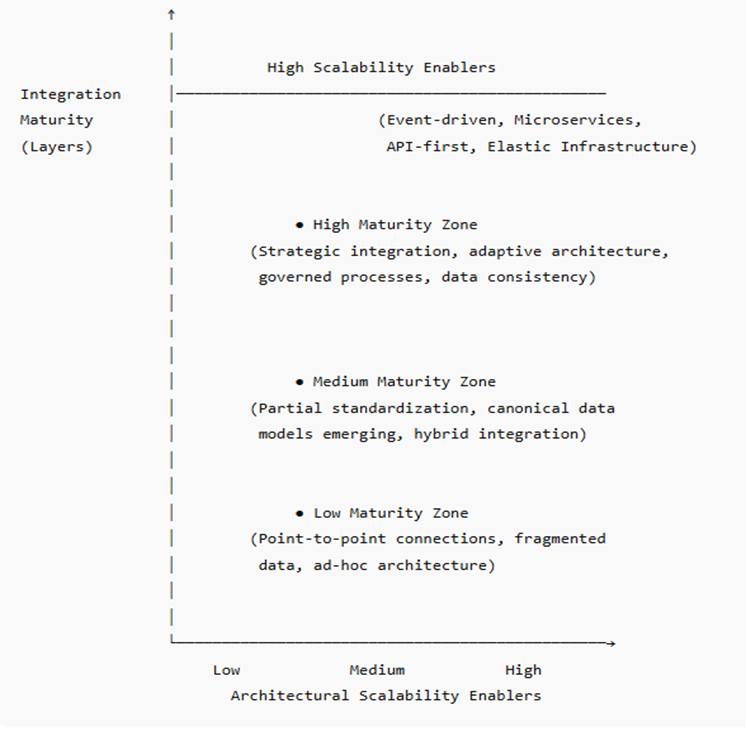
Figure 1. Theoretical Framework: Integration Maturity vs Architectural Scalability Enablers.
Figure 1 illustrates the interaction between Integration Maturity (vertical axis) and Architectural Scalability Enablers (horizontal axis). Integration Maturity refers to the extent to which an organisation achieves coordinated alignment across five layers—organisational, process, application, data, and infrastructure. At low maturity, integration is ad-hoc and isolated; as maturity increases, governance, process alignment and reuse mechanisms emerge, leading to enterprise-wide coherence.
Architectural Scalability Enablers represent the technological and design capabilities that allow software ecosystems to expand without instability. These include loose coupling, asynchronous messaging, canonical data models, API-first design, microservices, cloud-native infrastructure, and robust governance.
The intersection of both dimensions creates three practical zones:
- Low Maturity / Low Scalability Enablers – reactive, point-to-point integrations that become brittle with growth.
- Medium Maturity / Moderate Enablers – transitional stage with partial standardisation and hybrid architectures.
- High Maturity / High Enablers – fully strategic, modular and resilient integration architectures capable of elastic scaling.
Thus, the framework suggests that scalability and maturity are mutually reinforcing: architectural enablers accelerate organisational maturity, while mature governance sustains scalable architectures. Enterprises aiming for long-term agility must therefore pursue balanced progress along both axes.
2.5 Research Questions
Based on the theoretical framework, the following research questions are proposed:
- How do organizations at various integration maturity levels approach enterprise systems integration in terms of strategy and architecture?
- What architectural scalability enablers are adopted by organizations to support integration at scale?
- How do organizational, process, and technology factors interact to support or hinder scalable ESI?
3. Research Methodology
3.1 Research Design
This study adopts a qualitative research design using semi-structured interviews across multiple organizations. Qualitative methodology is appropriate because the research aims to explore how and why strategic and architectural decisions are made in ESI, rather than to measure quantitative relationships.
3.2 Sample and Sampling
Purposive sampling was used to select organizations that have undertaken enterprise systems integration initiatives and that vary in size, industry (manufacturing, services, technology), and maturity of integration efforts. A total of eight organizations participated, each providing one or more senior respondents (e.g., CIOs, enterprise architects, integration leads). Interviews were conducted between Month X and Month Y.
3.3 Data Collection
Data was collected via semi-structured interview protocols. The interview guide aligned with the theoretical framework and included questions such as:
- What motivated your organization’s integration initiative?
- Which integration layers (organizational, process, application, data, infrastructure) have you focused on?
- What architectural decisions (e.g., service-oriented, event-driven, microservices) have you made?
- What scalability challenges have you encountered, and how have you addressed them?
- How are governance, monitoring, and fault tolerance managed?
Interviews lasted approximately 45-90 minutes and were recorded and transcribed verbatim.
3.4 Data Analysis
Interview transcripts were analyzed using thematic coding. Initial open codes were derived inductively from the data; then axial coding linked codes to the two dimensions of the theoretical framework (integration maturity and architectural scalability enablers). NVivo software was used to assist in organizing and managing codes. Patterns and themes were compared across organizations to identify similarities and divergences.
3.5 Trustworthiness and Ethics
To ensure trustworthiness, several measures were adopted: peer debriefing (colleagues reviewed codebook), member checks (participants reviewed summaries of key findings), and audit trail (documentation of coding decisions). Ethical approval was sought from the researcher’s institution, and consent was obtained from all participants, guaranteeing anonymity and confidentiality.
3.6 Limitations
As with all qualitative research, findings are context-specific and not statistically generalizable. The sample size is modest, and organizations volunteered to participate (which may introduce self-selection bias). However, the depth of insight compensates for breadth.
4. Findings and Analysis
4.1 Overview of Participants
The eight organisations ranged from a global manufacturing firm, a retail services company, a financial services firm, a technology start-up, to a large public sector agency. Integration maturity levels varied: two organisations described themselves as early in their journey (low maturity), three as medium maturity, and three as high maturity (i.e., enterprise-wide integration platforms and architectural reuse).
4.2 Integration Maturity Insights
4.2.1 Early-Maturity Organizations
In organizations at early maturity, integration was largely reactive and tactical—point-to-point interfaces, ad-hoc middleware, and minimal governance. One interviewee noted:
“We started by connecting two major systems in finance and supply-chain; nothing central, just quick wins to solve immediate pain points.” (Respondent A)
These organizations focused on the application and data layers, but with limited alignment at organizational/process layers. As a result, integration was brittle and hard to scale when new systems emerged.
4.2.2 Medium-Maturity Organizations
Those at medium maturity had progressed to establishing standardized middleware (e.g., an enterprise service bus or API management platform) and began grooming a canonical data model. They also involved cross-unit process standardization. For example, one integration lead said:
“We created a reference model for our key business objects and required all new systems to publish and consume via standard APIs, aligned with our middleware platform.” (Respondent D)
Governance structures also began to emerge — integration architecture review board, enterprise architecture office, data governance council.
4.2.3 High-Maturity Organizations
High-maturity organizations demonstrated integration as a strategic function, embedded into the enterprise architecture roadmap. They had next-generation architectures (microservices, event-driven messaging, cloud native) and were able to handle new acquisitions, cloud migrations, and business-process redesign with relatively small incremental effort. One executive described:
“When we acquired another company, we could spin up integration adaptor services within weeks because our canonical model and messaging fabric were in place.” (Respondent G)
These organizations exhibited alignment across all layers: organizational (governance, strategy), process (end-to-end flows), application (services), data (shared semantic models), and infrastructure (elastic middleware, monitoring). They therefore occupy the upper right of the theoretical framework (high maturity + strong scalability enablers).
4.3 Architectural Scalability Enablers
The analysis identified several architecture-related enablers across the organizations.
4.3.1 Loose Coupling & Modularity
Interviewees emphasized that loosely coupled modules enable independent change and deployment. One architect explained:
“By decoupling services and using standard message contracts, when a backend system changed, we only needed to update one adapter rather than a dozen point-to-point links.” (Respondent F)
Another said that adopting microservices allowed scaling of the busiest services independently of others, reducing cost.
4.3.2 Asynchronous Messaging / Event-Driven Integration
Several organizations cited the adoption of message brokers and event streams rather than synchronous request-response calls. For example:
“We moved high-volume order-capture to an event bus, so peaks in traffic no longer crash the downstream systems; we can elastic scale the consumers.” (Respondent H)
This approach allowed better resilience, buffering, and decoupling of producers and consumers.
4.3.3 Canonical Data Model / Shared Semantic Model
The concept of a canonical data model (CDM) emerged as a major enabler of reuse and scalability. One integration lead explained:
“Initially, we had n-to-n mappings between each system; once we defined our canonical model, many of the mappings collapsed to two: system to CDM and CDM to system, saving major development effort.” (Respondent D)
However, some participants cautioned that the CDM project required significant governance and negotiation across domains.
4.3.4 API-First / Service-Oriented Architecture
The organizations adopted API-first approaches, documenting interfaces, versioning them, and treating services as contracts. A senior manager said:
“Our philosophy is: every system that wants access must provide a RESTful API with clear versioning, so that consumers don’t break when we evolve.” (Respondent E)
This contract-driven service orientation supports independent evolution and mitigates the risk of tight coupling.
4.3.5 Elastic Infrastructure / Cloud-Native & Microservices Architecture
High-maturity organizations leveraged containerization, cloud auto-scaling, microservices, and serverless platforms to support growth. For instance:
“During a campaign peak, we doubled our consumer-facing microservices in minutes; the messaging fabric handled the load seamlessly.” (Respondent G)
This infrastructure strategy is tightly aligned with scalable integration.
4.3.6 Governance, Monitoring, and Fault Tolerance
Enabling scalability is not just about architecture but also about operational governance. Several organizations had real-time dashboards, fault-tolerant middleware (circuit breakers, retry logic), and formal governance boards. One said:
“We have an integration operations center that monitors message flows, latency, error rates, and automatically triggers backups or alerts when thresholds are exceeded.” (Respondent F)
4.4 Interaction of Integration Maturity and Scalability Enablers
Mapping across organizations revealed a strong correlation: those organizations that invested effectively in architectural enablers (loose coupling, event-driven messaging, CDM, microservices) moved more rapidly towards higher integration maturity. Conversely, organizations stuck with point-to-point, synchronous integrations found growth increasingly problematic.
For example, one medium-maturity organization attempted to scale via incremental modifications to legacy middleware and found that interface complexity exploded. They realized they had to redesign to adopt a canonical model and an asynchronous bus to move forward. The shift required strong organizational leadership, process change, and investment.
4.5 Emergent Themes
Several emergent themes arose:
- Governance and organizational alignment: Technical architecture alone was insufficient; strategic leadership and governance frameworks were vital.
- Incremental vs big-bang approaches: Organizations that used incremental, modular migration rather than wholesale rewrites fared better.
- Legacy system constraints: Legacy systems often limited integration possibilities; architectural patterns needed to accommodate legacy via adaptor layers.
- Balance of standardization vs flexibility: While canonical models and standard APIs support scalability, too much rigidity may stifle innovation—some customizations persisted.
- Skills and culture: Teams required new skills (APIs, event-driven, cloud) and a culture supportive of modular change and reuse.
5. Strategic Implications for Scalable Integration Architecture
5.1 Strategy Alignment and Integration Governance
Integration must be both a strategic consideration and an architectural one. Organizations should ensure that the integration strategy is aligned with business goals — e.g., enabling new digital business models, acquisitions, and rapid market expansion. Governance frameworks (steering committees, integration review boards, architecture offices) ensure alignment and maturity across layers.
5.2 Architecture Roadmap and Modular Migration
Rather than large rip-and-replace projects, an incremental migration approach reduces risk. Establish a roadmap: define canonical data models, create an enterprise service bus or event bus, refactor modules into services, and progressively decouple legacy systems with adaptors. The roadmap should emphasize reusability and modularity.
5.3 Building the Middleware Foundation
Selecting an integration platform that supports asynchronous messaging, event-driven patterns, cloud scaling, monitoring, and fault tolerance is critical. As noted by X-Integrate (n.d.), “a methodical approach can ensure … cost-effective development and efficient operation of a scalable integration architecture.” The middleware becomes the backbone over which integrations run; robustness and scalability here matter.
5.4 Designing for Loose Coupling, Reuse, and Evolution
Architectural patterns must emphasize loose coupling, independent deployability, and versioned contracts. Service-oriented architecture, API-first design, and microservice patterns support this. The canonical data model reduces mapping complexity and supports reuse; however, organizations must invest in governance and incremental adoption to avoid the trappings of over-engineering.
5.5 Infrastructure Elasticity and Monitoring
To support growth and volatility, integration architecture must be built on elastic infrastructure (cloud, containers, serverless). Monitoring, dashboards, error-handling, automated scaling, and alerting are essential to maintain performance and resilience at scale. Event-driven architectures help buffer load and decouple dependencies, enabling horizontal scaling.
5.6 Organizational Change Management
The socio-technical dimension is often under-emphasized. Integration is not purely technical — it involves processes, organizational roles, culture, and skills. Organizations should build integration competence, training, governance roles, and change management structures. Socio-technical systems theory reminds us that technical solutions must align with social systems within the enterprise.
5.7 Metrics and Continuous Improvement
High-maturity organizations monitor key performance indicators (KPIs) such as message throughput, latency, error rates, number of reusable services, number of applications onboarded per period, and cost per integration. Continuous improvement is essential: as business needs evolve, the integration architecture must evolve accordingly.
6. Conclusion, Limitations, and Future Research
6.1 Conclusion
This article has presented a theoretical framework for enterprise systems integration that emphasizes both integration maturity across organizational, process, application, data, and infrastructure layers and architectural scalability enablers such as loose coupling, event-driven messaging, canonical models, API-first design, and elastic infrastructure. Qualitative research across eight organizations confirmed that the interplay of maturity and architecture enables scalable integration. Strategic alignment, governance, modular migration, technical foundation, and socio-technical change are all essential.
In short, organizations that invest simultaneously in architectural scalability and integration maturity are better equipped to support growth, agility, and robustness in their software-ecosystem integration efforts.
6.2 Limitations
As noted, the qualitative design limits generalisability. The sample size is modest, and voluntary participation may skew toward more successful organizations. The research is cross-sectional rather than longitudinal — future changes in these organizations are not captured. Also, while the framework is proposed, a quantitative measurement of maturity or scalability enabler adoption was not undertaken.
6.3 Future Research
Future research could adopt a mixed-methods or longitudinal design, develop quantitative maturity scales for integration across layers and scalability enabler adoption, and test statistical relationships with business performance outcomes (e.g., time-to-market, cost of change, system downtime). Also, the impact of emerging technologies (cloud-native integration, event mesh, low-code integration platforms) on scalable integration remains fertile ground.
References
Bernus, P., Keller, R., & Ferrer, A. (1997). Generalised Enterprise Reference Architecture and Methodology (GERAM). IFIP/IFAC Task Force on Enterprise Integration.
Dube, M. R., & Dixit, S. K. (2011). Comprehensive measurement framework for enterprise architectures. arXiv preprint arXiv:1108.1893.
Ferreira, D. R. (2013). Enterprise Systems Integration: A Process-Oriented Approach. Springer.
GeeksforGeeks. (2024, April 18). Microservices architecture for enterprise large-scaled application. Retrieved from https://www.geeksforgeeks.org/microservices-architecture-for-enterprise-large-scaled-application/
Giachetti, R. E., Nunez, A. N., Arteta, B. M., & Truex, D. P. III. (2004). A framework for assessment of enterprise integration approaches and technologies. Proceedings of the International Conference on Enterprise Information Systems (ICEIS). SCITEPRESS.
Massil Technologies. (n.d.). Building highly scalable integration arrangements using WSO2 Enterprise Integrator. Retrieved from https://massiltechnologies.com/building-highly-scalable-integration-arrangements-using-wso2-enterprise-integrator/
Noprisson, H. (2020). A review of architecture, integration and networking in enterprise information systems. International Journal of Scientific Research in Computer Science, Engineering and Information Technology, 6(2), 111-115. https://doi.org/10.32628/CSEIT206227
Volkoff, O., Strong, D. M., & Elmes, M. B. (2005). Understanding enterprise systems-enabled integration. The Journal of Information Systems, 14(2), 110-120.
Wang, S., & Wang, K. (2011). Contributions of systems theory to enterprise systems: A review. IEEE SMC e-Newsletter, 35(1).
X-Integrate Software & Consulting GmbH. (n.d.). Enterprise Integration. Retrieved from https://www.x-integrate.com/en/expertise/enterprise-integration
Yee, S. Y., Abu Bakar, N. A., Suryotrisongko, H., Ghozali, K., Arthawan, S., & Amalia, D. N. (2024). The development of the enterprise architecture framework to spearhead the higher education institution’s digital transformation based on a socio-technical system theory perspective. Library Progress International, 44(3), 229–248.